
大全能源

Search documents
疯狂的多晶硅期货
Jing Ji Guan Cha Wang· 2026-01-03 04:12
Core Viewpoint - The "anti-involution" trend has significantly driven the multi-crystalline silicon futures market, leading to a price surge of over 85% within six months, with prices reaching a peak of 63,000 yuan/ton [1][14]. Group 1: Market Dynamics - Since July 2025, the multi-crystalline silicon futures market has experienced a dramatic price increase, starting from around 31,000 yuan/ton and quickly surpassing 50,000 yuan/ton within a month [1]. - By December 30, 2025, the main contract "2605" was reported at 57,890 yuan/ton, marking a significant increase compared to the low of 31,000 yuan/ton in late June [14]. - The market has seen a notable rise in participation, with more traders entering the multi-crystalline silicon futures market as prices continued to climb [1]. Group 2: Influencing Factors - The "anti-involution" policy has emerged as a core driving factor for the multi-crystalline silicon futures market, with policy expectations and capital inflow creating a resonance that pushed prices higher [2]. - In late November 2025, a shift in market logic occurred due to a significant reduction in warehouse receipts, which fueled bullish sentiment and led to a price breakout [2]. - The establishment of a "silicon material storage platform" has been a key catalyst for the market's turnaround, transitioning from rumors to tangible actions [3]. Group 3: Supply and Demand Issues - Despite an overall surplus in industry capacity, the futures prices have continued to rise, raising questions about the underlying supply-demand dynamics [2]. - The actual supply of deliverable multi-crystalline silicon is limited, as most circulating goods do not meet delivery standards, creating structural shortages that support futures prices [10][11]. - The recent establishment of a multi-crystalline silicon capacity integration and acquisition platform has been viewed as a potential support for prices when they drop to certain levels [13]. Group 4: Future Outlook - Analysts predict that the multi-crystalline silicon industry may continue to experience a long-term capacity clearing pattern, with supply growth expected at around 3.7% and demand potentially decreasing by 10% due to shifts in focus towards energy storage [15]. - The pricing logic is evolving from cost competition to a test of the entire industry's profit coordination ability, with the actual transaction prices in the component segment being a critical indicator of sustainable trends [15].
银河期货多晶硅年度报告
Yin He Qi Huo· 2025-12-31 10:10
Report Industry Investment Rating - Not provided in the content Core Viewpoints of the Report - In 2026, domestic photovoltaic projects will face dual pressures of increased costs and declining electricity prices, with a projected over 20% year - on - year decline in newly - added photovoltaic installations to around 240GW. In the US, due to the "Big and Beautiful Act" and tariff barriers, newly - added photovoltaic installations are expected to decline year - on - year in 2026. In Europe, with subsidy reduction and power consumption capacity constraints, newly - added photovoltaic installations may decline to around 67GW in 2026. Emerging markets such as India and Brazil will continue to contribute to the global photovoltaic growth. The global newly - added photovoltaic installation in 2026 is expected to be 540GW, with a global component demand of about 600GW and a Chinese silicon wafer demand of around 600GW. On the supply side, under the continuous advancement of anti - involution and industry self - discipline, polysilicon production will be controlled within 1.05 million tons in 2026, with the entire industry's supply at 1.35 million tons. The price of polysilicon is likely to have a higher price center in 2026, and the price is expected to be between 45,000 and 75,000 yuan/ton [4][45]. Summary by Relevant Catalogs 1. Preface Summary Supply - demand Outlook - In 2026, domestic photovoltaic projects face cost increases and electricity price declines, with domestic newly - added photovoltaic installations expected to decline by over 20% to around 240GW. In the US, the "Big and Beautiful Act" and tariff barriers will lead to a decline in newly - added photovoltaic installations. In Europe, subsidy reduction and power consumption capacity constraints will cause newly - added installations to decline to around 67GW. Emerging markets will contribute to global photovoltaic growth. The global newly - added photovoltaic installation will be 540GW, with a component demand of about 600GW and a Chinese silicon wafer demand of around 600GW. Supply - side, polysilicon production will be controlled within 1.05 million tons, and the entire industry's supply will be 1.35 million tons [4]. Trading Logic - In 2026, the terminal demand for polysilicon is likely to decline. Under the guidance of "anti - involution" and industry self - discipline, polysilicon enterprises will sell according to demand, which will raise the price center in 2026. Constrained by the price law and anti - unfair competition law, the polysilicon price is difficult to fall below 45,000 yuan/ton. If the component price rises to 0.8 yuan/W in 2025, the high - end price of polysilicon in 2026 can be referred to as 75,000 yuan/ton under the extreme assumption of profit transfer to silicon materials. The polysilicon futures price will be generally strong in 2026, and a long - biased approach is recommended [5]. Strategy Recommendation - Unilateral: With the price center rising, take a long - biased approach, with the price range referring to (45,000, 75,000). - Arbitrage: As anti - involution in the polysilicon industry continues to advance and production is bound to decrease, go long on polysilicon and short on industrial silicon [7]. 2. Fundamental Situation Market Review - In December 2024, the photovoltaic industry association organized self - discipline among enterprises in the entire industry chain. Downstream crystal - pulling factories started a new round of inventory replenishment, and the spot price of polysilicon increased. In January, the polysilicon futures price was volatile and strong, once breaking through 45,000 yuan/ton. After Document No. 136, terminal installation rush accelerated, but due to high polysilicon inventory, the spot price was difficult to rise, and the futures price was volatile. After April, the installation rush subsided, and the component price faced pressure. First - tier polysilicon enterprises considered price cuts to reduce inventory, and the futures price dropped significantly. From May to June, the terminal demand declined after the installation rush subsided, and the prices in the entire industry chain fell, with the futures price breaking below the industry's cash - cost line. After July, the polysilicon industry started "anti - involution" and capacity integration. With the expectations of "sales at no less than cost" and "capacity storage", funds entered the market, pushing up the futures price. After September, the futures price rose above 50,000 yuan/ton. Due to slow progress in capacity integration, the futures valuation was difficult to give a higher premium, and the market was volatile. In December, the small number of trading warehouse receipts of polysilicon futures and the establishment of platform companies led to a volatile increase in price, breaking through 60,000 yuan/ton [9]. Demand - **Domestic Terminal Demand**: In 2026, the Chinese photovoltaic market will be squeezed by electricity price decline and cost increase. In 2025, the newly - added photovoltaic installation was expected to reach 300GW, a year - on - year increase of 8.3%. In 2026, the newly - added centralized photovoltaic installation may decline by more than 60GW year - on - year, and in the best - case scenario, the newly - added distributed photovoltaic installation will not increase year - on - year. Overall, the newly - added photovoltaic installation in 2026 is expected to be in the range of 230 - 240GW, a decline of over 20% year - on - year [13][14]. - **Overseas Terminal Demand**: In 2026, the US photovoltaic market will be affected by policy changes, and the newly - added photovoltaic installation is expected to decline to around 35GW. In Europe, due to economic pressure and power consumption capacity constraints, the newly - added photovoltaic installation is expected to decline by 5% year - on - year to 65 - 67GW. Emerging markets represented by India will contribute to the global newly - added photovoltaic installation demand [20][21]. - **Silicon Wafer, Battery, and Component Industries**: In 2026, the export volume of photovoltaic components may remain unchanged year - on - year, while the export volume of photovoltaic batteries will increase year - on - year. The production schedules of domestic silicon wafers, batteries, and components in 2026 will be adjusted downward year - on - year. The demand for polysilicon in 2026 is expected to decline to around 1.08 - 1.1 million tons [25][26]. Supply - The "Polysilicon Capacity Integration and Acquisition Platform" has been officially established, but in 2026, the scale of acquired capacity is about 400,000 tons, which has limited impact on actual supply. There is a market rumor that polysilicon enterprises reached a self - discipline initiative at the Xi'an Photovoltaic Annual Conference, aiming to control the total supply within 1 million tons in 2026. Even if the initiative is not effectively implemented, the core goal of polysilicon enterprises is to reduce inventory and maintain cash flow. It is expected that after February 2026, polysilicon enterprises will promote production - reduction plans, and the production in February will be reduced to below 90,000 tons [37][38]. Inventory - Currently, the factory inventory of polysilicon enterprises is close to 300,000 tons, the non - standard inventory of middle - stream futures and spot traders is 15,000 - 20,000 tons, and the new and old warehouse receipts are about 27,000 tons. The downstream inventory is about 150,000 tons. In 2026, under the background of demand - based sales, the total inventory of the polysilicon industry is expected to decline slightly [41]. 3. Future Outlook and Strategy Recommendation Fundamental Outlook - Similar to the supply - demand outlook in the preface summary, in 2026, the domestic newly - added photovoltaic installation will decline, the overseas market will have different trends, and the polysilicon supply will be controlled within 1.05 million tons [45]. Trading Logic Analysis - Similar to the trading logic in the preface summary, the terminal demand for polysilicon is likely to decline in 2026. Anti - involution and industry self - discipline will raise the price center, with the price difficult to fall below 45,000 yuan/ton and the high - end price referring to 75,000 yuan/ton [46]. Operation Strategy - Unilateral: Buy on dips. - Arbitrage: As anti - involution in the polysilicon industry continues and production decreases, go long on polysilicon and short on industrial silicon [46].
山西证券研究早观点-20251231
Shanxi Securities· 2025-12-31 01:02
Market Trends - The domestic market indices showed mixed performance, with the Shanghai Composite Index closing at 3,965.12, unchanged, while the Shenzhen Component Index rose by 0.49% to 13,604.07 [2] Industry Commentary - The solar power sector saw a significant increase in new installations, with a month-on-month growth of 75% in November, totaling 22.02 GW of new capacity [5][8] - The coal import data indicates a continued upward trend in import prices, with November's average price reaching $73 per ton, despite a year-on-year decrease in import volume [11][13] Company Insights - The report highlights the company "Hengdong Light" as a national-level "specialized and innovative" small giant in the optical communication field, focusing on passive optical devices [15][17] - Hengdong Light's revenue is projected to grow rapidly from 475 million yuan in 2022 to 1.315 billion yuan in 2024, with net profit expected to increase significantly during the same period [17][18] Investment Recommendations - The report suggests focusing on companies in the photovoltaic sector, including Aiko Solar and Longi Green Energy, as well as those involved in energy storage and market-oriented electricity [12] - The investment outlook for Hengdong Light is positive due to its competitive advantages and strong growth potential in the optical communication market [17][18]
中国光伏_跟踪支架盈利拐点_12 月 25 日:新一轮涨价提议下观望情绪升温-China Solar_ Tracking profitability inflection_ Dec-25_ Increasingly wait-and-see stance with a new round of price hike proposed
2025-12-30 14:41
Summary of China Solar Profitability Tracker - December 2025 Industry Overview - The report focuses on the solar industry, particularly the profitability dynamics of companies involved in the solar value chain in China. Key Highlights 1. **Price Hikes and Market Dynamics** - A new round of price hikes was proposed in December, with average pricing across the solar value chain increasing by 7% month-to-date (MTD) as Tier 1 players responded to rising silver costs, which surged by 45% quarter-to-date (QTD) [3][4] - Poly players raised spot prices by 22% during the week of December 15, reaching Rmb65/kg for Rod Poly and Rmb62/kg for Granular Poly [3] 2. **Inventory and Production Trends** - The supply/demand ratio deteriorated to 129% in December from 110% in November, indicating an oversupply situation [9] - Producer-side inventory days increased to 55 days in December from 38 days in November, suggesting a buildup of unsold inventory [11] 3. **Profitability Concerns** - Despite a 12% increase in value chain pricing compared to Goldman Sachs estimates, concerns remain about potential cash burn due to extended inventory days and slow production cuts [4] - The average cash gross profit margin (GPM) for Poly-Tier 1 was reported at 35%, with a slight decrease of 2 percentage points (ppt) [7] 4. **Segment Performance** - Cash profitability improved in Cell and Module segments but deteriorated in Glass, with Glass-Tier 1 GPM dropping to 1% [7] - The report indicates a preference for Film and High-efficiency Module segments, while expressing skepticism towards Glass and Wafer segments [4] 5. **Future Outlook** - The ongoing anti-involution campaign and new restrictions on below-cost pricing are expected to have a mild positive impact on pricing outlook for Poly, but downstream players may still need to reduce selling prices to maintain market share amid weak demand [4] - The report anticipates that normalized profitability will remain low unless Tier 1 capacity reductions occur [4] Additional Insights - The establishment of a joint venture platform for Poly capacity consolidation was reported, but progress is lagging behind initial targets [3] - The report emphasizes the importance of adopting cost reduction technologies to ensure positive cash generation for sustainable operations [4] Conclusion - The solar industry in China is facing significant challenges with inventory buildup and profitability concerns, despite recent price increases. The dynamics of supply and demand, along with the need for cost management, will be critical for companies navigating this environment.




11月太阳能发电新增装机环增75%,综合整治“内卷式”竞争
Shanxi Securities· 2025-12-30 05:04
Investment Rating - The report maintains an investment rating of "Synchronize with the market - A" for the power equipment and new energy industry [1] Core Viewpoints - In November, the newly installed solar power capacity increased by 75% month-on-month, indicating a significant recovery in the solar energy sector [4] - The report highlights the need for comprehensive regulation to address "involutionary" competition in key industries such as new energy vehicles, lithium batteries, and photovoltaics, aiming to enhance industry concentration and maintain fair competition [5] Summary by Relevant Sections Investment Recommendations - Recommended stocks include: - Aishuo Co., Ltd. (600732.SH) - Buy - B - Longi Green Energy (601012.SH) - Buy - B - Daqian Energy (688303.SH) - Buy - B - Flat Glass Group (601865.SH) - Buy - A - Haibo Innovation (688411.SH) - Buy - A - Sungrow Power Supply (300274.SZ) - Buy - A - Deye Technology (605117.SH) - Buy - A - Langxin Group (300682.SZ) - Buy - B - Quartz Co., Ltd. (603688.SH) - Buy - A - Hengdian East Magnetic (002056.SZ) - Buy - A - Bowei Alloy (601137.SH) - Buy - A [2] Market Performance - The solar power industry has shown a strong performance over the past year, with a notable increase in installed capacity and a focus on improving product consistency and reducing costs in the sensor market [3][4] Price Tracking - The report provides insights into the pricing trends of key components in the solar energy supply chain, including polysilicon, silicon wafers, battery cells, and modules, indicating a mixed outlook with some price increases and stability expected in the near term [6][8][9]


2025光伏行业盘点: "反内卷"推动价格回稳 企业自救提速
Di Yi Cai Jing· 2025-12-30 04:02
行业自救,"反内卷"进入关键期 2025年,光伏制造业处于周期低谷之际,"反内卷"成为全行业的核心共识与转型之路。光伏主产业链价 格在2025年下半年逐步见底甚至改善,全行业自律减产,推动硅料、硅片等环节价格企稳回升,光伏主 产业链上市企业积极自救,普遍实施降本增效,并在第三季度实现利润减亏。 在政策定调与企业自救驱动下,光伏"反内卷"成果逐步显现,行业告别过去装机规模竞争,正进入更强 调技术与质量的价值比拼阶段。 然而,价格回暖仅是行业修复的第一步。当前产业链复苏基础仍不牢固,终端需求尚未全面恢复,产能 过剩的根本矛盾有待解决。 市场监管总局近日在安徽合肥召开合规指导会,通报价格违法问题与风险,行业正处在"反内卷"的关键 节点。会议明确指出,当前光伏行业存在的低质竞争、同质化重复建设等"内卷式"竞争行为,已经让企 业普遍面临盈利困境,扭曲了市场资源配置。随着反内卷治理进入深水区,2026年或将成为光伏产业逆 转关键年份,检验光伏"反内卷"成效、推动产能实质性出清的攻坚之年。 产业链价格企稳,"反内卷"成果显现 今年7月以来,多部门政策部署层层递进,国家行业协会及企业协同推进,政策围绕控产能、控价格、 提标准 ...
“反内卷”推动价格回稳,光伏企业自救提速
Di Yi Cai Jing· 2025-12-28 03:50
Core Insights - The photovoltaic (PV) manufacturing industry is experiencing a cyclical low, with "anti-involution" becoming a core consensus and transformation path for the entire industry. Prices in the main PV supply chain are gradually stabilizing and even improving in the second half of 2025, driven by self-regulation and production cuts by companies [1][2]. Price Stabilization and Market Dynamics - Since July, multiple policy measures have been implemented to guide the PV industry towards a high-quality development phase focused on technological innovation. Core material prices, such as silicon, have shown signs of recovery, with the price of polysilicon contracts doubling since the end of June. The price of monocrystalline silicon wafers has increased by approximately 40% compared to early Q3 [2][3]. - The average price of N-type polysilicon has risen by about 54% compared to the end of Q2, indicating a significant upward trend in prices due to supply contraction, demand recovery, and rising costs [2][3]. Industry Self-Rescue and Transformation - The industry is undergoing a bifurcation, where technologically advanced companies are recovering profitability, while less efficient firms are exiting the market. Companies are focusing on cost control and improving production efficiency as part of their self-rescue strategies [4][5]. - Leading firms like LONGi Green Energy and Tongwei Co. are enhancing their operational capabilities through technological innovation and product upgrades, shifting the focus from price competition to value competition [4][5]. Financial Performance and Recovery Indicators - The financial performance of PV manufacturers is showing signs of improvement, with 14 out of 21 listed companies in the main PV supply chain reporting positive net profit growth in Q3. For instance, Daqo New Energy reported a 24.75% year-on-year increase in revenue for Q3, with a net profit turnaround [5][6]. - The stabilization of prices in the supply chain has been a key factor in reducing losses for manufacturers, particularly in the upstream silicon and wafer segments, where price increases have significantly improved gross margins [6]. Future Outlook and Challenges - The current recovery in the PV industry is still fragile, with terminal demand not fully restored and overcapacity issues remaining unresolved. The market is expected to face challenges as the "anti-involution" governance enters a critical phase, with 2026 being a pivotal year for the industry [1][6].


2025光伏行业盘点:“反内卷”推动价格回稳 企业自救提速
Di Yi Cai Jing· 2025-12-28 03:23
2025年,光伏制造业处于周期低谷之际,"反内卷"成为全行业的核心共识与转型之路。光伏主产业链价 格在2025年下半年逐步见底甚至改善,全行业自律减产,推动硅料、硅片等环节价格企稳回升,光伏主 产业链上市企业积极自救,普遍实施降本增效,并在第三季度实现利润减亏。 在政策定调与企业自救驱动下,光伏"反内卷"成果逐步显现,行业告别过去装机规模竞争,正进入更强 调技术与质量的价值比拼阶段。 然而,价格回暖仅是行业修复的第一步。当前产业链复苏基础仍不牢固,终端需求尚未全面恢复,产能 过剩的根本矛盾有待解决。 市场监管总局近日在安徽合肥召开合规指导会,通报价格违法问题与风险,行业正处在"反内卷"的关键 节点。会议明确指出,当前光伏行业存在的低质竞争、同质化重复建设等"内卷式"竞争行为,已经让企 业普遍面临盈利困境,扭曲了市场资源配置。随着反内卷治理进入深水区,2026年或将成为光伏产业逆 转关键年份,检验光伏"反内卷"成效、推动产能实质性出清的攻坚之年。 产业链价格企稳,"反内卷"成果显现 今年7月以来,多部门政策部署层层递进,国家行业协会及企业协同推进,政策围绕控产能、控价格、 提标准等多重方向落地,引导光伏产业迈向 ...

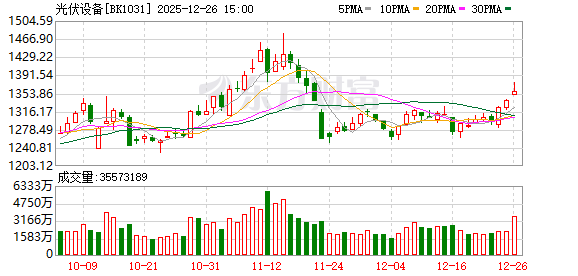
2025光伏行业盘点:“反内卷”推动价格回稳,企业自救提速
Di Yi Cai Jing· 2025-12-28 03:12
2026年或为光伏"反内卷"攻坚年 2025年,光伏制造业处于周期低谷之际,"反内卷"成为全行业的核心共识与转型之路。光伏主产业链价 格在2025年下半年逐步见底甚至改善,全行业自律减产,推动硅料、硅片等环节价格企稳回升,光伏主 产业链上市企业积极自救,普遍实施降本增效,并在第三季度实现利润减亏。 在政策定调与企业自救驱动下,光伏"反内卷"成果逐步显现,行业告别过去装机规模竞争,正进入更强 调技术与质量的价值比拼阶段。 然而,价格回暖仅是行业修复的第一步。当前产业链复苏基础仍不牢固,终端需求尚未全面恢复,产能 过剩的根本矛盾有待解决。 市场监管总局近日在安徽合肥召开合规指导会,通报价格违法问题与风险,行业正处在"反内卷"的关键 节点。会议明确指出,当前光伏行业存在的低质竞争、同质化重复建设等"内卷式"竞争行为,已经让企 业普遍面临盈利困境,扭曲了市场资源配置。随着反内卷治理进入深水区,2026年或将成为光伏产业逆 转关键年份,检验光伏"反内卷"成效、推动产能实质性出清的攻坚之年。 产业链价格企稳,"反内卷"成果显现 今年7月以来,多部门政策部署层层递进,国家行业协会及企业协同推进,政策围绕控产能、控价格、 提 ...
光伏行业月报:硅片、电池报价大幅提高,关注细分行业龙头-20251226
Zhongyuan Securities· 2025-12-26 09:24
电力设备及新能源 分析师:唐俊男 登记编码:S0730519050003 tangjn@ccnew.com 021-50586738 证券研究报告-行业月报 强于大市(维持) 电力设备及新能源相对沪深 300 指数表现 资料来源:聚源数据,中原证券研究所 -14% -5% 4% 13% 22% 30% 39% 48% 2024.12 2025.04 2025.08 2025.12 电力设备及新能源 沪深300 相关报告 《电力设备及新能源行业月报:治理企业价 格无 序 竞争 , 临近 年 底 需求 趋 于疲 软》 2025-11-28 《电力设备及新能源行业年度策略:反内卷 加速市场出清,关注细分领域龙头》 2025- 11-27 《电力设备及新能源行业专题研究:业绩逐 步见底》 2025-10-31 投资要点: 发布日期:2025 年 12 月 26 日 本报告版权属于中原证券股份有限公司 www.ccnew.com 请阅读最后一页各项声明 第1页 / 共17页 硅片、电池报价大幅提高,关注细分 联系人: 李智 电话: 0371-65585629 地址: 郑州郑东新区商务外环路 10 号 18 楼 地址: ...