华润啤酒

Search documents
多元退出渠道加速形成 | 2025年12月商办与办公空间发展报告
Sou Hu Cai Jing· 2025-12-26 15:14
Group 1: Office Market Trends - The national office market is experiencing accelerated contraction in investment sales, with new construction cooling and concentrated completions [4][8] - In November 2025, the average office rent in eight key cities was 2.48 yuan/square meter/day, down 6.28% month-on-month and 17.35% year-on-year, indicating a return to a downward trend after a brief recovery in October [12][11] - The supply peak in the office market is intensifying competition and vacancy pressure, leading landlords to adopt price reduction strategies to attract tenants [12][13] Group 2: Financing and Development - Swire Properties launched the "Qiantan Place," a super-grade A office project in collaboration with Lujiazui Group, highlighting the importance of high-quality office assets for corporate financing [5][16] - The 2025 REITs list includes commercial office facilities, specifically super-grade A and grade A office buildings in major cities, indicating a shift towards asset securitization in the commercial real estate sector [6][23] - Core city office assets are becoming crucial for commercial real estate companies to secure large-scale, low-cost financing in the current market environment [21][22] Group 3: Market Dynamics and Demand - The SMEDI index for November 2025 was 89.1, indicating continued challenges for small and medium enterprises, which are significant contributors to office space demand [31][34] - Major cities like Beijing, Shanghai, Guangzhou, and Shenzhen account for over 80% of new office leases, driven by established industry ecosystems and transportation advantages [21] - The demand for office space is increasingly supported by technology, finance, and pharmaceutical sectors, reflecting a shift in tenant profiles and operational strategies [21][19] Group 4: Asset Transactions and Legal Framework - Recent asset transactions in the commercial office market include a judicial auction of six construction projects in Tianjin, highlighting the trend of distressed asset sales due to financial difficulties of original developers [26][29] - The issuance of CMBS and asset-backed securities is becoming a mainstream method for commercial real estate companies to unlock the value of existing assets while maintaining ownership and operational control [22][24] - The market is witnessing a transition from traditional asset sales to more diversified exit strategies, including judicial auctions and asset securitization [27][25]

科技、医疗、银行等行业板块小幅上涨,大消费逆势回撤
Ge Long Hui· 2025-12-26 12:59
Group 1 - The Hang Seng Index maintained a slight increase of 0.17% at the close, with sectors such as internet, technology, healthcare, and banking showing minor gains, while the consumer sector experienced a decline [1] - The Hang Seng Technology Index saw a narrow range of fluctuations, closing up 0.14%, with notable increases in stocks like SMIC (up 3.14%), BYD, Kuaishou, NetEase, and Tencent, while Alibaba and Baidu faced slight declines [3] - The Hang Seng Healthcare Index rebounded after a previous drop, closing up 0.13%, with stocks like JD Health, WuXi Biologics, and Innovent Biologics showing small gains, whereas companies like 3SBio, CSPC Pharmaceutical, and Hansoh Pharmaceutical remained weak [3] Group 2 - The consumer sector faced a downturn, closing down 0.3%, with significant declines in stocks such as WuXi AppTec (down 3.22%) and Lao Pu Gold (down 2.67%), while companies like China Resources Beer, Horizon Robotics, and Alibaba Health managed to rise against the trend [3]

国家发改委、国家能源局重磅发布!
中国能源报· 2025-12-26 12:45
Core Viewpoint - The article discusses the release of the "Basic Rules for the Medium and Long-term Electricity Market" by the National Development and Reform Commission and the National Energy Administration, emphasizing the need for a unified national electricity market and the importance of balancing long-term supply and demand in the electricity sector [1][2]. Group 1: General Principles - The rules aim to accelerate the construction of a unified national electricity market system, standardize medium and long-term trading behaviors, and protect the legitimate rights and interests of market participants [5]. - The medium and long-term electricity market is defined as a market where registered entities conduct electricity trading for future delivery periods, including various time dimensions such as years, months, and weeks [5][6]. Group 2: Overall Requirements - The rules promote the integration of medium and long-term electricity markets with spot markets, ensuring smooth transitions in trading sequences, clearing, and market settlements [8]. - There is a focus on adapting to the volatility of renewable energy output, enabling flexible continuous trading, and promoting long-term power purchase agreements to stabilize consumption [8]. Group 3: Market Participants - Market participants include generation companies, electricity users, and new types of operators, all of whom must adhere to market rules and avoid manipulating prices [12][15]. - Generation companies have rights to participate in the market, sign contracts, and receive fair access to grid services [13]. Group 4: Trading Types and Price Mechanism - Medium and long-term trading includes various delivery periods, with different trading methods such as centralized trading and bilateral negotiations [25][30]. - The pricing mechanism for the medium and long-term market is determined by market forces, with specific provisions for green electricity trading [29][30]. Group 5: Trading Organization - Cross-regional electricity trading will be organized by designated electricity trading centers, with a focus on ensuring continuous operation and timely publication of trading calendars [32][34]. - The rules stipulate that key parameters for trading must be clearly defined before trading begins, and adjustments cannot be made during the trading process [44]. Group 6: Contract Management - All market participants must sign medium and long-term trading contracts, which serve as the basis for execution and help stabilize market expectations [64]. - Green electricity trading contracts must specify the traded electricity volume and pricing, including the environmental value of green electricity [66]. Group 7: Measurement and Settlement - The settlement of the medium and long-term market will generally occur on a monthly basis, with provisions for different types of settlements [72][76]. - Green electricity trading will involve separate settlements for energy and environmental value, ensuring compliance with sustainability pricing mechanisms [78]. Group 8: Information Disclosure - Market information will be disclosed periodically, with a retention period of at least two years, ensuring transparency for all market participants [81][83]. Group 9: Technical Support System - The electricity trading platform must include various functional modules to support market operations, ensuring interoperability and data exchange among different systems [84][88].
观酒 气泡黄酒爆火后“泡沫”散去,黄酒年轻化路在何方?
Nan Fang Du Shi Bao· 2025-12-26 06:25
Core Insights - The Chinese liquor industry is undergoing significant transformation in 2025, facing challenges such as high channel inventory and weak terminal sales, while also experiencing new opportunities driven by policy, consumption, and scenario changes [1] - The trend of product innovation targeting younger consumers is emerging, with low-alcohol beverages, fruit wines, and sparkling yellow wines becoming key connections to Generation Z [1] - The industry is witnessing a shift towards international markets as domestic growth slows, with liquor companies accelerating their global expansion efforts [1] Group 1: Industry Trends - The yellow wine sector is unexpectedly gaining attention, with Kuaijishan's "sparkling yellow wine" achieving over 10 million yuan in sales within 12 hours during a live stream event, leading to a surge in its stock price and market capitalization [3] - Despite initial success, the popularity of "sparkling yellow wine" has declined rapidly, highlighting the challenges traditional yellow wine companies face in appealing to younger consumers [5] - The competition between Kuaijishan and Guyuelongshan reflects a renewed market interest in the yellow wine industry, with both companies experiencing significant stock price fluctuations and market capitalization changes [6] Group 2: Company Performance - Kuaijishan reported a revenue of 1.212 billion yuan in the first three quarters of 2025, a year-on-year increase of 14.12%, while its net profit grew by 3.32% [6] - In contrast, Guyuelongshan's revenue for the same period was 1.186 billion yuan, a decline of 8.11%, although its net profit saw a slight increase of 0.17% [6] - Both companies are pursuing different strategies for product innovation, with Kuaijishan focusing on a "sparkling" series and Guyuelongshan expanding its product matrix to include diverse offerings [7] Group 3: Marketing and Channel Strategies - Kuaijishan emphasizes online marketing and influencer-driven sales, while Guyuelongshan focuses on upgrading traditional channels and forming cross-industry alliances to enhance offline penetration [9] - The rapid stock buyback plan initiated by Guyuelongshan indicates its confidence in the capital market and strategic stability in response to Kuaijishan's market capitalization lead [9] - The yellow wine industry's competition is not only about immediate marketing results but also reflects long-term transformation expectations, indicating a shift towards a more sustainable approach to young consumer engagement [9] Group 4: Future Directions for Yellow Wine - The yellow wine industry must innovate beyond mere imitation, focusing on flavor essence and health value to meet modern consumer preferences [11] - A nationwide channel network is essential for the success of young-oriented products, requiring a blend of online and offline strategies to cultivate consumer habits [12] - Cultural narratives surrounding yellow wine need to evolve from traditional storytelling to contemporary lifestyle integration, making it relevant to younger demographics [12]


300291重组复牌!并购拟IPO公司
Shang Hai Zheng Quan Bao· 2025-12-25 22:56
Core Viewpoint - The company Baina Qiancheng plans to acquire 100% of Zhonglian Century through a combination of share issuance and cash payment, aiming to enhance its digital marketing capabilities and achieve synergy in operations [2][4][11]. Group 1: Acquisition Details - Baina Qiancheng intends to issue shares and pay cash to acquire 100% of Zhonglian Century, along with raising matching funds from no more than 35 specific investors [2][4]. - The transaction's final price will be based on an evaluation report from a qualified asset appraisal agency, which is still pending completion [4]. Group 2: Zhonglian Century Overview - Zhonglian Century is a digital marketing service provider leveraging AI and big data, focusing on one-stop digital marketing solutions for industries such as telecommunications, finance, and e-commerce [2][4][5]. - The company has developed a robust R&D system and core technologies, including various intelligent marketing systems and algorithms, aimed at enhancing customer acquisition and operational efficiency [5]. Group 3: Financial Performance - In the first three quarters of the current year, Zhonglian Century reported a net profit of 178 million, surpassing its total net profit for the previous year [7]. - Financial data indicates that Zhonglian Century's total assets reached approximately 102.14 billion, with total liabilities of about 56.07 billion, and owner’s equity of around 46.07 billion as of September 30, 2025 [8]. Group 4: Strategic Rationale - Baina Qiancheng aims to enhance its competitive edge by integrating Zhonglian Century's advanced digital marketing technologies with its existing media resources and brand services [11]. - The acquisition is expected to optimize Baina Qiancheng's business structure and improve its overall competitiveness in the market [11].


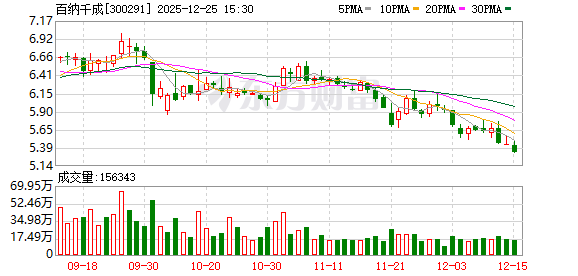
300291,重大资产重组!股票复牌!
Zhong Guo Ji Jin Bao· 2025-12-25 15:01
Group 1 - The company Baina Qiancheng plans to acquire 100% of Zhonglian Century's shares through a combination of issuing shares and cash payments, and will raise supporting funds from no more than 35 specific investors [2][4] - This transaction is expected to constitute a major asset restructuring and an associated transaction, but will not change the actual controller of the listed company [4] - Baina Qiancheng's stock will resume trading on December 26 [4] Group 2 - Baina Qiancheng primarily engages in multi-format film and marketing businesses, including movies, series, short videos, and various entertainment formats, generating revenue through copyright sales and content marketing [6] - Zhonglian Century is a comprehensive digital marketing service provider, known for its self-developed marketing technology service system, and has expanded its services into finance and e-commerce [6] - In 2023, 2024, and the first three quarters of 2025, Zhonglian Century achieved revenues of 736 million yuan, 1.382 billion yuan, and 1.003 billion yuan, with net profits of 151 million yuan, 177 million yuan, and 177 million yuan respectively [6] Group 3 - The acquisition is expected to enhance Baina Qiancheng's marketing business layout, integrating into China's mainstream digital advertising and cloud computing ecosystem, thereby improving its competitive strength [7] - Following the acquisition, the company's total assets, net assets, revenue, and net profit are anticipated to increase, further strengthening its operational capabilities [7] - Recently, Baina Qiancheng underwent a leadership change, with the resignation of the former chairman and the appointment of a new chairman and general manager [7]
300291 宣布重大资产重组!周五复牌!
Zheng Quan Shi Bao Wang· 2025-12-25 13:49
Core Viewpoint - Company Baina Qiancheng (300291) plans to acquire 100% of digital marketing service provider Xiamen Zhonglian Century Co., Ltd. (referred to as "Zhonglian Century"), which is expected to constitute a major asset restructuring [4][6]. Group 1: Acquisition Details - The acquisition will be executed through a combination of issuing shares and cash payments to obtain 100% of Zhonglian Century's shares, with a share issuance price set at 4.8 yuan per share, compared to the pre-suspension price of 5.33 yuan per share [4][6]. - The funds raised from issuing shares to no more than 35 specific investors will be used for cash consideration, transaction taxes, and intermediary fees related to the acquisition [4][6]. - Zhonglian Century, established in January 2013, focuses on providing one-stop digital marketing solutions leveraging its self-developed marketing technology service system [4][6]. Group 2: Financial Performance of Zhonglian Century - Zhonglian Century's revenue for the years 2023, 2024, and the first three quarters of 2025 is approximately 736 million yuan, 1.382 billion yuan, and 1.003 billion yuan, respectively, with net profits attributable to the parent company of approximately 151 million yuan, 177 million yuan, and 177 million yuan [4][6]. Group 3: Strategic Rationale - Company Baina Qiancheng aims to enhance its risk resistance and competitive strength through external acquisitions, particularly by integrating with companies that have strong synergies in similar business areas [7][8]. - The acquisition of Zhonglian Century is expected to break the bottleneck of Baina Qiancheng's traditional business model, transitioning it from a content provider and traditional advertising operator to a comprehensive marketing solution provider driven by data and AI [8]. - This strategic move aligns with national digital economy development strategies and is anticipated to improve the stability and sustainability of Baina Qiancheng's overall performance [8].
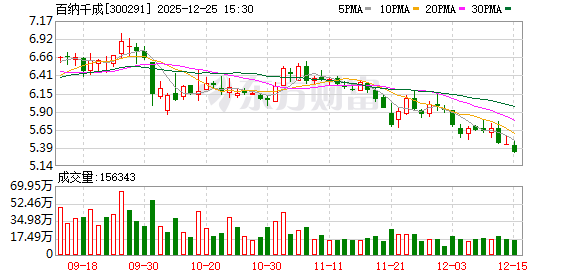
重大资产重组!300291,明起复牌
Xin Lang Cai Jing· 2025-12-25 13:14
Core Viewpoint - The company Baina Qiancheng (300291) plans to resume trading on December 26, 2025, after announcing a significant acquisition of 100% of Zhonglian Century through a combination of share issuance and cash payment [1][6]. Group 1: Acquisition Details - Baina Qiancheng intends to acquire 64.15% of Zhonglian Century from seven counterparties, and an additional 24.53% indirectly through the purchase of 100% of Xingjushengchuan from four counterparties [3][8]. - The company will also acquire 11.33% of Zhonglian Century by purchasing 100% of Dingchuang Century's assets from twenty counterparties, with a cash purchase of 1% of GP assets by a wholly-owned subsidiary [3][8]. Group 2: Business Overview - Baina Qiancheng primarily engages in multi-format film and marketing businesses, while Zhonglian Century is a leading digital marketing service provider that offers comprehensive digital marketing solutions across various industries, including telecommunications, finance, and e-commerce [3][8]. Group 3: Financial Impact - The acquisition is expected to enhance Baina Qiancheng's marketing business and improve its competitive edge by integrating into China's mainstream digital advertising and cloud computing ecosystem [3][9]. - Following the transaction, the company's total assets, net assets, operating income, and net profit are projected to increase, thereby strengthening its overall competitiveness and sustainability [9]. Group 4: Financial Performance - For the first three quarters of the year, Baina Qiancheng reported an operating income of 177 million, a year-on-year decrease of 73.43%, and a net profit attributable to shareholders of -67.54 million [4][9]. - The company’s total assets at the end of the reporting period were approximately 3.87 billion, reflecting a 2.83% increase from the previous year [10].
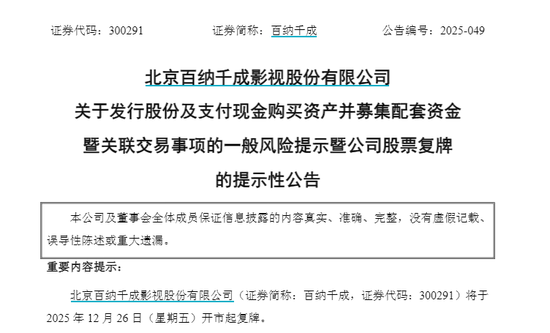
美团做起酒外卖,年营收或超60亿
Guan Cha Zhe Wang· 2025-12-25 10:49
Core Insights - The article highlights the rapid growth of Yima Songjiu, a liquor instant retail platform, which is projected to achieve a GMV of over 6 billion yuan in 2023, doubling from 3 billion yuan in 2022 [2][24] - Yima Songjiu has quickly become a leading player in the industry, reflecting the strong demand for instant home delivery of alcoholic beverages [3][28] Company Overview - Established in 2021 as a supplementary project for Meituan's flash purchase service in Huizhou, Yima Songjiu has expanded to over 2,000 warehouses across more than 200 cities, serving nearly 30 million users [3][11] - The platform offers over 800 SKUs, covering major categories such as beer, white liquor, red wine, and foreign liquor, with an average delivery time of 15 minutes [3][4] Competitive Advantages - Yima Songjiu promotes three main advantages: speed, price, and a light-asset model [4] - The platform's self-operated delivery model allows for faster delivery times, achieving a 50% on-time rate within 15 minutes and 95% within 25 minutes, significantly quicker than competitors [4][21] - Pricing strategies include using self-branded products to maintain high margins and leveraging Meituan's subsidies to offer competitive prices on well-known brands [4][5] Market Dynamics - The instant retail sector for alcoholic beverages is still in its early stages, with a projected market size of 100 billion yuan by 2027, indicating a compound annual growth rate of approximately 30% [24][27] - The industry faces challenges such as high delivery costs, low margins, and fluctuating demand, which complicate the balance between operational efficiency and profitability [21][29] Strategic Collaborations - Yima Songjiu has partnered with China Resources Beer to launch exclusive products based on real-time consumer data, showcasing the potential of instant retail platforms to influence product development [9][10] Future Outlook - The article suggests that the next phase of competition in the liquor instant retail market will focus on enhancing customer experience through specialized services and personalized recommendations [22][30] - The industry's growth is expected to be driven by changing consumer habits, particularly among younger generations who favor instant delivery services [27][28]


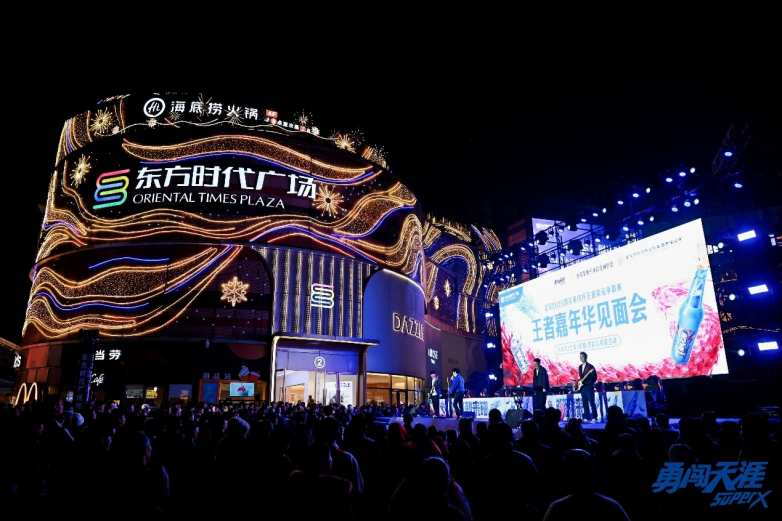
宜宾2025雪花勇闯杯王者荣耀争霸赛圆满落幕 电竞热潮与勇闯精神燃动宜宾
Zhong Guo Shi Pin Wang· 2025-12-25 08:32
Core Insights - The Yibin 2025 Snow Beer "Brave Challenge" King of Glory Championship concluded successfully on December 20, showcasing top esports talent and engaging the audience with a theme of "Shining Together for Ten Years" [2] Group 1: Event Highlights - The event featured four prominent esports figures, including a renowned player from AG Super Play and a top shooter from Beijing WB, who interacted with participants and showcased their skills [4] - The competition format was upgraded with simultaneous 5V5 matches on main and secondary stages, enhanced by real-time battle screens to create an immersive atmosphere [6] Group 2: Brand Engagement - Snow Beer "Brave Challenge" resonated with the youth, merging the brand's spirit of "Bravery" with the esports ethos of perseverance and fighting spirit [8] - The event not only provided a platform for esports enthusiasts to compete but also effectively communicated the brand's core message of courage and energy to the younger demographic [9]