
思源电气

Search documents
新浪财经资讯AI速递:昨夜今晨财经热点一览 丨2026年1月21日
Xin Lang Cai Jing· 2026-01-20 22:30
Group 1: Market Dynamics - The geopolitical tensions surrounding Greenland and Japan's fiscal concerns have disrupted the previously calm market, leading to significant declines in U.S. stocks and a rise in gold prices [1][8] - Investors are shifting from a dismissive attitude towards geopolitical risks to a more cautious stance, fearing potential outcomes like NATO disintegration or a full-scale trade war [1][8] Group 2: Investment Opportunities - Goldman Sachs reports that China's State Grid will invest 4 trillion yuan during the 14th Five-Year Plan, a 40% increase from the previous plan, benefiting companies like TBEA and Sanyuan Electric [9] - The focus of investment will shift towards accommodating renewable energy and digital loads, with a strong emphasis on ultra-high voltage and smart grid technologies [9] Group 3: Trade and Economic Growth - In 2025, Anhui province will join China's "trillion-dollar foreign trade club" with a total trade value of 10,135.57 billion yuan, driven by a robust industrial base, particularly in the automotive sector [10] - Henan province is also on track to join this club, with a foreign trade value exceeding 9,300 billion yuan, indicating a competitive landscape in the central region [10] Group 4: Currency and Financial Trends - The internationalization of the renminbi has progressed significantly, elevating it from a "peripheral currency" to a "secondary reserve currency," with expectations for further integration into global finance [12] - The focus for the upcoming Five-Year Plan will be on enhancing the international acceptance of the renminbi and promoting high-quality capital project openings [12] Group 5: Regulatory Actions - The Shanghai Futures Exchange has announced an increase in margin requirements and trading limits for various commodities, including copper and gold, in response to market volatility [13] - This regulatory action reflects a broader trend of risk management in the face of significant price fluctuations in the commodities market [13] Group 6: Corporate Issues - The company *ST Lifan has faced scrutiny due to allegations of financial fraud, leading to a significant drop in its stock price despite a temporary surge following a public letter from its controlling shareholder [15] - The company has reported continuous losses and is at risk of forced delisting, highlighting the challenges it faces in maintaining operational integrity [15] Group 7: Brand and Market Conflicts - The juice brand Huiyuan is embroiled in a trademark and market dispute, with conflicting claims from its founder and a restructuring investor, leading to confusion in product distribution [16] - This internal conflict has severely impacted Huiyuan's market share, indicating the risks associated with brand management and market positioning [16]
高盛:国家电网“十五五” 投资4 万亿,大增40%,特变电工、思源电气等将直接受益!
Xin Lang Cai Jing· 2026-01-20 13:32
Core Insights - The report from Goldman Sachs highlights a significant investment in China's power grid, with a target of 4 trillion RMB during the 14th Five-Year Plan (2026-2030), marking a 40% increase from the previous plan's 2.8 trillion RMB [3][4][19] - The investment shift focuses on accommodating renewable energy and digital economy needs, indicating a structural transformation in the power grid's role from merely transmitting electricity to efficiently integrating variable renewable energy sources [3][4][18] Investment Scale and Growth Logic - The unprecedented investment base supports a robust growth outlook for the power grid sector, with an average annual investment exceeding 800 billion RMB [4][19] - The growth logic is evolving, with a clear bifurcation in investment phases: high-voltage direct current (UHV) investments are expected to grow by 24% in 2026, while investments will shift towards smart grid infrastructure from 2028 to 2030 [7][22] Structural Changes in Investment - A significant structural change is underway, with distribution network investments projected to surpass transmission investments, increasing from 57% to 59% of total investments from 2026 to 2030 [8][23] - This shift reflects a fundamental redefinition of the grid's functionality, necessitating upgrades to accommodate distributed energy resources, electric vehicle charging stations, and virtual power plants [10][25] Necessity for Smart Investments - By 2030, renewable energy is expected to account for 30% of total electricity generation, introducing challenges for grid stability that require heightened levels of smart investments [11][26] - Investment growth may temporarily slow in 2027-2028 due to project cycles, but is anticipated to accelerate again in 2029-2030 to address increasing balance challenges [11][26] Market Dynamics and Leading Companies - The market is increasingly favoring leading companies in the sector, with major players like Suyuan Electric, Pinggao Electric, and TBEA capturing significant market shares in core equipment categories [12][29] - This "stronger getting stronger" dynamic suggests that as overall demand increases, companies with technological, brand, and delivery advantages will gain more substantial market shares and performance elasticity [12][29] Future System Upgrades - The 4 trillion RMB investment blueprint is not merely about infrastructure expansion; it represents a comprehensive upgrade of the energy system's underlying architecture, aiming to create a stronger, smarter, and more flexible power system [15][30] - The immediate benefits from UHV and backbone network upgrades are clear, while the long-term potential from grid digitalization and distribution network intelligence presents a valuable opportunity for future growth [15][30]


公募基金抢筹电力设备股
Zhong Guo Dian Li Bao· 2026-01-20 13:28
Group 1 - The core viewpoint is that several leading public funds are shifting their investments towards the power equipment sector, with companies like Jerry Holdings, Guoguang Electric, and Dongfang Electric becoming key holdings [1] - The smart distribution segment is highlighted as a major focus for public funds, with intensive research conducted on quality stocks in the power equipment sector regarding technological barriers, capacity planning, and overseas market expansion [1] - Fund managers believe that energy and power are essential foundations for AI computing power, indicating that investments in power equipment are necessary to complement the AI industry chain [1] Group 2 - The industry is expected to enter a high prosperity cycle due to a combination of policy, demand, and technology, driven by the State Grid's 4 trillion yuan investment and the anticipated growth in power equipment exports in 2026 [2] - Key areas for investors to focus on include ultra-high voltage, flexible DC, and digital microgrids, with an emphasis on selecting companies that can leverage both domestic investment benefits and overseas market opportunities [2]

反直觉!春节前哪些业绩线能成为强压下的“避风港”?
Xin Lang Cai Jing· 2026-01-20 11:42
Core Viewpoint - The market is becoming increasingly cautious as the Spring Festival approaches, with a focus on performance as a safe haven for investments, rather than speculative stories [1][2] Group 1: Investment Strategy - Investors should avoid the misconception that good performance guarantees profits; key factors include valuation, institutional holdings, and industry trends [1][2] - The correct investment logic involves looking for marginal performance improvement, low valuation (below 30% percentile), concentrated institutional holdings, and industry catalysts [2] Group 2: Key Sectors to Explore - **AI Power and Computing Infrastructure**: Strong demand driven by energy supply constraints; significant investments expected during the "14th Five-Year Plan" period [1][2] - **Semiconductors and AI Applications**: Anticipated market growth to $697 billion in 2025, with a focus on companies with solid order backlogs [6] - **Robotics**: Institutions are increasing allocations in this sector, with a focus on core components and automation penetration [6] - **Non-bank Financials**: Valuation recovery potential in brokerage firms, with a projected net profit of 30.05 billion yuan for CITIC Securities in 2025 [11] - **CXO in Pharmaceuticals**: Focus on companies with solid order books and revenue growth, particularly in ADC segments [16] - **Cash Flow Stable and Dividend Stocks**: High dividend yield stocks with stable cash flow are essential for risk management [18] - **Overseas Expansion**: Companies with strong overseas channels and brand power are positioned to benefit from global market growth [20] Group 3: Stock Selection Criteria - Stocks should have substantial orders, performance support, and clean ownership structures, avoiding those reliant solely on concepts without fundamentals [7] - Prioritize stocks with marginal performance improvement, low valuations, and institutional accumulation, while confirming the resolution of negative factors [20]

兴业证券:A股业绩预告即将进入披露高峰 关注哪些方向?
智通财经网· 2026-01-20 10:56
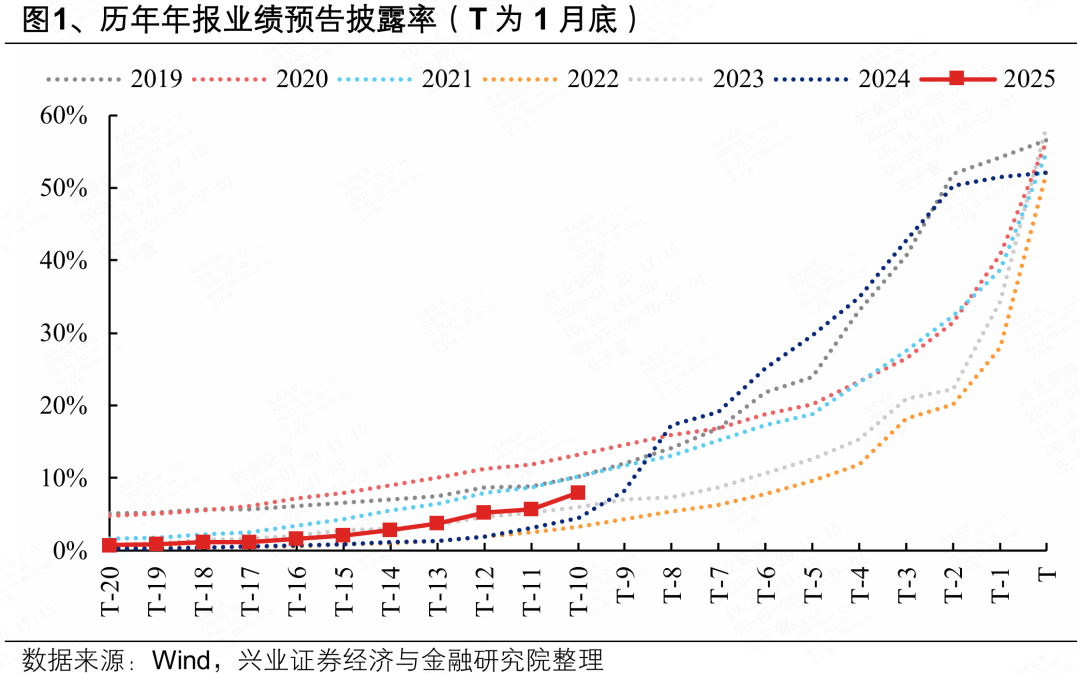
Core Viewpoint - As of January 19, the disclosure rate of annual performance forecasts for A-shares is 7.98%, with a peak expected in late January, where the final disclosure rate may reach around 55% [2][5]. Group 1: Performance Forecasts - The performance forecasts indicate that companies with significant net profit growth are primarily in sectors such as computing power, new energy, chemicals, pharmaceuticals, non-ferrous metals, and computers [6][10]. - By January 19, 447 A-share companies have released annual performance forecasts, with 144 companies expecting net profit growth exceeding 50%, mainly in computing power (semiconductors, communication equipment), new energy (batteries, photovoltaics), and chemicals [6][10]. Group 2: Market Reactions - As the performance forecasts enter their peak disclosure period, the correlation between stock prices and performance is expected to increase significantly in the latter half of January, with market sentiment returning to rationality [5]. - The market is likely to undergo a structural adjustment based on fundamentals, with previous hot sectors facing performance validation, while some low-performing but high-quality sectors may attract new capital inflows [5]. Group 3: Industry Insights - The sectors with upward revisions in profit forecasts since November include technology (especially in upstream computing hardware and downstream applications like consumer electronics and software), advanced manufacturing (new energy, military, automotive), and cyclical industries (building materials, non-ferrous metals, coal, steel) [12][13]. - The industries with lower performance growth since the last market rally include AI computing power, new energy, pharmaceuticals, and cyclical sectors like steel and glass fiber [14].

招商证券:国网“十五五”投资规划超预期,总投资预计达4万亿元聚焦新型电力系统
Xin Lang Cai Jing· 2026-01-20 09:26
Group 1 - The core investment of the State Grid Corporation during the 14th Five-Year Plan is expected to reach 4 trillion yuan, a significant increase of approximately 40% compared to the previous plan [1][5] - The implied annual compound growth rate (CAGR) for achieving this target is about 7%, which is comparable to the growth rate of 7.1% during the 14th Five-Year Plan [1][5] - The focus of investment is shifting from "stabilizing growth" to "building a new power system," indicating a high level of industry prosperity expected to continue throughout the 14th Five-Year Plan [1][5] Group 2 - The report highlights significant challenges in power consumption, with electricity demand expected to grow rigidly due to new needs from electric vehicles and AI computing [2][8] - The supply side has seen explosive growth in renewable energy installations, with nearly 80% of new photovoltaic and wind power capacity added in the last three years, exceeding the grid's original capacity [2][8] - The construction of external transmission channels (UHV/main grid) and the enhancement of system regulation capabilities (energy storage/distribution network) are viewed as key technical paths to address these challenges [2][8] Group 3 - The overseas power grid is entering a renewal cycle, with equipment averaging 30 to 40 years of service nearing replacement, leading to a "passive acceleration" of investment [3][9] - Chinese leading power equipment companies are demonstrating strong delivery capabilities and competitive advantages in transformers, switches, smart meters, and insulators, benefiting from early overseas market positioning [3][9] - These companies are expected to achieve more prominent development in this global cycle [3][9] Group 4 - The report suggests focusing on domestic companies such as Guodian NARI, Sifang Electric, China XD Electric, and TBEA, among others [6][11] - For overseas layout, companies like Sifang Electric, Igor, and TBEA are highlighted as key players [6][11]

反直觉!春节前哪些业绩线能成为强压下的“避风港”?
格隆汇APP· 2026-01-20 08:55
Core Viewpoint - The article emphasizes the importance of focusing on performance metrics rather than speculative stories in the current cautious market environment, especially as the Chinese New Year approaches. It suggests that investors should look for stocks with solid earnings forecasts, but also consider valuation, institutional holdings, industry trends, and potential catalysts before making investment decisions [5][6]. Group 1: Investment Strategy - Investors should avoid the misconception that good performance guarantees profitability, as demonstrated by a case where a CXO company saw a 40% increase in net profit but had already experienced an 80% stock price increase prior to the announcement, leading to a sell-off [6][8]. - Key selection criteria for stocks include marginal performance improvement, low valuation (below the 30th percentile), concentrated institutional holdings, and industry catalysts, supported by favorable policies [8]. Group 2: Sector Analysis - **AI Power and Computing Infrastructure**: The demand for AI-related power and computing infrastructure is strong, with a projected 40% increase in investment from the State Grid during the 14th Five-Year Plan. Companies in this sector are expected to have stable earnings and low valuations [10]. - **Semiconductors and AI Applications**: The semiconductor market is expected to recover in 2025, with a projected global market size of $697 billion, driven by domestic substitution and AI infrastructure needs. Companies with solid order backlogs should be prioritized [13]. - **Robotics**: The robotics sector is gaining attention from institutional investors, with a focus on companies that have substantial orders and clean shareholding structures. The sector is expected to benefit from increased automation in manufacturing by 2026 [14]. - **Non-Ferrous Chemicals**: The non-ferrous sector is linked to the demand for new energy and AI infrastructure, with potential recovery in demand for industrial metals like copper and aluminum by 2025 [15]. - **Commercial Aerospace and Satellites**: Despite recent stock price corrections, the long-term outlook for the aerospace sector remains positive, with upcoming satellite launches and applications expected to drive performance [16]. - **Non-Bank Financials**: The brokerage sector is expected to benefit from increased market activity, with estimates of net profit for CITIC Securities reaching 30.05 billion yuan in 2025, a 38.46% increase [18]. - **CXO in Pharmaceuticals**: The pharmaceutical sector should focus on CXO companies with solid performance metrics, as the global biopharmaceutical investment is expected to reach $63.88 billion in 2025, a 10.13% increase [20]. - **Cash Flow and Dividend Stocks**: In a cautious market, stocks with stable cash flow and high dividend yields (over 4%) are recommended as defensive positions [23]. - **Overseas Expansion**: Companies with strong overseas channels and brand power are positioned to benefit from global market growth, particularly in manufacturing sectors [24]. Group 3: Portfolio Management - Investors are advised to diversify their portfolios, suggesting a mix of 50% growth stocks, 30% defensive value stocks, and 20% turnaround opportunities to mitigate risks in a volatile market [28].

190.54亿元资金今日流出电力设备股
Zheng Quan Shi Bao Wang· 2026-01-20 08:49
Market Overview - The Shanghai Composite Index fell by 0.01% on January 20, with 20 industries rising, led by the oil and petrochemical sector with a gain of 1.74% and construction materials at 1.71% [1] - The telecommunications and defense industries experienced the largest declines, down 3.23% and 2.87% respectively [1] - The power equipment industry saw a decrease of 1.84% [1] Capital Flow Analysis - The main capital outflow from the two markets totaled 95.723 billion yuan, with 11 industries experiencing net inflows [1] - The banking sector led with a net inflow of 1.472 billion yuan and a daily increase of 0.80%, followed by the real estate sector with a 1.55% increase and a net inflow of 627 million yuan [1] - The power equipment industry had the largest net outflow, totaling 19.054 billion yuan, followed by the electronics sector with an outflow of 18.394 billion yuan [1] Power Equipment Industry Performance - Within the power equipment sector, 365 stocks were tracked, with 79 stocks rising and 280 stocks falling [2] - Notably, 5 stocks hit the daily limit up, while 2 stocks hit the daily limit down [2] - The top net inflow stocks included Ningde Times with 321 million yuan, followed by Hunan YN with 258 million yuan and Siyuan Electric with 184 million yuan [2] Top Gainers in Power Equipment - Ningde Times: +0.20%, turnover rate 0.83%, net inflow 321.47 million yuan [3] - Hunan YN: +2.77%, turnover rate 10.86%, net inflow 258.38 million yuan [3] - Siyuan Electric: -3.75%, turnover rate 3.68%, net inflow 183.55 million yuan [3] Top Losers in Power Equipment - Sunshine Power: -5.60%, turnover rate 4.13%, net outflow 1.61068 billion yuan [5] - TBEA: +0.92%, turnover rate 16.85%, net outflow 1.47952 billion yuan [5] - Longi Green Energy: -5.13%, turnover rate 4.18%, net outflow 1.22988 billion yuan [5]




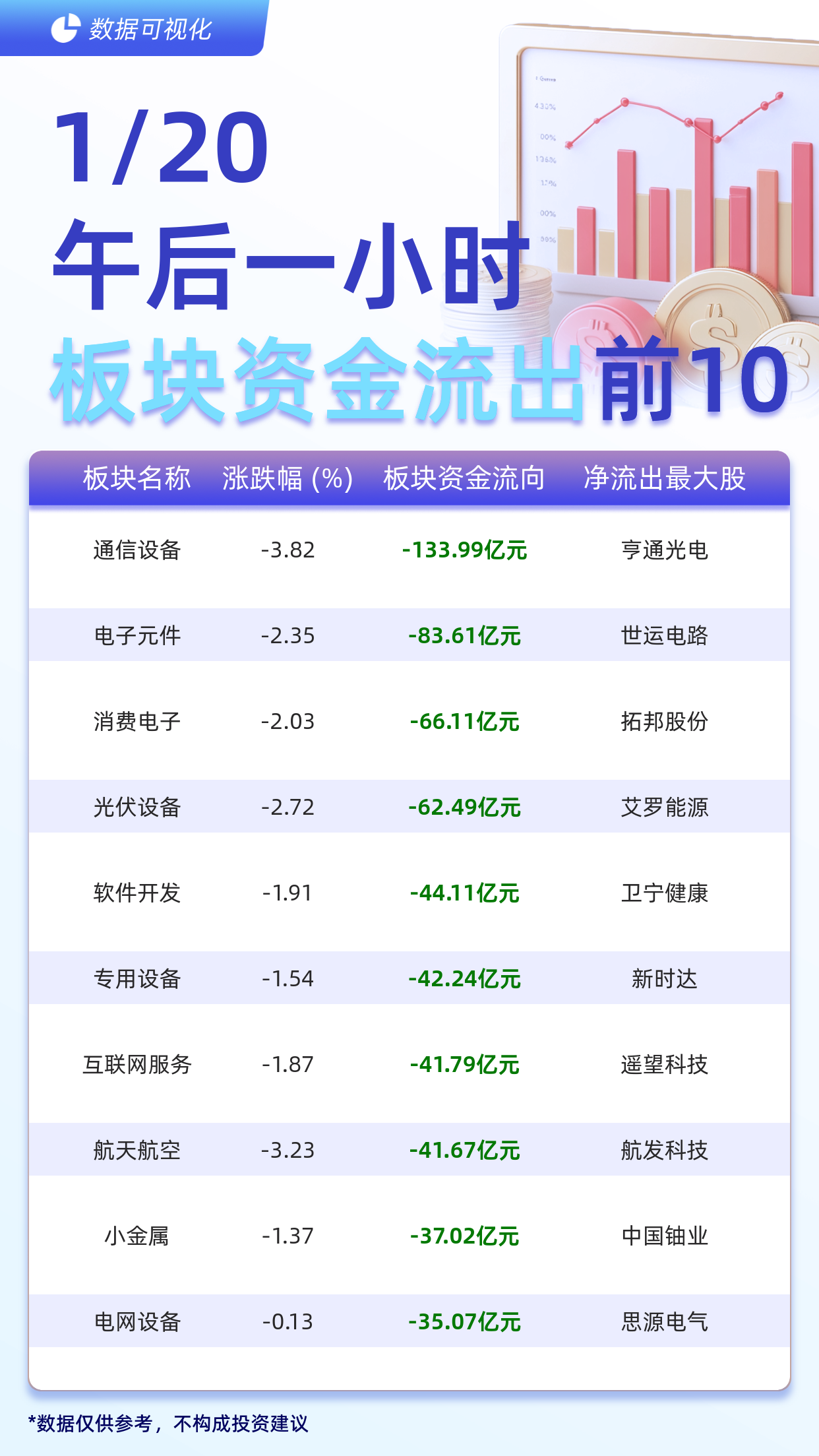
主力板块资金流出前10:通信设备流出133.99亿元、电子元件流出83.61亿元
Jin Rong Jie· 2026-01-20 06:26
Core Viewpoint - The main market experienced a significant outflow of capital, totaling 879.71 billion yuan, with various sectors facing substantial losses in funding [1]. Group 1: Capital Outflow by Sector - The top ten sectors with the largest capital outflows include: - Communication Equipment: -133.99 billion yuan, with a decline of 3.82% [2][3] - Electronic Components: -83.61 billion yuan, with a decline of 2.35% [2][3] - Consumer Electronics: -66.11 billion yuan, with a decline of 2.03% [2] - Photovoltaic Equipment: -62.49 billion yuan, with a decline of 2.72% [2] - Software Development: -44.11 billion yuan, with a decline of 1.91% [2] - Specialized Equipment: -42.24 billion yuan [1] - Internet Services: -41.79 billion yuan, with a decline of 1.87% [3] - Aerospace: -41.67 billion yuan, with a decline of 3.23% [3] - Minor Metals: -37.02 billion yuan, with a decline of 1.37% [3] - Power Grid Equipment: -35.07 billion yuan, with a minimal decline of 0.13% [3]
电网设备ETF(159326):百亿资金持续流入,AI引爆全球电力危机
Xin Lang Cai Jing· 2026-01-20 03:59
Core Viewpoint - The surge in the electric grid equipment ETF (159326) indicates a strong market optimism towards the electric grid equipment sector, driven by the anticipated global electricity crisis due to AI advancements [1][7]. Group 1: AI and Electricity Demand - The consensus in the industry is that "the end of AI is electricity," highlighting the critical role of electricity supply in AI development [2][8]. - A warning from research institutions suggests that the U.S. may face up to a 20% electricity shortfall by 2028 due to the high power consumption of AI data centers [2][8]. - Goldman Sachs predicts that by 2030, the electricity demand from AI data centers will increase by 175% compared to 2023 levels, creating a mismatch in the speed of data center construction and power line installation [2][8]. Group 2: Global Grid Aging and Opportunities for China - The global electric grid equipment sector is experiencing a structural shortage, with predictions indicating that the demand for power transformers in the U.S. will exceed supply by 30% this year due to AI-driven upgrades [3][9]. - European grids are among the oldest globally, averaging 45-50 years in service, necessitating urgent upgrades after two decades of underinvestment [3][9]. - Chinese electric grid equipment companies are leveraging their full industry chain advantages to expand internationally, with exports exceeding 65.5 billion yuan in the first nine months of 2025, marking a 36% year-on-year increase [3][9]. Group 3: Domestic Policy and Investment - Domestic electric grid investment is accelerating, with a cumulative investment of 560.4 billion yuan completed in the first eleven months of 2025, reflecting a 5.9% year-on-year growth [4][10]. - The State Grid plans to invest 4 trillion yuan during the 14th Five-Year Plan period, a 40% increase from the previous plan, which will stimulate demand across the industry chain [4][10]. - The establishment of a multi-level renewable energy consumption and regulation system by 2030 will provide a stable policy environment for the electric grid equipment sector [4][10]. Group 4: Electric Grid Equipment ETF Insights - The electric grid equipment ETF (159326) is a precise tool for investors looking to capitalize on this sector, with the top ten constituent stocks accounting for 54% of the index [5][11]. - Major companies in this ETF, such as State Grid NARI, TBEA, and Siyuan Electric, are not only key players in domestic grid construction but also significant beneficiaries of international expansion [5][11]. - As of January 19, 2026, the ETF has achieved a one-year return of 68.63%, significantly outperforming the CSI 300 index, indicating strong market performance [6][12].