
泡泡玛特

Search documents
在搜索框里打一场“伏击战”,CBI新锐TOP100品牌里的蓝海增长密码
Sou Hu Cai Jing· 2026-02-11 18:55
Group 1 - The consumer market is warming up in 2026, with companies like HBN and BeBeBus successfully entering the Hong Kong stock market, while brands like HuazhiXiao and XimuYuan continue to receive capital support from major players [1][3] - The market has shifted from a "burning money for scale" approach to a focus on "striving for net profit," emphasizing the importance of profitability for brands [1] - The report from Peking University's National School of Development highlights the "China Online Consumer Brand Index (CBI)" and provides a detailed analysis of various fast-moving consumer goods (FMCG) categories [3][6] Group 2 - The CBI report introduces the "Red and Blue Ocean Index," which identifies market demand gaps and provides guidance for brands to find "blue ocean" opportunities [6][9] - The report reveals that categories such as hair cleansing, facial care sets, and children's clothing are leading in the "blue ocean" market [6][8] - The index includes unique metrics like the search transaction growth gap, indicating new opportunities where consumer demand exceeds supply [9][10] Group 3 - New brands in the FMCG sector are capitalizing on unmet consumer needs, with successful examples like HaiGuiBaBa focusing on children's sunscreen and YiYe leveraging medical expertise for baby skincare [10][11] - The CBI rankings show that brands like HuazhiXiao and HBN are leading in the beauty sector, while BeBeBus excels in the mother and baby category [20][22] - The report emphasizes the importance of a comprehensive system that integrates research, aesthetics, and customer retention to build a competitive edge in the market [24][25] Group 4 - The shift in consumer power dynamics is moving from those who manage traffic to those who understand products and consumer sentiments [25][43] - Brands that can effectively meet consumer desires and create a sense of dependency will thrive, as seen with HuazhiXiao's aesthetic appeal and HBN's focus on trust [43][44] - The CBI report indicates that the future of successful brands lies in addressing unmet search demands and providing certainty in consumer experiences [44]


三大因素推动,消费企业扎堆赴港IPO!冷热分化下资本有了新逻辑
Sou Hu Cai Jing· 2026-02-11 15:52
消费企业扎堆赴港IPO。 2026年开年之后,港股市场的消费热潮再次升温。继2025年新茶饮、餐饮企业扎堆赴港上市后,今年初 鸣鸣很忙、东鹏饮料等细分赛道头部企业又组团登陆港股,钱大妈、袁记食品、君乐宝这些知名消费企 业也纷纷递交招股书,港股消费赛道再度变得热闹拥挤。据证券时报记者统计,2026年开年至今,已有 超10家消费类企业首次披露H股招股材料,数量相较2025年同期有明显增加。 但不难发现,2025年以来上市的消费企业,股价表现分化明显,这背后也反映出市场正重新审视消费企 业的真实价值。有受访人士认为,看似消费市场整体偏低迷的当下,一批消费巨头企业选择逆市赴港上 市,既是多重因素共同作用下的选择,也预示着资本市场的投资逻辑正朝着长期主义转变。 三大因素推动消费企业港股IPO 近日,东鹏饮料正式登陆港交所主板,募资总额达101亿港元,一举创下亚洲饮料行业的募资纪录。而 鸣鸣很忙的IPO也掀起资本市场热议,从招股文件来看,此次发行吸引了8家基石投资者参与,认购总 额约1.95亿美元,折合约15.2亿港元。 消费企业赴港上市的热度还在持续攀升:年营收近200亿元的乳业龙头君乐宝,已于1月19日向港交所递 表 ...
三大因素推动,消费企业扎堆赴港IPO!冷热分化下资本有了新逻辑
证券时报· 2026-02-11 15:44
三大因素推动消费企业港股IPO 近日,东鹏饮料正式登陆港交所主板,募资总额达101亿港元,一举创下亚洲饮料行业的募资纪录。而鸣鸣很忙的IPO也掀起资本市场热议,从招股文件 来看,此次发行吸引了8家基石投资者参与,认购总额约1.95亿美元,折合约15.2亿港元。 消费企业赴港上市的热度还在持续攀升:年营收近200亿元的乳业龙头君乐宝,已于1月19日向港交所递表;社区生鲜连锁钱大妈、手工水饺品牌袁记食品 也紧随其后,背后还有腾讯投资、红杉中国等知名机构加持。除此之外,比格餐饮、金星啤酒、百川名品等各细分赛道的龙头企业,也纷纷加入赴港上市 的排队行列,覆盖食品饮料、餐饮连锁、社区零售等多个领域,催生出一波前所未有的消费企业赴港上市潮。 这波扎堆赴港上市的现象也让不少人产生疑问:为何消费企业突然集体选择登陆港股?其实这并非偶然,而是多重因素共同作用的结果。在业内人士眼 中,当下消费企业赴港上市,并非可选的"选择题",而是"最优解"。 金鼎资本投资总监叶欣文在接受记者采访时从三个方面剖析了消费企业趋赴港股市场的背后动因。她指出,首要原因是近年来A股对消费连锁业态的审核 趋于严格,企业上市排队周期长,且对盈利持续性与合规 ...

银行理财1月份规模狂掉1万亿?一定要高度重视背后的影响
Xin Lang Cai Jing· 2026-02-11 15:24
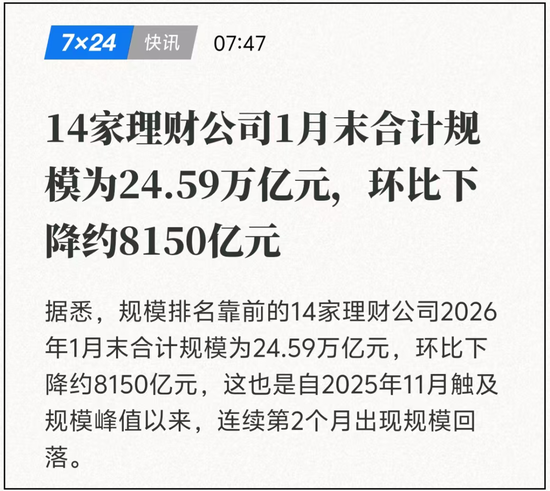
Core Viewpoint - The significant drop in the scale of bank wealth management products in January indicates a major shift in the industry, reflecting a healthy correction of inflated growth driven by unsustainable business models [1][4][26]. Group 1: Industry Scale Changes - In January, the scale of 14 leading bank wealth management subsidiaries decreased by over 800 billion, accounting for approximately 75% of the total wealth management industry scale, which was over 33 trillion at the end of 2025 [1][25]. - The total industry scale is estimated to have dropped by over 1 trillion in January, marking a substantial decline compared to previous years where the scale remained relatively stable [3][25]. Group 2: Business Model Implications - The decline in scale is seen as a necessary adjustment, as the previous growth was largely fueled by "retained earnings" and "ranking models," which artificially inflated yield levels [4][27]. - The end of the "ranking model" signifies a downward adjustment in the yield of pure debt wealth management products, which will lower the actual risk-free rate for Chinese residents and potentially increase the valuation of all risk assets [5][28]. Group 3: Future Industry Dynamics - The shift away from old business models necessitates a focus on research capabilities, product line structuring, and channel service improvements, leading to a transformation in wealth management product structures [5][28]. - The rise of multi-asset wealth management products indicates a growing trend towards diversification and a need for wealth management firms to adapt to changing market conditions [5][28]. Group 4: Market Environment - The low interest rate environment is pushing the industry towards a multi-asset investment approach, emphasizing the importance of asset allocation for both investment advisors and individual investors [5][29]. - The current market dynamics suggest that firms lacking the ability to provide effective asset allocation will struggle to remain competitive in the evolving landscape [5][29].
青岛市南:生肖经济“马”力全开
Zhong Guo Jing Ji Wang· 2026-02-11 14:44
"马"元素走俏节前消费市场,营造出吉祥喜庆的节日氛围。走进盒马鲜生香港中路门店,喜庆的马年装 饰随处可见,"年货模式"早已开启。货架上,马年礼盒、马年对联福字等成为热销商品,自制烘焙区 内,"马上来钱"轻甜马卡龙成为年轻人心头好。据销售人员介绍,富有青岛当地特色的"跃马迎春"海鲜 干货礼盒、花饽饽礼盒等销量持续走高。 融入马年生肖元素的黄金饰品、颇具传统文化特色的马年文创、以"马"为灵感创作的系列特色年货…… 2026年春节日益临近,"马年限定"商品走俏青岛市市南区新春市场。近日,记者走访发现,生肖"马"已 经成为今年各类商品设计的核心元素,"一马当先"领跑消费市场。 在万象城负一层的泡泡玛特门店,一款名为"马力全开"的毛绒挂件盲盒引发抢购潮。据该店工作人员介 绍,该系列盲盒汇集了LABUBU、星星人、DIMOO等8个热门IP,自上市以来就颇受关注。"造型可 爱,寓意美好,真是将情绪价值拉满了!"顾客黄莹边挑边说。门店对面,乐高店面大门口早已摆上了 摇钱树、财神爷等包含马年元素的积木装饰玩具,其中名为"骏马鸿图"的马年限定产品更是引起围观。 该产品以骏马元素为核心意象,诠释"马到成功,鸿运当头"的寓意。"过年 ...
教育出海:胜负手是成为「半个本地人」的时间
3 6 Ke· 2026-02-11 13:40
Core Insights - The Chinese education industry's growth trajectory was abruptly altered in 2021, leading to a significant shift towards international expansion, particularly in Southeast Asia and the Middle East, as companies sought to replicate their previous success in China [1] - The overseas markets are not merely smaller versions of China, and many efficiency models that worked domestically have failed or backfired in these new environments [1] Group 1: Reasons for Going Overseas - The discussion around international expansion among Chinese education companies began in earnest after the "Double Reduction" policy in 2021, which marked a critical turning point [2] - The decision to expand internationally was driven by a combination of slowing domestic growth and the need for new opportunities, rather than a grand strategic vision [2][4] - Personal experiences, such as a background in English education and previous international exposure, played a significant role in preparing individuals for this transition [2][3] Group 2: Challenges Faced in International Markets - The first major realization was that simply translating and adapting content from China was insufficient, as educational motivations and family structures varied significantly across countries [5][6] - The second challenge arose when attempting to export operational models that had been successful in China, which often did not resonate with local market dynamics, leading to ineffective marketing strategies [6][12] - The third realization was that organizational structures and management practices from China did not translate well, resulting in difficulties in recruitment and retention of local staff [12][15] Group 3: Market Analysis and Misjudgments - Initial market assessments focused on theoretical market size (TAM) and reachable market (SAM) but failed to account for the complexities of local educational environments and family dynamics [19][23] - The assumption that a large market size would guarantee success was proven wrong, as local conditions and cultural contexts played a crucial role in determining the viability of educational products [23] Group 4: Cultural Differences in Consumer Behavior - In Southeast Asia, education consumption resembles fast-moving consumer goods, where immediate experiences and visible value are critical for decision-making [24][26] - Conversely, in the Middle East, educational decisions are heavily influenced by family networks and trust, requiring a different approach to marketing and service delivery [24][27] Group 5: Long-term Strategy and Adaptation - Successful international expansion requires a long-term commitment and understanding of local contexts, rather than a short-term profit-driven mindset [30][32] - Companies must balance local insights with their operational strengths, ensuring that they adapt to local cultures while maintaining high standards of service and efficiency [32][33]
银行理财1月份规模狂掉1万亿?一定要高度重视背后的影响
表舅是养基大户· 2026-02-11 13:35
Core Viewpoint - The significant drop in the scale of bank wealth management products in January indicates a major shift in the industry, suggesting that the previous growth was unsustainable and that a transformation in business models is necessary [1][6]. Group 1: Industry Scale Changes - In January, the scale of 14 leading bank wealth management subsidiaries decreased by over 800 billion, which represents approximately 75% of the total wealth management industry scale, indicating a total industry drop of over 1 trillion [1][3]. - The scale drop of 1 trillion is substantial, especially when compared to a decrease of over 1200 billion in January 2024 and an increase of about 500 billion in January 2025, highlighting a significant shift in investor behavior [3]. Group 2: Business Model Transformation - The release of retained earnings and the end of the "ranking" business model for wealth management companies signal a need for a focus on research capabilities, product line layout, and channel service capabilities [4][7]. - The competition landscape in the wealth management industry is expected to undergo drastic changes, with a shift away from unsustainable business practices towards more robust investment strategies [5][7]. Group 3: Market Implications - The decline in wealth management scale reflects a healthy adjustment in the industry, as it removes inflated growth driven by unsustainable practices [6]. - The end of the previous business model will lead to a decrease in pure debt wealth management yields, which will lower the actual risk-free rate for Chinese residents, potentially increasing the valuation of risk assets [7]. - The transition in wealth management is not just a change for wealth management subsidiaries but requires a comprehensive transformation across management and sales channels [7]. Group 4: Investment Strategy Recommendations - The current low-interest-rate environment necessitates a multi-asset investment approach, emphasizing the importance of asset allocation for both investment advisors and individual investors [7][8]. - The rise of multi-asset wealth management products indicates a shift in investor preferences, with a significant increase in the allocation towards fixed income and public funds [7].

2025电商十大事件:告别红利,电商开始打硬仗
3 6 Ke· 2026-02-11 13:28
Core Insights - The e-commerce and retail sectors are experiencing significant changes, with the peak of traffic dividends and a shift in consumer behavior being the most critical factors for 2025 [1] - The year 2025 is marked by a decline in e-commerce penetration rate, with online retail sales expected to reach nearly 16 trillion yuan, growing by 8.6% compared to the previous year [1] Group 1: E-commerce Industry Trends - A "de-involution" movement in the e-commerce industry is led by platforms optimizing rules, regulating promotions, and enhancing technology [2] - Major platforms are adjusting controversial rules like "only refunds" and "mandatory shipping insurance" to balance consumer and merchant rights [2] - The introduction of supportive policies for merchants aims to lower costs and optimize traffic distribution, with Douyin e-commerce saving merchants over 32 billion yuan [2] Group 2: Instant Retail Competition - A fierce competition in instant retail has emerged, with major players like JD, Alibaba, and Meituan investing at least 30 billion yuan in marketing during Q2 [4] - The battle for market share in the instant retail sector is expected to reshape competition rules, leading to a stable state where Alibaba and Meituan may become long-term rivals [4] Group 3: Brand and Consumer Dynamics - The disappearance of top influencers has led brands to shift towards self-operated live streaming, with KOCs (Key Opinion Consumers) gaining traction as cost-effective marketing tools [9] - The 2025 Double 11 shopping festival has transformed into a battle of rationality among platforms, merchants, and consumers, with a focus on maintaining the lowest prices [10] Group 4: Regulatory Changes - The implementation of new tax regulations for e-commerce platforms marks the end of the long-standing "tax-free dividend," requiring merchants to report comprehensive income data [16] - The new tax rules are expected to impact how merchants operate, with a focus on compliance becoming essential for survival in the industry [16] Group 5: AI Integration - Major companies are heavily investing in AI, with Alibaba planning to invest over 380 billion yuan in AI and cloud infrastructure over the next three years [17] - The integration of AI tools is changing e-commerce operations, enhancing search capabilities and content conversion efficiency [18]



北水净买入腾讯超7亿,净卖出阿里巴巴超5亿
Ge Long Hui· 2026-02-11 12:19
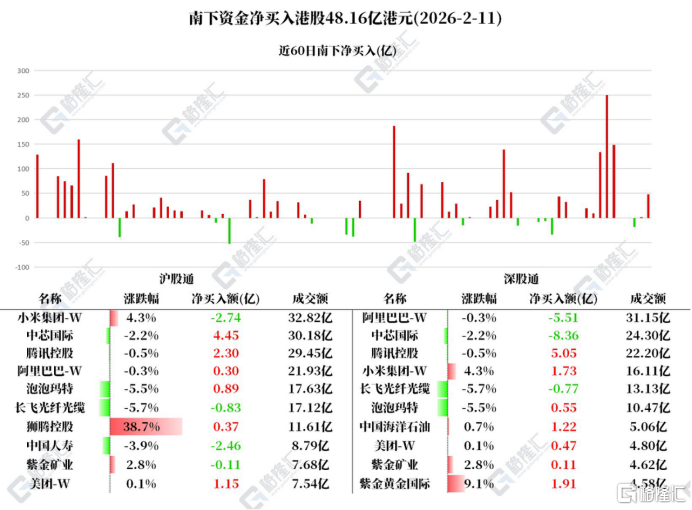
Group 1 - Southbound funds net bought Hong Kong stocks worth HKD 4.816 billion on February 11, with notable net purchases in Tencent Holdings (HKD 735 million), Zijin Mining International (HKD 191 million), Meituan-W (HKD 162 million), Pop Mart (HKD 144 million), and China National Offshore Oil Corporation (HKD 122 million) [1] - Significant net sales were observed in Alibaba-W (HKD 520 million), SMIC (HKD 390 million), China Life (HKD 246 million), Yangtze Optical Fibre and Cable (HKD 159 million), and Xiaomi Group-W (HKD 100 million) [1] Group 2 - Meituan announced plans to invest approximately USD 717 million to acquire Dingdong Group's "Dingdong Grocery" business in China, which Morgan Stanley believes will create synergies with Meituan's existing Xiaoxiang Supermarket and strengthen its position in the fresh food delivery market in East China [5] - CNOOC is influenced by geopolitical tensions, particularly regarding U.S.-Iran relations, which may affect short-term oil price volatility [5] Group 3 - Xiaomi is rumored to use the Snapdragon 8 Elite Gen6 for its standard version, with potential costs exceeding USD 300, approximately CNY 2074, amid rising DRAM and NAND prices increasing pressure on smartphone manufacturers [7] Group 4 - Lion Group Holdings is positioned to benefit from Hong Kong's growing status as a global Web3 and cryptocurrency innovation hub, supported by the implementation of the Stablecoin Regulation and the upcoming issuance of licenses for stablecoin issuers [6]
智通港股通活跃成交|2月11日



智通财经网· 2026-02-11 11:06
沪港通(南向)十大活跃成交公司 深港通(南向)十大活跃成交公司 智通财经APP获悉,2026年2月11日当天,小米集团-W(01810)、中芯国际(00981)、腾讯控股(00700)位 居沪港通(南向)成交额前3位,成交额分别为32.82 亿元、30.18 亿元、29.45 亿元;阿里巴巴- W(09988)、中芯国际(00981)、腾讯控股(00700) 位居深港通(南向)成交额前3位,成交额分别为31.15 亿元、24.30 亿元、22.20 亿元。 | 公司名称 | 成交金额 | 净买入额 | | --- | --- | --- | | 阿里巴巴-W(09988) | 31.15 亿元 | -5.51 亿元 | | 中芯国际(00981) | 24.30 亿元 | -8.36 亿元 | | 腾讯控股(00700) | 22.20 亿元 | +5.05 亿元 | | 小米集团-W(01810) | 16.11 亿元 | +1.73 亿元 | | 长飞光纤光缆(06869) | 13.13 亿元 | -7716.44 万元 | | 泡泡玛特(09992) | 10.47 亿元 | +5507.12 万元 ...