
迪哲医药

Search documents
迪哲医药(688192) - 迪哲医药:关于首次公开发行之暂时闲置募集资金进行现金管理的公告
2025-10-30 08:44
证券代码:688192 证券简称:迪哲医药 公告编号:2025-56 迪哲(江苏)医药股份有限公司 关于首次公开发行之暂时闲置募集资金进行现金管 理的公告 本公司董事会及全体董事保证公告内容不存在任何虚假记载、误导性陈述 或者重大遗漏,并对其内容的真实性、准确性和完整性依法承担法律责任。 迪哲(江苏)医药股份有限公司(以下简称"公司")于 2025 年 10 月 30 日 分别召开第二届董事会第十六次会议,审议通过了《关于首次公开发行之暂时 闲置募集资金进行现金管理的议案》,同意公司在不影响募集资金投资计划正 常进行的前提下,公司拟使用最高不超过人民币 42,000.00 万元(含本数)的暂 时闲置募集资金进行现金管理,使用期限自 2025 年 12 月 19 日起 12 个月之内 有效。公司会选择信誉好、规模大、有能力保障资金安全的发行主体所发行的 投资安全性高、流动性好的银行理财产品或存款类产品或保本型券商收益凭证 (包括但不限于保本型理财产品、协定性存款、结构性存款、定期存款、大额 转让存单、保本型券商收益凭证等)。在上述额度及期限范围内,公司可以循 环滚动使用资金。同时,公司董事会授权董事长或董事长授 ...

迪哲医药(688192) - 迪哲医药:华泰联合证券有限责任公司关于迪哲(江苏)医药股份有限公司使用首次公开发行之暂时闲置募集资金进行现金管理的核查意见
2025-10-30 08:40
华泰联合证券有限责任公司关于 迪哲(江苏)医药股份有限公司使用首次公开发行之 暂时闲置募集资金进行现金管理的核查意见 华泰联合证券有限责任公司(以下简称"华泰联合"、"保荐机构")作为迪 哲(江苏)医药股份有限公司(以下简称"迪哲医药"或"公司")2023 年度向 特定对象发行 A 股股票的保荐机构,根据《证券发行上市保荐业务管理办法》 《上海证券交易所科创板股票上市规则》以及《上海证券交易所科创板上市公司 自律监管指引第 1 号——规范运作》等相关规定履行公司 2023 年度向特定对象 发行 A 股股票的持续督导职责并承接公司首次公开发行的原保荐机构中信证券 股份有限公司未完成的首次公开发行相关的持续督导工作,对迪哲医药使用首次 公开发行之暂时闲置募集资金进行现金管理事项进行了核查,核查的具体情况如 下: 一、募集资金基本情况 根据中国证券监督管理委员会于 2021 年 11 月 5 日印发的《关于同意迪哲 (江苏)医药股份有限公司首次公开发行股票注册的批复》(证监许可﹝2021﹞ 3494 号)的决定,公司获准向社会公开发行人民币普通股 A 股 40,000,100 股, 发行价格为人民币 52.58 元 ...
迪哲医药(688192) - 2025 Q3 - 季度财报
2025-10-30 08:20
Financial Performance - The company's revenue for the third quarter reached ¥231,299,714.08, representing a year-on-year increase of 71.46%[3] - The total profit for the period was a loss of ¥203,910,752.21, with a cumulative loss of ¥582,901,080.21 for the year to date[3] - The basic earnings per share for the current period was -¥0.44, compared to -¥1.32 for the year to date[3] - The net profit for the first three quarters of 2025 was -582,953,152.35 RMB, compared to -649,647,448.06 RMB in the same period of 2024, showing an improvement[25] - Basic and diluted earnings per share for the first three quarters of 2025 were both -1.32 RMB, slightly better than -1.35 RMB in 2024[25] - The total comprehensive income attributable to the parent company's owners was -579,947,780.97 RMB in 2025, compared to -558,460,529.94 RMB in 2024[25] Research and Development - Research and development expenses totaled ¥235,968,603.38, accounting for 102.02% of revenue in the current period, a decrease of 35.09 percentage points[4] - The company plans to maintain stable funding for ongoing clinical research and development of its products[9] - The company is actively expanding its research and development efforts, particularly in the field of T-cell lymphoma treatment, as evidenced by multiple studies on its product, 高瑞哲®[16] - Research and development expenses increased to 644,235,609.66 RMB in 2025 from 567,728,545.76 RMB in 2024, reflecting a growth of approximately 13.5%[24] Assets and Liabilities - Total assets at the end of the reporting period were ¥2,955,346,622.51, an increase of 71.95% compared to the end of the previous year[4] - The equity attributable to shareholders of the listed company increased to ¥1,440,437,716.45, reflecting a significant rise of 643.43% year-on-year[4] - As of September 30, 2025, the company's total assets amounted to RMB 2,955,346,622.51, a significant increase from RMB 1,718,737,884.05 at the end of 2024[19][21] - The company’s total liabilities as of September 30, 2025, were RMB 1,511,613,180.21, slightly down from RMB 1,518,680,986.42 at the end of 2024[21] Cash Flow - The net cash flow from operating activities was -¥159,387,479.24 for the current period, with a cumulative cash flow of -¥424,056,847.98 for the year[3] - Operating cash flow for the first three quarters of 2025 was -424,056,847.98 RMB, slightly better than -463,308,340.42 RMB in 2024[28] - The company reported a significant increase in cash inflow from investment activities, totaling 7,282,910,041.68 RMB in 2025 compared to 2,709,870,267.04 RMB in 2024[28] - The net cash flow from financing activities was 1,640,908,417.60 RMB in 2025, compared to 606,803,240.41 RMB in 2024, indicating a substantial increase[29] Shareholder Information - The total number of common shareholders at the end of the reporting period is 8,806[11] - The largest shareholder, Advanced Manufacturing Industry Investment Fund, holds 108,923,023 shares, representing 23.71% of total shares[11] - AstraZeneca AB also holds 108,923,023 shares, accounting for 23.71%[11] - The company’s stockholders include Jiangsu Wuxi Dize Enterprise Management Partnership, holding 57,451,788 shares, or 12.51%[11] - The company’s stockholders also include Industrial Bank Co., Ltd. - Yongying Pharmaceutical Innovation Mixed Fund, holding 5,910,918 shares, or 1.29%[11] Product Development and Approvals - The company received FDA accelerated approval for ZEGFROVY® on July 2025, making it the first and only EGFR Exon20ins NSCLC innovative drug approved in the U.S.[13] - The company presented 11 new research results in the NSCLC field at the 2025 WCLC, demonstrating good efficacy and safety for ZEGFROVY® across various treatment stages[14] - Birelentinib (DZD8586) received FDA Fast Track Designation in August 2025 for treatment of relapsed/refractory CLL/SLL patients[15] - The company has initiated an international multi-center Phase III clinical study for birelentinib targeting relapsed/refractory CLL/SLL[15] - The company’s research on high瑞哲® (Golitinib) in combination with anti-PD-1 monoclonal antibodies is ongoing, providing important evidence for its clinical application in NSCLC[14] Operating Costs - Total operating revenue of RMB 586,301,134.90 for the first three quarters of 2025, a significant increase from RMB 338,451,000.00 in the same period of 2024, representing a growth of approximately 73.4%[23] - Total operating costs for the first three quarters of 2025 were RMB 1,234,483,936.24, compared to RMB 1,031,763,876.35 in the first three quarters of 2024, indicating an increase of about 19.6%[23] - The company incurred financial expenses of 22,699,804.01 RMB in 2025, up from 15,863,566.73 RMB in 2024, representing a rise of about 43.3%[24] - Sales revenue from goods and services received cash of 559,618,110.76 RMB in 2025, compared to 351,202,757.00 RMB in 2024, marking a growth of approximately 59.4%[28]
创新药高位盘整三个月,没机会了?金笑非称随便买入随便赚钱的阶段可能已经结束
市值风云· 2025-10-29 10:20
Core Viewpoint - The article discusses the recent trend of profit-taking in the innovative drug sector and the shift towards increasing allocations in the power equipment sector, highlighting the changing dynamics in investment strategies within the healthcare and technology industries [1][3]. Summary by Sections Innovative Drug Sector - The innovative drug sector has seen a significant rise of over 60% in the first half of the year, but has been in a high-level consolidation phase recently [3]. - Despite the average loss of nearly 8% among 28 ETFs tracking the innovative drug index since its peak on August 19, 2025, many funds have seen their shares increase, with some growing by over 100%-300% as investors rush to buy the dip [5]. - Fund manager Jin Xiaofei has significantly reduced his holdings in innovative drugs, indicating a shift in strategy as the sector's overall gains have been substantial, leading to a crowded trade [10][14]. Fund Performance and Adjustments - Jin Xiaofei's fund, Penghua Medical Technology Stock A, has shown a year-to-date return of 22.03% in Q3, outperforming its benchmark and the CSI 300 index [8]. - The fund's exposure to the pharmaceutical and biotechnology sector has decreased to 49.5%, a reduction of over 25 percentage points, reflecting a strategic pivot [10][14]. - The top ten holdings of the fund now include a mix of innovative drugs and medical device companies, indicating a broader industry coverage [12]. Future Outlook - Jin Xiaofei remains optimistic about the long-term prospects of innovative drugs but acknowledges that the ease of making profits in this sector may be over, shifting focus to identifying stocks with real competitive advantages [15]. - Other fund managers, such as Zhao Bei from ICBC Credit Suisse, have also expressed caution regarding overvalued innovative drug companies, favoring investments in the CXO sector and companies with significant overseas revenue [16][17]. - Investors holding innovative drug stocks should temper their short-term expectations and prepare for a longer investment horizon [18]. Shift to Power Equipment Sector - The fund has made substantial reallocations, reducing its pharmaceutical holdings to 23.3% and increasing its stake in the power equipment sector to 17.2% [19][23]. - New investments include companies like Pylon Technologies and Ganfeng Lithium, indicating a strategic shift towards sectors with perceived growth potential [24].






科创板“蝶变”
2 1 Shi Ji Jing Ji Bao Dao· 2025-10-28 23:10
Core Insights - The Sci-Tech Innovation Board (STAR Market) has transformed from an experimental platform for institutional innovation to a hub for "hard tech" companies during the "14th Five-Year Plan" period, with significant growth in the number and market value of technology innovation companies [1][2]. Group 1: Market Growth and Financial Performance - As of October 26, 2025, the number of listed companies on the STAR Market reached 589, with total IPO fundraising of 925.7 billion yuan and refinancing of 186.7 billion yuan, exceeding 1.1 trillion yuan in total [2]. - The proportion of strategic emerging industries and new productivity development directions aligns closely with the STAR Market's focus, with over 80% of companies in new generation information technology, biomedicine, and high-end equipment manufacturing [2]. - R&D investment in the STAR Market companies increased from 640 billion yuan to 1.07 trillion yuan, a growth of 66%, accounting for nearly 40% of the national R&D investment [3]. Group 2: Institutional Innovations and Support - The STAR Market has introduced various institutional innovations during the "14th Five-Year Plan," enhancing inclusivity and providing tailored support for companies at different stages [4]. - A total of 376 new companies were listed on the STAR Market during this period, with 37 unprofitable companies achieving profitability post-listing, representing over 40% [5]. - The STAR Market has streamlined refinancing conditions and established a quick financing system, significantly improving financing convenience for companies [5]. Group 3: Talent and Investment Dynamics - The STAR Market has fostered a positive cycle of "technology-industry-capital," with over 60% of founding teams comprising scientists and engineers, and nearly 30% of actual controllers also serving as core technical personnel [7]. - Approximately 90% of STAR Market companies received venture capital investment before going public, indicating a strong trend towards early-stage investment in hard technology [7]. - The STAR Market has developed a comprehensive index system, with 29 indices and 161 products tracking these indices, totaling nearly 260 billion yuan in scale [7]. Group 4: Future Outlook - As the "14th Five-Year Plan" concludes, the capital market is expected to undergo deeper reforms, focusing on developing new productivity and addressing structural financing challenges for technology innovation enterprises [8]. - The upcoming "15th Five-Year Plan" will emphasize improving long-term capital arrangements and enhancing the investment patience of market-oriented institutions [8].
华安基金:市场大幅反弹,创业板50指数涨9.48%
Xin Lang Ji Jin· 2025-10-28 06:12
Market Overview and Key Insights - The A-share market showed an overall upward trend last week, with major indices rebounding: CSI 300 rose by 2.9%, CSI 500 by 3.5%, CSI 1000 by 3.3%, ChiNext 50 by 9.5%, and Sci-Tech 50 by 7.3% [1] - The average daily trading volume in the A-share market was around 1.8 trillion yuan, indicating a slight decrease in market activity [1] - Market hotspots exhibited rapid rotation, shifting from computing hardware and coal to optical modules, aerospace, and oil and gas [1] - The current market style emphasizes structural opportunities, with a mid-to-long-term investment direction suggested to align with the 14th Five-Year Plan, focusing on policy support and industrial resonance [1] Focus on ChiNext - The ChiNext serves as a direct financing platform for growth-oriented innovative enterprises, particularly in the "three innovations and four new" sectors [1] - The ChiNext 50 Index focuses on four key sectors: information technology, new energy, financial technology, and pharmaceuticals, showcasing pure technology growth attributes [1][5] ChiNext 50 Index Composition - The ChiNext 50 Index has a significant weight in the information technology sector, comprising 44%, with 17% allocated to optical modules [6] - The optical module sector experienced a substantial rebound last week, driven by positive market sentiment and several favorable developments [6] - Key developments in the optical module market include an upward revision in demand for 1.6T optical modules and a projected supply shortage for high-speed optical modules [6] New Energy Sector Insights - The new energy photovoltaic sector saw a slight increase last week, with ongoing policy guidance aimed at promoting industry self-discipline [6] - The demand for energy storage is expected to grow, supported by the 14th Five-Year Plan, while battery prices stabilize [6] - Long-term trends indicate an improvement in supply-demand dynamics for new energy photovoltaics, with reduced silicon material inventory pressure and cost advantages for HJT components [6] Pharmaceutical Sector Overview - The pharmaceutical sector experienced a slight adjustment last week, with reduced funding attention and a potential technical correction [7] - The internationalization of innovative drugs is accelerating, with significant license-out transactions expected to reach 920.3 million USD by the third quarter of 2025 [7] - Policy moderation is evident, with a narrowing price reduction in procurement agreements, indicating a potential turning point for the medical device sector [7] ChiNext 50 ETF Performance - The ChiNext 50 ETF (code: 159949) focuses on leading companies in high-value sectors such as new energy vehicles, biomedicine, electronics, photovoltaics, and internet finance [8] - The ETF has a robust liquidity profile, with an average daily trading volume of 1.52 billion yuan over the past year, ranking among the top ETFs on the Shenzhen Stock Exchange [8] - The latest fund size of the ChiNext 50 ETF is 26.307 billion yuan, making it one of the largest funds tracking the ChiNext-related indices [8]

科创板的“十四五”成绩单:“试验田”里长出创新森林
2 1 Shi Ji Jing Ji Bao Dao· 2025-10-28 04:03
Core Insights - The Sci-Tech Innovation Board (STAR Market) has transformed from an experimental platform for institutional innovation to a hub for "hard tech" companies during the 14th Five-Year Plan period, with significant growth in the number and market capitalization of technology innovation companies [1][2] Group 1: Market Performance - As of October 26, 2025, the number of listed companies on the STAR Market reached 589, with total IPO fundraising of 925.7 billion yuan and refinancing of 186.7 billion yuan, exceeding 1.1 trillion yuan in total [2] - The proportion of technology innovation companies in the Shanghai market increased from 32% to 41%, and their market capitalization share rose from 27% to 32% [1] Group 2: Industry Focus - The STAR Market has seen over 80% of its companies in emerging industries such as new-generation information technology, biomedicine, and high-end equipment manufacturing [2] - Approximately 120 companies in the integrated circuit sector are listed on the STAR Market, covering all aspects of the industry chain, including design, manufacturing, and testing [2] Group 3: R&D Investment - R&D investment by companies in the Shanghai market increased from 640 billion yuan to 1.07 trillion yuan, a growth of 66%, accounting for nearly 40% of the national total [3] - STAR Market companies have accumulated 120,000 patents, with a median R&D intensity of 12.6%, leading all A-share sectors [3] Group 4: Institutional Innovation - The STAR Market has introduced various reforms, including the "STAR Market Eight" and "M&A Six," enhancing inclusivity and providing tailored support for companies at different stages [4][5] - The STAR Market has streamlined refinancing conditions and established a quick financing system, significantly improving financing convenience for companies [5] Group 5: Talent and Investment Dynamics - Over 60% of STAR Market companies have founding teams composed of scientists and engineers, with nearly 30% of actual controllers also serving as core technical personnel [7] - The STAR Market has fostered a culture of early, small, and hard-tech investments, with about 90% of companies receiving venture capital before listing [7] Group 6: Future Outlook - As the 14th Five-Year Plan concludes, the capital market is expected to undergo deeper reforms to enhance the development of new quality productivity [8] - Future initiatives will focus on improving long-term capital arrangements and facilitating the entry of medium to long-term funds into the market [8]




立足管用好用 科创板创新制度“工具箱”支持成长层公司加速成长
Zhong Guo Jin Rong Xin Xi Wang· 2025-10-28 02:44
Group 1: Core Views - The Sci-Tech Innovation Board (STAR Market) has successfully supported unprofitable tech companies to go public, with 54 such companies listed and 22 achieving profitability post-listing [1] - The "1+6" reform of the STAR Market aims to create a management loop for unprofitable companies, promoting technological innovation while managing market risks and protecting investors [1] Group 2: Financial Performance - In the first half of 2025, revenue for 32 companies in the STAR Market's growth tier increased by 37.79% year-on-year, while net profit losses were significantly reduced by 71.23 billion [1] - As of September 2023, 16 companies in the growth tier have announced refinancing plans to raise a total of 29.5 billion, with 8 companies successfully raising 13.2 billion [2] Group 3: Mergers and Acquisitions - The STAR Market's policies have invigorated mergers and acquisitions, with 6 transactions disclosed since the introduction of the "Eight Articles" policy, focusing on acquiring quality unprofitable companies [3] - The acquisition of a 72.33% stake in Chip Alliance by issuing shares and cash marks the first asset purchase transaction under the STAR Market's growth tier [3] Group 4: Talent Retention and Incentives - Stock incentive plans are crucial for attracting and retaining talent in tech companies, with over 60% of growth tier companies implementing such plans by September 2025 [5][6] - For instance, Junshi Biosciences has launched three stock incentive plans, covering over 90% of its employees, reflecting strong confidence in future performance [6]

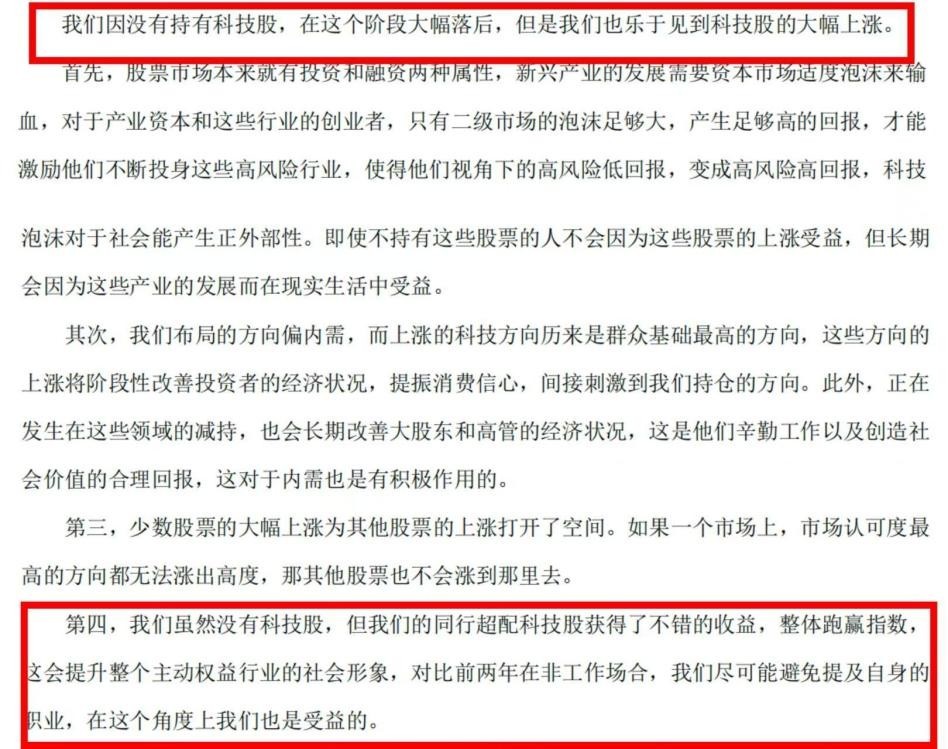
又见基金经理5000字走心三季报:因没持有科技股在这个阶段落后 但乐于见到其大涨!
Mei Ri Jing Ji Xin Wen· 2025-10-27 23:09
Core Viewpoint - The third-quarter report from Chen Jinwei, manager of Penghua Industrial Select Fund, has gained significant attention for its insights on the rise of technology stocks and the debunking of four misconceptions about "anti-involution" [1][2]. Group 1: Fund Performance - In the third quarter, Penghua Industrial Select Fund achieved a net value growth of 13.90%, with a year-to-date increase of 30.56%, ranking in the top 35 among 2,292 flexible allocation funds [1]. - The report highlights the importance of fund managers communicating their operational strategies and market views through financial reports, which serve as a crucial channel for investor engagement [1]. Group 2: Insights on Technology Stocks - Chen Jinwei noted that the market exhibited characteristics of a "slow bull" in the third quarter, with a significant portion of gains driven by a few technology leaders, as the top 10 stocks contributed nearly half of the gains in the CSI 300 index [3]. - Despite not holding technology stocks, Chen expressed a positive outlook on their rise, emphasizing that the development of emerging industries requires some market bubble to thrive, which ultimately benefits society [4][5]. Group 3: Debunking Misconceptions about "Anti-Involution" - Chen Jinwei addressed four misconceptions regarding "anti-involution," arguing that true market efficiency is hindered by involution, which is often perpetuated by local governments' leniency towards enterprises [8]. - He clarified that "anti-involution" encompasses both supply-side and demand-side policies, as it involves market reforms that enhance the returns on various factors of production, thus stimulating domestic demand [8][9]. - The report also suggests that "anti-involution" does not necessarily require significant capacity reduction, as controlling new increments can be effective [9]. - Chen pointed out that the disparity between leading and secondary companies has widened, indicating that only industry leaders currently possess substantial growth potential [9]. Group 4: Investment Strategy - The current focus of Penghua Industrial Select Fund is on midstream cyclical leaders, particularly in the chemical, pharmaceutical, and service consumption sectors [11]. - The fund has significantly increased its holdings in midstream cyclical leaders, with a notable emphasis on the chemical sector due to its competitive advantages and resilience against global consumption fluctuations [13]. - Chen Jinwei remains optimistic about specific segments within the pharmaceutical and consumer sectors, particularly service consumption, which is expected to benefit from easing supply and time constraints [13].
聚焦科创成长层丨立足管用好用 科创板创新制度“工具箱”支持公司加速成长
Zheng Quan Shi Bao· 2025-10-27 14:57
Group 1: Core Views - The Sci-Tech Innovation Board (STAR Market) has successfully supported unprofitable tech companies, with 54 such companies listed, of which 22 have achieved profitability post-listing [1] - The STAR Market's "1+6" reform has established a growth tier to create a management loop for unprofitable companies, promoting tech innovation while managing market risks and protecting investors [1] Group 2: Financial Performance - By the first half of 2025, revenue for 32 companies in the STAR Market's growth tier increased by 37.79% year-on-year, while net profit losses were significantly reduced by 71.23 billion yuan [1] Group 3: Fundraising and Capital - As of September 2023, 16 companies in the STAR Market's growth tier have announced refinancing plans to raise a total of 29.5 billion yuan, with 8 companies successfully raising 13.2 billion yuan [3] - The introduction of standards for light assets and high R&D investments has enhanced financing flexibility, allowing companies to increase R&D spending [3] - For instance, Cambrian Technology raised 3.985 billion yuan through a private placement, with over 30% of the funds allocated to R&D [3][4] Group 4: Mergers and Acquisitions - The STAR Market's policies have invigorated mergers and acquisitions, with 6 transactions disclosed since the introduction of the "STAR Market Eight Articles" [6] - ChipLink Integration's acquisition of a 72.33% stake in ChipLink Yuezhou marks the first asset purchase transaction using stock issuance in the STAR Market [6] Group 5: Talent Retention - Stock incentive plans are crucial for attracting and retaining talent in tech companies, with 33 companies in the STAR Market's growth tier implementing such plans [8] - For example, Junshi Biosciences has launched three stock incentive plans, covering over 2,200 employees, with a coverage rate exceeding 90% [9]