极米科技

Search documents
黑色家电板块11月26日涨0.06%,同洲电子领涨,主力资金净流出2903.37万元
Zheng Xing Xing Ye Ri Bao· 2025-11-26 09:05
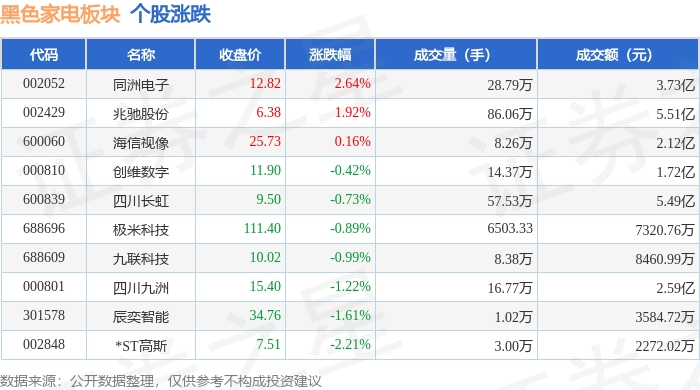
Market Overview - The black home appliance sector increased by 0.06% compared to the previous trading day, with Tongzhou Electronics leading the gains [1] - The Shanghai Composite Index closed at 3864.18, down 0.15%, while the Shenzhen Component Index closed at 12907.83, up 1.02% [1] Stock Performance - Key stocks in the black home appliance sector showed varied performance: - Tongzhou Electronics (002052) closed at 12.82, up 2.64% with a trading volume of 287,900 shares and a turnover of 373 million yuan - Non-Axis Co. (002429) closed at 6.38, up 1.92% with a trading volume of 860,600 shares and a turnover of 551 million yuan - Hisense Visual (600060) closed at 25.73, up 0.16% with a trading volume of 82,600 shares and a turnover of 21.2 million yuan - Other notable stocks included Skyworth Digital (000810) down 0.42% and Sichuan Changhong (600839) down 0.73% [1] Capital Flow - The black home appliance sector experienced a net outflow of 29.03 million yuan from institutional investors and 37.88 million yuan from speculative funds, while retail investors saw a net inflow of 66.92 million yuan [1] - Detailed capital flow for key stocks: - Tongzhou Electronics had a net inflow of 23.68 million yuan from institutional investors but a net outflow of 6.77 million yuan from speculative funds [2] - Sichuan Jiuzhou (000801) saw a net inflow of 1.89 million yuan from institutional investors and a net inflow of 2.41 million yuan from speculative funds [2] - Sichuan Changhong (600839) had a significant net outflow of 41.26 million yuan from institutional investors [2]





天风证券:新旧动能加速转换 零部件与智能割草机引领家电行业结构性增长
智通财经网· 2025-11-26 03:29
Core Viewpoint - The investment theme in the home appliance industry for 2026 is clear, focusing on seeking certainty amid uncertainty, identifying high growth in emerging categories, and seizing opportunities in a reshaped market landscape [1] Group 1: Market Performance - In the period from January to November 2025, the Shenwan home appliance industry index rose by 8%, with significant structural differentiation within the sector [2] - The home appliance components sector saw a remarkable increase of 62%, indicating a high premium on its growth logic [2] Group 2: White Goods - Domestic sales of white goods experienced a peak followed by a decline, influenced by national subsidies, with high base pressure expected in the second half of 2025 and the first half of 2026 [3] - Exports of white goods significantly slowed down from the second quarter of 2025 due to tariff uncertainties and high inventory levels after a rush to export [3] - With the expectation of U.S. Federal Reserve interest rate cuts and the overseas capacity layout of leading companies like Midea and Haier, white goods exports are anticipated to improve [3] Group 3: Black Goods - The global black goods market is undergoing a reshaping trend characterized by "Chinese brands advancing while Korean brands retreating," with companies like Hisense and TCL enhancing their market share through Mini LED technology upgrades and global capacity layouts [4] - The focus of competition is shifting towards technology, cost, and operational efficiency as the panel cycle weakens, allowing Chinese brands to capture more market space [4] Group 4: Emerging Categories - The global market for robotic vacuum cleaners is experiencing simultaneous growth in volume and price, although high price points are suppressing rapid penetration [5] - The competition in the robotic vacuum cleaner segment is expected to shift towards cost-effective products in 2026, with attention needed on the impact of subsidy reductions [5] - The smart lawn mower segment is seeing rapid penetration driven by mainstream technology routes, with Chinese brands like Ecovacs and Roborock leading in online market share [5] - The home NAS market has significant potential, with estimated sales growth capacity of about five times [5] Group 5: Investment Recommendations - Recommended stocks include major appliances such as Haier and Midea, small appliances like Roborock and Ecovacs, black goods like Hisense and TCL, and other appliances such as Shield Environment and Dechang [6]

地方政府与城投企业债务风险研究报告:成都篇
Lian He Zi Xin· 2025-11-25 11:37
1. Report Industry Investment Rating No relevant information provided. 2. Core Viewpoints of the Report - Chengdu is a key city in the national regional development strategy, with significant economic scale and fiscal strength. In 2024, its economy steadily improved, and the general public budget revenue slightly increased, but the comprehensive fiscal resources declined due to the decrease in government - funded revenue. With favorable national policies, it aims to build into an influential regional economic and technological innovation center [4]. - Chengdu conducts industrial spatial layout around the principle of "Eastward Expansion, Southward Extension, Westward Control, Northward Reconstruction, and Central Optimization". The economic and fiscal strength shows a decreasing trend from the inner - circle to the outer - circle areas. The government debt level in the main urban area is much lower than that in other districts and counties, and the city is strengthening the resolution of existing debts [4]. - Affected by the implementation of a package of debt - resolution policies, the bond issuance scale in Chengdu decreased significantly in 2025, with net outflows in bond financing. The financing structure of bond - issuing城投 enterprises is mainly bank loans and bond financing. The short - term debt repayment pressure in the near - suburban and far - suburban areas is relatively large [4]. 3. Summary According to Relevant Catalogs 3.1 Chengdu's Economic and Fiscal Strength 3.1.1 Regional Characteristics and Economic Development - Chengdu is a provincial capital, sub - provincial city, and national central city, playing a prominent role in the national regional development strategy. It has obvious locational advantages, with developed aviation transportation and rich water, mineral, and tourism resources. The population shows a continuous net inflow, and the urbanization rate has room for further improvement. In 2024, its GDP exceeded 2.30 trillion yuan, ranking third among sub - provincial cities, with a growth rate of 5.7%. The tertiary industry contributes significantly to the economy, and the city is focusing on cultivating industrial clusters such as electronic information, equipment manufacturing, and aerospace [5][7][8]. - In the future, under the guidance of national policies, Chengdu will build a new urban development pattern of "One Mountain Connecting Two Wings" and adhere to the "One - Game - of - Chess" concept of Sichuan and Chongqing to enhance its international competitiveness and regional radiation ability [11]. 3.1.2 Fiscal Strength and Debt Situation - Chengdu's fiscal strength ranks high among national sub - provincial cities, with strong stability of general public budget revenue and fiscal self - sufficiency. In 2024, the comprehensive fiscal resources declined due to the decrease in government - funded revenue. The government debt level ranked in the upper - middle position among sub - provincial cities in 2024. With large - scale future project investments, the government debt ratio may continue to rise [12][13]. 3.2 Economic and Fiscal Conditions of Each District and County in Chengdu 3.2.1 Economic Strength of Each District and County - Chengdu conducts industrial spatial layout according to the principle of "Eastward Expansion, Southward Extension, Westward Control, Northward Reconstruction, and Central Optimization" to achieve industrial differentiation and clustering. The economic scale of Chengdu High - tech Zone is far ahead, and the economic scale and urbanization rate of other districts and counties decrease layer by layer from the inner - circle to the outer - circle areas. The main urban area has obvious advantages in per - capita GDP and urbanization rate, and the far - suburban areas are relatively weak [16][22]. 3.2.2 Fiscal Strength and Debt Situation of Each District and County - Fiscal Revenue: The fiscal strength of Chengdu High - tech Zone is the strongest, and the fiscal strength of other districts and counties decreases from the main urban area to the outside. The general public budget revenue of Chengdu High - tech Zone, Chengdu Tianfu New Area, and the main urban area is relatively stable, while the comprehensive fiscal resources of the far - suburban areas rely more on superior subsidies. In 2024, the comprehensive fiscal resources of most far - suburban areas increased due to the growth of superior subsidies, while those of other areas declined to varying degrees due to the decrease in government - funded revenue [25][29]. - Debt Situation: The government debt level in the main urban area is much lower than that in other districts and counties. The government debt distribution is related to the industrial layout and development principle. In 2024, the government debt scale of each district and county generally increased. The main urban area had a significant increase in government debt mainly due to the large - scale issuance of refinancing special bonds. The city is strengthening debt management and promoting debt resolution and replacement [32][34]. 3.3 Debt - Repayment Ability of Chengdu's城投 Enterprises 3.3.1 Overview of Chengdu's城投 Enterprises - As of the end of October 2025, there were 106城投 enterprises with outstanding bonds in Chengdu, a decrease of 5 compared with the previous year. Among them, there are 9 municipal - level, 3 park - level, and 94 district - and - county - level城投 enterprises. In terms of grade distribution, there are 10 AAA - rated, 34 AA + - rated, and 57 AA - rated enterprises. Jin tang County has the most bond - issuing城投 enterprises [36]. 3.3.2 Bond Issuance of城投 Enterprises - In 2024, the number and scale of bonds issued by Chengdu's城投 enterprises decreased compared with the previous year. In 2025, from January to October, the bond issuance scale continued to decline, with a year - on - year decrease of about 28%. Most of the bond financing is used for debt rollover, and the overall bond financing shows a net outflow [39][40]. 3.3.3 Debt - Repayment Ability Analysis of Chengdu's城投 Enterprises - The financing structure of Chengdu's城投 enterprises is mainly bank loans and bond financing. Some district - and - county - level城投 enterprises have heavy debt burdens. In the next two years, the bond maturity scale of some districts and counties is relatively large, and the short - term debt - repayment ability of some areas is weak. The refinancing ability of the main urban area and near - suburban areas is significantly stronger than that of the far - suburban areas [45][49][51]. 3.3.4 Support and Guarantee Ability of Fiscal Revenue of Each District and County in Chengdu for the Debt of Bond - Issuing城投 Enterprises - Overall, the debt scale of Chengdu's城投 enterprises is large, and the ratio of "total debt of bond - issuing城投 enterprises + local government debt" to comprehensive fiscal resources in most districts and counties exceeds 500% [53].
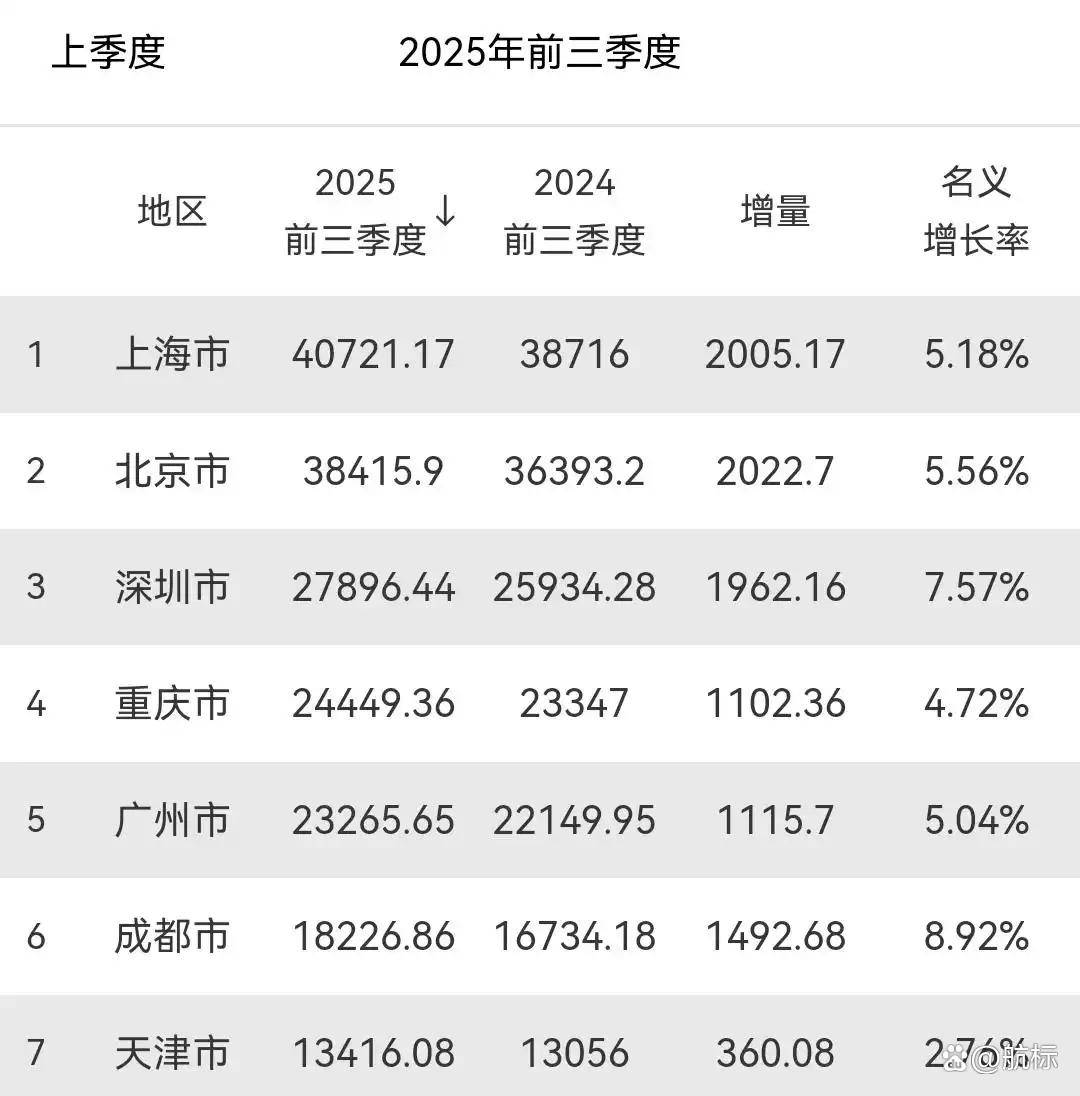
我国7个经济超强城市出炉:北京逼近上海,重庆近2.5万亿,成都增速约9%!
Sou Hu Cai Jing· 2025-11-24 21:22
| | 地区 | 2025 | 2024 | 增量 | 名义 | | --- | --- | --- | --- | --- | --- | | | | 前三季度 | 前三季度 | | 增长率 | | ー | 上海市 | 40721.17 | 38716 | 2005.17 | 5.18% | | 2 | 北京市 | 38415.9 | 36393.2 | 2022.7 | 5.56% | | 3 | 深圳市 | 27896.44 25934.28 | | 1962.16 | 7.57% | | 4 | 重庆市 | 24449.36 | 23347 | 1102.36 | 4.72% | | 5 | 广州市 | 23265.65 22149.95 | | 1115.7 | 5.04% | | 6 | 成都市 | 18226.86 16734.18 | | 1492.68 | 8.92% | | 7 | 天津市 | 13416.08 | 13056 | 360.08 | 28 向前景 | 区域经济的竞争,从来不只是数字的比拼,更是战略布局与产业动能的深度较量。2025年前三季度GDP数据近日揭晓,上海、北京、深 ...
2024年以来全国市场监管部门查办商标专利领域违法案件7.1万件
Yang Shi Wang· 2025-11-24 08:12
市场监管知识产权执法领域全国多省市协同办案模式初步形成,2024年组织查办案值超千万元大案 要案27件,查处江西某科技有限公司等侵犯"极米"注册商标专用权案等一批跨区域、多环节、长链条的 重大案件。 加强建章立制,制定发布《市场监管领域知识产权案件案由规定(试行)》等制度性文件,促进执 法规范化和效能提升。 央视网消息:据市场监管总局消息,市场监管部门坚决贯彻落实党中央、国务院决策部署,将知识 产权执法作为维护公平竞争市场秩序、激发市场活力的关键抓手,持续加大执法力度,着力构建公平、 透明、可预期的市场环境。 聚焦重点领域组织开展"守护知识产权"专项执法行动,2024年以来,全国市场监管部门共查办商标 专利领域违法案件7.1万件。 ...
2025年中国全屋智能行业财务指标分析 行业在发展过程中具备市场扩张的动力【组图】
Qian Zhan Wang· 2025-11-24 06:10
Core Insights - The Chinese whole-home smart industry is experiencing a growth trend in revenue, with a projected revenue of 211.85 billion in 2024, reflecting a growth rate of 10.6% [1] - The industry's sales gross margin shows a fluctuating trend, peaking at 34.8% in 2023 before declining to 33.5% in 2024 [2] - Inventory turnover rates are on a downward trend, decreasing from 5.14 times in 2020 to 4.64 times in 2024, attributed to changing consumer demands and rapid product updates [6] - Accounts receivable turnover rates have also shown a declining trend, from 17.53 times in 2020 to 15.23 times in 2024, indicating increasing management pressure [9] - The asset-liability ratio has fluctuated, decreasing to a low of 42.1% in 2022, then rising to 44.4% in the first half of 2025, reflecting dynamic adjustments in capital structure [11] Revenue Trends - The average revenue of representative companies in the Chinese whole-home smart industry is expected to grow significantly, reaching 211.85 billion in 2024, with a notable increase in the first half of 2025 at 116.69 billion [1] Profitability Analysis - The sales gross margin for the industry has shown volatility, starting at 33.9% in 2020, dropping to 32.2% in 2021, and then rising to 34.8% in 2023 before falling to 33.5% in 2024 [2] Inventory Management - The inventory turnover rate has decreased from 5.14 times in 2020 to 4.64 times in 2024, influenced by diverse consumer preferences and concerns over product depreciation [6] Accounts Receivable Management - The accounts receivable turnover rate has declined from 17.53 times in 2020 to 15.23 times in 2024, reflecting increased challenges in managing receivables [9] Capital Structure - The asset-liability ratio has shown a downward trend to 42.1% in 2022, followed by a rise to 44.4% in the first half of 2025, indicating changes in the industry's capital structure [11]






一站体验未来生活!全球首发节智能科技首发站亮相京东MALL
Bei Jing Ri Bao Ke Hu Duan· 2025-11-22 05:07
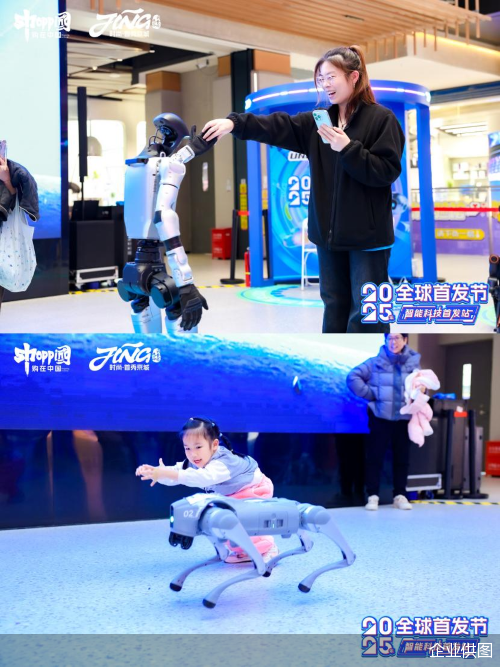
Core Insights - The event showcased the latest advancements in smart technology, including interactive robots, smart wearables, and AI learning assistants, highlighting the trend towards an intelligent lifestyle [1][3][5] Group 1: Robotics - The event featured a popular robotics experience area with various robots demonstrating motion control and voice interaction capabilities, including the Yushu G1 humanoid robot and the Yushu GO2 robotic dog [1] - The performance of the Zhongqing PM01 robot captivated the audience with a dynamic dance, showcasing the integration of technology and entertainment [1] - Consumer-grade entertainment robots, such as the Le Sen robot and the Alpha robotic dog, were designed to engage families and enhance daily life [1] Group 2: Smart Home Appliances - The smart home appliance section included innovative products like the "AI Eye" equipped kitchen appliances from Casarte and Panasonic's diamond-cut inner tub washing machine, transforming laundry experiences [3] - Other brands like XGIMI and JmGO presented their latest 4K ultra-high-definition smart home projectors, indicating a shift towards advanced home entertainment solutions [3] Group 3: Wearable Technology and Learning Aids - The smart wearables area was vibrant, showcasing various brands that offered the latest devices for health and fitness management, emphasizing the impact of technology on personal wellness [5] - In the smart learning section, AI-powered learning machines demonstrated their role in enhancing educational support through human-computer interaction [5] Group 4: Event Format and Consumer Engagement - The event utilized a "flash + permanent" model, combining pop-up market experiences with ongoing brand engagement to boost consumer activity [5] - Special promotions and discounts were offered at both the main and sub-venues to provide tangible benefits to consumers [5]

互动体验先行 主分会场联动 2025年全球首发节智能科技首发站正式启幕
Bei Jing Shang Bao· 2025-11-21 12:00
Core Insights - The event "2025 Global Launch Festival Smart Technology Launch Station" took place from November 21 to 23, showcasing a variety of smart technology products and creating an immersive consumer experience [1][14] - The event featured a combination of "display, sales, interaction, and experience," aiming to reshape consumer engagement with smart technology [1][14] Group 1: Event Overview - The event was co-hosted by the Beijing Municipal Bureau of Commerce and the Chaoyang District People's Government, held at JD MALL (Shuangjing) as the main venue and JD MALL (South Third Ring) as a secondary venue [1][11] - It aimed to stimulate market vitality by integrating pop-up and permanent retail experiences, creating a new consumption ecosystem [1][13] Group 2: Product Categories - The event showcased various categories including robots, smart home appliances, wearable devices, smart transportation, and AI learning tools, allowing consumers to experience the convenience and enjoyment brought by smart technology [3][5] - Notable products included humanoid robots from Yushu Technology, smart washing machines from Haier, and AI-enabled kitchen appliances from Casarte, highlighting innovations in home living [5][8] Group 3: Consumer Engagement - The interactive robot experience area was particularly popular, featuring performances and real-time interactions with the audience, effectively bridging the gap between advanced technology and everyday consumers [7][10] - The event utilized a seamless transition from "seeing" to "buying," enhancing consumer engagement through immersive experiences [10][14] Group 4: Promotional Strategies - The event implemented a "pop-up + permanent" model, creating a closed-loop of customer flow and consumption during the event [13] - Various promotional activities were offered, including limited-time gifts for store entry and exclusive offers for purchases, aimed at enhancing consumer participation [13]
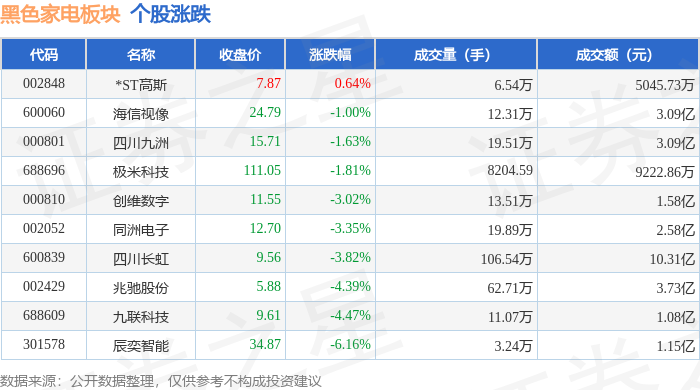
黑色家电板块11月21日跌2.93%,辰奕智能领跌,主力资金净流出3.24亿元
Zheng Xing Xing Ye Ri Bao· 2025-11-21 09:33
Market Overview - The black home appliance sector experienced a decline of 2.93% on November 21, with Chenyi Intelligent leading the drop [1] - The Shanghai Composite Index closed at 3834.89, down 2.45%, while the Shenzhen Component Index closed at 12538.07, down 3.41% [1] Stock Performance - Key stocks in the black home appliance sector showed varied performance, with *ST Gauss rising by 0.64% to a closing price of 7.87, while Chenyi Intelligent fell by 6.16% to 34.87 [1] - Other notable declines included Sichuan Changhong down 3.82% to 9.56 and Zhaochi Co. down 4.39% to 5.88 [1] Capital Flow - The black home appliance sector saw a net outflow of 324 million yuan from main funds, while retail investors contributed a net inflow of 340 million yuan [1] - The capital flow data indicates that major funds withdrew significantly from several stocks, including Sichuan Changhong and Zhaochi Co., while retail investors showed interest in stocks like *ST Gauss and Sichuan Jiuzhou [2]


极米港股IPO,能否换来新估值?
Sou Hu Cai Jing· 2025-11-21 08:27
Core Viewpoint - The trend of companies going public in Hong Kong has surged, with 286 new stock applications received by the Hong Kong Stock Exchange in the first three quarters, more than double the number from the same period last year. Among these, companies like XGIMI Technology are attempting to capitalize on the A+H listing opportunity, despite facing significant financial challenges [2][4]. Financial Performance - XGIMI Technology reported a revenue of 1.63% growth year-on-year for the first half of 2025, amounting to 1.626 billion yuan, while net profit surged over 2000% to 88.66 million yuan, largely due to government subsidies of 48.87 million yuan, which accounted for over half of the profit [5][7][8]. - The company's operating cash flow showed a significant decline, with a net cash flow of -440 million yuan, a drop of 357% year-on-year, indicating structural issues in operations [5][8]. Market Position and Valuation - Since its peak market valuation of approximately 43 billion yuan post-IPO, XGIMI's market value has plummeted by nearly 82% to about 7.825 billion yuan as of October 13, 2025, losing over 35 billion yuan in value [10][11]. - The company has seen significant shareholder reductions, with major shareholders like Baidu and others decreasing their stakes, reflecting a loss of confidence in the company's fundamentals [12][13]. International Expansion - XGIMI's international revenue reached 1.086 billion yuan in 2024, growing by 18.94% and accounting for 31.9% of total revenue, up from less than 11% three years prior. The company has expanded into markets such as Japan, Europe, and North America [14][18]. - Despite the growth in international sales, the overall sales gross margin has slightly decreased, indicating that the expansion has not significantly improved profitability [16][17]. Competitive Landscape - The domestic projection market is becoming increasingly competitive, with local brands like Xiaomi and others overtaking foreign brands in market share. This intensifying competition is putting pressure on XGIMI's market space [21]. - The overall projection market in China is experiencing a decline, with a projected decrease in sales volume and revenue for 2025, indicating a shift from growth to competition for existing market share [20][22]. Future Challenges - XGIMI faces challenges in maintaining its growth trajectory as the international expansion benefits begin to wane, and new business ventures, such as in-car projection, are still in the early stages and have not yet contributed significantly to revenue [22][23]. - The company is at a critical juncture, needing to navigate the decline in its core business while seeking new growth avenues amid a challenging market environment [22][23].