
新产业

Search documents
统筹推进科技创新产业创新和金融服务,培育发展新质生产力
Shan Xi Ri Bao· 2025-12-31 00:49
Core Viewpoint - The articles collectively emphasize the importance of high-quality development in Shaanxi province, focusing on technological innovation, industrial transformation, and financial services as key drivers for economic growth and modernization. Group 1: Economic Development Strategy - The provincial economic work conference outlines a blueprint for economic and social development in Shaanxi by 2026, emphasizing the integration of technological and industrial innovation with financial services [1] - The "14th Five-Year Plan" is highlighted as a critical period for achieving substantial progress in various sectors, including solar energy, new displays, commercial aerospace, and biomedicine [1][2] Group 2: Innovation and Talent Development - The integration of education, technology, and talent development is crucial for strengthening high-quality technological supply, with initiatives aimed at creating innovation hubs and enhancing research capabilities [3] - The focus is on collaborative innovation between universities, research institutions, and enterprises to produce original research outcomes and foster a robust talent development ecosystem [3] Group 3: Reform and Financial Support - The synergy between "three reforms" and technological financial reforms is essential for overcoming systemic barriers and energizing innovation, thereby supporting industrial upgrades and high-quality development [4] - Establishing a comprehensive service network for the transformation of technological achievements is prioritized, along with enhancing the effectiveness of technology transfer from universities and state-owned enterprises [4] Group 4: Industrial Optimization and Future Industries - The strategy includes optimizing and upgrading the industrial system to solidify the foundation of the real economy, with a focus on developing trillion-level industrial clusters in modern energy, advanced manufacturing, and strategic emerging industries [5] - Emphasis is placed on seizing opportunities in artificial intelligence and other future industries to drive digital transformation and high-end development in traditional sectors [5]

培育乡村新产业新业态要打好“四张牌”
Xin Lang Cai Jing· 2025-12-30 23:17
Core Viewpoint - The modernization of agriculture and rural areas is crucial for China's overall modernization, and cultivating new industries and business formats in rural areas is an effective way to create new economic momentum and development models [1] Group 1: Regional Characteristics - Different regions in China have significant disparities in natural resources, location, industrial foundation, and human capital, necessitating a tailored approach to rural industrial development to avoid homogenization [2] - It is essential to assess local resources and capabilities accurately, highlighting strengths and addressing weaknesses to inform future industrial development directions [2] - Strategies should be categorized based on market principles, with government playing a precise role in policy implementation, such as developing specialty agricultural clusters in resource-rich areas [2] Group 2: Technological Empowerment - Emphasizing technological innovation is key to attracting advanced production factors and fostering new industries and business formats in rural areas [3] - Strengthening agricultural technology innovation and accelerating the transformation of technological achievements into productive forces is vital for enhancing agricultural productivity [3] - The development of smart agriculture and digital services is crucial for improving rural marketing capabilities and creating a comprehensive technology-application ecosystem [3] Group 3: Cultural and Tourism Integration - Deep decoding and revitalization of rural culture can enhance the integration of culture and industry, making rural business formats more relatable and appealing [4] - Creating rural cultural IP by preserving authentic local culture and innovating through digital arts and products can attract new consumer flows [4] - Promoting multi-industry integration in rural areas, such as agriculture, culture, and tourism, can develop diverse and engaging rural tourism experiences [4] Group 4: Policy Support and Services - Optimizing the rural business environment and innovating the combination of human, capital, and land resources is essential for achieving production function upgrades [5] - Establishing a talent service system for young entrepreneurs in rural areas can attract and retain talent, fostering a new generation of rural leaders [5] - Financial services should be improved to support rural industries, including the establishment of development funds and innovative financial products tailored to local needs [5][6]
广东:深入实施提振消费专项行动 加大对重大项目和民生项目的投资力度
Zheng Quan Shi Bao Wang· 2025-12-30 11:55
人民财讯12月30日电,12月30日,中国共产党广东省第十三届委员会第八次全体会议暨省委经济工作会 议在广州召开。 会议强调,要突出抓改革、促开放,在推动粤港澳大湾区建设上迈出新步伐,发挥好主力军和火车头作 用,深化与港澳的合作,不断做深做实大湾区"一点两地"全新定位;深化改革攻坚,着力深化营商环境 改革,激发各类经营主体活力,抓好改革试点示范,充分释放改革效能;坚定不移扩大高水平开放,深 入实施"粤贸全球"计划,统筹好高质量"引进来"和高水平"走出去",稳步推进制度型开放,加强与海南 的相向而行,更好服务国家对外开放大局。要突出扩内需、优供给,在畅通经济循环上迈出新步伐,深 入实施提振消费专项行动,加大对重大项目和民生项目的投资力度,切实增强内需的主动力和稳定锚作 用;深入实施新一轮重点产业链高质量发展行动,推动传统产业焕新发展、新产业(300832)新赛道加 快培育、服务业扩能提质,加快构建以先进制造业为骨干的现代化产业体系;强化科技创新引领支撑, 纵深推进粤港澳大湾区国际科技创新中心、综合性国家科学中心、高水平人才高地建设,推动科技创新 和产业创新深度融合、互促双强。 ...
我国数据科技创新发展有了“指导书”
Zhong Guo Fa Zhan Wang· 2025-12-30 03:59
Core Viewpoint - The National Bureau of Statistics of China has released the "Implementation Opinions on Strengthening Data Science and Technology Innovation," aimed at promoting deep integration with industrial innovation and enhancing the data resource system to support the construction of a digital China [1] Group 1: Goals and Objectives - By 2027, a number of leading and supporting data science and technology innovation platforms are to be established, forming an efficient innovation mechanism that integrates enterprises, academia, research, and application [1] - A preliminary data-driven industrial innovation system is expected to be established, with breakthroughs in key technologies and equipment related to data supply, circulation, utilization, and security [1] - By 2030, key technologies in the data field are anticipated to reach international leading levels, with an overall leap in data science and technology innovation and industrial ecosystem [1] Group 2: Measures for Implementation - The "Implementation Opinions" focus on three main areas: strengthening technological breakthroughs and high-level applications, cultivating the data science and technology innovation industry ecosystem, and solidifying the foundational support for data science and technology innovation [1] - A total of 12 measures have been deployed to achieve the aforementioned goals [1]
专家热议:人工智能如何赋能银行业提质增效
Zhong Guo Jing Ji Wang· 2025-12-30 03:27
金融界总编辑金明正表示,中国银行业发展新动能正持续积聚,行业摒弃规模情结转向提质增效,以反 内卷、优服务、错位发展为共识,数智化转型向纵深推进,人工智能、大模型等新技术重塑业务流程与 服务模式,为破解融资难、融资贵提供科技支撑。 此外,华夏银行信息科技管理部总经理韩波在会上分享了依托 AI 打造全链路协同体系的实践,实现服 务效率与客户体验双提升;光大银行智能运营中心副总经理黄广明介绍了该行推动 AI 大模型应用的成 效,聚焦流程自动化增效;中信百信银行大数据部总经理周北春详解了AI技术在银行智能风控领域应 用的突破。(经济日报记者 马春阳) 中国社科院大学教授、国务院原副秘书长江小涓表示,"十五五" 时期我国科技创新产业(300832)将 迎来快速发展,产业创新将呈现蓬勃态势,创新项目有望以 "涌现式" 形态出现。金融业须加快市场 化、数智化、国际化转型步伐,抓住我国科技创新带来的新机遇,拓展自身的发展空间。 与会人士普遍认为,人工智能是赋能金融提质增效的关键变量,将成为破解金融行业效率瓶颈、激活创 新动能的重要抓手。清华大学经济管理学院教授、中国金融研究中心主任陆瑶在会上阐释了AI与大数 据对金融机构风险 ...
陕西将强化统筹落实经济工作重点任务
Zhong Guo Jing Ji Wang· 2025-12-30 02:34
2026年陕西经济工作头绪多,会议指出要纲举目张,抓好重点任务落实。一是统筹推进扩投资和促消 费,用足用好"两重""两新"政策,滚动推进项目谋划储备、组织实施、投产达效,着力激发民间投资活 力,精心开展提振消费专项行动和服务消费提质惠民行动,扩大优质商品和服务供给,更好挖掘内需拉 动经济增长的潜能。二是统筹推进科技创新产业(300832)创新和金融服务,以西安区域科技创新中心 建设和教育科技人才一体发展强化高质量科技供给,以"三项改革"和科技金融改革协同促进科技创新和 产业创新深度融合,以"秦创原"产业创新聚集区建设和链长制推动产业体系优化升级,更好培育发展新 质生产力。三是统筹推进深层次改革和高水平开放,落实全国统一大市场建设"五统一、一开放"要求, 深化开发区管理制度、国资国企、要素市场化配置等关键性改革,优化外事外贸外资外经外宣联动机 制,提升自由贸易试验区制度型开放水平,加强横向经济技术协作,推动构建中欧班列经济圈,更好释 放发展的动力活力。此外,还要统筹推进城乡融合和区域联动,统筹推进降碳减污扩绿增长,统筹推进 民生保障和社会建设,统筹推进问题整改和风险出清,推动各项部署安排落地见效。 2026年是 ...
“北方第二城”或将易主,北方经济格局正经历深层演变?
Xin Jing Bao· 2025-12-30 02:00
Core Viewpoint - The competition between Qingdao and Tianjin for the title of "Northern Second City" is intensifying, with Qingdao poised to surpass Tianjin in GDP by the end of 2025, reflecting deeper changes in the economic landscape of Northern China [1][3]. Economic Data Comparison - In the first three quarters of 2025, Qingdao's GDP reached 1.337347 trillion yuan, growing by 5.4%, while Tianjin's GDP was 1.341608 trillion yuan, with a growth of 4.7%, resulting in a narrow gap of 42.61 billion yuan [1]. - Qingdao's economic increment for the first three quarters was 97.437 billion yuan, compared to Tianjin's 74.221 billion yuan, highlighting a key factor in Qingdao's rapid catch-up [2]. Historical Context - Qingdao became the "Northern Third City" in 2000 by surpassing Dalian and Shenyang, but faced significant gaps with Tianjin in 2015, where Tianjin's GDP was 1.83 times that of Qingdao [2]. - The gap between Qingdao and Tianjin narrowed to approximately 1.3 trillion yuan by 2024, indicating Qingdao's sustained economic growth [2]. Industrial Development Paths - Qingdao's growth is driven by the integration of emerging industries and traditional strengths, with a 7.7% increase in industrial output, particularly in high-end manufacturing sectors like new energy vehicles and optical electronics [4]. - Tianjin, while facing challenges in industrial transformation, maintains a strong industrial base and is focusing on developing new industries such as biomedicine and vehicle networking [5]. Strategic Planning - Both cities have outlined their "14th Five-Year" plans, with Qingdao aiming for a GDP of over 2 trillion yuan and emphasizing its role as a leader in the Shandong Peninsula urban cluster [7]. - Tianjin's strategy focuses on high-quality development and enhancing its role within the Beijing-Tianjin-Hebei region [7]. Regional Economic Dynamics - The competition between Qingdao and Tianjin is fostering a "salmon effect," encouraging both cities to optimize their industrial structures and enhance urban capabilities [8]. - The close economic performance of these cities reflects an increase in internal economic vitality in Northern China and a trend towards more balanced regional development [8].
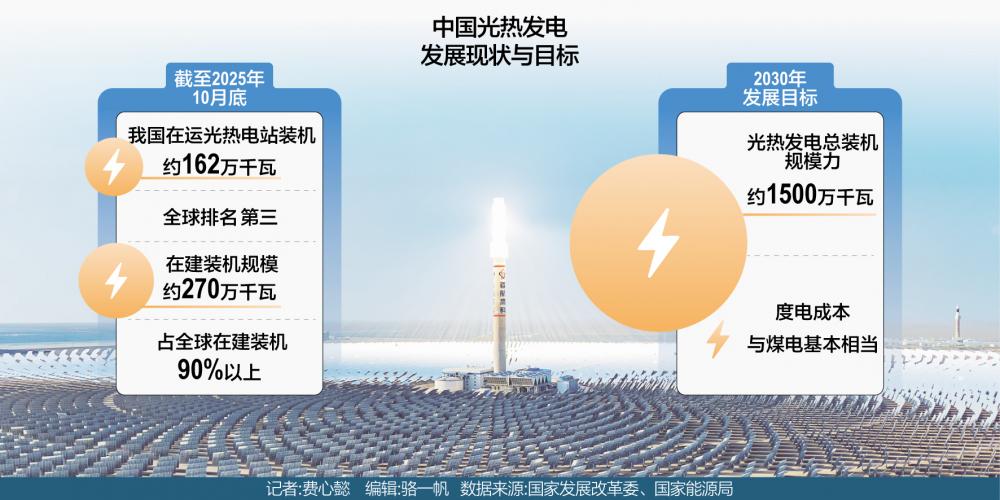
剑指1500万千瓦装机目标 光热发电要与煤电度电成本看齐
2 1 Shi Ji Jing Ji Bao Dao· 2025-12-29 23:06
Core Viewpoint - The National Development and Reform Commission and the National Energy Administration have issued guidelines aiming for a significant expansion of solar thermal power capacity in China, targeting 15 million kilowatts by 2030, with costs comparable to coal power [1][2]. Group 1: Development Goals and Challenges - The overall goal for solar thermal power is to reach a total installed capacity of approximately 15 million kilowatts by 2030, with electricity costs on par with coal power [1][2]. - Current challenges include high initial investment, weak market competitiveness, underutilization of system support value, and the need for technological advancements [2][5]. - The cost of electricity from solar thermal power has decreased significantly, with construction costs dropping from approximately 300,000 yuan per kilowatt to 150,000 yuan, and electricity costs around 0.6 yuan per kilowatt-hour [5][6]. Group 2: Policy Measures and Support - Five policy measures have been proposed to address the bottlenecks in solar thermal power development: strengthening planning guidance, enhancing market cultivation, supporting system regulation, encouraging technological innovation, and improving policy guarantees [2][6]. - The government aims to create a fair and orderly market environment to convert the system value of solar thermal power into economic benefits [11]. Group 3: Technological and Industrial Development - The focus will be on advancing technology through the construction of larger solar thermal power plants, enhancing efficiency, and reducing costs through economies of scale [6][7]. - The establishment of solar thermal industrial parks or clusters is encouraged to promote deep cooperation between upstream and downstream sectors, achieving cost reduction and efficiency [7][8]. Group 4: Integration into the Energy System - Solar thermal power is recognized for its dual role as a peak-shaving power source and long-duration energy storage, which can stabilize the output fluctuations of wind and solar energy [1][9]. - The guidelines suggest three application scenarios for solar thermal power: construction in large energy bases, support for load centers, and the development of integrated systems that enhance supply security [9][10].

重要活动 纵论知识产权保护与转化
Zhong Guo Ji Jin Bao· 2025-12-29 09:29
Group 1 - The event "Shenzhen Stock Exchange · Innovation Forum" focused on the development and challenges in the field of intellectual property, emphasizing its role as a core institutional arrangement for protecting and incentivizing innovation [1] - China is transitioning from being a major importer of intellectual property to a creator, aiming to improve the quality of intellectual property during the 14th Five-Year Plan period [1] - Experts from various sectors, including government, research institutions, listed companies, and investment agencies, gathered to share insights on intellectual property protection and transformation [1] Group 2 - Current challenges faced by listed companies in intellectual property include a large number of patents with a scarcity of high-quality patents that can form barriers, potential disputes due to lack of due diligence in mergers and acquisitions, and neglecting open innovation and corporate venture capital (CVC) [3] - Proposed strategic shifts include integrating patent navigation and concept validation in R&D, involving intellectual property departments in strategic decision-making, and utilizing CVC to invest in early-stage hard technology projects [3] Group 3 - The significance of patents as a "moat" in the battery sector was highlighted, with companies using intellectual property risk management to secure supply chains and mitigate collaboration risks [4] - Companies emphasized the importance of a "prevention + warning" mechanism to address potential risks associated with talent mobility and data governance [4] Group 4 - The discussion also focused on bridging the gap between patents and industrial application, with a call for standardized mechanisms to enhance communication efficiency and reduce costs [6][7] - The National Intellectual Property Administration is promoting initiatives such as deepening patent open licensing trials, building a financial ecosystem for intellectual property, and enhancing data empowerment for intelligent matching of supply and demand [7] Group 5 - The Shenzhen Stock Exchange aims to support the integration of technology, industry, and capital, contributing to the construction of a strong intellectual property nation [8]
数字经济赋能下新业态劳动者发展逻辑与保障路径
Feng Huang Wang Cai Jing· 2025-12-29 08:06
Core Viewpoint - The breakthrough development of digital technology is reshaping the allocation of production factors, leading to the emergence of new employment models centered around the platform economy, which has become a significant growth driver in China's job market [1] Group 1: Current Development Status of New Employment Forms - The deep integration of digital technology and the real economy has given rise to diversified new employment forms characterized by "platform empowerment, flexible autonomy, and multi-dimensional value" [2] - The explosive growth of the platform economy has provided vast opportunities for new employment, with the value added of new industries and business models expected to account for 18% of GDP by 2024, creating 15 million jobs in the live-streaming e-commerce sector alone [3] - New employment forms have penetrated various sectors, providing flexible employment channels for traditional industry workers, college graduates, and migrant workers, thus becoming a crucial support for regional employment [3] Group 2: Challenges Faced by New Employment Workers - Despite rapid development, the "de-employer" characteristic of digital technology conflicts with traditional labor protection systems, leading to multiple challenges in rights protection, career development, and social recognition for workers [6] - The ambiguity of labor relations in new employment forms has resulted in a gray area for rights protection, with over 80,000 civil cases related to new employment forms concluded in courts nationwide in 2024 [7] - Workers face a "ceiling" in career development, with over 80% of position service workers lacking systematic training, making it difficult to transition from "manual" to "skilled" roles [10] Group 3: Exploration of Protection Paths for New Employment Workers - To address the development challenges faced by new employment workers, a systematic solution is needed, focusing on "institutional adaptation, ethical technology, and upgraded services" [11] - A clear definition of labor relations is essential for rights protection, requiring detailed standards for identifying different employment scenarios to close institutional loopholes [12] - Platforms should shift from "efficiency-first" to "human-machine collaboration," establishing transparency in algorithms and enhancing corporate responsibility to create a win-win mechanism for both business development and worker protection [13] - A supportive service network should be established to meet the diverse needs of new employment workers, enhancing social recognition and breaking down occupational biases [14]