
火山引擎

Search documents
豆包大模型1.6-vision正式发布
Mei Ri Jing Ji Xin Wen· 2025-09-30 08:06
每经AI快讯,火山引擎官微30日宣布,正式发布豆包大模型1.6-vision。据介绍,豆包大模型1.6-vision 是豆包大模型家族首个具备工具调用能力的视觉深度思考模型,拥有更强的通用多模态理解和推理能 力,并支持Responses API。 ...
阿里云是AI 时代的“安卓” 谁是 AI 时代的“苹果”
Sou Hu Cai Jing· 2025-09-30 06:39
Core Viewpoint - Alibaba Cloud aims to position itself as the "Android platform" in the AI and cloud industry, seeking to create a strong ecosystem to gain market influence and compete effectively with other tech giants [1][10][23] Group 1: Industry Positioning - The term "Android" is used to describe Alibaba's strategy, emphasizing its open-source approach and the need for a robust ecosystem to attract businesses [11][18] - The competition in the AI and cloud market is likened to a battle between "Android" and "Apple," with Alibaba Cloud representing the former and Volcano Engine potentially representing the latter [23][24] - The AI and cloud market is expected to evolve into a two-polar or even a single-polar structure, with Nvidia currently holding a dominant position [7][9][10] Group 2: Market Dynamics - The AI and cloud industry is experiencing significant growth, with a reported 400% increase in model invocation in the first half of 2025 compared to the entire year of 2024 [17] - Alibaba Cloud holds a 27% market share in China's public cloud model invocation, ranking second behind Volcano Engine, which has a 49.2% share [17] - The industry's growth is driven by the increasing clarity of growth logic centered around AI and cloud technologies, making it a critical area for investment [6][7] Group 3: Competitive Strategies - Alibaba's open-source strategy is seen as a key factor in attracting customers, similar to how Google leveraged its services to promote Android [11][12] - Volcano Engine adopts a different approach by focusing on application-level openness while keeping its underlying technology closed, which is compared to Apple's strategy [18][19] - The competition between Alibaba and Volcano Engine highlights different market strategies, with Alibaba leveraging its established customer base and Volcano Engine focusing on low-cost, high-volume token sales [20][21][22]


AI 时代,阿里云想当“安卓” ,那谁是“苹果”?
3 6 Ke· 2025-09-30 00:54
Core Viewpoint - Alibaba Cloud aims to position itself as the "Android platform" in the AI and cloud industry, seeking to create a strong ecosystem to gain market influence and compete effectively against other major players [1][9][12]. Group 1: Industry Positioning - The term "Android" is used to describe a platform that is open and accessible, which aligns with Alibaba's strategy of promoting open-source solutions to lower barriers for developers [10][18]. - The competition in the AI and cloud market is increasingly seen as a battle between major players, with Alibaba and its cloud services being positioned as a key contender [6][9][12]. - The market is evolving towards a potential two-polar structure, with Alibaba and Nvidia being significant players, indicating a shift from a multi-polar to a more centralized competitive landscape [6][8][12]. Group 2: Market Dynamics - The AI and cloud market is experiencing rapid growth, with IDC reporting a significant increase in the usage of large models, indicating a robust demand for AI services [17]. - The competitive landscape is characterized by a focus on building alliances and partnerships, as seen with Nvidia's collaboration with OpenAI and Oracle, which reflects a strategic move to enhance market positioning [8][9]. - The growth of AI is expected to create substantial opportunities in the coming decades, with a clear focus on AI and cloud as the core drivers of this growth [5][6]. Group 3: Competitive Strategies - Alibaba's strategy includes leveraging its existing market advantages and a strong open-source approach to attract businesses that need to innovate quickly [10][18]. - In contrast, Volcano Engine adopts a more closed approach at the foundational level while providing an open application layer, which is reminiscent of Apple's strategy of offering user-friendly products [20][21]. - The pricing strategy of Volcano Engine, which focuses on low-cost token sales, is aimed at increasing market penetration and attracting a broader user base [22][23].
具身智能 创造未来丨2025智能机器人与公共安全创新发展论坛在京成功举办
机器人圈· 2025-09-29 06:47
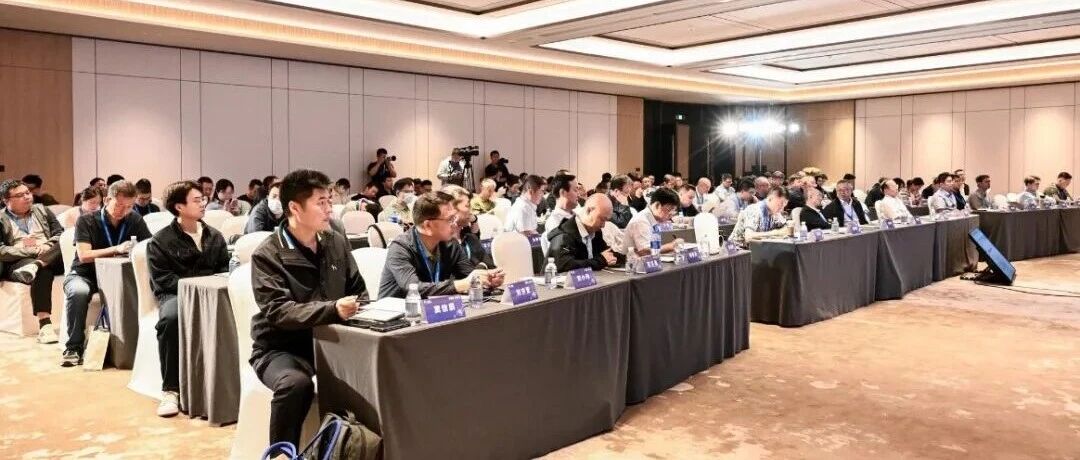
Core Viewpoint - The forum focused on the integration of intelligent robots and public safety, emphasizing the importance of technological advancements and practical applications in this field [1][10]. Group 1: Forum Overview - The 2025 Intelligent Robots and Public Safety Innovation Development Forum was held in Beijing on September 26, organized by the China Security and Prevention Products Industry Association [1]. - The forum gathered experts from government departments, industry associations, research institutions, and intelligent robot companies to discuss trends and breakthroughs in the integration of robotics and public safety [1][10]. Group 2: Key Speakers and Contributions - Keynote speeches were delivered by Liu Xiaojing, Vice Chairman of the China Security Association, and Liu Mingfang, former Deputy Director of the Ministry of Public Security's Science and Technology Information Committee, highlighting the strategic direction for integrating robotics with public safety [6][8]. - Various experts presented reports on the current state and future trends of intelligent robots, including the evolution of police robots and the impact of 5G technology on security applications [12][14][33]. Group 3: Technological Insights - The report by Dong Kai from the China Academy of Information and Communications Technology indicated that China’s robotics industry is now among the world's top tiers, with 2025 expected to be a pivotal year for intelligent robots transitioning from labs to market [12]. - Li Jian from the Ministry of Public Security emphasized the shift of police robots towards a collaborative intelligent system, integrating AI and 5G technology to enhance operational efficiency [14]. Group 4: Practical Applications - The application of intelligent robots in specific scenarios, such as the automatic inspection robots at East Jiang Port, was discussed, showcasing their role in enhancing national security and efficiency [17]. - Reports highlighted the need for advanced infrastructure and robust algorithms to support AI applications in the security industry, aiming for a seamless integration from model development to practical application [18][28]. Group 5: Future Directions - The forum concluded with a vision for a more intelligent, safe, and efficient human-machine collaborative governance model, driven by the deep integration of AI and robotics [33].
MaaS将主导公有云市场 最后谁将争夺市场第一?
Zhong Guo Xin Wen Wang· 2025-09-28 11:41
Core Insights - The public cloud market in China is increasingly competitive, with a focus on token usage and AI capabilities rather than just market share [1][2] - The IDC report indicates that by mid-2025, the token usage in China's public cloud will reach 536.7 trillion, with the Volcano Engine's MaaS platform experiencing a 3.98-fold increase in usage and capturing 49.2% market share [1] - Omdia's report forecasts that the AI cloud market in China will reach 22.3 billion yuan by mid-2025, with Volcano Engine holding a 14.8% share [1] Group 1 - The Volcano Engine's MaaS platform has seen significant growth, with a market share increase from 46.4% in 2024 to 49.2% in the first half of 2025 [1] - The emphasis on token usage reflects a shift in how cloud service providers are evaluated, with customers prioritizing actual service experience over traditional metrics [2] - The "flywheel effect" of increased token usage leads to faster model iteration and improved user experience, solidifying Volcano Engine's competitive advantage [2][3] Group 2 - The national data bureau reported that as of June, over 400PB of high-quality datasets have been built in China, with daily token consumption exceeding 30 trillion, marking a 300-fold increase in 18 months [3] - Performance metrics, such as response time and availability, show that the Volcano Engine's MaaS platform outperforms competitors, particularly with the DeepSeek model [3] - The ongoing market restructuring driven by AI capabilities is expected to enhance technological progress and service upgrades in the cloud industry [3]
中国AI云市场,究竟谁是“第一”?
3 6 Ke· 2025-09-28 03:32
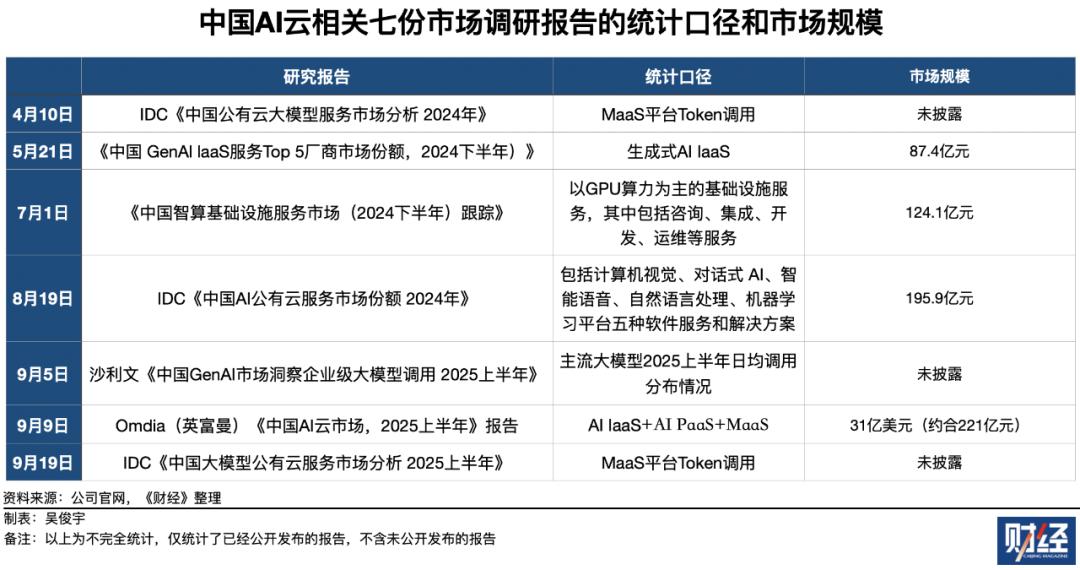
Core Insights - The competition for dominance in China's "AI cloud" market is intensifying as companies like Alibaba Cloud, ByteDance's Volcano Engine, and Baidu Smart Cloud vie for market share [1][5] - The definition and scope of "AI cloud" remain ambiguous, leading to varying statistics and claims from different cloud service providers [2][6] Market Research Reports - Seven market research reports on the AI cloud market have been published by IDC, Omdia, and Sullivan, with IDC providing the most comprehensive analysis [3][4] - Omdia estimates the total revenue of China's AI cloud market to be $3.1 billion (approximately 221 billion yuan) for the first half of 2025, with Alibaba Cloud holding a 35.8% market share [7] Company Rankings - Alibaba Cloud ranks first in five of the seven reports, while Volcano Engine leads in the rapidly growing MaaS model service market [5][14] - Baidu Smart Cloud and Alibaba Cloud are tied for first place in the AI public cloud services market, which has evolved from the small model era prior to 2022 [15] Market Growth and Projections - Alibaba Cloud's revenue for the first half of 2025 is projected to be 63.5 billion yuan, reflecting a year-on-year growth of 21.8% [28] - Volcano Engine aims for revenue exceeding 20 billion yuan in 2025, with a long-term goal of surpassing 100 billion yuan by 2030 [29] Token Market Dynamics - The token calling market is currently small but is expected to grow rapidly, with daily token consumption in China increasing from 100 billion to over 30 trillion in just over a year [30][31] - The revenue from token calls is projected to grow exponentially, making it a critical area for competition among cloud service providers [32][33]

云栖行至2025:阿里云不只是“云”
Bei Jing Shang Bao· 2025-09-24 16:37
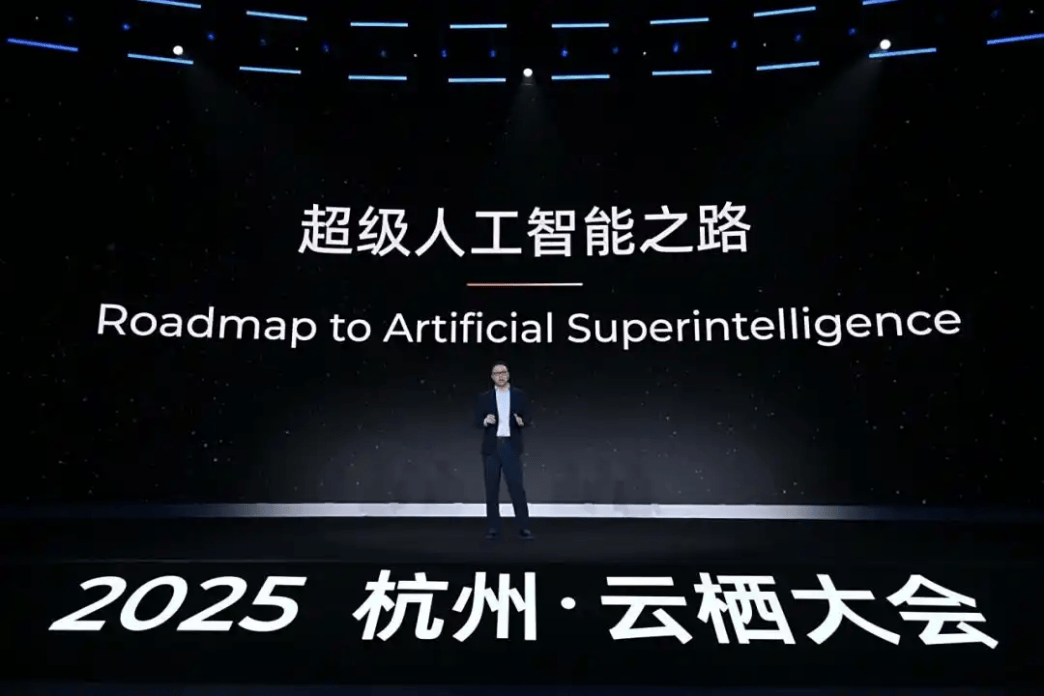
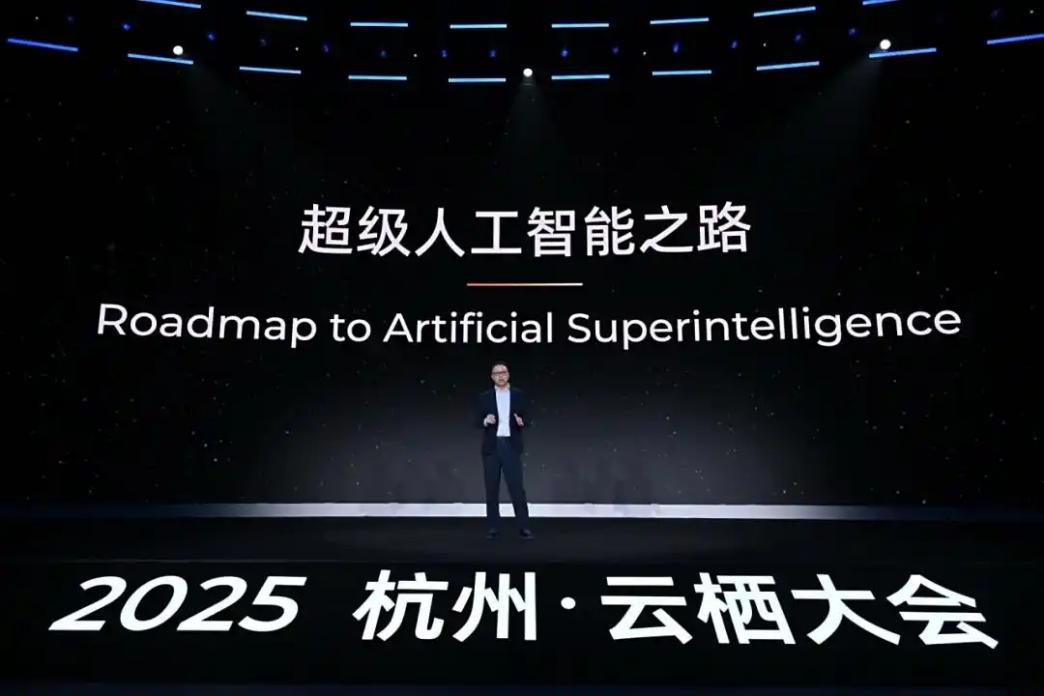
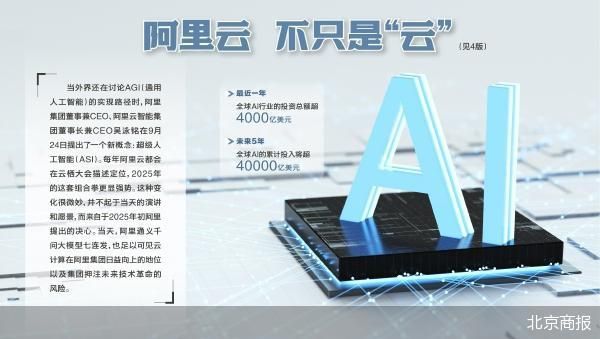
Core Viewpoint - Alibaba Group's CEO Wu Yongming introduced the concept of Super Artificial Intelligence (ASI) during the Cloud Summit, emphasizing a significant investment in AI infrastructure and a vision that extends beyond General Artificial Intelligence (AGI) [1][3]. Investment and Infrastructure - Alibaba plans to invest 380 billion yuan (approximately 53.5 billion USD) over three years to build AI infrastructure, indicating a strong commitment to advancing AI technology [3][4]. - The global AI industry has seen over 400 billion USD in investments in the past year, with projections of cumulative investments exceeding 4 trillion USD over the next five years [3]. AI Development Stages - Wu outlined a three-stage roadmap to achieve ASI: intelligent emergence, autonomous action, and self-iteration, currently positioned in the second stage where AI assists humans [3][4]. - The company aims to create an AI ecosystem akin to Android, focusing on open-source development and building a next-generation AI cloud for global smart computing [4]. Market Position and Competition - Alibaba Cloud holds the leading market share in China and is recognized as one of the few companies capable of vertical integration in AI infrastructure and cloud computing [6][8]. - The company emphasizes its international strategy, aiming to compete globally while downplaying domestic rivals [6][7]. Technological Advancements - Alibaba Cloud released seven new AI models, including the Qwen3-Max, which boasts a pre-training data volume of 36 trillion tokens and over a trillion parameters, showcasing advanced coding and tool-calling capabilities [8][9]. - The performance of these models positions Alibaba among the top tier globally, with significant scores in various AI benchmarks [8][9]. Future Outlook - The industry is experiencing rapid investment and innovation, with no visible limits to the capabilities of AI models, indicating a competitive landscape where Alibaba is positioned to benefit significantly from AI advancements [9].
不止3800亿元,阿里计划追加AI基建投入,股价涨超9%
Nan Fang Du Shi Bao· 2025-09-24 11:13
云栖大会上,吴泳铭预测,未来五年全球AI累计投入金额将超过4万亿美元,"这是人类历史上最大的算 力和研发投入"。对比2022年生成式AI元年,2032年阿里云全球数据中心的能耗规模将提升10倍。 吴泳铭说,阿里云是少数能做到软硬件垂直整合的AI云计算平台。在硬件和网络层面,阿里云自研核 心存储系统、网络架构、计算芯片等;阿里云同时拥有业内领先的通义模型,从而实现基础设施架构设 计与模型架构设计的协同创新。 云栖大会上,阿里云智能集团首席技术官周靖人发布了7款通义大模型,以及全新升级的阿里云多款AI Infra产品和服务。 "行业对AI基础设施的需求远超我们的预期。"9月24日的2025云栖大会上,阿里巴巴集团董事兼首席执 行官吴泳铭透露,阿里正在推进3800亿元的AI基础设施建设,并计划追加更大的投入。 受此消息影响,截至9月24日港股收盘,阿里巴巴(09988.HK)股价大涨9.16%,报174.0港元/股,创下 近四年来新高。 此前2月,吴泳铭曾宣布,阿里将在未来三年投入超过3800亿元,用于建设云和AI硬件基础设施,投资 总额超过去十年的总和。 AI基建(AI Infra)之于AI,如同电⽹之于电⼒。云 ...

行业观察 | Token市场占据半壁江山,火山引擎在打什么牌?
Sou Hu Cai Jing· 2025-09-22 15:16
Core Insights - The article emphasizes that the volume of Tokens called is a more accurate reflection of the actual load of large models in the AI cloud market than the scale of GPU computing power [2][6][11] - Volcano Engine has emerged as a significant player in the Chinese AI cloud market, with a revenue target exceeding 20 billion yuan for 2025, following a revenue of over 11 billion yuan in 2024 [2][3][35] - The focus on Token consumption indicates a shift in the cloud computing industry from selling computing power to selling Tokens, which could provide a competitive advantage for Volcano Engine [6][20][36] Market Position - According to IDC reports, Volcano Engine holds a 49.2% market share in the large model public cloud service market for the first half of 2025, up from 46.4% in 2024 [3][6] - In the AI infrastructure market, Volcano Engine ranks third with a 9% market share, and in the generative AI infrastructure market, it ranks second with a 14.2% market share [3] Token Consumption Growth - The Token consumption in China is experiencing rapid growth, with a reported increase of nearly 10 times from June to December 2024 [7][12] - The total Token consumption in the Chinese large model public cloud service market reached 537 trillion times in the first half of 2025 [7] - Volcano Engine's Ark platform saw a year-on-year increase of 3.98 times in Token consumption [7] Strategic Focus - Volcano Engine prioritizes Token consumption over revenue from GPU computing, viewing it as a better indicator of AI industry health and customer engagement [6][9][10] - The company aims to create a virtuous cycle where stronger model capabilities lead to increased AI applications and higher Token consumption [10][21] Future Outlook - Predictions suggest that by the end of 2027, the daily Token consumption of the Doubao model could exceed 100 trillion, marking a growth of at least 100 times from 2024 [18] - The shift from "selling computing power" to "selling Tokens" is seen as a significant evolution in cloud computing technology and business models [20][36] Competitive Landscape - Volcano Engine's strategy mirrors that of Google, which has successfully integrated its AI models with consumer applications to enhance Token consumption and reduce computing costs [22][35] - The company is positioned to leverage its extensive consumer application ecosystem, including Douyin and Doubao, to further increase its market share in Token consumption [34][35]
火山引擎推出智能营销Agent!让AI驱动营销与增长
Cai Fu Zai Xian· 2025-09-22 11:22
Core Insights - The core focus of the news is on the advancements and practical outcomes of the Data Agent in the field of intelligent marketing, highlighting its ability to simplify operations and enhance decision-making through natural language interaction [1][2]. Group 1: Product Features and Benefits - Data Agent significantly reduces the technical usage barrier by allowing users to generate detailed data analysis reports or obtain relevant knowledge with a simple sentence input [1]. - The implementation of Data Agent has drastically shortened the onboarding period for new customer service employees from one month to seven days, achieving service levels comparable to silver or gold standard representatives [1]. - The system enhances decision-making efficiency by automatically generating visual reports and analytical conclusions based on natural language descriptions of user needs [2]. Group 2: Data Integration and User Profiling - Data Agent's core data foundation is built on three pillars: customer data platform (VeCDP) managing attribute data, internal business knowledge data, and third-party public data from social media and e-commerce platforms [2]. - The system can create comprehensive customer profiles that surpass traditional simple tagging capabilities by integrating structured and unstructured data to accurately identify consumer behavior characteristics [2]. Group 3: Application Scenarios and Performance Metrics - Data Agent demonstrates four key value scenarios, including rapid analysis of vast data sets to generate deep insight reports and reducing average communication rounds from seven to two or three, achieving a 200% efficiency improvement [2]. - The "one customer, one strategy" engine enhances user targeting, resulting in over 30% increase in click-through rates and an 80% improvement in return on investment (ROI) [2]. Group 4: Technical Architecture and Future Development - The technical architecture of Data Agent is designed to decouple from large model bases, ensuring the system benefits from large models, small models, and engineering applications [3]. - This design allows Data Agent to evolve with advancements in large model technology while maintaining business safety and accuracy [3]. - Future developments aim to position Data Agent as a "strategic advisor" capable of long-term trend forecasting and complex scenario simulations [3]. Group 5: Industry Impact - Data Agent's intelligent marketing capabilities have been successfully implemented across various industries, including automotive and financial advisory sectors, enhancing user interaction and market analysis efficiency [3]. - The transition from broad marketing strategies to refined individual operations is being driven by Data Agent's data integration and intelligent mining capabilities [3].