
磐久128超节点AI服务器

Search documents
资产配置周报告|大金融发力,反攻节点出现!
Xin Lang Cai Jing· 2025-12-08 12:27
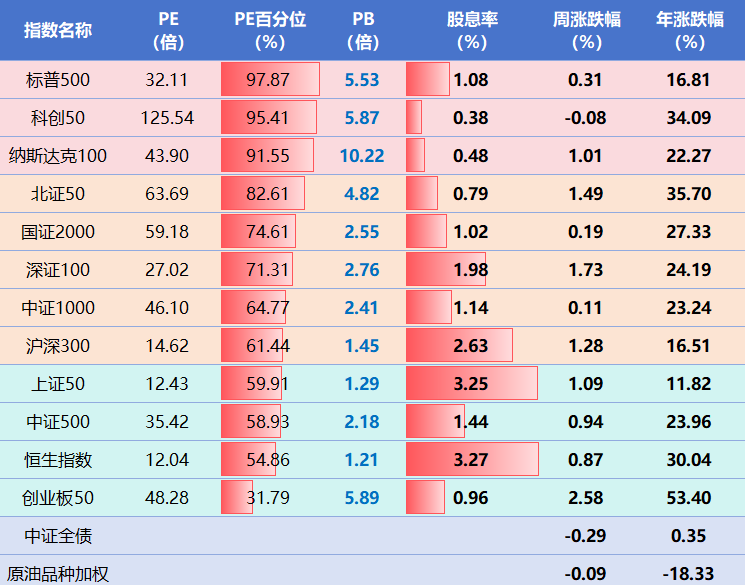
Market Overview - The overall market sentiment is cautiously optimistic, with a focus on the financial sector showing signs of recovery, particularly with major indices rebounding above key levels [1][39] - The current price-to-earnings (PE) ratio for the market is 22.92 times, with a significant stock-bond yield spread of 2.52%, indicating favorable conditions for equity investments [4][42] Sector Performance - The top-performing sectors last week included non-ferrous metals, oil and petrochemicals, and national defense and military industry, while media entertainment, household goods, and real estate saw declines [14][52] - The aerospace and Fujian sectors demonstrated sustained performance, while other sectors experienced rotation, indicating increased operational difficulty in the short term [2][40] Investment Strategies - Short-term strategies should focus on sectors highlighted in the 14th Five-Year Plan, such as controllable nuclear fusion, quantum technology, and commercial aerospace, with a recommendation to maintain trading discipline [2][40] - The long-term outlook remains bullish, with the expectation of a gradual recovery in the market, particularly in sectors with structural opportunities like consumer electronics and AI [9][47] Bond Market Insights - The bond market is currently experiencing low volatility, with the 10-year government bond yield at 1.85%, indicating a stable interest rate environment [11][49] - The yield curve is expected to remain stable unless influenced by significant policy changes or international events [11][49] Emerging Industry Opportunities - The marine economy is gaining attention, with government reports emphasizing the development of deep-sea technology, which is expected to drive growth in related sectors [16][19] - Solid-state batteries are projected to see significant advancements, with energy density potentially exceeding 500Wh/kg, positioning them as a key technology in the future of energy storage [23][28] - The humanoid robotics sector is poised for growth, with increasing demand expected to exceed 100 million units domestically, creating substantial market opportunities for related components [32][35]

云 +AI 战略落地, 一幅全球化创新图景由此展开
Tai Mei Ti A P P· 2025-12-02 08:21
Core Viewpoint - The integration of cloud and AI technologies is reshaping global industrial structures and optimizing resource allocation, with Chinese companies increasingly becoming leaders in this space [2][3]. Group 1: Global Expansion and Infrastructure - Alibaba Cloud is accelerating its international investments, with plans to establish new regional nodes in Brazil, France, and the Netherlands, and expand data centers in Mexico, Japan, South Korea, Malaysia, and Dubai [4]. - Currently, Alibaba Cloud operates in 29 regions with 91 availability zones and over 3,200 edge nodes globally [4]. - The demand for AI is driving cloud growth, with Alibaba's smart cloud revenue reaching 33.4 billion yuan, a 26% year-on-year increase, and overseas market growth outpacing domestic figures [5]. Group 2: AI and Cloud Strategy - Alibaba Cloud's AI computing power has increased over five times in the past year, introducing the new generation of AI servers that support multiple AI chips [6]. - The new high-performance network architecture supports massive data transmission needs, with storage and container services optimized for AI applications [7][8]. - By 2028, Alibaba Cloud plans to increase its global capacity by 14 times, with significant investments in overseas infrastructure [8]. Group 3: Partnerships and Collaborations - Major global companies, including BMW, HP, and Standard Chartered, are partnering with Alibaba Cloud to enhance their operations through AI and cloud technologies [9][10]. - Alibaba Cloud has formed a strategic partnership with SAP to integrate enterprise software with its cloud infrastructure, focusing initially on the Chinese market [10]. - The collaboration with the World Swimming Federation marks a significant step in providing cloud services for international sports events [11]. Group 4: AI-Driven Globalization - The demand for AI-driven solutions is prompting Chinese companies to expand internationally, with Alibaba Cloud supporting over 250,000 enterprises across various sectors [14][16]. - Companies like Meitu and Midea have successfully leveraged Alibaba Cloud's capabilities to enhance their global operations and digital transformation [15]. - Trust and compliance are critical factors for Chinese companies entering international markets, with Alibaba Cloud providing robust security and compliance frameworks [16]. Group 5: Future Outlook - The rise of AI is expected to lead to a reconfiguration of global industrial divisions, benefiting small and medium enterprises through accelerated innovation [17]. - The competition among major cloud providers is intensifying, with the potential for only a few dominant platforms to emerge globally [17].


谷歌算力目标曝光!未来4-5年提升千倍 国产AI算力产业链有望蓬勃发展(附概念股)
Zhi Tong Cai Jing· 2025-11-24 02:20
Group 1 - Google aims to double its computing capacity every six months, targeting a 1000-fold increase in capabilities over the next 4 to 5 years [1] - The competition in AI infrastructure is highlighted as the most critical and costly aspect of the AI race, with a focus on cost, energy consumption, computing power, storage, and network connectivity [1] - Alphabet has raised its capital expenditure forecast to between $91 billion and $93 billion for this year, with significant increases expected in 2026 [1] Group 2 - The domestic computing power industry is expected to shine in 2025, driven by the global AI wave and accelerated infrastructure deployment [2] - Companies like Industrial Fulian and Zhongji Xuchuang reported impressive profit growth, with Industrial Fulian's net profit increasing by 48.52% year-on-year [2] - The demand for AI hardware infrastructure remains strong, with North American cloud providers' capital expenditures reaching $96.4 billion in Q3 2025, a 67% year-on-year increase [2] Group 3 - The domestic AI computing power industry is anticipated to flourish in 2026, supported by government policies and major domestic players [3] - Key areas of focus include domestic computing chips, computing devices, network equipment, AIDC, and cloud platforms [3] Group 4 - Alibaba's cloud division launched the Pangu 128 ultra-node AI server, which supports 128 AI computing chips, enhancing inference performance by 50% [4] - Baidu introduced new AI chips and ultra-node servers, outlining a five-year roadmap for its Kunlun chips [4] - SenseTime has formed a strategic partnership with Cambrian to enhance its AI computing capabilities through domestic chips [4]

港股概念追踪 | 谷歌算力目标曝光!未来4-5年提升千倍 国产AI算力产业链有望蓬勃发展(附概念股)
智通财经网· 2025-11-23 23:23
Group 1 - Google must double its computing capacity every six months to meet the increasing demand driven by AI advancements, aiming for a 1000-fold increase in capabilities over the next 4 to 5 years [1] - Alphabet has raised its capital expenditure forecast to between $91 billion and $93 billion for this year, with significant investments expected in 2026 due to rising AI competition and cloud demand [1] - Major cloud service providers, including Google, Microsoft, Meta, and Amazon, are projected to spend over $380 billion collectively this year on AI infrastructure [1] Group 2 - The domestic AI computing industry is expected to shine in 2025, with companies in the server, PCB, and optical module sectors showing impressive performance [2] - Industrial Fulian reported a net profit of 22.487 billion yuan for the first three quarters, a year-on-year increase of 48.52%, while Zhongji Xuchuang's net profit surged by 90.05% to 7.132 billion yuan [2] - The demand for AI hardware infrastructure remains strong, with North American cloud providers' capital expenditures reaching $96.4 billion in Q3 2025, a 67% year-on-year increase [2] Group 3 - The domestic AI computing industry is expected to flourish in 2026, driven by the release of new chips from Nvidia and other major players, as well as the growth of domestic chip production [3] - It is recommended to focus on five key segments: domestic AI chips, computing devices, network equipment, AIDC, and cloud platforms [3] Group 4 - Alibaba's cloud division launched the Panjiu 128 ultra-node AI server, which supports 128 AI computing chips and boasts a 50% improvement in inference performance [4] - Baidu introduced new AI chips and super nodes, outlining a five-year roadmap for its Kunlun chip series [4] - SenseTime has formed a strategic partnership with Cambrian to enhance its AI computing capabilities through domestic chips [4] - ZTE is focusing on AI solutions, providing end-to-end intelligent computing solutions to support digital transformation across various industries [4]
超节点持续演进,看好国产算力 | 投研报告
Zhong Guo Neng Yuan Wang· 2025-11-12 02:53
Core Viewpoint - The computer industry index has underperformed compared to major stock indices, indicating a challenging market environment for the sector [1][2]. Market Review - During the week of November 3 to November 7, the Shanghai Composite Index rose by 1.08%, the ChiNext Index increased by 0.65%, and the CSI 300 Index gained 0.82%. In contrast, the computer (Shenwan) index fell by 2.54%, lagging behind the Shanghai Composite by 3.62 percentage points, the ChiNext by 3.19 percentage points, and the CSI 300 by 3.36 percentage points, ranking 30th among all industries [1][2]. Weekly Insights - NVIDIA is leading the trend of supernodes, a technology architecture for building large-scale computing clusters, which integrates thousands of GPUs into a single logical unit. The latest NVLink technology has reached its fifth generation, with each GPU having 18 NVLink connections, achieving a total bandwidth of 1800GB/s, significantly surpassing PCIe Gen6 [3]. - NVIDIA's upcoming NVL72, set to be released in March 2024, will integrate 36 Grace CPUs and 72 Blackwell GPUs into a liquid-cooled cabinet, delivering a total of 720 PFLOPs for AI training and 1440 PFLOPs for inference [3]. Domestic Major Players Accelerating Supernode Layout - **Inspur**: On November 6, during the World Internet Conference, Inspur launched the world's first single-cabinet 640-card supernode, achieving a 20-fold increase in computing density [4]. - **Huawei**: In April, Huawei introduced the CloudMatrix384 supernode, capable of creating a super-large cluster with over 160,000 cards. As of September, over 300 units have been sold, primarily to government and enterprise clients [4]. - **Alibaba**: At the 2025 Cloud Computing Conference, Alibaba Cloud unveiled the Panjiu 128 supernode AI server, which enhances inference performance by 50% compared to traditional architectures [5]. - **Baidu**: Announced the launch of the Kunlun supernode at the 2025 Baidu Cloud Intelligence Conference, making supercomputing capabilities available [5]. - **ZTE**: Developed a supernode server with 64 GPUs, featuring an innovative design that reduces latency to the nanosecond level [5]. - **Inspur Information**: Released the "Yuan Nao SD200" supernode AI server aimed at trillion-parameter models [5]. Investment Recommendations - Focus on companies involved in computing power such as Cambricon, Haiguang Information, Inspur, and others [6]. - Consider AIDC-related firms like Kehua Data and Yunse Intelligent [6]. - Explore AI application companies including Kingsoft Office, iFlytek, and others [6].

阿里巴巴-W(09988.HK)2QFY26前瞻:云继续加速增长 闪购亏损达到单季度峰值
Ge Long Hui· 2025-10-12 03:14
Core Viewpoint - Alibaba is expected to report a revenue increase of 4% year-on-year for Q2 FY26, with adjusted EBITA margin at 3.5% [2][3] Group 1: Financial Performance - For Q2 FY26, Alibaba is projected to achieve revenue of 245.6 billion yuan, representing a 4% year-on-year growth, with international digital commerce and cloud intelligence revenues increasing by 17% and 30% respectively [2][4] - The adjusted EBITA for Q2 FY26 is anticipated to be 8.5 billion yuan, down 79% year-on-year, with an adjusted EBITA margin of 3.5%, reflecting a decline of 13.6 percentage points [2][4] Group 2: Business Segments - The cloud segment is expected to continue accelerating, with revenue growth of 30% year-on-year for Q2 FY26, while maintaining stable EBITA margins [2] - The Chinese e-commerce group is forecasted to see a 5% year-on-year increase in GMV for Q2 FY26, with a take rate showing year-on-year improvement, although seasonal factors may impact revenue [2][3] - Instant retail is projected to incur an adjusted EBITA loss of 36.5 billion yuan for Q2 FY26, with expectations of a turnaround starting in Q3 FY26 [2] Group 3: Investment and Future Outlook - The company has slightly adjusted its revenue forecasts for FY2026 to FY2028, with expected revenues of 1,050.3 billion yuan, 1,187.9 billion yuan, and 1,305.0 billion yuan respectively, reflecting minor downward adjustments [3] - The adjusted net profit forecasts for FY2026 to FY2028 have been revised to 108.4 billion yuan, 150.2 billion yuan, and 177.2 billion yuan, primarily due to higher-than-expected investments in flash purchase and AI-related applications [3]
国产阵营加码超节点:华为阿里领跑,AI算力走向系统级效率
Bei Ke Cai Jing· 2025-10-11 07:53
Core Insights - The demand for AI computing power is accelerating from single-point breakthroughs to system-level integration, with "super nodes" emerging as a new product form to overcome traditional computing bottlenecks [1][2] - Major Chinese tech companies are leading the development of super nodes, with Huawei and Alibaba launching advanced AI server products that significantly enhance computing capabilities [1][4] Group 1: Super Node Development - The super node architecture is defined as an AI system composed of AI computing nodes interconnected through high-speed protocols, supporting 32 or more AI chips with bandwidth of at least 400GB/s [2] - Huawei's CloudMatrix384 super node integrates 384 Ascend NPUs and 192 Kunpeng CPUs, achieving a single-card inference throughput of 2300 Tokens/s [1][3] - Alibaba's new generation Panjiu 128 super node AI server features self-developed CIPU 2.0 chips and supports 128 AI computing chips in a single cabinet [1][4] Group 2: Global AI Infrastructure Trends - Global tech giants like NVIDIA, OpenAI, and Meta are accelerating AI infrastructure development, with significant investments planned for the coming years [1][7] - OpenAI has partnered with AMD to deploy 6 gigawatts of AMD GPU computing power, and plans to use NVIDIA systems for its next-generation AI infrastructure [7][8] - NVIDIA executives project that AI infrastructure spending will reach $3 trillion to $4 trillion by 2030, indicating a robust growth trajectory for the sector [9][10] Group 3: Industry Challenges and Opportunities - The AI computing landscape faces challenges such as communication walls, power consumption, and complexity, necessitating the development of super nodes [2] - The core challenge for the domestic computing industry lies in the maturity of the ecosystem, despite opportunities arising from advancements in chip manufacturing and other related fields [5][6]

阿里华为双双押注AI“超节点”,科创半导体ETF(588170)获资金加仓,近4日均净流入达2.45亿元!
Mei Ri Jing Ji Xin Wen· 2025-10-10 05:47
Group 1: Semiconductor Market Performance - The Shanghai Stock Exchange's Sci-Tech Innovation Board semiconductor materials and equipment index decreased by 3.76% as of October 10, 2025 [1] - Major component stocks such as SMIC, Hu Silicon Industry, and Tianyue Advanced saw declines of 6.77%, 6.45%, and 6.23% respectively [1] - The Sci-Tech Semiconductor ETF (588170) fell by 3.91%, with a latest price of 1.5 yuan [1] Group 2: ETF Liquidity and Scale - The Sci-Tech Semiconductor ETF (588170) recorded a turnover rate of 23.71% during trading, with a transaction volume of 651 million yuan, indicating active market participation [1] - The latest scale of the Sci-Tech Semiconductor ETF reached 2.809 billion yuan, marking a new high since its inception [1] - Over the past two weeks, the ETF's shares increased by 23.4 million shares, demonstrating significant growth [1] Group 3: Fund Flows - The latest net outflow for the Sci-Tech Semiconductor ETF (588170) was 66.055 million yuan [1] - In the last four trading days, there were net inflows on three days, totaling 979 million yuan, with an average daily net inflow of 245 million yuan [1] Group 4: AI Server Developments - Alibaba Cloud launched the Panjiu 128 ultra-node AI server, which integrates self-developed CIPU 2.0 chips and high-performance network cards, improving inference performance by 50% compared to traditional architectures [2] - Huawei reported selling over 300 units of its CloudMatrix 384 ultra-node, primarily serving government and enterprise clients [2] - Huawei plans to release the Atlas 950 SuperPoD ultra-node with a computing scale of 8192 cards by Q4 2026, and the Atlas 960 SuperPoD with 15488 cards by Q4 2027 [2] Group 5: Semiconductor Equipment and Material Insights - Huatai Securities noted that the bottleneck in computing chip production lies in advanced manufacturing capacity, which is constrained by yield cultivation and core equipment supply, particularly photolithography machines [3] - As of Q3 2025, over 500 advanced packaging stepper photolithography machines have been delivered, with a global market share of 35% and a domestic market share of 90% [3] - The ongoing technological breakthroughs in photolithography and other core equipment are expected to gradually achieve self-sufficiency, alleviating equipment constraints for downstream advanced foundries [3] Group 6: Semiconductor ETF Focus - The Semiconductor Materials ETF (562590) and its associated funds focus on semiconductor equipment (59%) and materials (24%), emphasizing the upstream semiconductor sector [4]
阿里巴巴-W(09988):2QFY26前瞻:云继续加速增长,闪购亏损达到单季度峰值
Guoxin Securities· 2025-10-10 02:51
Investment Rating - The investment rating for Alibaba-W (09988.HK) is "Outperform the Market" (maintained) [1][6][20] Core Views - The report anticipates a 4% year-on-year revenue growth for 2QFY26, with adjusted EBITA margin at 3.5%. Revenue is expected to reach 245.6 billion yuan, driven by a 17% increase in international digital commerce and a 30% increase in cloud intelligence revenue, while the Chinese e-commerce group is projected to decline by 13% quarter-on-quarter [3][5][20] - The cloud segment is expected to continue accelerating growth with a 30% year-on-year revenue increase, while maintaining stable EBITA margins. The company is actively advancing its AI infrastructure with a planned investment of 380 billion yuan [3][11][20] - The Chinese e-commerce group is projected to achieve a GMV growth of 5% year-on-year, with a take rate increase. However, the report notes that the profit margin is expected to continue declining due to competitive pressures [3][18][20] Summary by Sections Financial Forecasts - Revenue for FY2026 is adjusted to 1,050.3 billion yuan, with a slight decrease of 1.5%. The adjusted net profit forecast for FY2026 is revised to 108.4 billion yuan, reflecting a 14% decrease due to higher-than-expected investments in flash sales and AI-related costs [4][20][23] Cloud Intelligence Group - The cloud segment is projected to achieve a revenue growth of 30% year-on-year in FY26Q2, with stable EBITA margins. The company has launched several AI models and upgraded its AI infrastructure significantly [11][12][13] Chinese E-commerce Group - The report estimates a 5% year-on-year GMV growth for FY26Q2, with a focus on maintaining market share despite competitive pressures. The adjusted EBITA loss for instant retail is expected to be 36.5 billion yuan, with a peak in losses observed in August [18][19][20] Other Segments - The AIDC segment is expected to see a slowdown in revenue growth, maintaining a near breakeven performance. Other segments are projected to incur losses of around 5 billion yuan due to increased AI application costs and investments in delivery services [19][20]
国信证券10月通信行业投资策略:AI高景气度延续 算力基础设施持续受益
Zhi Tong Cai Jing· 2025-10-09 09:18
Core Viewpoint - The global AI sector continues to thrive, with significant capital expenditures planned by North American and Chinese cloud service providers (CSPs) for 2025, indicating strong growth potential in AI infrastructure and related technologies [1][3]. Group 1: North American CSPs - North American CSPs, including Amazon, Google, Meta, Microsoft, and Oracle, plan to spend over $370 billion on capital expenditures in the 2025 fiscal year, representing a 40% year-on-year increase [1]. - Oracle's latest quarterly report shows a remaining performance obligation (RPO) of $455 billion at the end of FY26Q1, an increase of $317 billion from the previous quarter, with expectations of $35 billion in capital expenditures for FY26 [1]. - Benefiting from AI development, Hon Hai Precision Industry (Foxconn), a major manufacturer for NVIDIA, reported September revenue of NT$837.1 billion, a significant increase of 38.01% month-on-month and 14.19% year-on-year, marking a historical high for the same period [1]. Group 2: Chinese CSPs - Chinese CSPs, including ByteDance, Alibaba, Tencent, and Baidu, are expected to invest over 450 billion yuan in AI computing power by 2025, with a rapid industrialization process for domestic super-node computing clusters [3]. - In September, Alibaba unveiled its next-generation Panjiu 128 super-node AI server at its Cloud Summit, while ZTE showcased a super-node server supporting 64 GPUs and advanced CPU and large-capacity switch chip plans [3]. - Huawei announced a super-large computing cluster capable of supporting 520,000 NPUs, potentially reaching nearly one million NPUs at its 2025 Fully Connected Conference [3]. Group 3: Technology and Infrastructure - The demand for optical modules is strong, with the industrialization of new technologies like CPO and OCS accelerating [4]. - Major chip manufacturers such as NVIDIA, AMD, and Broadcom are expanding their collaborations with CSPs, leading to increased demand for high-end chips [4]. - TSMC, a key supplier of advanced packaging technology (CoWoS), is enhancing its CoWoS capacity in response to the rising demand for optical modules [4]. Group 4: Investment Recommendations - The upcoming Q3 earnings season is expected to validate the high demand for computing power infrastructure, with recommendations to focus on optical devices, communication equipment, liquid cooling, and edge computing [5]. - Specific investment targets include China Mobile, Zhongji Xuchuang, ZTE, and Guanghetong, with a suggestion for long-term allocation in major telecom operators due to their stable operations and increasing dividend payouts [5].




