
礼来

Search documents
创新出海节奏恢复,关注复苏细分领域
Huaxin Securities· 2025-11-03 08:49
Investment Rating - The report maintains a "Recommended" investment rating for the pharmaceutical industry [1] Core Insights - The rhythm of innovative drug licensing-out transactions has recovered, with a total of 103 transactions and a total amount of $92.03 billion in the first three quarters of 2025, representing a 77% increase compared to the total amount for 2024 [2] - The research and CXO sectors continue to lead the recovery in the pharmaceutical industry, with significant profit growth in these areas [4] - The medical device bidding market has shown a steady recovery, with a year-on-year growth of 29.8% in the third quarter of 2025 [5] - The self-immune field has seen breakthroughs in overseas licensing, indicating a growing alignment with global R&D trends [6] - The weight loss market is experiencing competitive mergers and acquisitions, highlighting its attractiveness and potential impact on Chinese companies [7] - Trends in respiratory infectious diseases are expected to influence the demand for detection and treatment medications [8] Summary by Sections 1. Pharmaceutical Market Tracking - The pharmaceutical industry outperformed the CSI 300 index by 1.74 percentage points in the last week, ranking 9th among 31 primary industry indices [21] - In the last month, the pharmaceutical industry underperformed the CSI 300 index by 1.83 percentage points, ranking 24th [25] 2. Pharmaceutical Sector Trends and Valuation - The pharmaceutical industry index has a current PE (TTM) of 38.80, above the five-year historical average of 31.26 [42] 3. Recent Research Achievements - The report highlights various recent research outputs, including weekly industry reports and insights on innovative drug licensing trends [48] 4. Recent Industry Policies and News - The National Healthcare Security Administration has initiated reforms for immediate settlement of medical insurance funds, aiming for 80% coverage by the end of 2025 [50] - Recent news includes significant breakthroughs in GLP-1 therapies and the approval of new drugs for chronic hepatitis B [51][52] 5. Recommended Companies and Profit Forecasts - The report provides a list of recommended companies with their respective EPS and PE ratios, indicating a positive outlook for several firms in the pharmaceutical sector [10]


速递|四环医药联手美国公司,加码研发新型减重药!
GLP1减重宝典· 2025-11-02 11:10
Core Viewpoint - The article discusses the collaboration between Hong Kong-listed company Four Seasons Pharmaceutical (00460.HK) and U.S. biotechnology firm Abalone Bio to develop a new generation of obesity treatment drugs, highlighting the intensifying competition in the global weight loss drug market [4][5]. Group 1: Collaboration Details - Four Seasons Pharmaceutical will gain access to Abalone Bio's proprietary "cell receptor bias technology platform," which aims to enhance weight loss efficacy while reducing gastrointestinal side effects [5]. - The partnership plans to complete candidate drug screening by 2026 and will share global commercialization rights [5]. - Abalone Bio was founded by scholars from Stanford University, and its core technology has attracted interest from major pharmaceutical companies like Novartis and Eli Lilly [5]. Group 2: Industry Context - The collaboration signifies a strategic move by Chinese pharmaceutical companies in the ongoing GLP-1 weight loss drug development trend, indicating a competitive landscape in the global weight loss drug market [4][5]. - The article emphasizes the importance of this partnership in addressing Four Seasons Pharmaceutical's shortcomings in target optimization, providing technical support for future regulatory submissions in both the U.S. and China [5].

慢病防控加码,渠道革新与研发竞赛破局代谢慢病市场
2 1 Shi Ji Jing Ji Bao Dao· 2025-10-31 08:58
Group 1: Health Planning and Chronic Disease Management - The National Health Commission aims to increase the average life expectancy of Chinese residents from 79 years in 2024 to around 80 years within five years, supported by chronic disease prevention efforts [1] - Chronic diseases such as cardiovascular diseases and cancer are on the rise, with over 80% of total deaths attributed to these conditions, posing significant health and economic challenges [1] - The government has integrated chronic disease prevention into national strategy, focusing on obesity management as a key area for policy intervention [3][4] Group 2: Market Dynamics and Opportunities - The obesity treatment market is becoming increasingly competitive, with major pharmaceutical companies like Novo Nordisk and Eli Lilly leading with their GLP-1 products, while domestic companies are also advancing their offerings [5][8] - The CGM market in China is projected to grow from approximately 1.7 billion yuan in 2020 to 17.9 billion yuan by 2030, indicating a strong demand for diabetes management solutions [5] - The global market for obesity and metabolic drugs is expected to exceed $100 billion by 2030, with GLP-1 drugs being a significant growth driver [5] Group 3: Distribution and Accessibility - The retail market for GLP-1 products is expanding, with companies like Novo Nordisk and Eli Lilly actively pursuing this channel due to high entry barriers in hospital settings [6] - Online channels, particularly platforms like JD Health, are becoming dominant in the weight loss drug market, accounting for over 70% of sales, significantly outpacing traditional channels [6][7] - The shift from passive to proactive health management is driving growth in home medical devices, with a notable increase in demand for self-monitoring tools [7] Group 4: Innovation and Competitive Landscape - The GLP-1 market is characterized by a "dual oligopoly" with Novo Nordisk and Eli Lilly holding significant market share, but local companies are intensifying competition through differentiated product offerings [8][9] - Domestic firms are focusing on unmet clinical needs and expanding indications to build long-term competitiveness, moving the industry from a "follower" to a "leader" position [9] - Innovations in drug delivery methods and combination therapies are being explored by local companies to enhance their market presence and address diverse patient needs [9]


甘李药业(603087):胰岛素制剂销售放量 2025Q1-Q3业绩高增长
Xin Lang Cai Jing· 2025-10-31 06:30
Core Insights - The company reported significant growth in revenue and net profit for the first three quarters of 2025, with revenue reaching 3.047 billion yuan and net profit at 818 million yuan, representing year-on-year increases of 35.73% and 61.32% respectively [1][2]. Group 1: Revenue Growth - Domestic sales revenue for the first three quarters of 2025 was 2.690 billion yuan, up 44.01%, while international sales revenue was 353 million yuan, up 45.52% [2]. - The growth in revenue is attributed to the price increase following the continuation of domestic insulin procurement and the expansion of international market sales [2][3]. Group 2: Domestic Sales Performance - Domestic insulin formulation revenue reached 2.624 billion yuan, reflecting a year-on-year growth of 45.6%, with volume contributing 27.3% and price contributing 18.3% to this growth [3]. Group 3: Global Strategy - The company is actively pursuing a global strategy, resulting in high growth in international sales, including a 10-year technical transfer and supply agreement with Brazil, with a total order value of no less than 3 billion yuan [4]. Group 4: R&D Pipeline - The company is advancing its insulin weekly formulation, which is expected to become a cornerstone drug for diabetes treatment globally, with several projects in clinical trials progressing well [5]. Group 5: Investment Outlook - The company forecasts net profits of 1.109 billion yuan, 1.432 billion yuan, and 1.595 billion yuan for 2025 to 2027, with respective year-on-year growth rates of 80.4%, 29.1%, and 11.4% [6].

黄仁勋演讲引爆英伟达5万亿美元市值
Bei Jing Shang Bao· 2025-10-30 16:56
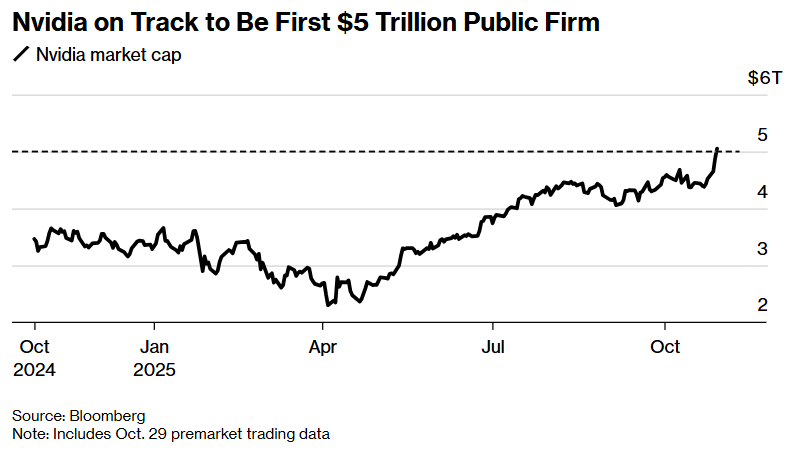
Core Insights - Nvidia has emerged as a key player in the AI era since the launch of ChatGPT at the end of 2022, with its stock price rising significantly and market capitalization reaching $5.03 trillion as of October 29, 2023 [1] - Nvidia's market value has seen exponential growth, surpassing $1 trillion in June 2023, $2 trillion in March 2024, and reaching $3 trillion within three months, indicating a rapid increase in investor confidence and demand for AI technologies [1] - CEO Jensen Huang emphasized the end of Moore's Law and the beginning of a new era characterized by exponential growth in AI computing power during his keynote at the GTC conference [1] Financial Performance - Nvidia's upcoming Blackwell and Rubin GPU chips are projected to generate over $500 billion in revenue over the next five quarters, with current orders reaching 20 million units, five times the total shipments of the previous Hopper architecture [2] - Major cloud computing companies, including Amazon, Meta, Google, Microsoft, Oracle, and CoreWeave, are expected to increase their capital expenditures to $632 billion by 2027, highlighting the growing importance of cloud computing in the tech landscape [2] Strategic Initiatives - Nvidia has invested $1 billion in Nokia to develop an AI-native 6G wireless protocol stack, NVIDIA ARC, which will be compatible with Nokia's existing AirScale architecture [3] - The company aims to enhance wireless communication efficiency through AI technology, enabling telecom operators to launch new AI services on existing infrastructure [3] - Nvidia introduced NVQLink, a new interconnect architecture that connects quantum processors directly to Nvidia GPUs, showcasing its commitment to advancing quantum computing [3] Market Context - Huang refuted claims of an AI bubble, asserting that companies are willing to pay for diverse AI models, indicating a strong market demand for AI solutions [4] - As Nvidia's market value surpassed $5 trillion, it positioned itself ahead of other tech giants like Microsoft and Apple, which have also seen significant market capitalization growth [4] Future Outlook - Nvidia's focus on "accelerated computing" remains central to its strategy, with Bank of America raising its target price for Nvidia shares from $235 to $275, suggesting a potential market capitalization of $6.68 trillion [5]

英伟达市值飙上5万亿后,AI牛市能否延续至2026?
Jin Shi Shu Ju· 2025-10-30 13:16
Core Viewpoint - Nvidia has become the first company to surpass a market capitalization of $5 trillion, highlighting the unprecedented influence of AI in capital markets and the global economy [1] Group 1: Market Performance - Nvidia's stock price surge reflects the strong demand for AI, with the company reaching a market cap of $2 trillion in March 2024, $3 trillion in just 66 trading days, and $4 trillion by July 2025, surpassing both Apple and Microsoft [2] - The company's market cap now exceeds the combined market values of AMD, ARM, ASML, Broadcom, Intel, Lam Research, Micron Technology, Qualcomm, and TSMC, as well as the total market cap of the utilities, industrials, and consumer staples sectors in the S&P 500 [1] Group 2: AI Industry Dynamics - Nvidia is positioned as a key player in the AI sector, with significant partnerships and investments in companies like OpenAI, Oracle, Nokia, and Eli Lilly, which have contributed to the positive market sentiment [1] - The company has shipped 6 million units of its Blackwell chip and received an additional 14 million orders, indicating strong demand for its products [1] Group 3: Valuation Concerns - Analysts express concerns about Nvidia's high valuation, with a price-to-earnings ratio of 33 times expected earnings for the next year, compared to the S&P 500 average of 24 times [3] - Despite the high valuation, Nvidia's stock is still considered attractive by some analysts, with expectations of total sales reaching $500 billion over the next five quarters [5] Group 4: Investment Risks - There are concerns among investors and analysts about the potential for an "internet bubble" scenario, given the significant investments in data centers and chip production, alongside high debt levels and relatively limited current revenue [2] - Nvidia's access to the Chinese market remains an uncertain factor that could impact future revenue [2]
礼来美股盘前涨近1.5%
Di Yi Cai Jing· 2025-10-29 12:39
Group 1 - The core point of the article is that Eli Lilly's stock rose nearly 1.5% in pre-market trading following the announcement that Walmart will provide prescription services for the Zepbound injection [1] Group 2 - Eli Lilly's stock performance indicates positive market sentiment towards the company's recent developments [1] - The partnership with Walmart for Zepbound injection services may enhance accessibility and distribution of the product [1]
“AI信仰”再掀巨浪! Blackwell与Rubin将托起5万亿美元AI帝国 黄仁勋坚信AI纪元已至
智通财经网· 2025-10-29 10:15
Core Insights - Nvidia's CEO Jensen Huang unveiled significant advancements in AI technology at the GTC conference, including a native AI 6G network platform, a Robotaxi fleet based on Nvidia's autonomous driving platform, and the next-generation AI GPU architecture, Rubin, which shows substantial performance improvements over Blackwell [1][3][4] - Following these announcements, Nvidia's stock surged over 6%, closing at $201, with a market capitalization reaching $4.9 trillion, just shy of the $5 trillion milestone [1] - Huang projected that Nvidia's data center business revenue would exceed $500 billion over the next five quarters, driven by the Blackwell and Rubin architectures, significantly surpassing Wall Street's expectations [3][6] Nvidia's AI Strategy - Nvidia is transitioning from a chip design company to a comprehensive AI technology platform, which includes a full-stack infrastructure and an operational ecosystem for AI [3][4] - The company aims to be the strongest foundation for AI, with a focus on high-performance, low-energy AI GPU architectures, and plans to release the Rubin Ultra architecture by late 2027 [5][9] Market Reactions and Predictions - Goldman Sachs reported that Nvidia's projected $500 billion revenue is significantly higher than market consensus, indicating a renewed investor enthusiasm for AI-related investments [3][12] - Major financial institutions, including HSBC, have raised their target price for Nvidia's stock to $320, suggesting a bullish outlook that could see Nvidia's market cap surpass $7 trillion [4][11] AI Infrastructure and Collaborations - Nvidia is investing heavily in AI infrastructure, including a $1 billion stake in Nokia to develop AI-native 6G networks and partnerships with companies like Uber and Eli Lilly to enhance AI applications in various sectors [10][11] - The company is also focusing on the development of advanced AI computing systems, with the Rubin architecture expected to deliver significant performance improvements over previous models [9][10] Long-term AI Market Outlook - The demand for AI computing power is expected to continue growing, driven by substantial investments from both the government and tech giants in AI infrastructure [12][14] - Analysts predict that the current AI investment wave could reach $2 trillion to $3 trillion, indicating a robust long-term growth trajectory for companies like Nvidia and its peers in the AI computing space [14][15]
炸翻全球科技圈!黄仁勋“AI春晚”引爆英伟达,反驳AI泡沫、抛GPU核弹…
Sou Hu Cai Jing· 2025-10-29 02:46
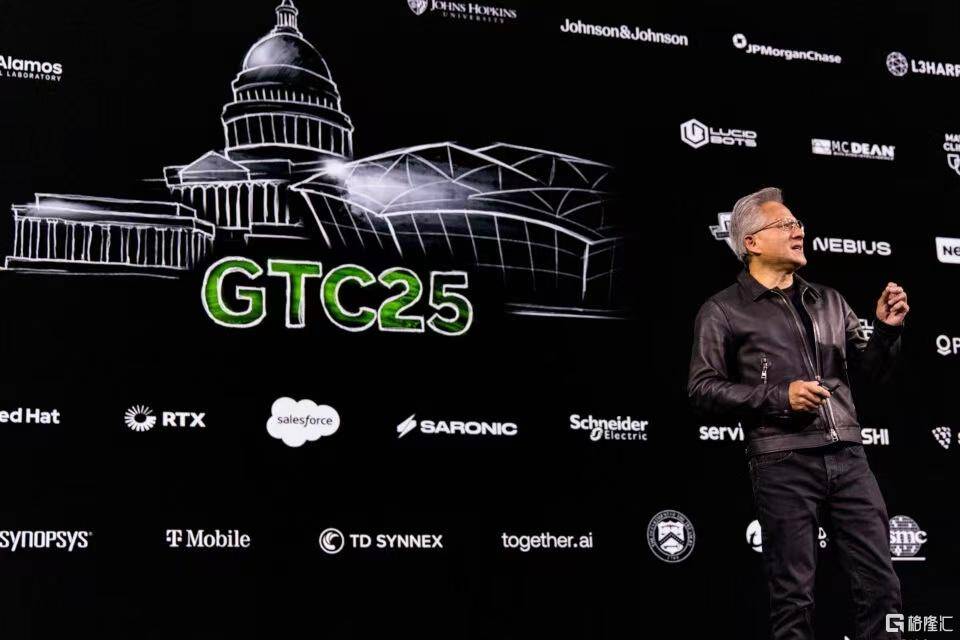
Core Insights - Huang Renxun's keynote at the GTC conference highlighted significant advancements in AI and technology, marking the beginning of "Computing Revolution 2.0" for NVIDIA, which saw its market value approach $5 trillion after a 5% increase in stock price [2][3][12]. Group 1: Strategic Partnerships and Collaborations - NVIDIA announced a $1 billion equity investment in collaboration with Nokia to develop a 6G AI platform, alongside partnerships with T-Mobile and Cisco for the first 6G AI-native wireless stack in the U.S. [5][6]. - The company is working with the U.S. Department of Energy to build seven supercomputers, including the largest AI supercomputer for the department, equipped with 100,000 NVIDIA Blackwell GPUs [9][10]. Group 2: Technological Innovations - NVIDIA introduced NVQLink technology to connect quantum processors with GPU supercomputers, gaining support from 17 quantum processor manufacturers and 5 controller manufacturers [7][8]. - The company unveiled the BlueField-4 data processing chip and the industrial-grade edge AI platform IGX Thor, significantly enhancing processing capabilities [11]. Group 3: AI Market Outlook - Huang Renxun refuted claims of an AI bubble, asserting that the demand for NVIDIA GPUs remains strong, with 6 million Blackwell architecture GPUs shipped in the past four quarters [12][14]. - The anticipated sales for Blackwell and the upcoming Rubin chip are projected to reach $500 billion [15]. Group 4: Future Developments - NVIDIA's roadmap includes the production of the fastest AI chip, Blackwell, in Arizona, marking a significant milestone in U.S. manufacturing [18][19]. - The next-generation Vera Rubin super GPU has completed lab testing and is expected to enter mass production soon, designed for both AI and scientific tasks [20].
研判2025!中国口腔崩解片行业发展背景、发展现状、竞争格局及发展趋势分析:老年人口数量持续增加,带动口腔崩解片需求上涨[图]
Chan Ye Xin Xi Wang· 2025-10-29 01:17
Core Insights - The oral disintegrating tablet (ODT) market in China is experiencing significant growth due to advancements in pharmaceutical technology and increasing consumer demand for convenient and efficient drug formulations [1][8] - The market size for oral disintegrating tablets in China is projected to reach 1.159 billion yuan in 2024 and is expected to grow to 1.230 billion yuan in 2025 [1][8] Industry Overview - Oral disintegrating tablets are a drug formulation that dissolves quickly in the mouth, offering advantages such as ease of use, rapid absorption, high bioavailability, and fewer side effects [4] - These tablets are particularly suitable for children, the elderly, and patients with swallowing difficulties, making them ideal for emergency medications and various therapeutic areas [4][6] Market Dynamics - The demand for oral disintegrating tablets is driven by the aging population in China, with the elderly population expected to reach 219.69 million by the end of 2024, reflecting a year-on-year increase of 1.35% [6] - Approximately 50% of individuals have difficulty swallowing traditional tablets and capsules, highlighting the need for formulations that dissolve without water [6] Industry Chain - The industry chain for oral disintegrating tablets includes upstream raw materials (active pharmaceutical ingredients, super disintegrants, binders, sweeteners), midstream production, and downstream sales channels (medical institutions, pharmacies, e-commerce) [7] Competitive Landscape - The market features competition from both domestic and foreign companies, with notable domestic players like Kanghong Pharmaceutical, Huahai Pharmaceutical, and Kelun Pharmaceutical, as well as foreign firms like Pfizer and Eli Lilly [9] Development Trends - Continuous technological innovation is expected, focusing on new formulation techniques and excipient applications to enhance drug solubility and stability [11] - The trend towards personalized medicine may lead to the development of oral disintegrating tablets tailored for specific patient demographics, such as children and the elderly [12][13] - Strengthening industry integration will be crucial, with a focus on building a complete ecosystem around oral disintegrating tablets, including raw material supply, production improvements, and market promotion [14]


