
辉瑞

Search documents
医药生物行业周报(9月第4周):流感进入活跃期-20250929
Century Securities· 2025-09-29 01:19
Investment Rating - The report does not explicitly state an investment rating for the industry [2] Core Insights - The pharmaceutical and biotechnology sector experienced a decline of 2.2% from September 22 to September 26, underperforming compared to the Wind All A index (0.25%) and the CSI 300 index (1.07%) [3][8] - The flu season is becoming active, with monitoring data indicating a slow upward trend in respiratory infectious diseases, particularly in southern provinces [3][12] - The upcoming ESMO conference from October 17 to 21 in Berlin will feature significant research contributions from Chinese scholars, with 23 studies included in the Late-Breaking Abstracts [3][12] Market Weekly Review - The pharmaceutical and biotechnology sector declined by 2.2%, with only the other biological products sector showing a slight increase of 0.05%. The raw materials sector saw a significant drop of 8.22% [8][9] - Notable stock performances included Sunflower (57.9% increase), Aopumai (23.9% increase), and Xinlitai (15.8% increase), while Borui Pharmaceutical (-38.4%) and Zhongsheng Pharmaceutical (-14%) faced significant declines [11][12] Industry News and Key Company Announcements - The National Healthcare Security Administration launched a "100-day action" to address prominent issues in medical insurance fund management, effective until December 31, 2025 [12][13] - Pfizer announced its acquisition of Metsera for approximately $4.9 billion, focusing on developing next-generation obesity and cardiometabolic disease drugs [16][17] - The ESMO conference has highlighted 23 groundbreaking studies from Chinese researchers, marking a significant achievement for the industry [16][17]
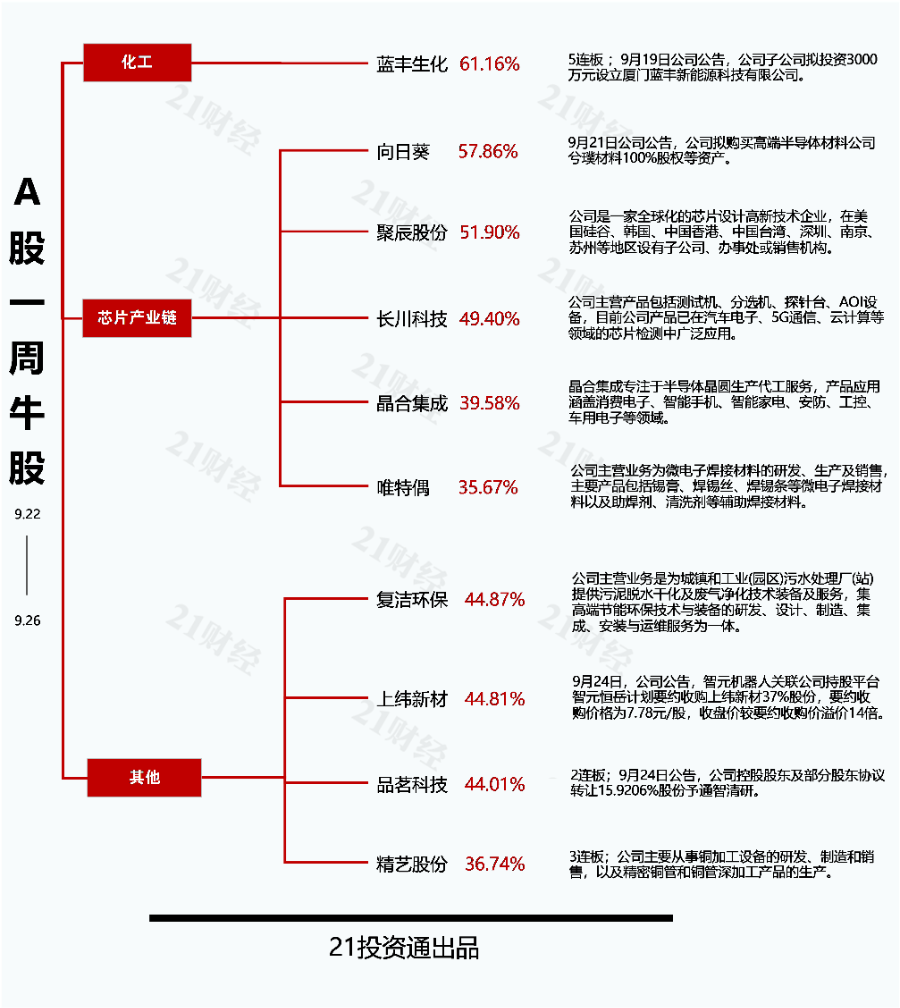
上纬新材再涨超44%;最熊股博瑞医药周跌超38%丨透视一周牛熊股
2 1 Shi Ji Jing Ji Bao Dao· 2025-09-28 07:49
Market Performance - The A-share market indices collectively rose during the week of September 22 to September 26, with the Shanghai Composite Index closing at 3828.11 points, up 0.21% for the week [1] - The Shenzhen Component Index closed at 13209.00 points, up 1.06%, while the ChiNext Index closed at 3151.53 points, up 1.96% [1] - Over 30% of stocks experienced gains, with 126 stocks rising over 15% and 50 stocks declining over 15% [1] Top Gainers - Bluefeng Biochemical (002513.SZ) led the gainers with a weekly increase of 61.16%, followed by Sunflower (300111.SZ) with a 57.86% rise [2] - Other notable gainers included Jucheng Technology (688123.SH), Changchuan Technology (300604.SZ), and Fuke Environmental Protection (688335.SH), all with gains exceeding 44% [2] - Bluefeng Biochemical is a major domestic producer of pesticides, and it recently established a subsidiary focused on high-efficiency N-type crystalline silicon photovoltaic products [2][3] Top Losers - Borui Pharmaceutical (688166.SH) was the biggest loser, with a decline of 38.36% [5] - Other significant decliners included Xiangjiang Holdings (600162.SH) and Haotaitai (603848.SH), both with declines over 22% [5] - Borui Pharmaceutical's stock price fell to 58.06 yuan per share, with a 12.57% drop on September 26 alone [6] Company Developments - Borui Pharmaceutical announced a stock repurchase plan, proposing to buy back shares worth between 10 million and 20 million yuan [9] - The company is progressing with its overseas market expansion, with several clinical trials ongoing for its weight loss products in the U.S. [8][9] - Pfizer's acquisition of Metsera for $7.3 billion has impacted Borui Pharmaceutical's stock, signaling a shift in market expectations for weight loss drug development [10]


华创医药周观点:2025Q3医药业绩前瞻2025/09/28
华创医药组公众平台· 2025-09-28 07:40
Market Review - The CITIC Pharmaceutical Index decreased by 1.98%, underperforming the CSI 300 Index by 1.54 percentage points, ranking 22nd among 30 CITIC first-level industries [7] - The top ten stocks by increase this week included Xiangrikui, Aopu Mai, and Xinlitai, with increases of 57.86%, 23.89%, and 15.81% respectively [7][37] - The top ten stocks by decrease included Borui Pharmaceutical and Jimin Health, with decreases of 38.36% and 19.65% respectively [7][37] Overall View and Investment Themes - The pharmaceutical sector is currently undervalued, with public funds (excluding pharmaceutical funds) having low allocation to the sector. The company maintains an optimistic outlook for the growth of the pharmaceutical industry in 2025, expecting diverse investment opportunities [12] - The innovative drug sector is transitioning from quantity to quality, focusing on differentiated and internationalized pipelines. Companies that can deliver profitable products are expected to be favored [12] - In the medical device sector, there is a noticeable recovery in bidding volumes for imaging equipment, and home medical devices are benefiting from subsidy policies. The company suggests focusing on key players in these areas [12] - The life sciences service sector is expected to see a rebound in overseas investment and domestic demand, with a focus on CXO and life science services as a growth driver [12] - The pharmaceutical industry is anticipated to enter a new growth cycle, particularly in the specialty raw materials sector, which is expected to benefit from cost improvements and low valuations [12] Industry and Individual Stock Events - The Chinese traditional medicine sector is expected to see growth driven by basic drug reforms and national enterprise reforms, with a focus on companies like Kunming Pharmaceutical Group and Kangyuan Pharmaceutical [10][31] - The medical service sector is expected to improve due to anti-corruption measures and centralized procurement, enhancing the competitiveness of private medical institutions [13][26] - The blood products sector is projected to grow significantly during the 14th Five-Year Plan period, with increased approval for plasma stations and expanding product offerings [13] - The medical device market is experiencing a shift towards domestic alternatives, particularly in high-value consumables and imaging equipment, with significant growth expected in 2024 and beyond [20][21] 2025Q3 Pharmaceutical Performance Outlook - Expected revenue growth rates for various companies in Q3 2025 range from 0% to over 60%, with notable mentions including Bai Pu Sai Si and Kanglong Huacheng [14] - The innovative drug sector is expected to see significant contributions from companies like Betta Pharmaceuticals and Hengrui Medicine, with growth rates projected between 10% and 30% [14] Investment Recommendations - The company recommends focusing on the pharmaceutical retail sector, particularly in light of the accelerating trend of prescription outflow and the optimization of competitive dynamics [25] - In the medical device sector, attention is drawn to companies benefiting from the recovery in bidding for imaging equipment and the growth of home medical devices [20] - The life sciences service sector is highlighted for its potential recovery and growth opportunities, particularly in overseas markets [24]
趋势研判!2025年中国化疗药物行业全景速览:随着癌症患者人数不断增多,市场对化疗药物的需求持续增长,国内企业不断上市,市场竞争加剧[图]
Chan Ye Xin Xi Wang· 2025-09-28 01:32
Core Viewpoint - The chemotherapy drug market in China is experiencing growth due to increasing cancer patient numbers and rising consumer spending, despite competition from targeted therapies. Chemotherapy drugs remain dominant due to their stable efficacy, broad anti-cancer properties, and relatively low prices [1][4][5]. Group 1: Industry Overview - Chemotherapy drugs are a crucial method for cancer treatment, classified into various types such as alkylating agents, antimetabolites, and plant-derived anticancer drugs [2][3]. - The demand for chemotherapy drugs in China is projected to reach 3.858 billion units with a market size of 135.59 billion yuan in 2024, led by plant alkaloids and antimetabolites [5][6]. - The global chemotherapy drug market is expected to grow from 33.53 billion USD in 2024 to 36.84 billion USD in 2025, with the Asia-Pacific region holding a significant share [4][5]. Group 2: Market Dynamics - The Chinese chemotherapy drug market is characterized by a dual driving force of strong demand for certain drug types while facing pressure from generics and targeted therapies [5][10]. - The production of chemotherapy drugs in China is anticipated to increase to 3.432 billion units by 2025, reflecting a growth trend in domestic manufacturing capabilities [6][10]. - The competitive landscape is intensifying with local companies like Heng Rui Medicine and Qilu Pharmaceutical making significant strides in both generic and innovative drug development [10][11]. Group 3: Regulatory Environment - The Chinese government has implemented supportive policies to encourage the development of innovative cancer treatment drugs, providing a favorable environment for industry growth [8][9]. - The industry is witnessing accelerated drug approval processes and procurement policies that favor local manufacturers, enhancing competition [10][11]. Group 4: Future Trends - The chemotherapy drug sector is expected to evolve towards precision medicine, with advancements in targeted therapies and combination treatments [11]. - Innovations in drug delivery systems, such as nanotechnology, are anticipated to enhance treatment efficacy and patient outcomes [11].





美国关税政策又有变数!白宫最新发声!
Zheng Quan Shi Bao Wang· 2025-09-27 06:07
Group 1 - The U.S. White House announced that the new tariff measures on pharmaceuticals will not apply to countries that have trade agreements with the U.S. [2][4] - The new tariffs include a 100% tariff on imported brand-name or patented drugs starting October 1, 2025, unless companies establish pharmaceutical manufacturing in the U.S. [4] - Pharmaceutical stocks showed mixed performance in the U.S. market, with Novavax rising by 2.52% and Moderna falling by 0.49% on the day of the announcement [1][2] Group 2 - The U.S. will maintain a 15% tariff cap on pharmaceuticals from trade partners like the EU and Japan, as per existing agreements [2][4] - The U.K. will face a 100% tariff on pharmaceuticals due to ongoing negotiations regarding their trade agreement with the U.S. [2][3] - Canadian steel and related manufacturing industries have seen significant declines in output and exports due to U.S. tariffs, with a 24.8% drop in production since March [5][6]
关税突变!白宫最新发声!
天天基金网· 2025-09-27 02:44
Group 1 - The article discusses the recent changes in the U.S. tariff policy regarding pharmaceuticals, stating that the new tariffs will not apply to countries that have trade agreements with the U.S. [3][4] - On September 26, U.S. pharmaceutical stocks showed mixed performance, with Novavax rising by 2.52% and Pfizer increasing by 0.68%, while Moderna and UnitedHealth saw declines of 0.49% and 0.43%, respectively [3]. - The U.S. will impose a 100% tariff on imported brand-name or patented drugs starting October 1, unless companies establish manufacturing facilities in the U.S. [6]. Group 2 - The White House confirmed that the new tariffs on pharmaceuticals will adhere to existing agreements, maintaining a 15% tariff cap for the EU and Japan [4]. - British officials indicated that the UK is willing to negotiate higher prices for certain pharmaceuticals to protect exports to the U.S. [5]. - The Canadian steel industry has faced significant declines in production and exports due to U.S. tariffs, with a 24.8% drop in output since March and a 25.5% decrease in exports of non-alloy steel by July [7][8].

关税,突变!白宫最新发声!
券商中国· 2025-09-27 02:29
Group 1: Core Views - The recent U.S. tariff policy changes will not apply to countries that have trade agreements with the U.S., such as the EU and Japan, which will maintain a 15% tariff cap on pharmaceuticals [2][4] - President Trump announced a 100% tariff on all brand-name and patented drugs starting October 1, 2025, unless companies establish manufacturing in the U.S. [4][5] - The U.S. Chamber of Commerce has urged the government to reconsider new tariffs on heavy trucks, emphasizing that major import sources are allies and do not pose a security threat [6] Group 2: Market Reactions - Following the announcement of the new tariffs, pharmaceutical stocks showed mixed performance in the U.S. market, with Novavax rising by 2.52% and Moderna falling by 0.49% [1] - Japanese and South Korean pharmaceutical stocks mostly declined, with notable drops including Sumitomo Pharma down over 3% and Samsung Biologics down over 2% [1] Group 3: Impact on Other Industries - The Canadian steel industry has faced significant declines due to U.S. tariffs, with production down 24.8% and exports down 25.5% since March [7] - The U.S. Labor Statistics Bureau reported a 4.7% year-over-year increase in furniture prices due to tariff impacts [5]

大股东“硬刚”创始团队背后,海鲸药业欲“染指”盟科药业
Huan Qiu Lao Hu Cai Jing· 2025-09-26 11:00
Core Viewpoint - The conflict between Genie Pharma, the largest shareholder of Mengke Pharmaceutical, and the founding team led by Zhengyu Yuan has intensified, particularly regarding a proposed private placement and change of control involving Haijing Pharmaceutical [1][2][3] Group 1: Shareholder Dispute - Genie Pharma holds 71.57 million shares of Mengke Pharmaceutical, accounting for 10.92% of the total share capital, and has voted against multiple proposals related to the private placement [2] - Genie Pharma has proposed to remove three directors, including founder Zhengyu Yuan, and to elect three new directors, highlighting the growing rift between the major shareholder and the founding team [2][4] - The disagreement stems from Mengke Pharmaceutical's recent announcement of a private placement to Haijing Pharmaceutical, which Genie Pharma has publicly criticized [1][3] Group 2: Private Placement Details - Mengke Pharmaceutical plans to issue 164 million shares to Haijing Pharmaceutical, raising up to 1.033 billion yuan, which would give Haijing a 20% stake and make it the controlling shareholder [1][3] - Genie Pharma has raised concerns about the financial stability of Haijing Pharmaceutical, questioning its ability to fund the private placement given its reported total assets of approximately 700 million yuan and total liabilities of about 300 million yuan [6][7] Group 3: Financial Performance and Challenges - Mengke Pharmaceutical has been facing financial difficulties, with cumulative losses of approximately 1.221 billion yuan from 2022 to mid-2025, and has not yet achieved profitability [10] - The company’s only commercial product, the antibiotic Contizolam, has limited market potential due to competition from other established products [9][10] - Mengke Pharmaceutical's cash flow has been negative for several years, with only 237 million yuan remaining as of mid-2025, raising concerns about its ability to fund ongoing research and development [10]

两日股价累跌30%,为何辉瑞“扇动翅膀”,博瑞医药就处在风波中?
Tai Mei Ti A P P· 2025-09-26 00:32
Core Viewpoint - The significant drop in the stock price of Borui Pharmaceutical is linked to Pfizer's acquisition of Metsera, which has raised concerns about the competitive landscape in the GLP-1 drug market [1][2][4]. Group 1: Stock Performance and Market Reaction - Borui Pharmaceutical's stock price has fallen by 70% over 30 consecutive trading days, with a 30% drop occurring within just two days following the announcement of Pfizer's acquisition [1]. - The latest rolling price-to-earnings ratio for Borui Pharmaceutical stands at 313.01, significantly higher than the industry average of 31.43 [1]. - The external factors, particularly the Pfizer acquisition, are identified as the primary cause of the stock price decline, as Borui's operational status remains normal [1]. Group 2: Pfizer's Acquisition of Metsera - Pfizer announced the acquisition of Metsera for up to $7.3 billion, focusing on developing next-generation treatments for obesity and metabolic diseases [2][4]. - Metsera's lead drug, MET-097i, is a GLP-1 receptor agonist showing promising results in clinical trials, with participants experiencing an average weight loss of 11.3% [2][3]. - The acquisition reflects Pfizer's strategic move to strengthen its position in the GLP-1 market, especially after facing setbacks with its own GLP-1 drug developments [3][4]. Group 3: Borui Pharmaceutical's Potential - Borui Pharmaceutical is recognized as a potential player in the GLP-1 space, with its core product BGM0504 showing significant efficacy in clinical trials for type 2 diabetes and weight loss [6][8]. - BGM0504 has demonstrated superior results in reducing HbA1c levels compared to placebo and has shown promising weight loss effects in overweight participants [7][8]. - Despite its strong R&D capabilities, Borui faces uncertainty regarding its inclusion in multinational corporations' acquisition lists amid the ongoing "buying spree" in the innovative drug sector [8].
东吴证券:MNC纷纷下注小核酸领域 中国企业有望抢占全球蓝海市场
Zhi Tong Cai Jing· 2025-09-24 07:24
Core Insights - The RNAi therapy market is projected to reach a global market size of $25 billion by 2030, with a significant share in common diseases and tumors, accounting for 54% of the total market size [3] - The Chinese RNAi therapy market is expected to grow from approximately $4 million in 2022 to over $300 million by 2025, with a CAGR exceeding 300%, and is projected to reach around $3 billion by 2030 [3][1] Group 1: Market Trends - The global RNAi therapy market has seen a substantial increase from $12 million in 2018 to $362 million in 2020, with a CAGR of 449.2% [3] - The recent surge in small nucleic acid drugs has led to a wave of business development (BD) activities, with major pharmaceutical companies like Novartis, AZ, and others investing heavily in this field [4] Group 2: Technological Advancements - Recent breakthroughs in small nucleic acid drug design have addressed challenges such as vascular degradation, immune activation, and delivery mechanisms, enhancing the potential for effective treatments [2] - Successful approvals of multiple small nucleic acid drugs, such as Nusinersen with $1.6 billion in sales, Vutrisiran with $970 million (yoy +73%), and Inclisiran with $750 million (yoy +112%), demonstrate their efficacy and safety [2] Group 3: Investment Opportunities - The current landscape shows a limited number of approved small nucleic acid drugs, with 22 drugs expected to be approved by mid-2025, indicating a potential for market expansion [5] - Companies with innovative pipelines and technology platforms, such as Yuyuan Pharmaceutical and Chengdu XianDao, are highlighted as potential investment targets [6]
