vivo

Search documents
为什么电池越大,充电反而“慢”了?
3 6 Ke· 2026-01-26 06:07
Core Viewpoint - The rapid advancement in battery technology has led to significant increases in battery capacity, with recent models reaching up to 10,000mAh, indicating a shift away from traditional charging methods [1][3]. Group 1: Battery Capacity Development - The evolution of battery capacity has progressed from a few hundred mAh to 10,000mAh in recent years, marking a significant leap in technology [3]. - The battery industry had stagnated for a decade due to limitations in graphite materials, which have a theoretical capacity ceiling of 372mAh/g [3][5]. - The introduction of silicon as a material for battery anodes has the potential to increase capacity significantly, with a theoretical capacity of 4200mAh/g, over eleven times that of graphite [5][9]. Group 2: Mechanisms of Energy Storage - Traditional graphite anodes use an "intercalation storage mechanism," which limits the number of lithium ions that can be captured [7]. - Silicon anodes utilize an "alloying storage mechanism," allowing for a much higher efficiency in capturing lithium ions, thus breaking the capacity limits of graphite [9]. Group 3: Challenges with Silicon Anodes - Silicon's significant volume expansion during charging (up to three times) poses challenges, leading to structural damage and rapid capacity loss [11][13]. - The formation of a solid electrolyte interphase (SEI) layer on silicon can consume lithium ions and increase internal resistance, further complicating battery performance [13]. Group 4: Technological Solutions - Key technological advancements include the development of nano-carbon coating to mitigate silicon expansion, allowing for stable battery operation [15][17]. - Innovations in electrolyte formulation, such as solid-liquid hybrid technology, help reduce side reactions and provide mechanical strength to accommodate silicon expansion [19]. - The use of single-walled carbon nanotubes enhances conductivity within the battery, ensuring efficient energy transfer [21]. Group 5: Charging Speed and Battery Design - Despite larger battery capacities, charging speeds have decreased due to the inherent properties of silicon, which is a semiconductor with lower conductivity compared to graphite [25]. - The transition from dual-cell to single-cell designs in batteries limits the ability to achieve high charging power, as increased current leads to excessive heat generation [31][33]. - The need for safety in charging has led to stricter limitations on charging speeds, as high currents can result in dangerous conditions within the battery [33][36]. Group 6: Future Prospects and Challenges - The current silicon-carbon batteries face issues with voltage drop during discharge, which can lead to premature power cut-off by battery management systems [38]. - The ongoing investment in battery technology aims to bridge the gap between energy technology and computational advancements, paving the way for future innovations in various fields [40].

以旧换新新政深圳落地:港客买华为三折叠手机能省近2000元
2 1 Shi Ji Jing Ji Bao Dao· 2026-01-26 05:57
Core Insights - The implementation of the old-for-new policy in Shenzhen in 2026 has significantly boosted local consumer spending, particularly benefiting both local residents and visitors from Hong Kong [1][3] - The consumption patterns of Hong Kong visitors have structurally changed, driven by policy incentives such as the departure tax refund, leading to an expansion in the types of products purchased [2][3] Policy Impact on Consumption - The departure tax refund policy has led to a notable increase in the number of tax refund stores in Shenzhen, with over 1,000 new stores added in 2025, bringing the total to over 2,000 [3] - The first duty-free store in Shenzhen opened in August 2025, marking a new phase in the inbound consumption market, with a diverse range of domestic products available [3] Visitor Statistics - In 2025, a total of 264 million people crossed the Shenzhen-Hong Kong land border, with an average of 723,000 daily crossings, a 14% year-on-year increase [4] - Hong Kong and Macau residents accounted for 171 million of these crossings, representing over 60% of total traffic, highlighting their importance in the consumption market [4] Consumption Trends - The share of Hong Kong visitors' spending in Shenzhen has increased from a few percentage points to approximately 20%-30% in certain shopping centers, with some categories nearing 40% [5][6] - The sales of departure tax refund items in shopping centers have seen a year-on-year growth of over 200%, with the number of tax refund transactions increasing by 13 times in the first 11 months of 2025 [6] Price Advantages - The departure tax refund provides significant price advantages for Hong Kong visitors, with potential savings of up to 1,040 yuan on high-value items like smartphones and laptops [7][8] - The average spending per transaction for Hong Kong visitors ranges from 5,300 to 6,000 yuan, with higher-priced items like computers driving up the average [8] Enhancements in Consumer Experience - Shenzhen shopping centers are enhancing the consumer experience for Hong Kong visitors by implementing bilingual services, optimizing payment methods, and providing shuttle services from border crossings [10][11] - The establishment of dedicated service teams in shopping centers aims to improve international service levels and facilitate tax refund processes [11] Broader Implications - The consumption trends driven by Hong Kong visitors are influencing other cities in China, with officials from cities like Xiamen and Wuhan seeking to learn from Shenzhen's practices in tax refunds and visitor services [12]
以旧换新新政深圳落地:港客买华为三折叠手机能省近2000元
21世纪经济报道· 2026-01-26 05:52
Core Viewpoint - The implementation of the old-for-new policy in Shenzhen has significantly boosted local consumption, particularly benefiting both local residents and Hong Kong visitors who can take advantage of dual policies such as tax refunds and discounts [1][2]. Group 1: Policy Impact on Consumption - The old-for-new policy, combined with the New Year holiday effect, has rapidly stimulated the local consumption market in Shenzhen [1]. - In 2025, Shenzhen saw a substantial increase in the number of tax refund stores, with over 1,000 new stores opened, bringing the total to over 2,000 [3]. - The introduction of the first city duty-free store in Shenzhen on August 26, 2025, marked a new phase in the inbound consumption market, featuring a variety of domestic products [3]. Group 2: Hong Kong Visitors' Spending Trends - In 2025, the total number of inbound and outbound personnel through Shenzhen-Hong Kong land ports reached 264 million, with Hong Kong and Macau residents accounting for over 60% [4]. - The consumption behavior of Hong Kong visitors has shifted from low-priced items to a broader range of products, including electronics and luxury goods, driven by tax refund policies [5][7]. - The average spending per transaction for Hong Kong visitors is now between 5,300 to 6,000 yuan, with higher-priced items like computers seeing significant sales [10]. Group 3: Retail Environment Enhancements - Shenzhen's commercial establishments are enhancing the shopping environment for Hong Kong visitors by implementing bilingual services, optimizing payment methods, and providing shuttle services from ports to shopping centers [14][15]. - The establishment of specialized teams in shopping malls, such as the one in Shenzhen MixC, focuses on improving services for Hong Kong visitors and expanding tax refund operations [16]. - Despite the improvements, there are still areas for enhancement, such as better information dissemination and language support for Hong Kong visitors [17]. Group 4: Broader Implications - The consumption trends driven by Hong Kong visitors are influencing other cities, with officials from places like Xiamen and Wuhan seeking to learn from Shenzhen's practices in tax refunds and visitor services [18].
eBay禁止AI智能体自动购物丨合规周报(第223期)
2 1 Shi Ji Jing Ji Bao Dao· 2026-01-26 05:31
Group 1: AI Security Discussions - During the Davos World Economic Forum, AI security was highlighted as a core technological risk facing enterprises, with concerns about the rapid proliferation of AI Agents impacting deployment rhythms [2] - EY's Raj Sharma emphasized the need for industrial-grade security systems for AI agents, which currently lack clear identity and tracking mechanisms, contrasting with traditional IT systems [2] - KPMG's Tim Walsh noted that AI has become a central topic in cybersecurity discussions, leading some companies to slow down AI project progress to ensure security systems are robust before data migration [2] Group 2: Meta's AI Role Restrictions - Meta Platforms announced a temporary ban on underage users accessing its AI roles while updating its platform, although they can still use the AI assistant with age-appropriate protections [3] - This decision follows previous measures introduced in October to protect underage users from inappropriate content and sensitive topics [3] Group 3: eBay's Policy on AI Shopping - eBay updated its user agreement to prohibit third-party generative AI from interacting with its platform for automatic shopping without permission, effective February 20, 2026 [4] - This move comes as various AI companies have launched automatic shopping features, highlighting eBay's intent to control AI interactions on its platform [4] Group 4: Douyin's Account Recovery Efforts - Douyin's 2025 governance white paper revealed a 60% increase in the coverage of its "anchor health score" mechanism, with 370,000 accounts being indefinitely recovered for violations [5] - The AI model improved violation handling efficiency by 31%, leading to a 37% reduction in overall violation exposure [5] Group 5: OpenAI's Revenue Growth - OpenAI reported over $1 billion in new annual recurring revenue in the past month, entirely from its API business, marking a significant milestone for the company [6][7] - The growth is attributed to the API team's efforts, indicating a shift from a consumer subscription model to a comprehensive AI service provider [7] Group 6: Apple's Advertising Expansion - Apple confirmed the introduction of more advertising placements in App Store search results starting March 3, 2024, with plans to expand globally by the end of March [8] - This expansion aims to provide advertisers with more opportunities to reach users, as approximately 65% of app downloads occur after a search [8] Group 7: Vivo's AI Glasses Project Cancellation - Vivo has reportedly halted its AI glasses project, which had been in development for six months, due to concerns about differentiation in the current market [9] - Following the cancellation, Vivo will refocus its efforts on mixed reality (MR) technology [9]
早报:苹果2025高端出货占比98%!雷军谈小米造车初心
Sou Hu Cai Jing· 2026-01-26 00:15
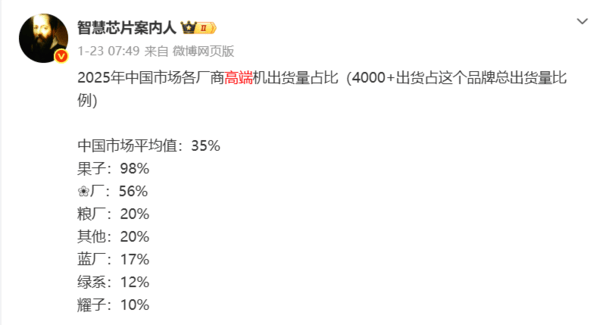
Group 1 - The core viewpoint of the article highlights the competitive landscape of the high-end smartphone market in China, where Apple leads with a 98% market share, followed by Huawei at 56%, and Xiaomi at 20% [1][3] - The average market share of high-end smartphones (priced above 4000 yuan) in China is 35%, indicating significant growth potential for other manufacturers [1][3] - In the domestic SUV quality ranking for Q4 2025, Xiaomi's YU7 achieved a complaint-to-sales ratio of 0.9 per ten thousand, significantly lower than the industry average of 24.8, ranking first among 358 models evaluated [3] Group 2 - Xiaomi's SU7 electric sedan boasts a one-year resale value of 70.22%, leading its segment, with a second-hand car resale rate of 80.1%, reflecting strong consumer recognition and market competitiveness [6] - Samsung's chairman Lee Jae-Yong emphasized the need for the company to avoid complacency despite recent performance improvements, highlighting ongoing structural risks in the competitive landscape [6][8] - The South Korean robotics market ranks fourth globally in installation numbers, with a robot density that is the highest worldwide, but 71.2% of total shipments are for domestic use, indicating a low export ratio compared to Japan [10]


超八成展品搭载AI“科技年货”引爆新春
Nan Fang Du Shi Bao· 2026-01-25 23:12
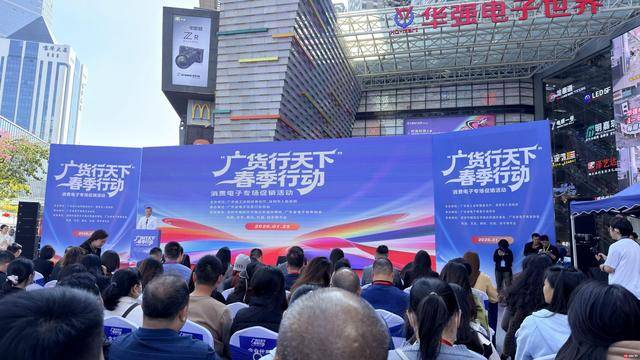
Core Viewpoint - The "Guangdong Goods Going Global" spring action for consumer electronics in Shenzhen's Huaqiangbei has successfully showcased the innovation of local brands in the AI wave, attracting significant consumer interest and boosting the electronic information industry chain [3][6][10]. Group 1: Event Overview - The event gathered 50 leading consumer electronics companies, including Huawei and DJI, to display their products, emphasizing "Guangdong Manufacturing" and "Shenzhen Creation" [3][4]. - Huaqiangbei experienced an additional 100,000 visitors on the event day, a 15% increase year-on-year, highlighting the area's popularity as a consumer electronics hub [3][4]. Group 2: Consumer Engagement - The event attracted a diverse group of foreign buyers from regions such as the Middle East and Southeast Asia, indicating strong international interest in "Guangdong Goods" [4][5]. - Local enterprises showcased innovative products like AI glasses and collaborative robots, which resonated well with both domestic and international consumers [5][6]. Group 3: Product Innovation - Over 80% of the exhibited products featured AI capabilities, transforming traditional hardware into smart lifestyle companions [6][7]. - Shenzhen's consumer electronics have evolved from traditional goods to AI hardware and smart terminals, representing a significant upgrade in manufacturing [6][7]. Group 4: Market Dynamics - Huaqiangbei serves as a critical hub for global sourcing, with over 7,000 foreign buyers visiting daily and more than 300 million packages shipped annually [7][8]. - The event has stimulated the entire electronic information industry chain, enhancing the connection between local manufacturing and global markets [8][9]. Group 5: Internationalization Efforts - The event featured international volunteers providing translation and procurement assistance, reflecting a commitment to facilitating global trade [10]. - The initiative aims to promote Guangdong's manufacturing on a global scale, enhancing its reputation and driving consumer engagement [10].

“广货行天下”走进华强北,消费电子专场促销活动正式启动!
Sou Hu Cai Jing· 2026-01-25 09:37
Group 1 - The "Guangdong Goods Going Global" Spring Action for consumer electronics was launched on January 25, organized by the Guangdong Provincial Department of Industry and Information Technology and the Shenzhen Municipal Government, featuring 50 leading consumer electronics companies [2] - The event showcased innovations from "Made in Guangdong" and "Created in Shenzhen" in the context of the AI technology wave, aiming to meet diverse and high-quality consumer demands [2] - The exhibition attracted a large number of foreign buyers from regions such as the Middle East, Southeast Asia, and Europe, highlighting the international appeal of the products [5] Group 2 - Exhibiting companies offered significant discounts, including a 15% national subsidy and additional store-specific promotions, with some mobile devices having store discounts up to 700 yuan [7] - The event included a special exhibition showcasing the entrepreneurial history and achievements of Huaqiangbei, emphasizing its unique entrepreneurial spirit and industrial strength [7] - Advanced technologies are rapidly being integrated into electronic products, wearable devices, and home products, transforming them into "New Year gifts" that are both innovative and emotionally engaging [7]


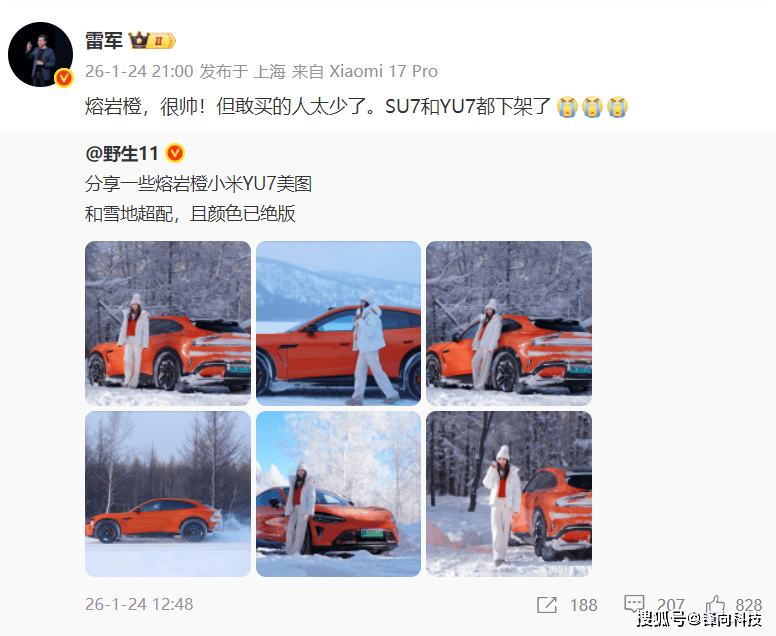
熔岩橙下架,雷军泪目、周意保在辟谣、荣耀在发限量版
Sou Hu Cai Jing· 2026-01-25 06:02
Group 1 - Xiaomi has discontinued the lava orange color for its SU7 and YU7 models, with CEO Lei Jun expressing disappointment over low sales despite the color's unique appeal and high production difficulty [5] - The Honor 500 Pro MOLLY 20th Anniversary Limited Edition has been launched, featuring a fully customized design in collaboration with Pop Mart, priced at 4,499 yuan, with a post-subsidy price of 3,999 yuan; the Honor 500 series is approaching 1 million units sold [7] - OPPO's product manager Zhou Yibao has denied rumors regarding the design of the Find X9 Ultra, stating that the leaked images are false and that the official announcement will come after the Spring Festival [8]
慕了!内存芯片巨头年终奖人均64万;32岁程序员猝死背后公司被扒,曾给39万“封口费”;马斯克曝星舰成本将降99%,商业航天受捧|AI周报
AI前线· 2026-01-25 05:33
Group 1 - SK Hynix announced a record year-end bonus of approximately 1.36 billion KRW (around 640,000 RMB) per employee, part of a shareholder participation plan allowing employees to receive up to 50% of their bonuses in company stock [2][4] - The new bonus structure, effective from the end of January, allows for bonuses to be based on 10% of the previous year's operating profit, with 80% paid in the current year and the remaining 20% deferred over two years [3][4] - The company’s operating profit for the previous year is estimated at 45 trillion KRW, leading to the high bonus payout [4] Group 2 - Zhang Yutong, president of Kimi, stated that the company utilizes only 1% of the resources from top U.S. laboratories to develop leading open-source models, which reportedly outperform some closed-source models [5] - Kimi's valuation reached 4.8 billion USD (approximately 33 billion RMB) in its latest funding round, reflecting strong market demand for AI IPO candidates [5] Group 3 - A tragic incident involving a 32-year-old programmer who died due to excessive work hours has raised concerns about workplace culture, particularly regarding the lack of cooperation from the employer in recognizing the incident as a work-related injury [6][7] - The company involved, Vision Shares, has been criticized for its handling of the situation, including offering a "hush money" payment to the family and obstructing investigations into the work conditions leading to the programmer's death [7][8] Group 4 - Volkswagen announced plans to cut 35,000 jobs, including a third of its management positions, as part of a strategy to save 1 billion euros by 2030 amid industrial slowdowns and competition [10][11] - The restructuring aims to streamline management and enhance operational efficiency, particularly as the company transitions towards electrification and digitalization [11] Group 5 - TikTok has established a U.S. data security joint venture to manage data protection while retaining ownership of its algorithm, ensuring compliance with U.S. regulations [19] - The joint venture will be responsible for TikTok's U.S. operations, allowing over 200 million American users to continue using the platform [19] Group 6 - Elon Musk announced that SpaceX aims to achieve full reusability of its Starship this year, potentially reducing launch costs by 99% [15][16] - Musk also discussed plans for deploying solar-powered AI satellites in the coming years, highlighting the efficiency of solar energy in space [16] Group 7 - OpenAI plans to launch its first hardware device in the second half of 2026, aiming to transform user interaction with technology [22] - The device is designed to provide a more focused and less distracting user experience, contrasting with current smart devices [22] Group 8 - Baichuan Intelligence released the M3 Plus model, which boasts the lowest hallucination rate in medical scenarios, enhancing the reliability of AI-generated medical conclusions [27] - The model incorporates unique evidence anchoring technology to provide accurate citations for its outputs [27]





马斯克:将推动特斯拉转型为估值25万亿美元的机器人公司;安克创新与飞书发布AI录音豆;黄仁勋称AI时代蓝领更吃香丨AI周报
创业邦· 2026-01-25 03:07
Core Insights - The article highlights significant developments in the AI industry, including new product launches, funding rounds, and strategic partnerships, reflecting the rapid evolution and investment in AI technologies globally. Group 1: AI Product Developments - Baidu's Wenxin App is introducing a social feature with "multi-agent group chat" capabilities, aiming to enhance user interaction without directly competing with WeChat [8] - Anker Innovation and Feishu launched the AI hardware product "Anker AI Recording Bean," which features advanced audio recording capabilities and integrates with Feishu's AI functionalities [9] - Baidu released the official version of Wenxin Model 5.0, which supports multi-modal understanding and has 2.4 trillion parameters [17] - Baichuan Intelligence launched the M3 Plus model, which significantly reduces factual hallucinations to 2.6% [19] - Alibaba Health introduced the AI product "Hydrogen Ion," aimed at clinical and research applications with a focus on low hallucination rates [27] Group 2: AI Company Funding and Valuation - OpenEvidence, a medical AI startup, completed a $250 million Series D funding round, valuing the company at $12 billion [22] - OpenAI's CFO announced that the company's annual revenue for 2025 is projected to exceed $20 billion, a significant increase from $6 billion in 2024 [38] - ElevenLabs is negotiating new funding that could raise its valuation to $11 billion [29] - The AI startup Anthropic is seeking to raise at least $25 billion, with Sequoia Capital expected to participate [28] Group 3: AI Industry Trends and Insights - Nvidia's CEO highlighted the increasing demand for skilled tradespeople, suggesting that roles like plumbers and electricians could see six-figure salaries due to the AI-driven infrastructure boom [11] - The global AI financing events decreased by 13 compared to the previous period, with a total disclosed financing amount of 9.57 billion RMB [42] - The distribution of AI funding in China is concentrated in Guangdong and Jiangsu provinces, indicating regional investment trends [47] Group 4: AI Market Competition and Strategic Moves - Google DeepMind's CEO praised ByteDance as a leading AI company in China, suggesting they are only six months behind the cutting edge [11] - Apple plans to significantly revamp Siri into an AI chatbot, aiming to enhance its competitive position in the AI market [36] - Tesla's CEO Elon Musk is pushing for a transformation into a robotics company, with the Optimus robot as a key focus, despite production challenges [8]