
双汇发展

Search documents
食品加工板块11月7日跌0.12%,交大昂立领跌,主力资金净流出1.76亿元
Zheng Xing Xing Ye Ri Bao· 2025-11-07 08:41
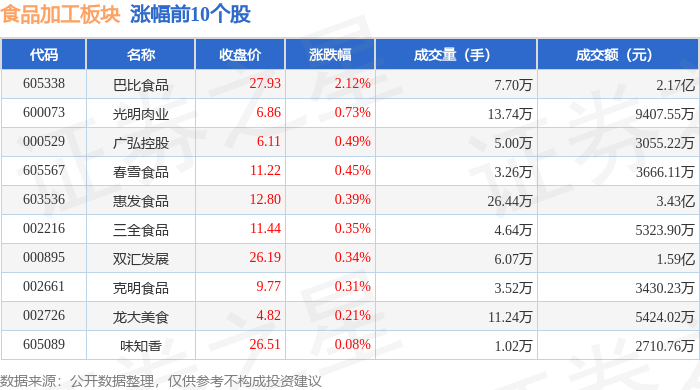
Market Overview - On November 7, the food processing sector declined by 0.12% compared to the previous trading day, with Jiao Da Ang Li leading the decline [1] - The Shanghai Composite Index closed at 3997.56, down 0.25%, while the Shenzhen Component Index closed at 13404.06, down 0.36% [1] Individual Stock Performance - Baba Foods (605338) closed at 27.93, up 2.12% with a trading volume of 77,000 shares and a turnover of 217 million yuan [1] - Guangming Meat Industry (600073) closed at 6.86, up 0.73% with a trading volume of 137,400 shares and a turnover of 94.08 million yuan [1] - Jiao Da Ang Li (600530) closed at 8.01, down 4.76% with a trading volume of 188,700 shares and a turnover of 154 million yuan [2] Capital Flow Analysis - The food processing sector experienced a net outflow of 176 million yuan from institutional investors, while retail investors saw a net inflow of 155 million yuan [2] - Notable individual stock capital flows include: - Shuanghui Development (000895) with a net inflow of 14.07 million yuan from institutional investors [3] - Guangming Meat Industry (600073) with a net outflow of 372,020 yuan from retail investors [3]


人造肉概念股短线拉升,国恩股份涨停
Mei Ri Jing Ji Xin Wen· 2025-11-07 05:33
Group 1 - The artificial meat concept stocks experienced a short-term surge, with Guoen Co., Ltd. hitting the daily limit up [1] - Fuxiang Pharmaceutical saw an increase of over 15% [1] - Other companies such as Huabao Co., Haoxiangni, Shuanghui Development, Chengzhi Co., and Chunxue Food also experienced gains [1]


2025年1-9月食品制造业企业有10999个,同比增长4.9%
Chan Ye Xin Xi Wang· 2025-11-07 03:35
2016-2025年1-9月食品制造业企业数统计图 数据来源:国家统计局,智研咨询整理 相关报告:智研咨询发布的《2025-2031年中国食品饮料制造行业发展动态及投资前景评估报告》 2025年1-9月,食品制造业企业数(以下数据涉及的企业,均为规模以上工业企业,从2011年起,规模 以上工业企业起点标准由原来的年主营业务收入500万元提高到年主营业务收入2000万元)为10999个, 和上年同期相比,增加了514个,同比增长4.9%,占工业总企业的比重为2.11%。 上市公司:黑芝麻(000716),双汇发展(000895),千味央厨(001215),青岛食品(001219),三 全食品(002216),得利斯(002330),金字火腿(002515),洽洽食品(002557),克明食品 (002661),煌上煌(002695),海欣食品(002702),麦趣尔(002719),龙大美食(002726),桂 发祥(002820) 知前沿,问智研。智研咨询是中国一流产业咨询机构,十数年持续深耕产业研究领域,提供深度产业研 究报告、商业计划书、可行性研究报告及定制服务等一站式产业咨询服务。专业的角度、品质化的服 ...

湖北省赤壁市市场监督管理局食品安全监督抽检信息公告 (2025年第9期)
Zhong Guo Zhi Liang Xin Wen Wang· 2025-11-06 09:06
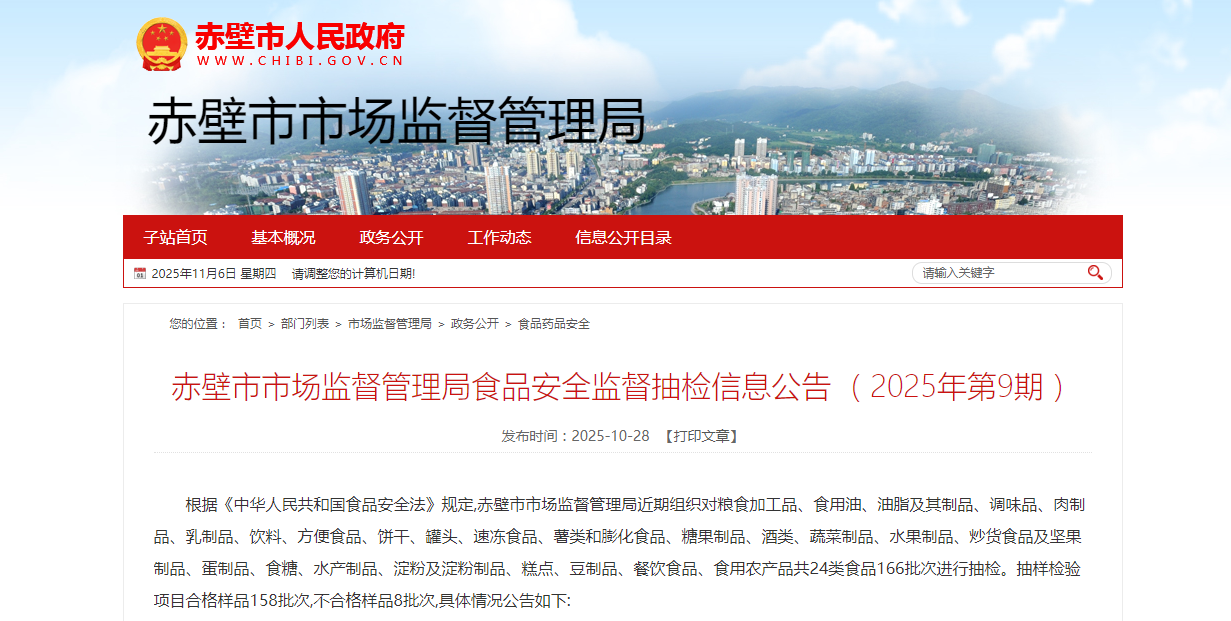
Core Viewpoint - The article reports on the recent food safety inspection conducted by the Market Supervision Administration of Chibi City, revealing that out of 166 food samples tested, 158 were compliant while 8 were found to be non-compliant, highlighting ongoing food safety concerns in the region [4]. Summary by Category Food Categories Inspected - A total of 24 food categories were inspected, including grain products, edible oils, seasonings, meat products, dairy products, beverages, convenience foods, snacks, canned foods, frozen foods, and more [4]. Inspection Results - Out of 166 samples tested: - 158 samples were compliant - 8 samples were non-compliant - Breakdown of non-compliant samples: - Catering food: 29 samples tested, 7 non-compliant - Edible agricultural products: 29 samples tested, 1 non-compliant - Grain products: 11 samples tested, all compliant - Edible oils and fats: 3 samples tested, all compliant - Seasonings: 3 samples tested, all compliant - Meat products: 8 samples tested, all compliant - Dairy products: 4 samples tested, all compliant - Beverages: 7 samples tested, all compliant - Convenience foods: 6 samples tested, all compliant - Snacks: 2 samples tested, all compliant - Canned foods: 2 samples tested, all compliant - Frozen foods: 4 samples tested, all compliant - Potato and puffed foods: 8 samples tested, all compliant - Candy products: 2 samples tested, all compliant - Alcohol: 6 samples tested, all compliant - Vegetable products: 8 samples tested, all compliant - Fruit products: 2 samples tested, all compliant - Nuts and seeds: 3 samples tested, all compliant - Egg products: 1 sample tested, all compliant - Sugar: 1 sample tested, all compliant - Aquatic products: 2 samples tested, all compliant - Starch and starch products: 3 samples tested, all compliant - Pastries: 19 samples tested, all compliant - Bean products: 3 samples tested, all compliant [4].
食品加工板块11月6日涨0.33%,惠发食品领涨,主力资金净流出4300.53万元
Zheng Xing Xing Ye Ri Bao· 2025-11-06 08:51
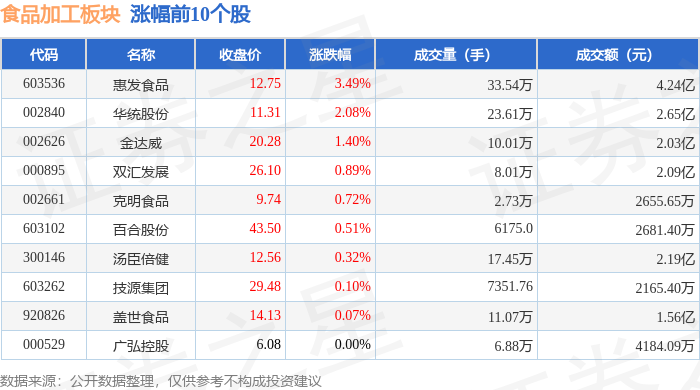
Core Insights - The food processing sector experienced a slight increase of 0.33% on November 6, with Huihua Foods leading the gains [1] - The Shanghai Composite Index closed at 4007.76, up 0.97%, while the Shenzhen Component Index closed at 13452.42, up 1.73% [1] Stock Performance Summary - Huihua Foods (603536) closed at 12.75, up 3.49% with a trading volume of 335,400 shares and a transaction value of 424 million yuan [1] - Huadong Co. (002840) closed at 11.31, up 2.08% with a trading volume of 236,100 shares and a transaction value of 265 million yuan [1] - Quandawei (002626) closed at 20.28, up 1.40% with a trading volume of 100,100 shares and a transaction value of 203 million yuan [1] - Shuanghui Development (000895) closed at 26.10, up 0.89% with a trading volume of 80,100 shares and a transaction value of 209 million yuan [1] - Other notable stocks include Kemei Foods (002661) at 9.74, up 0.72%, and Zihua Co. (603102) at 43.50, up 0.51% [1] Capital Flow Analysis - The food processing sector saw a net outflow of 43.01 million yuan from institutional investors, while retail investors experienced a net outflow of 4.97 million yuan [2] - Speculative funds recorded a net inflow of 47.97 million yuan [2] Individual Stock Capital Flow - Huihua Foods (603536) had a net inflow of 26.54 million yuan from institutional investors, while retail investors saw a net outflow of 41.39 million yuan [3] - Shuanghui Development (000895) recorded a net inflow of 8.97 million yuan from institutional investors [3] - Kemei Foods (002661) had a net inflow of 4.63 million yuan from institutional investors, with retail investors experiencing a net outflow of 2.10 million yuan [3]



红利策略仍具配置价值,300红利低波ETF(515300)逆市红盘冲击3连涨!
Sou Hu Cai Jing· 2025-11-05 03:04
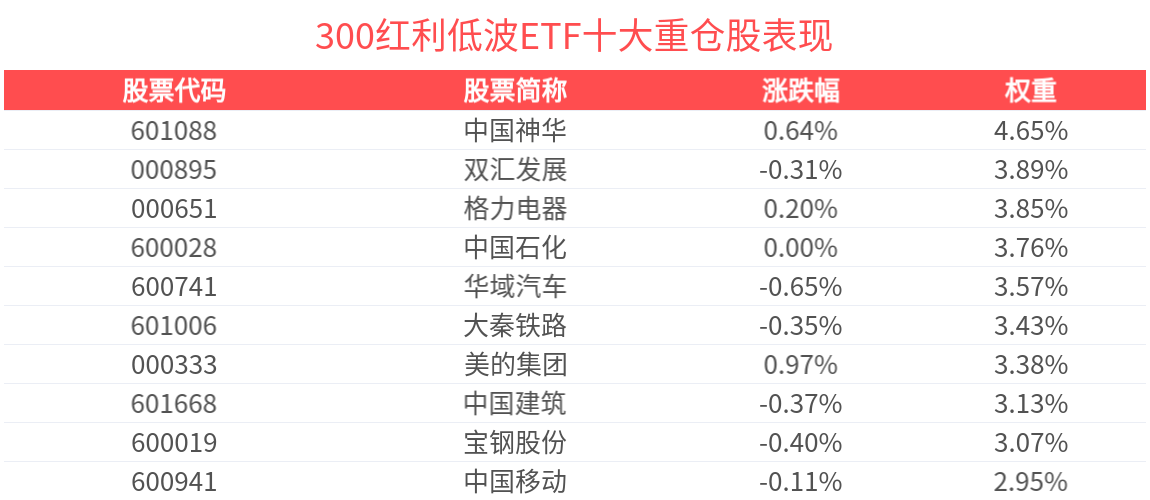
Group 1 - The core viewpoint indicates that the "insurance capital + industrial capital" may become an important source of incremental funds for the banking sector in the future [2] - The banking sector's holdings are at a historical low, revealing investment value, and the dividend strategy continues to hold allocation value [2] - The dividend sector shows greater allocation value during low interest rate periods, with excess returns negatively correlated with government bond yields [2] Group 2 - As of October 31, 2025, the top ten weighted stocks in the CSI 300 Dividend Low Volatility Index include China Shenhua, Shuanghui Development, Sinopec, Gree Electric Appliances, and others, accounting for a total of 35.78% [2] - The CSI 300 Dividend Low Volatility ETF has seen a net value increase of 59.42% over the past five years, ranking 81 out of 1033 index equity funds [1] - The ETF's highest single-month return since inception was 13.89%, with the longest consecutive monthly gain being five months and a maximum increase of 14.56% [1]






地方政府与城投企业债务风险研究报告:河南篇
Lian He Zi Xin· 2025-11-04 12:20
1. Report Industry Investment Rating No information provided in the content. 2. Core Viewpoints of the Report - Henan Province has a high - level economic development with a leading GDP in China, but a relatively low per - capita GDP and urbanization rate. The province has taken measures to prevent and resolve government debt risks, and has completed the implicit debt resolution plan for seven consecutive years since 2018 [4]. - There is a high degree of differentiation in the development of cities in Henan. Zhengzhou has an absolute advantage in economic and fiscal strength, and Luoyang also maintains a leading position. Some cities have relatively high government debt ratios and need to pay attention to the credit risks of urban investment enterprises [4]. - Most of Henan's bond - issuing urban investment enterprises still face significant short - term debt repayment pressure, and the bond maturity scale of provincial - level, Zhengzhou, and Luoyang urban investment enterprises in 2026 is large. Attention should be paid to the credit risks of urban investment enterprises with relatively heavy local government debt burdens, low debt - repayment and support capabilities, and insufficient refinancing capabilities [4]. 3. Summary by Relevant Catalogs 3.1 Henan's Economic and Fiscal Strength 3.1.1 Regional Characteristics and Economic Development - Henan is located in the central - eastern part of China, with superior transportation location and prominent resource endowment. It has a high - level economic development, a leading GDP, a middle - lower per - capita GDP, and a low urbanization rate. The industrial structure is "tertiary - secondary - primary", and strategic opportunities such as the construction of the Central Plains Urban Agglomeration help the regional development [5]. - Henan has a large population, with a permanent population of 97.85 million in 2024, ranking third in China. The urbanization rate is 59.22%, lower than the national average, with large room for development [9]. - In 2024, Henan's GDP was 6.358999 trillion yuan, ranking sixth in China, with a growth rate of 5.1%. The per - capita GDP was 64,900 yuan, lower than the national level. The industrial and service industries have good development momentum, and investment in fixed assets and industry has increased [10][14][15]. 3.1.2 Fiscal Strength and Government Debt - In 2024, Henan's general public budget revenue decreased slightly year - on - year, ranking in the upper - middle level in China. The fiscal self - sufficiency rate is low, and the government - funded revenue continued to decline. The provincial government debt ratio and liability ratio are in the middle in China, but the liability level is rising rapidly [23]. - In 2024, Henan's local government debt ratio and liability ratio were 169.48% and 33.51% respectively, ranking 15th and 10th in China, up 26.36 and 3.25 percentage points from the end of the previous year [24]. 3.2 Economic and Fiscal Conditions of Prefecture - Level Cities in Henan 3.2.1 Economic Strength of Prefecture - Level Cities - There is a high degree of imbalance in the development of cities in Henan. Zhengzhou is the only city with a GDP of over one trillion yuan, and Luoyang and Nanyang also have obvious leading advantages. Most cities have a lower urbanization rate than the national average [26]. - The economic development levels of cities in Henan are highly differentiated, showing a ladder - like distribution. In 2024, most cities' GDP rankings remained the same as in 2023. In terms of per - capita GDP, Zhengzhou and Jiyuan lead, and Zhoukou ranks last. In terms of urbanization rate, Zhengzhou has the highest level [35][36]. 3.2.2 Fiscal Strength and Government Debt of Prefecture - Level Cities - The fiscal strength of cities in Henan is highly differentiated. Zhengzhou leads in terms of fiscal revenue scale and fiscal self - sufficiency rate. In 2024, the general public budget revenue of some cities fluctuated, and more than half of the cities' government - funded revenue decreased. The superior subsidy income contributes significantly to the comprehensive financial resources [38]. - In 2024, the government debt balance of all cities in Henan increased, with Zhengzhou having the largest balance. The government debt ratio and liability ratio of all cities increased, and the debt burden is relatively heavy. Shangqiu, Puyang, Xuchang, and Zhoukou had a relatively large increase in the government debt ratio [48][49]. 3.2.3 Debt Resolution - Henan has taken various measures to prevent and resolve government debt risks, and the overall debt risk is controllable. It has optimized the debt structure and reduced the risk level. Since 2024, the spread of urban investment bonds in Henan has shown a downward trend [50][53]. 3.3 Debt Repayment Ability of Urban Investment Enterprises in Henan 3.3.1 Overview of Urban Investment Enterprises - There are bond - issuing urban investment enterprises in Henan at the provincial level and in 18 cities. The administrative levels of these enterprises are mainly at the prefecture - level and district - county levels, and they are mainly distributed in Zhengzhou and its surrounding cities. The credit levels of Zhengzhou's urban investment enterprises are relatively high [55]. - As of the end of September 2025, there were 148 bond - issuing urban investment enterprises in Henan, with a total balance of outstanding bonds of 768.689 billion yuan. High - credit - level enterprises are mainly concentrated at the provincial level and in Zhengzhou, and AA - level enterprises account for the highest proportion [56][57]. 3.3.2 Bond Issuance - In 2024, the number of bonds issued by Henan's urban investment enterprises decreased year - on - year, while the scale increased. Most cities maintained a net inflow of bond financing. From January to September 2025, the bond issuance rhythm slowed down, and regional differentiation intensified [63]. 3.3.3 Debt Repayment Ability Analysis - At the end of 2024, most of Henan's bond - issuing urban investment enterprises faced significant short - term debt repayment pressure, and the bond maturity scale of provincial - level, Zhengzhou, and Luoyang urban investment enterprises in 2026 is large. The debt burden of some cities' urban investment enterprises is relatively heavy [68][71]. 3.3.4 Support and Guarantee Ability of Local Fiscal Revenue for Urban Investment Enterprises' Debt - At the end of 2024, the ratio of "total debt of bond - issuing urban investment enterprises + local government debt" to comprehensive financial resources in Henan cities was at least about 220.15%. Zhengzhou had the highest ratio, and the support and guarantee ability of some cities was under pressure [76].
2025年中国肉牛养殖行业市场规模、进入壁垒及投资战略研究
Sou Hu Cai Jing· 2025-11-04 07:14
Core Insights - The report titled "2026-2032 China Beef Cattle Breeding Industry Market Deep Analysis and Investment Value Assessment" aims to provide insights into the development trends and future prospects of the beef cattle breeding industry in China [1][23] - The beef cattle breeding industry is characterized by scientific management practices aimed at improving growth rates and meat quality while ensuring animal welfare [1][8] Industry Overview - Beef cattle breeding involves selecting, feeding, disease prevention, and environmental control to enhance growth and meat quality, ultimately supplying beef products to the market [1][8] - The industry integrates various technologies, including genetic breeding and nutrition, to meet consumer demands for both quantity and quality of beef [1][8] Industry Chain Analysis - The beef cattle breeding industry chain encompasses production, processing, and distribution, with upstream activities focused on breeding and feed production, while downstream activities include slaughtering, processing, and logistics [2][9] - The market size of the beef cattle breeding industry is projected to reach approximately 768 billion yuan by 2024, driven by consumer demand and supportive industry policies [2][14] Competitive Landscape - The competitive structure of the beef cattle breeding industry is shifting from a fragmented market to a more concentrated one, with leading companies like Yili, Mengniu, and New Hope dominating the first tier through mergers and technological innovation [3][16] - Regional leaders and small-scale farmers face increasing pressure to consolidate or partner with larger firms to survive [3][16] Market Dynamics - The cold chain logistics sector supporting the beef industry is expected to generate revenues of 536.1 billion yuan in 2024, reflecting a 3.7% year-on-year growth, which enhances the efficiency of beef distribution [12][13] - The industry is transitioning from quantity expansion to quality enhancement, with a growing emphasis on premium beef products [2][14] Future Outlook - The report provides a comprehensive analysis of the favorable and unfavorable factors affecting the beef cattle breeding industry, including policy support and rising consumer demand, as well as challenges such as disease risks and insufficient quality beef sources [23][41] - The investment strategy section outlines potential investment opportunities and risks in the beef cattle breeding sector from 2026 to 2032 [41][42]

河南供应链,有多厉害?
3 6 Ke· 2025-11-04 01:08
Core Insights - The article emphasizes the emergence of Henan as a significant player in China's food supply chain, transforming it into a vital hub for food production and distribution, often referred to as the "kitchen of the nation" [1][17] - Henan's food supply chain is characterized by a comprehensive and efficient network that supports local brands and facilitates their growth on a national scale [1][8] Group 1: Key Players in Henan's Food Industry - Notable food brands from Henan, such as Sanquan, Si Nian, Shuanghui, and Baixiang, have successfully penetrated national markets, showcasing the effectiveness of the local supply chain [2][3] - Sanquan Foods, established in 1992, has become a leader in China's frozen food industry, leveraging Henan's agricultural resources and transportation networks for rapid expansion [2][3] - Si Nian Foods has developed a sustainable agricultural supply chain model, establishing order-based agricultural bases that enhance the quality and standardization of local produce [5][7] Group 2: Supply Chain Advantages - Henan's food industry benefits from a complete supply chain ecosystem, with over 7,800 small and medium-sized enterprises supporting the frozen food sector [3][10] - The region's population of 100 million provides a vast market and diverse consumer demands, contributing to the competitive edge of local brands like Sanquan [3][10] - The success of the acid-spicy noodle industry in Tongxu County exemplifies Henan's ability to create a full-cycle industrial ecosystem, integrating production, logistics, and retail [8][10] Group 3: Retail and Distribution Innovations - The local supermarket chain, Pang Dong Lai, exemplifies the integration of local agricultural production with retail, achieving significant cost reductions and quality control through direct sourcing [13][14] - Pang Dong Lai's collaboration with local suppliers has led to the development of customized products, enhancing its market position and supporting local businesses [14][16] - The establishment of logistics bases, such as the JD Logistics Supply Chain Base in Xuchang, further strengthens the efficiency of Henan's food supply chain [14][16] Group 4: Government Support and Infrastructure - The Henan provincial government prioritizes the development of the food industry, aiming to build a trillion-level modern food cluster by 2025 [16] - Continuous improvements in transportation infrastructure, including a comprehensive high-speed rail and highway network, facilitate efficient logistics and distribution [16][17] - The Zhengzhou Airport Economy Comprehensive Experimental Zone enhances the region's capability to export products nationally and internationally, supporting the growth of Henan's food supply chain [16][17]



万联晨会-20251104
Wanlian Securities· 2025-11-04 01:03
Core Viewpoints - The A-share market showed a rebound on Monday, with the Shanghai Composite Index rising by 0.55% to 3976.52 points, and the Shenzhen Component Index increasing by 0.19% [2][8] - The media industry led the gains among sectors, while the non-ferrous metals sector lagged behind [2][8] - The total trading volume in the A-share market was approximately 2.11 trillion RMB, with over 3400 stocks rising [2][8] Industry Analysis Food and Beverage Industry - The food and beverage sector continues to experience a downward trend in performance, with a year-on-year revenue growth of 0.15% for the first three quarters of 2025, totaling 831.395 billion RMB, while net profit attributable to shareholders decreased by 4.57% to 171.059 billion RMB [11] - Only soft drinks, beer, and fermented seasoning products showed positive growth in both revenue and net profit, with revenue growth rates of 30.97%, 10.93%, and 3.92% respectively [11] - The white wine sector is facing significant challenges, with revenue and net profit growth rates turning negative at -5.83% and -6.93% respectively for the first three quarters of 2025 [14] - The beer sector showed signs of recovery, with revenue and net profit increasing by 2.02% and 11.82% respectively, indicating improved profitability [15] - The snack and soft drink segments performed well, with notable growth from brands like Dongpeng Beverage, which achieved over 34% growth in both revenue and net profit [16] Social Services Industry - The social services sector reported stable revenue growth of 4.94% year-on-year, totaling 150.954 billion RMB, but net profit decreased by 2.86% to 8.697 billion RMB [19] - The tourism and scenic area segment saw revenue growth of 5.09%, but net profit fell by 17.79%, indicating a disparity in performance across different attractions [19] - The hotel and restaurant sector experienced a revenue decline of 4.05% and a significant net profit drop of 25.46%, reflecting ongoing pressure on consumer spending [19] Investment Recommendations - In the food and beverage sector, there are structural investment opportunities, particularly in the beverage, snack, and health supplement industries, with a focus on quality leaders in energy drinks and innovative snack brands [17] - The white wine industry is expected to stabilize, with low valuations and high dividends providing support, suggesting potential investment opportunities as inventory levels decrease [17] - The social services sector is anticipated to benefit from policy support aimed at boosting service consumption, particularly in tourism and education [20]