华恒生物

Search documents
生态环境部推进PVC行业无汞化转型,原油价格走强
Huaan Securities· 2026-02-02 11:11
Investment Rating - The industry investment rating is "Overweight" [2] Core Insights - The chemical sector is experiencing a dual drive of cyclical recovery and growth, with a focus on organic silicon, PTA, polyester filament, caprolactam, spandex, vitamins, sweeteners, refrigerants, and phosphorus chemicals [5][6] - The organic silicon industry is entering a recovery phase, with new applications becoming the core growth engine. From 2019 to 2024, domestic DMC capacity is rapidly expanding, leading to temporary oversupply and continuous price declines. However, by 2025, no new capacity is expected, and demand from emerging sectors like new energy vehicles and photovoltaics is maintaining high growth [5][6] - The PTA and polyester filament industry is moving towards a new prosperity cycle as the capacity expansion phase is nearing its end, with new capacity mainly concentrated in leading enterprises [6] - The refrigerant market is entering a high prosperity cycle due to quota policies and stable demand growth from the heat pump and cold chain markets [7] - The synthetic biology sector is expected to see explosive demand growth as fossil-based materials face disruptive challenges, with a focus on energy-efficient products [8] - OLED technology is accelerating its penetration into larger displays, supported by government policies promoting the new display industry [9] - The demand for electronic chemicals is increasing due to the rapid development of the semiconductor industry, particularly in China, where the market is heavily reliant on imports [11] Summary by Sections Industry Performance - The chemical sector's overall performance ranked 12th with a decline of 0.86% during the week of January 26 to January 30, 2026 [20] - The top three performing sectors were oil and petrochemicals (7.95%), communications (5.83%), and coal (3.68%) [20] Key Industry Dynamics - The Ministry of Ecology and Environment is promoting the mercury-free transformation of the PVC industry, focusing on the development of mercury-free catalysts [36] - Recent geopolitical tensions in the Middle East have led to increased oil prices, with WTI crude averaging $61.33 per barrel, up 2.39% from the previous week [36]
招商证券:1月港股消费观察:外卖反垄断如何影响港股消费股前景?
CMS· 2026-01-27 03:31
Investment Rating - The report provides a positive outlook on the food and beverage sector, recommending leading companies in snacks and condiments [7][9]. Core Insights - The report highlights a decline in retail sales growth, with December's year-on-year growth at 0.9%, down 0.4 percentage points from November, indicating a potential slowdown in consumer spending [8]. - The food and beverage sector shows positive signals, particularly for Moutai, which is expected to maintain stable pricing due to supply-side constraints and increasing demand [9][10]. - The report anticipates that service consumption will be the main growth driver for 2026, with an expected overall consumption growth rate of 5.1% [8]. Industry Size - The industry comprises 1,216 stocks, with a total market capitalization of 17,809.1 billion and a circulating market capitalization of 16,466.7 billion [3]. Performance Metrics - The absolute performance over 1 month, 6 months, and 12 months is 4.4%, 7.0%, and 27.3% respectively, while the relative performance is 3.4%, -7.1%, and 4.5% [5]. Sector Recommendations - The report recommends focusing on leading companies in various sectors, including: - Food and beverage: Emphasis on Moutai and other snack brands [9]. - Textile: Anticipation of a turnaround for Li Ning in 2026 [13][14]. - E-commerce: Positive outlook on Alibaba due to its cloud business growth potential [24]. - Agriculture: Continued recommendation of leading pig farming companies and attention to planting policy catalysts [30]. Specific Company Insights - Moutai is expected to see stable pricing and growth in demand, with a focus on core products [9]. - Li Ning is actively launching new products and expanding its retail presence, aiming for a rebound in 2026 [13][14]. - Alibaba's cloud business is projected to accelerate growth driven by AI advancements [24]. - The agricultural sector is advised to focus on leading pig farming companies and the implications of planting policies [30].
百望股份联手华恒生物 为财务数智化转型筑牢合规底座
Zheng Quan Ri Bao Wang· 2026-01-26 11:12
Core Insights - The collaboration between Baiwang Co., Ltd. and Anhui Huaheng Biotechnology Co., Ltd. aims to leverage AI technology to create intelligent financial and tax solutions, enhancing compliance and efficiency in financial digital transformation [1][2] Group 1: Company Profiles - Baiwang Co., Ltd. is a leading data intelligence enterprise in China, focusing on "data + AI" innovation, with a core asset of massive, real-time transaction data [1] - Anhui Huaheng Biotechnology Co., Ltd. is a high-tech enterprise specializing in synthetic biology, providing innovative and sustainable products in various fields such as animal nutrition and functional foods [1] Group 2: Collaboration Details - The partnership focuses on digital invoice management and electronic accounting file management, aiming to empower Huaheng's financial management system with intelligent upgrades [2] - Baiwang will assist Huaheng in building an integrated input invoice pool, automating the entire process of invoice collection, verification, and deduction certification, significantly enhancing management efficiency and data accuracy [2] - Baiwang's capabilities include multi-language invoice intelligent parsing, which will help Huaheng manage overseas invoices more effectively [2] Group 3: Future Directions - The collaboration is set to deepen in the field of financial digitalization, aiming to break down regional barriers and support Chinese enterprises in achieving compliant operations and efficient development in market competition [3]

基础化工行业周报:五部门出台零碳工厂建设意见,美国拟敲定年度生物燃料配额
Huaan Securities· 2026-01-26 00:24
Investment Rating - The industry investment rating is "Overweight" [2] Core Insights - The chemical industry is experiencing a dual drive of cyclical recovery and growth, with a focus on organic silicon, PTA, polyester filament, caprolactam, spandex, vitamins, sweeteners, refrigerants, and phosphorus chemicals [5][6] - The organic silicon industry is entering a recovery phase, driven by new applications in sectors like new energy vehicles and photovoltaics, with significant improvements in supply-demand dynamics expected [5][6] - The PTA/polyester filament industry is seeing a reduction in capacity expansion, leading to a new cycle of prosperity due to improved domestic and external demand [6] - The refrigerant market is entering a high prosperity cycle due to quota policies and stable demand growth from sectors like heat pumps and cold chain logistics [7] - The synthetic biology sector is poised for explosive growth as fossil-based materials face disruptive challenges, with a focus on energy efficiency and carbon tax costs [8] - OLED technology is rapidly penetrating various markets, supported by government policies aimed at fostering the new display industry [9] - The demand for high-frequency and low-loss electronic resins is increasing due to the rise of AI infrastructure and low-orbit satellite communications [10] - The electronic chemicals sector is benefiting from the expansion of wafer production capacity, with increasing demand for key materials in the semiconductor industry [11] Summary by Sections Industry Performance - The chemical sector ranked 4th in overall performance with a weekly increase of 7.29%, outperforming the Shanghai Composite Index by 6.45 percentage points [20][21] Key Industry Dynamics - The Ministry of Industry and Information Technology has issued guidelines for zero-carbon factory construction, aiming to establish a benchmark by 2027 across various industries [35] - The U.S. government plans to finalize the annual biofuel blending quota, maintaining high growth targets for the biofuel industry [35]
五部门出台零碳工厂建设意见,美国拟敲定年度生物燃料配额
Huaan Securities· 2026-01-25 13:33
Investment Rating - Industry Rating: Overweight [2] Core Insights - The chemical industry is experiencing a dual drive of cyclical recovery and growth, with a recommendation to focus on sectors such as organic silicon, PTA, polyester filament, caprolactam, spandex, vitamins, sweeteners, refrigerants, and phosphorus chemicals [5][6] - The organic silicon industry is entering a recovery phase, with new applications becoming key growth drivers. From 2019 to 2024, domestic DMC capacity is expected to expand rapidly, leading to a temporary oversupply and price decline. However, by 2025, no new capacity is anticipated, and demand from emerging sectors like new energy vehicles and photovoltaics is expected to maintain high growth [5][6] - The PTA/polyester filament industry is approaching a turning point, with capacity expansion cycles nearing their end. The demand side is expected to continue growing, supported by improved external demand due to easing trade tensions [6] - Refrigerants are entering a high prosperity cycle due to quota policies that will reduce supply while demand remains stable, driven by market expansion in Southeast Asia and the development of heat pumps and cold chain markets [7] - The synthetic biology sector is poised for significant growth as fossil-based materials face disruptive challenges, with a focus on energy-efficient products and the potential for bio-based materials to see explosive demand [8] - OLED technology is rapidly penetrating various markets, with government policies supporting the development of new display industries and accelerating the localization of key materials and equipment [9] - The demand for electronic chemicals is increasing due to the rapid growth of the semiconductor industry, particularly in China, where the market is heavily reliant on imports [11] Summary by Sections Industry Performance - The chemical sector ranked 4th in overall performance for the week of January 19-23, 2026, with a gain of 7.29%, outperforming the Shanghai Composite Index by 6.45 percentage points [5][20] - The top-performing sub-sectors included textile chemical products (13.10%), nitrogen fertilizers (10.58%), and other chemical raw materials (10.09%) [21] Key Company Dynamics - The top three gaining companies for the week were Jianghua Micro (46.41%), Jiuding New Materials (28.47%), and Hongbaoli (26.73%) [26] - The companies in focus for potential investment include KaiSai Biological, Huaheng Biological, and other leading firms in synthetic biology and electronic chemicals [8][11][32] Industry Developments - The Ministry of Industry and Information Technology has issued guidelines for the construction of zero-carbon factories, aiming to establish a benchmark by 2027 across various sectors [35] - The U.S. government plans to finalize the 2026 biofuel blending quotas, maintaining high growth targets while addressing industry concerns [35]




化工新材料产业周报:台积电加大先进封装投资,2025年中国电力储能装机同增54%-20260125
Guohai Securities· 2026-01-25 08:44
Investment Rating - The industry investment rating is "Recommended" (maintained) [1] Core Viewpoints - The new materials sector is a crucial direction for the future development of the chemical industry, currently experiencing rapid growth in downstream demand. With policy support and technological breakthroughs, domestic new materials are expected to accelerate their long-term growth. The report emphasizes that "one generation of materials leads to one generation of industries," highlighting the foundational nature of the new materials industry as the material basis for other industries [4][15]. Summary by Relevant Sections 1. Electronic Information Sector - Focus areas include semiconductor materials, display materials, and 5G materials [5]. - Recent developments include TSMC's plan to increase investment in advanced packaging technology, aiming to upgrade existing InFO equipment and establish a new WMCM production line, with a target capacity of approximately 60,000 wafers per month by the end of 2026 [6][40]. 2. Aerospace Sector - Key materials of interest are PI films, precision ceramics, and carbon fibers [7]. - The successful launch of the Long March 12 rocket, which deployed 19 low-orbit satellites, demonstrates the capabilities of China's aerospace technology [8][50]. 3. New Energy Sector - Focus areas include photovoltaics, lithium-ion batteries, proton exchange membranes, and hydrogen storage materials [9]. - By the end of 2025, China's power storage capacity is projected to reach 213.3 GW, a year-on-year increase of 54%, with new energy storage accounting for over two-thirds of this capacity [10]. 4. Biotechnology Sector - Key areas include synthetic biology and scientific services [11]. - Significant advancements in agricultural biotechnology were reported, including breakthroughs in crop genetic improvement and the development of new wheat varieties [12]. 5. Energy Conservation and Environmental Protection Sector - Focus areas include adsorption resins, membrane materials, and biodegradable plastics [13]. - The government has initiated projects to support equipment upgrades across various sectors, with a total investment exceeding 460 billion yuan [14]. 6. Key Companies and Profit Forecasts - The report highlights several key companies with their respective stock prices and earnings per share (EPS) forecasts for 2023 to 2025, indicating a generally positive outlook for the new materials sector [16].

仙乐健康、西子健康、禹王生物……营养健康企业为何扎堆赴港上市?
Sou Hu Cai Jing· 2026-01-21 10:00
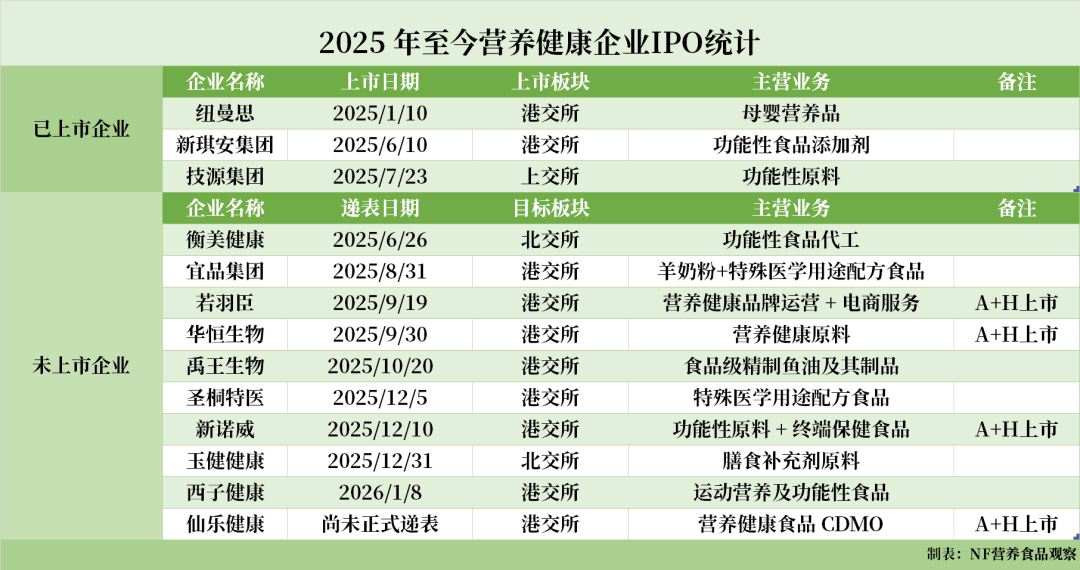
Core Insights - The nutrition and health sector is experiencing a surge in IPO activity, with many companies targeting the Hong Kong stock market for their listings [3][8] - The trend is driven by a combination of expansion needs and financial pressures faced by companies, prompting them to seek capital through public offerings [3][9] Group 1: IPO Activity - Since the beginning of 2025, at least 13 companies in the nutrition and health sector have either successfully listed or initiated the IPO process, with over 70% aiming for the Hong Kong market [3][8] - Notable companies include Newman, Xinqian Group, and Hengmei Health, with various business focuses such as maternal and infant products and functional food additives [1] Group 2: Reasons for Listing - Companies like Hengmei Health and Yujian Health are planning to use raised funds for significant production expansions, indicating a clear demand for growth [3] - Financial pressures, such as high current liabilities and asset-liability ratios exceeding 90%, are motivating companies like Yuwang Bio to pursue IPOs as a means to optimize capital structure [3][9] Group 3: A+H Listing Trend - Four out of the 13 companies are pursuing an A+H share listing model, reflecting a strategic goal for global expansion [5] - Brands leveraging new e-commerce channels, such as Xizi Health and Ruoyuchen, are also rapidly moving towards capital market engagement [5] Group 4: Hong Kong Market Appeal - The Hong Kong stock market has become increasingly attractive due to a systematic revaluation of Chinese assets and heightened interest from international long-term investors [8] - In 2025, the Hong Kong IPO market saw 114 new listings, a 63% increase year-on-year, with total fundraising reaching HKD 286.3 billion, a 227% increase [8] Group 5: Policy Support - The introduction of the "Science and Technology Enterprise Special Line" by the Hong Kong Stock Exchange has provided a more efficient pathway for companies to list, enhancing the appeal of the market [9] - Listing in Hong Kong offers companies not just financing opportunities but also helps in establishing international governance structures and enhancing global influence [9][10] Group 6: Strategic Implications - The trend towards listing in Hong Kong signifies a broader shift towards internationalization and standardization for domestic nutrition and health companies [10] - Companies are expected to improve financial transparency and information disclosure quality as they engage with global investors [10]


免费领取!《2025中国合成生物制造产业发展白皮书》
synbio新材料· 2026-01-21 02:53
Core Viewpoint - The article emphasizes the rising importance of biomanufacturing as a strategic and innovative sector, which is seen as a new growth point that can drive industrial structure optimization and economic model transformation. The release of the "2025 China Synthetic Biomanufacturing Industry Development White Paper" highlights the current state and trends of biomanufacturing, analyzes the industry chain and key application directions, and provides insights into challenges and policy recommendations for the industry [1]. Group 1: Current State and Trends - The white paper outlines the development status and trends of biomanufacturing, including a comparative analysis of the biomanufacturing sectors in China and the United States [5]. - It discusses the key platform facilities in the global biomanufacturing industry, indicating the infrastructure necessary for growth [5]. - Future development trends in biomanufacturing are explored, suggesting potential directions for innovation and investment [5]. Group 2: Policy Landscape - The report details major policies affecting biomanufacturing both domestically and internationally, providing a comprehensive overview of regulatory environments [5]. - It categorizes foreign and domestic policies that impact the biomanufacturing industry, highlighting the importance of supportive regulations for growth [5]. Group 3: Industry Chain and Applications - An analysis of the biomanufacturing industry chain is presented, identifying key components and stakeholders involved in the sector [5]. - The report outlines several key application areas for biomanufacturing, including pharmaceuticals, food, personal care, agriculture, chemicals, materials, and energy, indicating the versatility of biomanufacturing technologies [5]. Group 4: Key Enterprises and Investment Landscape - The white paper identifies ten leading enterprises in China's biomanufacturing industry, showcasing significant players that are driving innovation and market growth [6]. - It also summarizes the strategic directions of 15 listed companies in synthetic biology, providing insights into their investment and development strategies [6]. - The investment and financing situation in the domestic synthetic biology sector for the period of 2024-2025 is discussed, indicating trends in capital flow and investment opportunities [6]. Group 5: Challenges and Recommendations - The report addresses the challenges faced by China's biomanufacturing industry, including technological, regulatory, and market-related issues that could hinder growth [6]. - Targeted policy recommendations are provided to address these challenges, aiming to foster a more conducive environment for the development of the biomanufacturing sector [6].

趋势研判!2026年中国营养功能食品合同生产行业壁垒、政策、市场规模、细分格局、竞争格局及发展趋势:市场将持续扩容,健康零食占比最大[图]
Chan Ye Xin Xi Wang· 2026-01-21 01:27
Core Insights - The nutritional functional food industry is experiencing significant growth driven by national policies, increased health awareness, and rising living standards. The market is projected to reach 288 billion yuan by 2025 and 328 billion yuan by 2026 [1][5]. Industry Overview - Nutritional functional foods are defined as foods that contain ingredients beneficial to human health, excluding health foods that require special approval. This category includes special dietary foods and regular packaged foods [2][3]. - The industry is characterized by a diverse range of products and applications, with health snacks being the largest segment, followed by gut health, beauty nutrition, weight management, and sports nutrition [1][5]. Market Size and Growth - The market size for nutritional functional foods in China is expected to grow from 144 billion yuan in 2019 to 288 billion yuan in 2025, with a further increase to 328 billion yuan by 2026 [5][6]. - Specific market segments for 2025 include health snacks at 103 billion yuan (35.76%), gut health at 65 billion yuan (22.57%), beauty nutrition at 39 billion yuan (13.54%), weight management at 36 billion yuan (12.50%), and sports nutrition at 22 billion yuan (7.64%) [1][5]. Industry Structure - The industry operates on a contract manufacturing model, where one party (the client) outsources production to another party (the contractor). This model allows for specialization in production while the client focuses on marketing and brand management [3][4]. - The supply chain includes upstream raw materials such as vitamins, proteins, and minerals, while the midstream involves research, production, and marketing [6]. Competitive Landscape - The competitive landscape is fragmented, with a few leading companies dominating the market. The top five companies accounted for 17.3% of the market share in 2023, up from 13.9% in 2022 [8]. - Major players in the industry include Hengmei Health, Xianle Health, Dajiang Biotechnology, and others, each with unique advantages [7][8]. Regulatory Environment - Recent government policies, such as the "National Food and Nutrition Development Outline (2025-2030)," aim to promote the nutritional functional food industry by emphasizing innovation and quality in food production [7]. Future Trends - The demand for health-oriented products is expected to grow due to rising income levels and an aging population, creating a favorable environment for the nutritional functional food industry [8].


免费领取!《2025中国合成生物制造产业发展白皮书》
synbio新材料· 2026-01-20 08:47
Core Insights - The article emphasizes the rising importance of biomanufacturing as a strategic and innovative sector, which is seen as a new growth point that can help optimize industrial structures and transform economic models [1]. Group 1: Current State and Trends - The "2025 China Synthetic Biomanufacturing Industry Development White Paper" was officially released on August 1, highlighting the current status and trends in biomanufacturing [1]. - The report analyzes the global biomanufacturing industry, including key platform facilities and a comparative study of the US and China in this field [5]. Group 2: Policy Landscape - The white paper discusses major policies affecting biomanufacturing both domestically and internationally for the years 2024-2025 [5]. Group 3: Industry Map and Applications - It provides a comprehensive map of the Chinese biomanufacturing industry and analyzes the industry chain along with key application directions, including biomanufacturing in pharmaceuticals, food, personal care, agriculture, chemicals, materials, and energy [5]. Group 4: Key Enterprises - The report identifies ten leading enterprises in the Chinese biomanufacturing sector, detailing their contributions and roles within the industry [5][6]. Group 5: Company Strategies - It outlines the synthetic biology strategies of 15 listed companies, summarizing their development approaches and corresponding popular products [5][6]. Group 6: Investment and Challenges - The white paper reviews the investment and financing situation in domestic synthetic biology from 2024 to mid-2025 and discusses the challenges faced by the biomanufacturing industry in China, along with proposed countermeasures [5][6].