
苏州银行

Search documents
银行股马年开局遇冷
Di Yi Cai Jing Zi Xun· 2026-02-24 12:31
Core Viewpoint - The A-share market experienced a positive start to the year, but bank stocks continued to be underperformers, reflecting ongoing concerns about credit quality and lending dynamics in the context of stable LPR rates and lower-than-expected credit growth [2][3][4]. Market Performance - On the first trading day of the year, the Shanghai Composite Index rose by 0.87% to 4117.41 points, while the Shenzhen Component increased by 1.36% and the ChiNext Index by 0.99% [3]. - The banking sector saw a decline of 0.24%, with more stocks falling than rising, indicating a divergence in performance compared to other sectors [3]. - The China Securities Banking Index has retreated nearly 16% from its peak in July 2022, contrasting with an 18% rise in the broader market during the same period [3]. Credit and Lending Dynamics - The latest financial data revealed that new RMB loans in January amounted to 4.71 trillion yuan, lower than the 5.13 trillion yuan recorded in January 2022, indicating a year-on-year decrease in credit growth [3][4]. - The social financing scale increased by 7.22 trillion yuan in January, with a notable decline in loans to the real economy, which increased by 4.9 trillion yuan, down by 317.8 billion yuan year-on-year [3][4]. Institutional Research Focus - Institutional interest in bank research has decreased compared to previous years, with 16 banks undergoing 63 institutional surveys in 2023, involving 467 institutions, compared to 20 banks and 92 surveys in the same period last year [6]. - Key areas of focus during these surveys included credit quality, liability management under margin pressure, capital replenishment plans, and asset quality outlook [6][7]. Future Outlook and Strategies - Analysts predict that the trend of prioritizing credit quality over quantity will become more pronounced in 2023, with significant attention on post-Spring Festival operational rhythms and consumer spending [4][5]. - Banks are expected to enhance their non-interest income sources, with strategies including the promotion of wealth management products and diversified capital replenishment channels to address ongoing profitability pressures [8][9].


银行经营周期如何定价各类资产?
GF SECURITIES· 2026-02-24 12:04
Investment Rating - The report assigns a "Buy" rating for the banking sector, indicating an expectation of stock performance exceeding the market by more than 10% over the next 12 months [58]. Core Insights - In 2025, the banking sector's asset growth is projected to be 8.01%, an increase from 6.52% in 2024, driven by factors such as fiscal stimulus, cross-border capital inflows, and the activation of maturing deposits [5][13]. - The report identifies two key cycles affecting asset pricing in banking: the bank expansion cycle and the interest margin cycle, suggesting a comprehensive analysis of these cycles [5][13]. - The debt cycle is characterized as a fundamental aspect of the bank expansion cycle, with a model proposed by Dalio outlining seven stages of a typical debt cycle, which can be influenced by external debt reliance [16][19]. - The report anticipates limited upward space for the debt cycle in 2026, with government leverage expected to increase by 5.89%, lower than the 7.6% projected for 2025 [35][36]. - The banking interest margin cycle is expected to stabilize in 2025, following two complete cycles since 2010, with a correlation observed between bank interest margins and the 30Y-10Y government bond spread [41][45]. Summary by Sections Bank Expansion Cycle - The asset growth rates for different types of banks in 2025 are projected as follows: state-owned banks at 11%, joint-stock banks at 4.74%, city commercial banks at 9.68%, and rural commercial banks at 5.17%, all exceeding the average growth rate [5][13]. - The report emphasizes the importance of understanding the relationship between bank assets and liabilities, highlighting that credit and debt expansion are cyclical and self-reinforcing [15][16]. Debt Cycle Analysis - The report outlines that the current debt cycle, which began in 2022, has lasted 16 quarters, surpassing previous cycles, and indicates a shift in leverage dynamics among enterprises, government, and households [35][36]. - The analysis includes a comparison of deflationary and inflationary debt cycles, noting that the U.S. faces greater inflationary pressures due to higher external debt reliance compared to China [21][19]. Interest Margin Cycle - The report notes that the banking interest margin has experienced significant fluctuations since 2010, with a stabilization phase expected to begin in 2025 [41][45]. - It highlights the impact of loan repricing cycles on interest margins, with a notable decline in loan rates observed in recent years [49][50].




银行股马年开局遇冷,机构调研透露几大隐忧
Di Yi Cai Jing· 2026-02-24 12:01
Core Viewpoint - The enthusiasm for institutional research on banks has declined compared to previous years, with a focus on credit quality and the impact of interest rate spreads on profitability [1][6]. Group 1: Market Performance - On the first trading day of the Year of the Horse, the A-share market saw a rise, with the Shanghai Composite Index up 0.87% and the Shenzhen Component Index up 1.36%, while the banking sector fell by 0.24% [2]. - The banking sector has experienced a divergence in performance, with state-owned banks declining while some regional banks have shown improvement [2]. - The China Securities Banking Index has retreated nearly 16% from its peak in July 2022, while the broader market has increased by nearly 18% during the same period [2]. Group 2: Credit and Monetary Policy - The latest LPR remained unchanged for both the 1-year and 5-year terms, marking a period of stability in interest rates [3]. - In January, new RMB loans totaled 4.71 trillion yuan, lower than the 5.13 trillion yuan in January 2022, indicating a slowdown in credit growth [2][3]. - The People's Bank of China (PBOC) is expected to maintain liquidity support through MLF operations, with a net injection of 300 billion yuan in February [3][4]. Group 3: Institutional Research Focus - Institutional research has shown a preference for banks in economically promising regions, with a significant number of surveys conducted on smaller banks in the Yangtze River Delta [6]. - Key areas of focus during institutional surveys include credit demand, interest margin pressures, capital adequacy, and asset quality outlook [6][7]. - The trend of "deposit migration" towards equity markets is noted, with banks expected to enhance their wealth management and middle-income sources [4][7]. Group 4: Profitability and Capital Management - Banks are under pressure regarding profitability, with institutions increasingly inquiring about capital adequacy and internal capital replenishment strategies [8]. - Several banks plan to explore diverse capital replenishment channels, including issuing capital-boosting bonds and optimizing business structures to enhance capital efficiency [8].





机构:政策工具维持银行间流动性均衡,关注银行配置窗口
Sou Hu Cai Jing· 2026-02-24 07:21
银行ETF华夏(515020)是跟踪中证银行指数(399986)综合费率最低的ETF,其联接基金A类 008298;联接基金C类008299;联接D类024642。 截至15:00,中证银行指数(399986)下跌0.25%。成分股涨跌互现,招商银行领涨0.59%,郑州银行上 涨0.52%,兰州银行上涨0.44%;渝农商行领跌1.95%,重庆银行下跌1.57%,苏州银行下跌0.85%。银行 ETF华夏(515020)下跌0.18%,最新报价1.65元。 每日经济新闻 中国银河认为,目前政策面财政政策积极,货币政策延续稳息差导向,对业绩形成支撑,利好估值修 复,银行板块配置窗口值得关注。 人民银行2月24日公告称,以固定利率、数量招标方式开展了5260亿元7天期逆回购操作,操作利率为 1.4%。因今日有14524亿元逆回购到期,公开市场实现净回笼9264亿元。考虑3月初有重要会议召开, 广发证券预计央行继续灵活高效开展公开市场操作维持银行间流动性整体均衡。 有市场人士分析称,当前政策利率引导作用进一步增强,短期市场利率运行更加平稳;央行综合运用多 种货币政策工具,提供短中长期流动性,对银行资金面形成利好。 ...
银行业周度追踪2026年第6周:商业银行四季度利润增速回升-20260224
Changjiang Securities· 2026-02-23 23:30
Investment Rating - The industry investment rating is "Positive" and maintained [11] Core Insights - The banking index fell by 1.3% this week, underperforming the CSI 300 and ChiNext indices by 1.6% and 2.5% respectively, indicating a short-term style switch in the market [6][19] - H-shares of banks led the gains, while most A-shares declined, with notable performances from Huaxia Bank and Shanghai Bank due to improved earnings and strong expectations for convertible bond conversions [6][19] - The price-to-book (PB) ratio and return on equity (ROE) of bank stocks remain undervalued, with a continued recommendation for high-quality city commercial banks in Zhejiang, Jiangsu, and Shandong provinces, including Hangzhou Bank, Ningbo Bank, Jiangsu Bank, Nanjing Bank, Qingdao Bank, Qilu Bank, and Suzhou Bank [6][19] - The report also suggests focusing on low-valuation, high-dividend, and convertible bond opportunities, particularly in Industrial Bank [6][19] Summary by Sections Market Performance - The banking sector's trading activity has decreased, with turnover rates falling, although the transaction volume share for state-owned and rural commercial banks has rebounded [8][39] - The average dividend yield for the six major state-owned banks in A-shares is 4.28%, with a spread of 249 basis points over the 10-year government bond yield, while H-shares yield 5.21% [7][29] Profit Growth and Net Interest Margin - The overall asset growth rate for commercial banks reached 9.0% year-on-year by the end of Q4 2025, with major state-owned banks seeing a growth rate of 10.8% [9][44] - The net profit growth for commercial banks was 2.3% year-on-year, indicating a positive trend, particularly among city and rural commercial banks [9][44] - The net interest margin for 2025 is projected at 1.42%, with a marginal stabilization observed, and a further narrowing of the decline expected in 2026 [9][46] Asset Quality - The non-performing loan (NPL) ratios across various banks are stable or improving, attributed to increased write-off efforts, while the provision coverage ratio continues to decline [10][49] - Capital adequacy ratios remain stable, with attention on the potential impact of the second round of fiscal injections for state-owned banks and refinancing for smaller banks in 2026 [10][49]


马年理财启新程 稳健配置成主流
Xin Lang Cai Jing· 2026-02-21 06:56
Group 1: Investment Trends - The demand for investment and financial management is increasing as residents have more disposable income during the Spring Festival, driven by year-end bonuses and the trend of saving "growth funds" for children [1][2] - Financial experts suggest that investors should focus on asset allocation rather than blindly chasing high returns or sticking to single products, emphasizing a balanced approach to wealth growth [2] Group 2: Financial Products and Services - Various financial institutions, including Guangfa Bank and Suzhou Bank, are launching child-specific financial products such as dedicated bank cards and savings accounts, with some offering interest rates as high as 1.75% for three-year deposits [3] - The low interest rate environment is expected to persist, leading to a decrease in available high-yield deposit products, which has shifted investor focus towards alternative investment options [3][4] Group 3: Asset Allocation Strategies - In a low interest rate environment, securing long-term returns is crucial, with large time deposits still serving as a foundational element in asset allocation [4] - Investors are encouraged to diversify their portfolios by including liquid assets like short-term bond funds and equity assets to capture excess returns while maintaining stability [4][5] Group 4: Market Outlook - The stock market is anticipated to continue its slow bull trend, with technology stocks expected to remain a primary investment focus, particularly in sectors highlighted in the "14th Five-Year Plan" [7] - The current valuation of the market, with the CSI 300 index trading at around 15 times earnings, suggests that there are still ample investment opportunities available [7]
1月金融数据点评:存款开门更红,债券融资靠前
KAIYUAN SECURITIES· 2026-02-14 08:15
Investment Rating - The industry investment rating is "Overweight" (maintained) [1] Core Insights - The report highlights a significant rebound in M1 and M2 growth rates due to the Spring Festival effect and proactive marketing by banks, with January M1 growth at 4.9% and M2 at 9.0% [3] - January saw a notable increase in new RMB deposits, totaling 8.09 trillion yuan, significantly higher than the previous year's 4.32 trillion yuan, driven by corporate, fiscal, and non-bank deposits [3] - The report indicates a shift towards short-term loans, with January's new RMB loans at 4.71 trillion yuan, reflecting a decrease in medium to long-term loans [4][5] - The investment suggestion emphasizes the need to monitor credit and deposit maturity windows in March, with large banks and quality regional banks expected to benefit from expansion and performance certainty [5] Summary by Sections Deposit and Loan Trends - January's new RMB deposits were 8.09 trillion yuan, with corporate deposits increasing by 2.82 trillion yuan, fiscal deposits by 1.22 trillion yuan, and non-bank deposits by 2.56 trillion yuan [3] - The structure of loans shows a significant increase in short-term loans, with corporate short-term loans up by 3.1 trillion yuan, while medium to long-term loans decreased by 2.8 trillion yuan [5] Social Financing - The total social financing in January was 7.22 trillion yuan, with a stock growth rate of 8.2%, reflecting a slight decrease from the previous month [4] - Direct financing, including corporate and government bonds, saw a year-on-year increase, indicating a shift in financing methods [4] Investment Recommendations - The report recommends focusing on banks with strong balance sheet expansion capabilities, specifically mentioning Citic Bank and Suzhou Bank, while also highlighting beneficiaries like Agricultural Bank, Industrial and Commercial Bank, Jiangsu Bank, and Chongqing Bank [5]

利润跌27%、授信涨67%:苏州银行关联授信30亿
Xin Lang Cai Jing· 2026-02-14 06:00
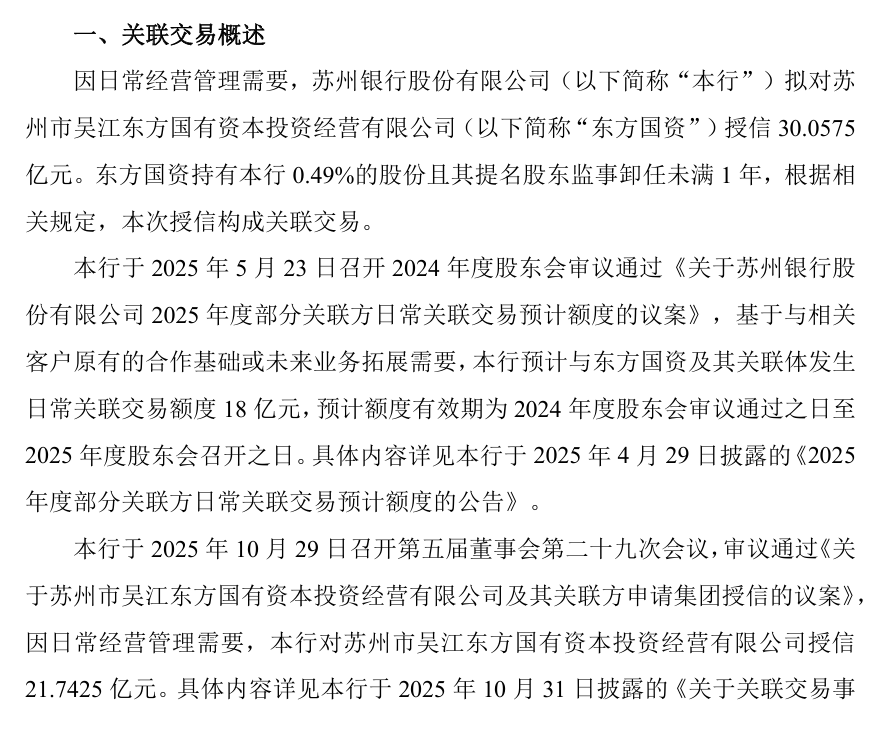
2026年2月11日,苏州银行(002966)披露关联交易公告,公告显示,该行董事会已审议通过对苏州市吴江东方国有资本投资 经营有限公司(下称"东方国资")追加授信,至此对东方国资的总授信额度累计达到30.1亿元。 此次授信存在明显的数据反差:苏州银行持续追加对东方国资的授信额度,甚至一度触碰原定授信额度的边界;而作为融资方 的东方国资,正面临业绩变脸、净利润大幅下滑的局面。 苏州银行此次对东方国资的授信,在程序上被明确界定为"关联交易"。根据公告披露,东方国资持有苏州银行0.5%的股份,且 其提名的股东监事卸任尚未满一年,按照监管相关规定,其关联方身份仍处于敏感的"存续期"内。值得关注的是,这种关联关 系并未成为信贷审核的约束条件,反而似乎为东方国资打开了通往巨额资金池的通道。 回溯过往授信记录,苏州银行对东方国资的授信额度增长速度令人瞩目。2025年4月29日,苏州银行在年度预计额度公告中明 确,对东方国资及其关联体的日常关联交易授信预计额度仅为18亿元。然而,短短半年后的2025年10月,苏州银行便通过董事 会决议,将该授信额度提升至21.7425亿元,彼时已超出年初预计额度3.7425亿元。 进入20 ...
2026年1月金融数据点评:存款搬家加速,M1、M2增速大幅回升
GF SECURITIES· 2026-02-14 05:23
Investment Rating - The industry rating is "Buy" [6] Core Insights - The overall social financing growth slightly declined to 8.2% in January, while M1 and M2 growth rates significantly rebounded, with M1 growing by 4.9% and M2 by 9.0% [6][16] - Government net financing increased significantly by 2,831 billion yuan year-on-year, contributing to the overall social financing growth [6][17] - The report indicates a shift in deposit structure due to accelerated deposit migration, impacting M1 negatively while having limited effect on M2 [6][16] Summary by Sections Overall Situation - Social financing growth decreased slightly to 8.2%, while M1 and M2 growth rates increased significantly [15][16] - M1 and M2 growth rates rose by 1.1 percentage points and 0.5 percentage points respectively compared to the previous month [6][16] Government Sector - Fiscal strength showed a year-on-year decline, impacting overall financing dynamics [39] Household Sector - Demand remained stable year-on-year, with short-term loan demand increasing [39] Corporate Sector - Short-term loan demand increased year-on-year, while bill financing saw a significant reduction [39] Non-Bank Sector - The acceleration of deposit migration was noted, with non-bank deposits increasing by 1.45 trillion yuan year-on-year [6][39]
财通资管双泰债券型证券投资基金基金份额发售公告
Zhong Guo Zheng Quan Bao - Zhong Zheng Wang· 2026-02-13 22:56
登录新浪财经APP 搜索【信披】查看更多考评等级 [重要提示] 1、财通资管双泰债券型证券投资基金(以下简称"本基金")的募集申请经中国证监会2025年12月3日证 监许可【2025】2658号文准予注册。中国证券监督管理委员会(以下简称"中国证监会")对本基金的注 册并不代表中国证监会对本基金的风险和收益做出实质性判断、推荐或者保证。 2、本基金的基金类型为债券型证券投资基金,本基金的运作方式为契约型开放式。 3、本基金管理人为财通证券资产管理有限公司(以下简称"本公司"或"基金管理人"),本基金托管人 为苏州银行股份有限公司(以下简称"苏州银行"),登记机构为本公司。 4、本基金的发售对象为符合法律法规规定的可投资于证券投资基金的个人投资者、机构投资者、合格 境外投资者以及法律法规或中国证监会允许购买证券投资基金的其他投资人。 5、本基金将于2026年3月9日至2026年3月20日通过基金管理人指定的销售机构公开发售。 (1)本基金首次募集规模上限为60亿元人民币(不包括募集期利息)。基金管理人根据认购的情况可 适当调整募集时间并及时公告,但最长不超过法定募集期限。基金募集过程中募集规模达到60亿元的, ...