
海信视像

Search documents
探秘“灯塔工厂”
Qi Lu Wan Bao· 2026-01-16 17:32
Core Insights - Hisense Television has become the first company in the global television industry to be recognized as a "Lighthouse Factory" by the World Economic Forum (WEF) [2] Group 1: Technological Advancements - The Hisense factory in Qingdao utilizes advanced technologies such as large language models, knowledge base retrieval, and simulation to create a closed-loop management system for the entire production chain [2] - Hisense has pioneered an AI-based digital process design model, accumulating over 100,000 process data entries in its knowledge base [2] - The proprietary Xinghai large model enables rapid automatic generation of comprehensive process plans, including steps, operational requirements, and material distribution [2] Group 2: Production Efficiency - The integration of numerous intelligent industrial robots has significantly reduced the labor intensity of traditional manual work [2] - The implementation of these technologies has greatly enhanced production efficiency and product quality at the Hisense factory [2]


全球灯塔网络评选出23个新工厂,其中16个来自中国
Zhong Guo Xin Wen Wang· 2026-01-16 13:59
Core Insights - The World Economic Forum has welcomed 23 new lighthouse factories into the Global Lighthouse Network, showcasing how these factories are achieving significant industry transformation amidst geopolitical turmoil, cost pressures, and rapid technological changes [1] - The newly inducted factories are leveraging advanced technologies, particularly AI, to enhance operational resilience, competitiveness, and sustainability [1][2] - The annual white paper released by the Forum outlines pathways for large-scale operational transformation to enhance resilience and impact, drawing insights from over 220 lighthouse factories across more than 30 countries [1][2] Group 1: Operational Transformation - Leading companies are institutionalizing successful practices by integrating AI into daily decision-making and extending transformation across the entire value chain [2] - The newly launched AI industrial intelligence platform, Lumina, consolidates data from over 1,000 successful transformation factories, helping leaders benchmark performance and avoid common pitfalls [2][3] - 94% of successful transformations are attributed to the integration of multiple technologies, with AI being the most widely deployed, followed by IoT, cloud computing, and digital twins [2] Group 2: Performance Metrics - New lighthouse factories have achieved significant improvements in various performance metrics, such as a 400% increase in personalized product range and a 29% reduction in delivery cycles at Carl Zeiss Optical [7] - Hisense Qingdao factory has seen an 84% net promoter score, a 34% reduction in R&D cycles, and an 18% decrease in material costs through comprehensive digital transformation [8] - ACG Packaging Materials achieved a 40% reduction in delivery cycles and a 20% decrease in raw material costs, alongside a 71% drop in product defect rates [10] Group 3: Sustainability and Resilience - Factories are increasingly focusing on sustainability, with Ningde Times reducing carbon footprints by 56% and achieving significant reductions in emissions through innovative energy solutions [32] - The transformation initiatives at SOCAR Carbamide led to a 21% increase in production throughput and a 24% improvement in natural gas utilization efficiency [25] - The focus on sustainable practices is evident in the new lighthouse factories, which aim for net-zero and circular development goals, leading to industry-leading performance in energy conservation and waste reduction [32][36] Group 4: Talent Development - Companies like AUO in Suzhou have implemented digital initiatives to enhance employee engagement and reduce turnover rates by nearly 70%, while also increasing productivity by 29% [37] - Schneider Electric's initiatives in Wuhan focus on advanced solutions for workforce design and talent planning, contributing to significant operational improvements [38]

中国新增16个“灯塔工厂”,其中7家企业来自长三角
Xin Hua Cai Jing· 2026-01-16 12:14
Core Insights - The latest selection of "Lighthouse Factories" by the World Economic Forum highlights the strong capabilities of China's manufacturing sector in digital and intelligent transformation, with 16 out of 23 selected companies being from China, representing over 60% of the total [1] Group 1: Lighthouse Factory Selection - The "Lighthouse Factory" initiative, launched by the World Economic Forum and McKinsey in 2018, recognizes top smart manufacturing capabilities [2] - From September 2025, the evaluation will include five new categories: customer-centricity, production efficiency, supply chain resilience, sustainability, and talent [2] - The 16 Chinese companies span all five categories, with the largest group being "Production Efficiency Lighthouse Factories," which includes nine companies such as EVE Energy and Michelin [2] Group 2: Regional Performance - The Yangtze River Delta region stands out with seven selected companies, including Faurecia and Midea, marking significant achievements in the textile and automotive seating sectors [3] - Jiangsu Yueda Textile became the first "Lighthouse Factory" in the global cotton spinning industry, while Faurecia achieved the same in the automotive seating sector [3] Group 3: Industry Trends - The selected companies have made significant advancements in enhancing supply chain and operational resilience, integrating AI into core production operations, and expanding digital transformation across their networks [4] - The shift from exploring technological possibilities to institutionalizing successful practices indicates a growing emphasis on resilience and sustainability in industry operations [3][4]
重庆江北机场开通重庆—布达佩斯全货机航线
Zhong Guo Min Hang Wang· 2026-01-16 08:35
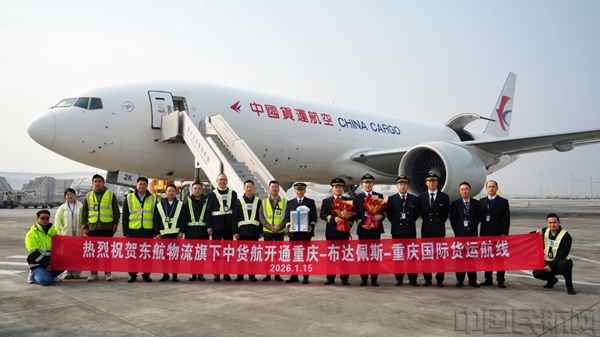
Core Viewpoint - The launch of the Chongqing-Budapest all-cargo flight route marks a significant step in enhancing international logistics and trade connections between China and Europe, particularly benefiting local industries in Chongqing and Budapest [1][2][3] Group 1: Route Details - The Chongqing-Budapest all-cargo route is the third international and regional all-cargo route established by China Cargo Airlines in Chongqing, with a cargo capacity of 86 tons and a planned operation of three flights per week [1][2] - Budapest, as the first Central and Eastern European country to sign a government cooperation document under the Belt and Road Initiative with China, serves as a key logistics hub in Europe due to its strategic location [2] Group 2: Economic Impact - The new route is expected to enhance trade relations between Chongqing and Hungary, significantly improving the supply chain response time for Chongqing's key products such as new energy vehicle parts and laptops [3] - The establishment of this route will also support Budapest in enhancing its logistics distribution capabilities within Europe, facilitating deeper integration of the China-Europe industrial chain [3] Group 3: Future Developments - Chongqing Jiangbei Airport aims to continue expanding its international cargo flight network, targeting high-quality development as an international aviation logistics hub, with a focus on connecting Southeast Asia and Europe and North America [3] - Currently, Chongqing Jiangbei Airport operates 23 international (regional) cargo routes with a weekly flight volume of 77, gradually building a comprehensive international logistics corridor [3]
探访全球首座电视行业“灯塔工厂”
Xin Hua She· 2026-01-16 06:48
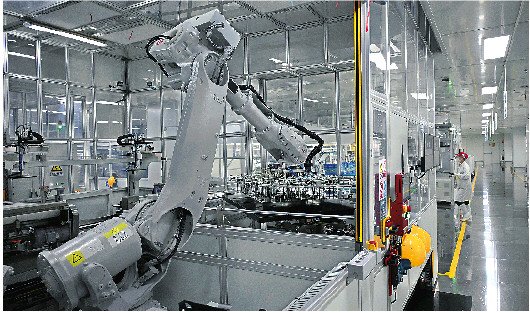
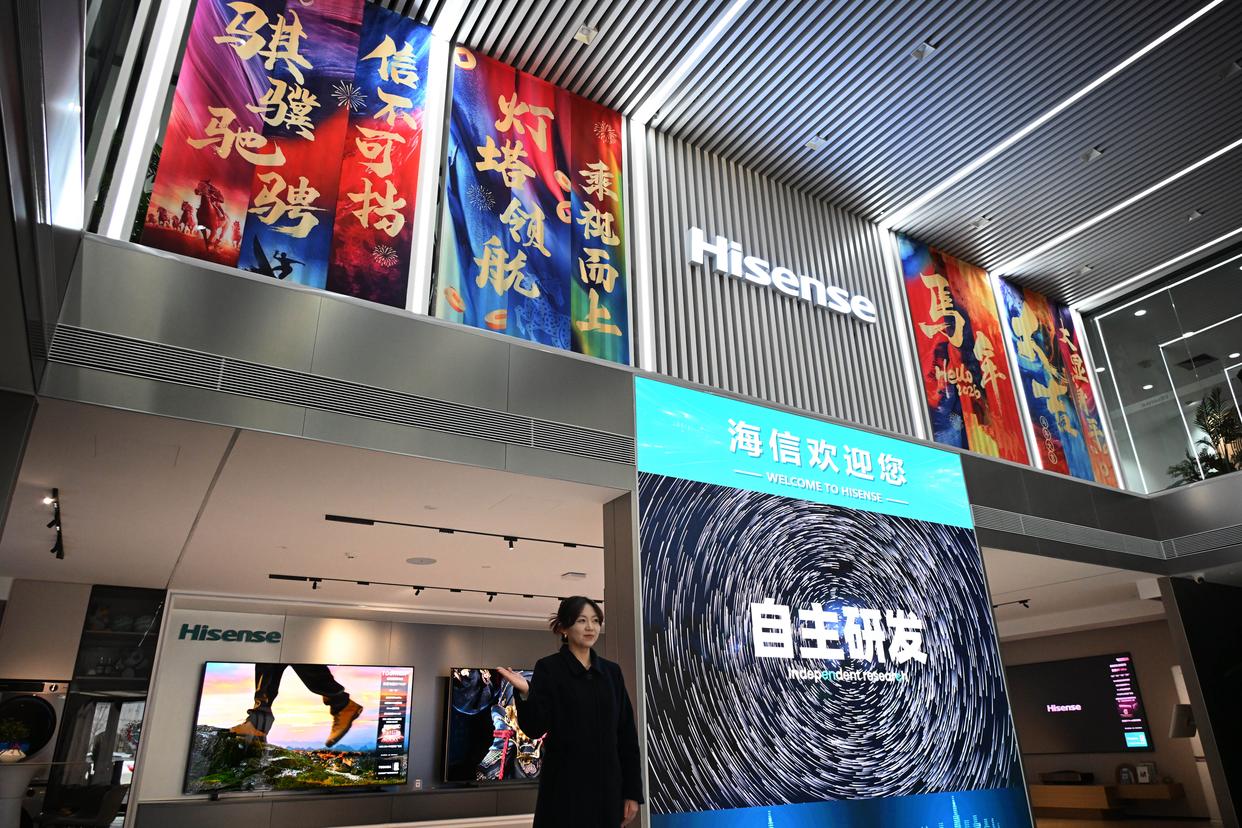
海信视像工作人员在介绍青岛工厂基于物联网技术构建的设备健康度管理模型(1月13日摄)。新华社记者 李紫恒 摄 新员工在海信视像青岛工厂VR大空间实训基地参加岗前培训(1月13日摄)。新华社记者 李紫恒 摄 一名海信视像青岛工厂员工从生产线旁经过(1月13日摄)。新华社记者 李紫恒 摄 工业机器人在海信视像青岛工厂智能装配线上忙碌(1月13日摄)。新华社记者 李紫恒 摄 1月15日,世界经济论坛(WEF)公布最新一期全球"灯塔工厂"名单,中国海信电视成为全球电视行业首家获此殊荣的企业。在位于山东青岛的海信视像工 厂,智能生产车间基于大语言模型、知识库检索、仿真赋能等技术,构建起全生产链智造闭环管理体系。海信视像首创基于AI的数字化工艺设计模式,沉 淀出超过10万条工艺数据的知识库,结合自主研发的星海大模型,可迅速自动生成涵盖工序步骤、操作要求、物料分配等全要素的工艺方案,搭配大量智能 工业机器人的应用,在减轻传统人工劳动强度同时,大大地提升了生产效率和产品质量。 海信视像青岛工厂迎宾展示大厅(1月13日摄)。新华社记者 李紫恒 摄 自动搬运机器人AGV在海信视像青岛工厂智慧仓储区运输物料(1月13日摄)。新华社 ...
海信视像电视工厂获评“灯塔工厂” 全链AI驱动大屏电视20秒瞬时智造
Zheng Quan Shi Bao Wang· 2026-01-16 06:48
在海信视像(600060)电视工厂,一台台85英寸大屏电视正以惊人的效率流转——平均每 20秒便能完 成一台成品下线。日前,这座电视工厂被世界经济论坛(WEF)评选入最新一期全球"灯塔工厂"名单, 海信视像成为全球电视行业首家获此称号的企业,同时海信视像电视工厂也是行业首个"以用户为中心 +全链AI智造""双引擎"数字化转型工厂。 在智造环节,AI带来的效率和质量提升同样震撼。海信打造了行业领先的第三代数字化高效电视生产 线,集成了25项海信自研的首台套自动化设备,其中11项为业内首创。 以通过机器人实现"面板自动精准卡合"这一行业首创技术为例,以往85英寸大屏面板的精准装配需要5 名工人手动对齐,不仅费力,还存在精度偏差和效率瓶颈。如今,这里搭载了行业首创的矩阵式面板精 确卡合方案,通过多组高精度视觉相机为机器人赋能"眼睛",搭配AI"大脑"实现自动撕膜、精准装配和 实时校准的全流程自动化操作,它能实现0.1毫米级的精准定位,确保每次抓取和装配都毫厘不差。 "这样可以将一线制造同事从重体力、重复性的劳动中解放出来,让他们可以做技术性更强的工作 。我 们相信,技术的进步不是为了替代人,而是为了让人从重复劳动中 ...
中国灯塔工厂数量已突破百家大关
麦肯锡· 2026-01-16 04:01
Core Insights - The Global Lighthouse Network has added 23 new manufacturing benchmark companies, reflecting the ongoing industrial transformation and ambition for change in the global manufacturing sector since its inception in 2018 [2][3] - The new lighthouse factories are transitioning from fragmented digital pilots to comprehensive AI-driven transformations, excelling in five dimensions: production efficiency, supply chain resilience, customer-centricity, sustainability, and talent [3][5] - China has surpassed 100 lighthouse factories, marking a significant milestone in smart manufacturing and showcasing the country's capabilities in large-scale implementation and technological innovation [6] Group 1: New Lighthouse Factories - The new lighthouse factories are focusing on three AI-enabled scenarios: building scalable digital and data infrastructure for agility, empowering employees through human-machine collaboration, and enhancing AI impact through cross-departmental collaboration [5] - These factories are evolving from "smart factories" to "cognitive networks," achieving a balance between speed, standardization, autonomy, visibility, connectivity, and cybersecurity [5] Group 2: Industry Impact - The Global Lighthouse Network aims to recognize world-class factories and value chains that excel in production efficiency, supply chain resilience, customer-centricity, sustainability, and talent [8] - The initiative is a collaboration between the World Economic Forum and McKinsey & Company, supported by industry leaders committed to shaping the future of global manufacturing [8]

全球首个电视“灯塔工厂”诞生记
Jing Ji Guan Cha Wang· 2026-01-16 03:27
Core Viewpoint - The World Economic Forum has welcomed 23 new "lighthouse factories" into its global network, showcasing advanced technologies that enhance production efficiency, supply chain resilience, sustainability, talent development, and customer-centric practices. Hisense's Qingdao factory is the only "lighthouse factory" in the global television industry, recognized for its intelligent, digital, and user-centered manufacturing capabilities [1]. Group 1: Factory Overview - Hisense's Qingdao factory covers an area of 310,000 square meters and produces a television every 20 seconds, representing a decade of continuous upgrades in smart manufacturing [1]. - The factory aims to combine top-tier smart manufacturing capabilities with a deep focus on user needs, transitioning from a single product technology advantage to a comprehensive advantage that includes cutting-edge technology, industrial manufacturing, and user experience [2]. Group 2: Challenges and Solutions - Hisense faced the challenge of adapting to diverse global market preferences, leading to the development of hundreds of television models annually. The company shifted its focus from merely "excellence in manufacturing" to a user-centered approach utilizing AI, big data, and VR simulation [2][3]. - The construction of a "lighthouse factory" requires significant technical accumulation and continuous investment over a decade, with Hisense starting its smart manufacturing initiative as a top priority in 2015 [3][4]. Group 3: Technological Integration - Hisense has integrated AI throughout the entire production process, utilizing over 40 use cases that combine intelligent agents, big data, VR, and digital simulation technologies to enhance efficiency, quality, and flexible manufacturing [7]. - The factory has achieved a 34% reduction in R&D cycles and an 18% decrease in material costs, while also improving employee training time by 60% [8]. Group 4: Future Vision - The future vision for Hisense includes the development of a "factory brain" that can manage and optimize multiple factories globally, enhancing standardization and intelligence in production processes [11]. - The plan to replicate the "lighthouse factory" model involves four steps: establishing IoT connectivity, empowering AI scenarios, coordinating global factories, and evolving into a smart entity capable of proactive decision-making [10].
邓庆旭对话贾少谦:恪守质量信仰,做快时代中的坚守者
Xin Lang Cai Jing· 2026-01-16 02:55
Core Viewpoint - The fundamental principle for a manufacturing enterprise, regardless of market cycles, is to prioritize quality as its core value [1][11]. Group 1: Company Development and Strategy - Hisense has shown steady growth over the past year, showcasing its latest World Cup customized products at CES, emphasizing "AI technology" and its advancements in artificial intelligence and smart hardware [1][11]. - The company has a long-standing commitment to quality, which is deeply embedded in its corporate philosophy and operational practices [3][14]. - Hisense's development strategy has evolved to include high technology, high quality, and high-level service since the maturation of the Chinese market economy in 1993 [3][13]. Group 2: Quality Management Philosophy - Hisense maintains a zero-tolerance policy towards quality issues, believing that even a 0.01% defect rate can lead to a complete failure for affected customers [3][13]. - The company has institutionalized its quality philosophy into what is known as the "Seven Military Regulations" for quality management [3][13]. - Quality is viewed as a moral obligation and a core value that cannot be overlooked, as stated by the chairman [4][18]. Group 3: Technological Innovation and R&D - Hisense has invested significantly in chip technology, being the only domestic home appliance company involved in research across various semiconductor fields [4][15]. - The RGB-Mini LED technology represents a breakthrough in display technology, requiring advanced capabilities in both RGB lighting and image quality control [5][15]. - The development of the "Xinxin" chip in 2005 marked a milestone for Hisense, enabling the company to lead in display technology [15]. Group 4: Digital Quality Management - Hisense is implementing a digital quality management system that leverages AI and machine vision for real-time monitoring and anomaly detection, shifting from post-production checks to proactive quality control [7][17]. - The company has established a digital framework that integrates research, supply chain, quality improvement, and carbon management, addressing traditional traceability challenges [6][16]. - Hisense's Qingdao factory has been recognized as a "lighthouse factory," showcasing its advanced AI-driven quality control processes that have improved detection efficiency by 70.7% [7][17]. Group 5: Global Brand Positioning - As a global sponsor for the upcoming 2026 World Cup, Hisense aims to enhance its brand visibility and trust through high-quality products showcased at major sporting events [9][19]. - The company emphasizes that quality is essential for brand strength and global competitiveness, committing to further integrate AI into its quality ecosystem [8][18]. - Hisense's approach to manufacturing focuses on long-term foundational values, ensuring that quality remains a priority in all aspects of its operations [10][19].
广东启动“广货行天下”春季行动,家电打头阵
Zhong Guo Xin Wen Wang· 2026-01-16 02:54
Group 1 - The "Guangdong Products Going Global" spring action was launched on January 15 in Foshan, marking the beginning of the 2026 promotional activities for Guangdong products [1] - The spring action covers 12 major categories including home appliances, mobile phones, clothing, food, smart terminals, automobiles, beauty and daily necessities, cultural tourism, and agriculture, attracting over 6,000 participating enterprises [1] - The first event focused on home appliances, featuring over 1,900 large-scale home appliance companies in Guangdong, with 55 well-known brands such as Midea, Gree, Galanz, and Hisense showcasing quality products and conducting live-stream sales [1] Group 2 - The promotional campaign is structured around a multi-layered discount system involving government subsidies, enterprise discounts, and platform support, providing consumers with various benefits including government "national subsidies," brand direct discounts, platform exclusive live prices, and consumer vouchers [2] - The Guangdong Provincial Department of Industry and Information Technology stated that the "Guangdong Products Going Global" initiative aims to enhance the market exposure and influence of high-quality industrial products from Guangdong, promoting online sales and contributing to economic stability [2] - The department plans to hold 12 online promotional events in a "one product per week" rhythm leading up to the Spring Festival, focusing on advantageous industries such as mobile phones, clothing, and food [2]

