老板电器

Search documents
海尔、美的、TCL、松下…家电巨头们正掀起一场AI联姻潮
Guan Cha Zhe Wang· 2025-10-14 10:08
Core Insights - The home appliance market in China is undergoing a transformation as companies partner with AI technology firms to explore new paths for growth following the end of government subsidies [1][3] - Major players like Haier, TCL, and Midea are actively engaging in AI collaborations, indicating a shift towards integrating AI into their product offerings and operational strategies [1][4] Group 1: AI Collaborations - Haier has signed a comprehensive strategic cooperation agreement with Alibaba, marking a significant step in the ongoing trend of home appliance and AI partnerships [1] - TCL is working with Alibaba Cloud to develop a specialized AI model focused on semiconductor display technology, enhancing smart terminal image quality and interaction [3] - Midea is collaborating with Huawei to create a smart home ecosystem, aiming for seamless interconnectivity across devices and brands [4] Group 2: Marketing and Global Expansion - The partnership between Haier and Alibaba will also focus on deepening cooperation in e-commerce, leveraging Haier's industrial strengths and Alibaba's overseas e-commerce framework to build a digital ecosystem [7] - International brands like Panasonic are also entering AI collaborations, with plans to develop smart home solutions for Southeast Asia and the Middle East in partnership with Alibaba Cloud [7]





厨卫电器板块10月14日涨0.55%,万和电气领涨,主力资金净流出942.64万元
Zheng Xing Xing Ye Ri Bao· 2025-10-14 08:39
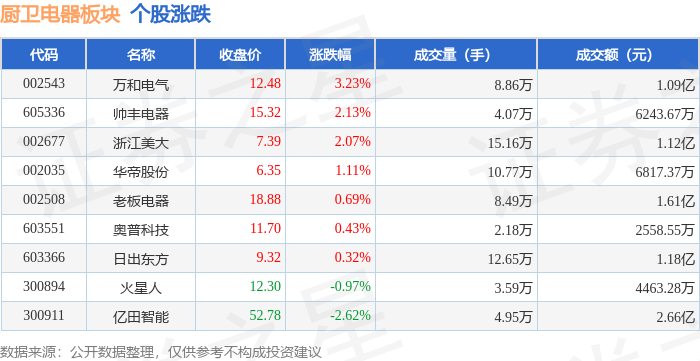
Core Insights - The kitchen and bathroom appliance sector saw a rise of 0.55% on October 14, with Wanhe Electric leading the gains [1] - The Shanghai Composite Index closed at 3865.23, down 0.62%, while the Shenzhen Component Index closed at 12895.11, down 2.54% [1] Sector Performance - Wanhe Electric (002543) closed at 12.48, up 3.23% with a trading volume of 88,600 shares and a turnover of 109 million yuan [1] - Shuaifeng Electric (605336) closed at 15.32, up 2.13% with a trading volume of 40,700 shares and a turnover of 62.44 million yuan [1] - Zhejiang Meida (002677) closed at 7.39, up 2.07% with a trading volume of 151,600 shares and a turnover of 112 million yuan [1] - Other notable performances include Vatti (002035) up 1.11%, Boss Electric (002508) up 0.69%, and Aopu Technology (603551) up 0.43% [1] Capital Flow Analysis - The kitchen and bathroom appliance sector experienced a net outflow of 9.43 million yuan from institutional investors and 24.35 million yuan from retail investors, while individual investors saw a net inflow of 33.78 million yuan [1] - Specific stock capital flows indicate that Yitian Intelligent (300911) had a net inflow of 21.91 million yuan from institutional investors, while Wanhe Electric had a net inflow of 5.78 million yuan [2] - Boss Electric (002508) faced the largest net outflow from institutional investors at 28.59 million yuan, while retail investors contributed a net inflow of 32.01 million yuan [2]

申万宏源:白电板块股价安全边际高和弹性大兼顾 出口不改长期增长趋势
智通财经网· 2025-10-14 02:41
Group 1: White Goods Industry Overview - The white goods and kitchen appliances sector continues to show growth, benefiting from real estate policies and the "old-for-new" replacement program [1] - In the first eight months of 2025, the air conditioning industry produced 149.32 million units, a year-on-year increase of 6%, with sales reaching 152.57 million units, up 7% [1] - The domestic sales of refrigerators and washing machines also saw growth, with refrigerator sales up 4% and washing machine sales up 6% year-on-year [1] Group 2: Company Performance Expectations - Midea Group expects a 3% increase in revenue and an 8% increase in performance for Q3 2025 [2] - Gree Electric anticipates no change in revenue and net profit for Q3 2025 [2] - Haier Smart Home forecasts a 5% increase in revenue and a 10% increase in performance for Q3 2025 [2] Group 3: Kitchen Appliances Sector - The kitchen appliances sector is experiencing recovery due to real estate and the "old-for-new" policy, with Boss Electric expecting a 2% increase in revenue but a 7% decline in performance for Q3 2025 [3] - Other companies like Vatti and Yitian are also projecting flat or negative growth in revenue and performance for Q3 2025 [3] Group 4: Small Appliances Sector - The small appliances sector is seeing significant growth, with companies like Stone Technology expecting an 80% increase in revenue and a 40% increase in performance for Q3 2025 [4] - Other brands like Joyoung and Supor are also projecting varying degrees of growth in revenue and performance for Q3 2025 [4] Group 5: New Display and Lighting Sector - The emerging display sector is at a turning point, with Hisense Visual expecting an 8% increase in revenue and a 20% increase in performance for Q3 2025 [5] - Companies like OP Lighting and XGIMI are also forecasting modest growth in revenue for Q3 2025 [5]


厨卫电器板块10月13日跌0.05%,万和电气领跌,主力资金净流出1560.47万元
Zheng Xing Xing Ye Ri Bao· 2025-10-13 12:38
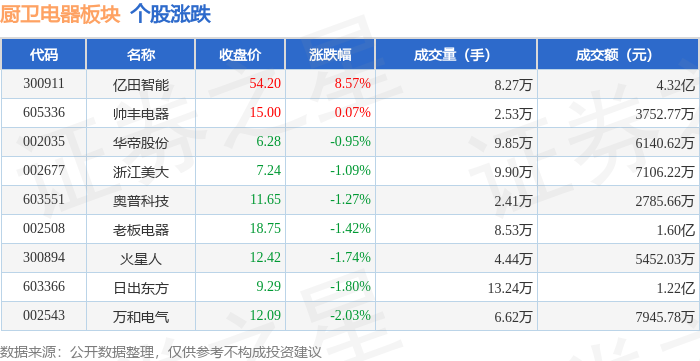
Market Overview - The kitchen and bathroom appliance sector experienced a slight decline of 0.05% on October 13, with Wanhe Electric leading the drop [1] - The Shanghai Composite Index closed at 3889.5, down 0.19%, while the Shenzhen Component Index closed at 13231.47, down 0.93% [1] Stock Performance - Yichu Xiangneng (300911) saw the highest increase, closing at 54.20 with a rise of 8.57% and a trading volume of 82,700 shares [1] - Other notable performances include: - Shuaifeng Electric (605336) at 15.00, up 0.07% - Weisheng Co. (002035) at 6.28, down 0.95% - Zhejiang Meida (002677) at 7.24, down 1.09% - Aopu Technology (603551) at 11.65, down 1.27% - Boss Electric (002508) at 18.75, down 1.42% - Huoxingren (300894) at 12.42, down 1.74% - Rishidongfang (603366) at 9.29, down 1.80% - Wanhe Electric (002543) at 4.12, down 2.03% [1] Capital Flow - The kitchen and bathroom appliance sector saw a net outflow of 15.60 million yuan from institutional investors, while retail investors contributed a net inflow of 0.91 million yuan [1] - Detailed capital flow for selected stocks includes: - Zhejiang Meida (002677): Institutional net inflow of 2.48 million yuan, retail net outflow of 2.60 million yuan [2] - Yichu Xiangneng (300911): Institutional net inflow of 1.91 million yuan, retail net outflow of 2.49 million yuan [2] - Aopu Technology (603551): Institutional net inflow of 1.44 million yuan, retail net outflow of 3.92 million yuan [2] - Wanhe Electric (002543): Institutional net inflow of 0.43 million yuan, retail net outflow of 5.33 million yuan [2] - Boss Electric (002508): Institutional net outflow of 0.58 million yuan, retail net outflow of 6.65 million yuan [2] - Shuaifeng Electric (605336): Institutional net outflow of 1.07 million yuan, retail net inflow of 1.55 million yuan [2] - Huoxingren (300894): Institutional net outflow of 1.42 million yuan, retail net inflow of 1.88 million yuan [2] - Rishidongfang (603366): Institutional net outflow of 18.57 million yuan, retail net inflow of 17.63 million yuan [2]
老板电器入围《经济观察报》2024—2025年度受尊敬企业
Jing Ji Guan Cha Wang· 2025-10-13 09:36
Group 1 - The company Boss Electric (002508) has been recognized as a respected enterprise for the 2024-2025 period by Economic Observer, highlighting its excellent performance in quality operations, innovation breakthroughs, and social contributions [1] - According to the comprehensive value assessment system for listed companies in China, the company has achieved positive growth in operating revenue and total assets for three consecutive years [1]

抢公章、堵审计,内斗11年终“改姓”:昔日“厨电第一股”,快被拖垮了
商业洞察· 2025-10-13 09:23
Core Viewpoint - Vatti Holdings, once hailed as the "first stock in kitchen appliances," has transformed into a family business after 11 years of internal strife, culminating in a board dominated by the Pan family and the removal of restrictions on family members holding executive positions [2][4]. Group 1: Internal Struggles and Governance Changes - The recent shareholder meeting resulted in the election of Sun Dongbo as an independent director, leaving four out of the seven board members as members of the Pan family [2][4]. - The company amended its articles of association to remove the clause prohibiting relatives of founders from holding executive positions, overturning the previous agreement established by the "Seven Gentlemen of Vatti" [4][6]. - The internal conflict peaked in March 2023 when the former chairman of Vatti Electronics, Wu Gang, refused to cooperate with the parent company's audit, leading to a dramatic confrontation that ended with Vatti Holdings acquiring 60% of Vatti Electronics from Wu Gang and others [4][22]. Group 2: Financial Performance and Market Position - Vatti's revenue in 2024 was only 6.3 billion yuan, significantly trailing behind competitors like Fotile and Boss Appliances, which reported revenues of 17.6 billion yuan and 11.2 billion yuan, respectively [4][22]. - The company's performance continued to decline in Q1 2025, with revenue and net profit dropping by 8.8% and 14.33%, respectively, compared to the same period last year [22][23]. - From 2017 to 2022, Vatti's revenue compound annual growth rate was only 0.31%, and net profit fell from 510 million yuan to 143 million yuan [22][24]. Group 3: Product and Brand Challenges - Vatti's traditional product lines, including stoves and disinfection cabinets, have seen significant declines, with disinfection cabinet sales plummeting by 18.96% and cabinet sales dropping by 57.59% [26][27]. - The company's market share in the high-end kitchen appliance segment has drastically decreased, with a 6.8 percentage point loss in the mid-range market over five years [26][27]. - Vatti's reputation has suffered due to numerous consumer complaints regarding product quality and inadequate after-sales service, with thousands of complaints filed on platforms like Black Cat Complaints [27][28]. Group 4: Research and Development Investment - In 2024, Vatti's R&D investment was 263 million yuan, representing only 4.13% of its revenue, while its sales expenses reached 702 million yuan [31]. - The company holds 3,287 effective patents, which is less than half of Fotile's, and less than 30% of these are invention patents [31][31]. - Vatti's strategic focus on marketing over R&D has contributed to its declining brand loyalty and market position, as it struggles to keep pace with competitors [28][31].


毛利率逆势领跑行业!华帝股份44.1%高毛利背后的“战略突围”
Xin Lang Zheng Quan· 2025-10-11 02:48
Core Insights - The overall sales of the kitchen and bathroom industry in the first half of 2025 showed growth, but there was significant differentiation in performance across various product categories [1] - Vatti Co., Ltd. achieved approximately 2.8 billion yuan in revenue and 272 million yuan in net profit attributable to shareholders in the first half of 2025, with an improvement in overall gross margin [1][2] - The company's gross margin increased by 3 percentage points to 44.1%, with core products like range hoods, stoves, and water heaters showing year-on-year improvements in gross margins [1][3] Industry Performance - The retail volume of kitchen and bathroom appliances grew by 5.1% year-on-year, while retail sales increased by 3.9%, indicating a slower growth in sales compared to volume [2] - The high-end and smart appliance segments are experiencing significant growth, with sales shares of high-priced products increasing notably [2] Company Strategy and Innovation - Vatti's gross margin for offline channels rose by 6.83 percentage points to 45.89%, while the new retail channel's gross margin reached 41.51% [3] - The company focuses on enhancing profitability, capturing market share, and improving operational efficiency, with a strong emphasis on high-end strategies, marketing capabilities, and product innovation [4] - Vatti launched several new products in March 2025, including the GW6i beauty bath gas water heater and the FA50P steam and baking integrated machine, marking the beginning of the high-end water heater era [4][5] - The company has filed 472 new patents this year, bringing the total to 4,690, emphasizing its commitment to innovation and differentiation in product offerings [5]
厨电巨头们今年钱都花哪了?
3 6 Ke· 2025-10-11 02:41
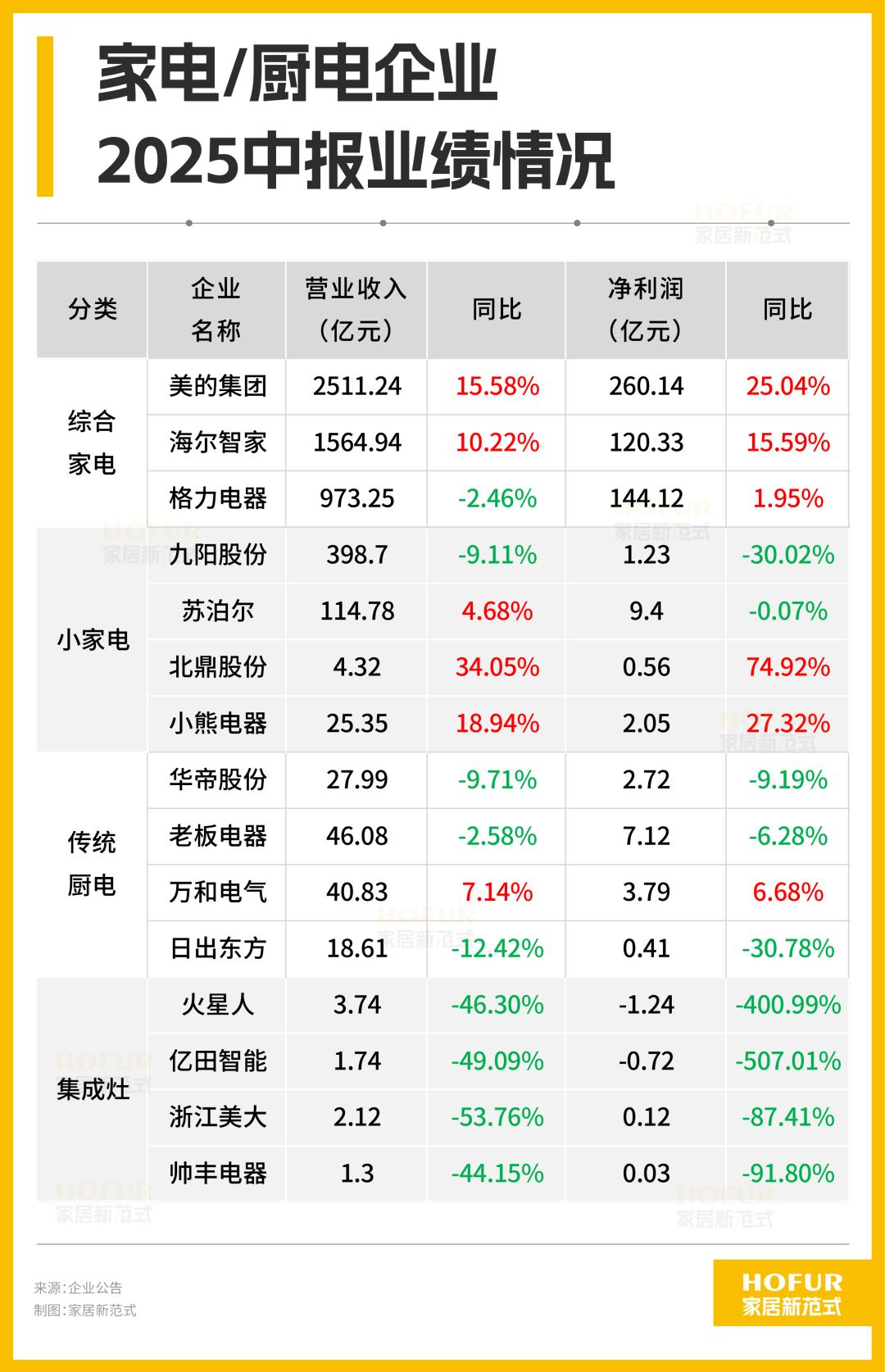
Core Viewpoint - The home appliance industry is experiencing a significant divergence in performance, with comprehensive and small appliance companies thriving, while traditional kitchen appliance and integrated stove companies are struggling with declining revenues and profits [1][4]. Group 1: Performance Overview - Comprehensive appliance giants like Midea and Haier are benefiting from national subsidy policies, overseas market growth, and innovative smart products, achieving revenue growth of 15.58% and 10.22% respectively [2][4]. - In contrast, traditional kitchen appliance companies such as Vatti and Boss Electric are facing revenue declines, with Vatti's revenue down by 9.71% and Boss Electric's by 2.58% [2][4]. - Integrated stove companies, referred to as the "four little dragons," are collectively experiencing significant revenue and profit declines, with companies like Mars and Yitian reporting losses [3][4]. Group 2: Financial Metrics - Midea Group reported a revenue of 251.12 billion and a net profit of 26.01 billion, while Haier's revenue was 156.49 billion with a net profit of 12.03 billion [2]. - The gross profit margin and net profit margin of leading companies like Boss Electric and Vatti are significantly higher than those of emerging brands, indicating a clear tiered differentiation in profitability [5][8]. - Boss Electric leads the industry with a gross profit margin of 50.43% and a net profit margin of 15.26%, showcasing its strong position in the high-end kitchen appliance market [5][8]. Group 3: Strategic Insights - The report highlights a shift in kitchen appliance companies from scale expansion to quality and efficiency, with leading firms maintaining high gross margins through brand and technology barriers [13][34]. - Companies are increasingly focusing on optimizing product structures and diversifying their offerings to mitigate risks, as seen with Boss Electric's entry into cabinet products [30][34]. - New retail, lower-tier markets, and overseas expansion are becoming key channels for growth, with companies like Vatti and Midea actively building new retail channels and expanding their presence in overseas markets [30][32]. Group 4: Cash Flow and Financial Management - The analysis indicates that cash flow is crucial for companies to withstand market fluctuations, with leading firms like Boss Electric and Vatti demonstrating strong cash flow generation capabilities [18][25]. - Most companies are tightening their investment strategies, focusing on cash flow management and reducing leverage to maintain operational stability [21][23]. - The financial management of traditional brands is generally more robust, with lower management expenses and effective cost control compared to emerging brands facing higher operational costs [17][25].

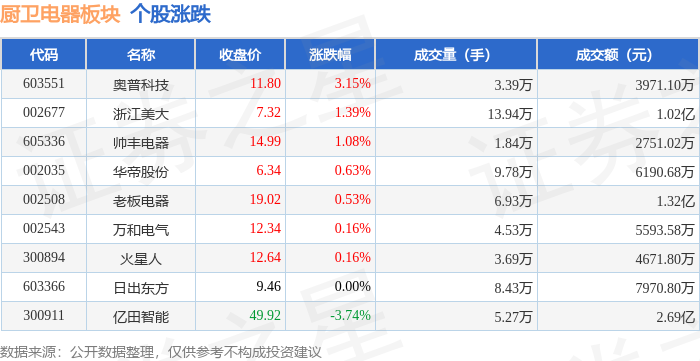
厨卫电器板块10月10日涨0.05%,奥普科技领涨,主力资金净流出2144.36万元
Zheng Xing Xing Ye Ri Bao· 2025-10-10 08:45
Core Insights - The kitchen and bathroom appliance sector experienced a slight increase of 0.05% on October 10, with Aopu Technology leading the gains [1] - The Shanghai Composite Index closed at 3897.03, down 0.94%, while the Shenzhen Component Index closed at 13355.42, down 2.7% [1] Sector Performance - Aopu Technology (603551) closed at 11.80, up 3.15% with a trading volume of 33,900 shares and a turnover of 39.71 million yuan [1] - Zhejiang Meida (002677) closed at 7.32, up 1.39% with a trading volume of 139,400 shares and a turnover of 102 million yuan [1] - Shuaixing Electric (605336) closed at 14.99, up 1.08% with a trading volume of 18,400 shares and a turnover of 27.51 million yuan [1] - Other notable performances include Vatti Corporation (002035) up 0.63%, and Boss Electric (002508) up 0.53% [1] Capital Flow Analysis - The kitchen and bathroom appliance sector saw a net outflow of 21.44 million yuan from institutional investors, while retail investors contributed a net inflow of 28.36 million yuan [1] - Aopu Technology experienced a net outflow of 730,000 yuan from institutional investors, while retail investors had a net inflow of 502,060 yuan [2] - Boss Electric (002508) had a net inflow of 8.037 million yuan from institutional investors, despite a net outflow of 974,930 yuan from speculative funds [2]


抢公章、堵审计,内斗11年终“改姓”:昔日“厨电第一股”,快被拖垮了
首席商业评论· 2025-10-10 04:34
Core Viewpoint - The article discusses the decline of Vatti Corporation, once a leading player in the kitchen appliance industry, highlighting internal conflicts, management issues, and market competition as key factors contributing to its downfall [4][7][26]. Group 1: Internal Conflicts and Management Changes - Vatti Corporation has experienced prolonged internal strife, culminating in a board reshuffle that solidified the dominance of the Pan family, with the majority of board members now being family members [5][6]. - The company has modified its bylaws to remove restrictions on family members holding executive positions, signaling a shift towards a family-controlled enterprise [6][7]. - The internal power struggle peaked in 2023 when a conflict over control of Vatti Electronics led to a public dispute involving accusations of misconduct and a subsequent acquisition of shares to resolve the issue [22][24]. Group 2: Financial Performance and Market Position - Vatti's revenue has significantly lagged behind competitors, with 2024 revenues at 6.3 billion yuan, far below the 17.6 billion yuan of Fotile and 11.2 billion yuan of Boss Appliances [7][24]. - The company has seen a compound annual growth rate (CAGR) of only 0.31% from 2017 to 2022, with net profit plummeting from 510 million yuan to 143 million yuan during the same period [24][26]. - In Q1 2025, Vatti reported a revenue decline of 8.8% and a net profit drop of 14.33%, indicating ongoing financial struggles [25][24]. Group 3: Product and Brand Challenges - Vatti's product sales have suffered, with significant declines in key categories such as disinfection cabinets (down 18.96%) and cabinets (down 57.59%) in 2024 [28][29]. - The company's market share in the high-end segment has drastically decreased, with a notable loss of 6.8 percentage points in the mid-range market over five years [28]. - Consumer complaints regarding product quality and after-sales service have surged, reflecting a deteriorating brand reputation [29][31]. Group 4: Research and Development Investment - Vatti's R&D investment in 2024 was only 263 million yuan, representing a mere 4.13% of revenue, compared to competitors with higher R&D spending [32][33]. - The company holds 3,287 effective patents, which is less than half of Fotile's, and less than 30% of these are invention patents, indicating a lack of innovation [33]. Group 5: Future Outlook - Vatti faces a critical juncture, needing to address internal issues and adapt to a rapidly changing market landscape to avoid further decline [33]. - The company must decide whether to continue its current trajectory or make significant changes to regain market relevance and consumer trust [33].