华利集团

Search documents
华利集团:第三季度归母净利润7.65亿元,同比下降20.73%
Xin Lang Cai Jing· 2025-10-29 12:01
Core Insights - The company reported a revenue of 6.019 billion yuan for Q3 2025, representing a year-on-year decline of 0.34% [1] - The net profit attributable to shareholders was 765 million yuan, down 20.73% year-on-year [1] - The basic earnings per share stood at 0.66 yuan [1]
华利集团(300979) - 2025 Q3 - 季度财报
2025-10-29 11:55
2025 年第三季度报告 本公司及董事会全体成员保证信息披露的内容真实、准确、完整,没有虚假记载、误 导性陈述或重大遗漏。 中山华利实业集团股份有限公司 2025 年第三季度报告 证券代码:300979 证券简称:华利集团 公告编号:2025-062 中山华利实业集团股份有限公司 3.第三季度财务会计报告是否经过审计 □是 否 一、主要财务数据 (一) 主要会计数据和财务指标 重要内容提示: 1.董事会及董事、高级管理人员保证季度报告的真实、准确、完整,不存在虚假记载、误导性陈述或重大遗漏,并承担 个别和连带的法律责任。 2.公司负责人、主管会计工作负责人及会计机构负责人(会计主管人员)声明:保证季度报告中财务信息的真实、准确、 完整。 公司是否需追溯调整或重述以前年度会计数据 □是 否 | | 本报告期 | 本报告期比上年 | 年初至报告期末 | 年初至报告期末 | | --- | --- | --- | --- | --- | | | | 同期增减 | | 比上年同期增减 | | 营业收入(元) | 6,018,738,053.15 | -0.34% | 18,679,602,486.47 | 6.67% ...
政策引导分红回报力度 118只个股最新股息率超5%
Zheng Quan Shi Bao· 2025-10-28 18:22
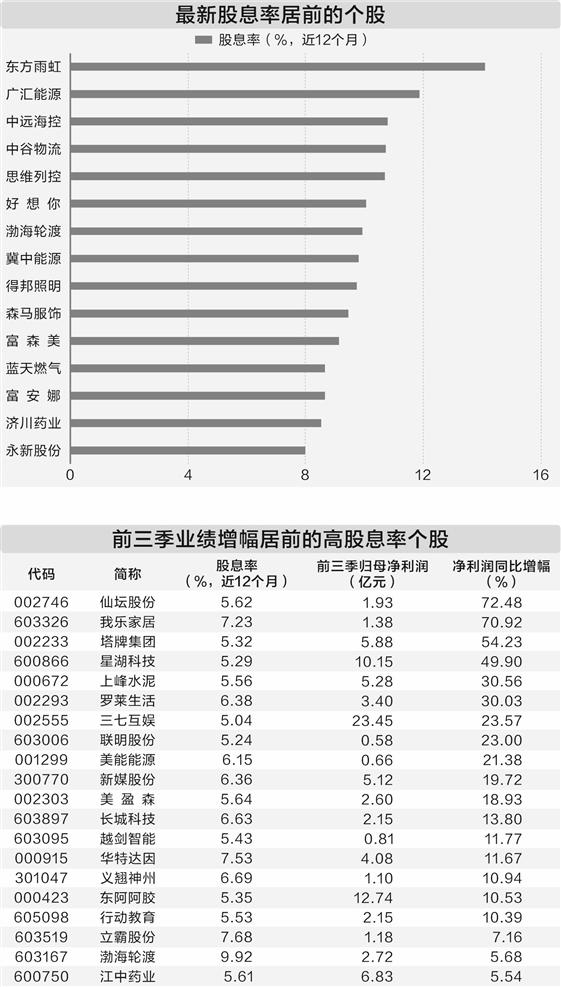
Core Viewpoint - The China Securities Regulatory Commission has proposed measures to enhance investor returns by encouraging listed companies to adopt share buybacks and increase dividend distributions, marking a shift towards a return-focused capital market [2][3]. Group 1: Dividend Policies and Trends - The new guidelines advocate for listed companies to implement multiple dividend distributions annually, enhancing the stability and predictability of dividends [3]. - The current policy environment is favorable for dividend investments, with a significant number of companies showing high dividend yields, particularly in a context of declining risk-free interest rates [3][4]. Group 2: High Dividend Yield Stocks - As of October 28, there are 118 stocks with a dividend yield exceeding 5%, with 6 stocks surpassing 10%, including Dongfang Yuhong at 14.1% and Guanghui Energy at 11.87% [4]. - Dongfang Yuhong has distributed a total of 5.881 billion yuan in cash dividends over the past year, while Guanghui Energy has a cumulative dividend of over 16.3 billion yuan from 2021 to 2024 [4]. Group 3: Performance of High Dividend Stocks - Among high dividend yield stocks, 24 companies reported significant net profit growth in the first three quarters, with Xiantan Co. leading at a 72.48% increase [5]. - Other notable performers include Wo Le Home with a 70.92% increase and Tapai Group with a 54.23% increase in net profit [5]. Group 4: Valuation and Growth Potential - A total of 21 stocks with high dividend yields are identified as undervalued, showing potential for significant price appreciation, with some having a price-to-earnings ratio below 20 and a price-to-book ratio below 2 [6]. - Hongcheng Environment is highlighted for its substantial growth potential, with a projected price increase of 42.83% and a stable dividend yield [6][7].

买阿迪达斯羽绒服的人,被上了一课
盐财经· 2025-10-28 09:42
Core Viewpoint - The article discusses the outsourcing model of Adidas, highlighting consumer reactions to the revelation that their products are manufactured by third-party factories like Xuezhongfei, which has sparked discussions about brand transparency and consumer awareness [4][12][23]. Group 1: Adidas Outsourcing Model - Adidas has largely outsourced its production to third-party factories, focusing on design, research, and marketing to maximize profits [4][8]. - The company has no significant production lines of its own, with only a small percentage of high-end products manufactured in Germany [8][12]. - The outsourcing model allows Adidas to maintain a "light asset" operation, reducing fixed asset investments and risks while enabling quick adjustments to production based on market changes [18][20]. Group 2: Consumer Reactions and Market Dynamics - Consumers have expressed dissatisfaction upon discovering that Adidas products are made by Xuezhongfei, leading to discussions about the price differences between branded and unbranded products [6][24]. - The price comparison shows that Adidas's down jacket, priced at 867.71 yuan with 70% down content, is significantly more expensive than a similar product from Xuezhongfei, which costs 569 yuan with 85% down content [6][8]. - The article notes a shift in consumer awareness, with a growing demand for transparency regarding product origins and manufacturing processes [23][24]. Group 3: Global Production Strategy - Adidas's production strategy has evolved, with a significant shift of manufacturing bases from China to Southeast Asia, particularly Cambodia and Vietnam, driven by cost considerations and supply chain optimization [16][20]. - In 2021, Cambodia became the largest manufacturing country for Adidas apparel, accounting for 21% of total production, while China's share dropped to 20% [16]. - Recent strategic adjustments have seen an increase in locally produced goods in China, with 95% of products sold in the Chinese market being "Made in China" [17]. Group 4: Quality Control and Challenges - The outsourcing model presents challenges in quality control, with reports of product quality issues arising from factories in Vietnam and Cambodia [20][22]. - The relationship between brands and their manufacturing partners is complex, balancing the need for production capacity with the risk of competition from the manufacturers themselves [22]. - The article emphasizes the importance of maintaining brand image and consumer trust, suggesting that brands should enhance supply chain transparency to meet evolving consumer expectations [23].


从运动鞋到羽绒服,阿迪达斯几乎没有自己的生产线
阿尔法工场研究院· 2025-10-28 00:06
Core Viewpoint - The article discusses the outsourcing model of Adidas, highlighting consumer reactions to the revelation that their products are manufactured by third-party factories like Xuezhongfei, leading to discussions about brand transparency and consumer awareness [4][5][8]. Group 1: Adidas Outsourcing Model - Adidas has largely outsourced its production to third-party factories, focusing on design, research, and marketing to maximize profits [4][8]. - The company has no significant production lines of its own, with most of its manufacturing done by factories in regions like Guangdong and Fujian, China [8][9]. - The outsourcing strategy allows Adidas to maintain flexibility in production and cost management, enabling quick adjustments to market changes [15][16]. Group 2: Consumer Reactions and Market Dynamics - Consumers expressed dissatisfaction upon discovering that high-priced Adidas products were made by Xuezhongfei, prompting discussions about the value of brand versus actual product quality [5][19]. - A comparison of prices revealed that similar products from Xuezhongfei were significantly cheaper, raising questions about the pricing strategies of major brands like Adidas [5][19]. - The article notes a shift in consumer awareness, with buyers increasingly interested in the actual manufacturing details rather than just the brand name [18][19]. Group 3: Strategic Adjustments and Market Performance - Adidas has been adjusting its production strategy, with a notable increase in locally produced items in China, reflecting a shift back towards domestic manufacturing [12][14]. - The company aims to regain consumer trust through deeper localization and responsiveness to market demands, as evidenced by its plans to establish a new headquarters in Shanghai [14]. - Recent financial performance indicates a positive trend, with Adidas's revenue in the Greater China region growing by 10% year-on-year in 2024, showcasing the effectiveness of its strategic adjustments [15].
中国银河证券:细分需求引领新供给,服饰消费迎新机
Xin Lang Cai Jing· 2025-10-27 09:01
中国银河证券发布研报表示,"十五五"期间技术创新在纺服行业将赋能企业提质增效,新材料研发拓展 产品功能边界,满足消费者个性化需求,持续推动纺服行业从传统加工向高附加值方向转型升级。1、 户外场景渗透,国产体育龙头在丰富品类,精细化管理上具有竞争优势,关注安踏体育、特步国际、李 宁、361度。2、品牌服饰在产品、运营模式上有创新供给,关注海澜之家、比音勒芬、波司登。3、上 游制造在国际化产能布局、绑定优质品牌客户以及具有规模效应的龙头纺织企业,关注开润股份、华利 集团、伟星股份、申洲国际。 ...

轻工制造及纺服服饰行业周报:泡泡玛特Q3收入超预期,康耐特独供夸克AI眼镜近视镜片-20251027
ZHONGTAI SECURITIES· 2025-10-27 08:51
Investment Rating - The report maintains an "Overweight" rating for the light industry manufacturing sector [3] Core Insights - Pop Mart's Q3 revenue performance exceeded market expectations, with a year-on-year growth of 245%-250% for Q3 2025, driven by strong performance in both domestic and overseas markets [5][6] - The report emphasizes the importance of new consumption valuation switching logic and highlights the stable operational performance of sports brands in Q3 [3] - The report suggests that the overseas market is a key growth engine for Pop Mart, with significant growth potential in regions like the Americas and Asia-Pacific [5][6] Summary by Sections Market Overview - The light industry manufacturing index increased by 2.62%, ranking 12th among 28 industries, while the textile and apparel index rose by 0.37%, ranking 25th [11] - Key sub-sectors within light industry manufacturing showed positive growth, including packaging and printing (3.27%) and paper (2.65%) [11] Company Performance - Pop Mart's Q3 revenue growth was driven by a 185%-190% increase in domestic revenue and a 365%-370% increase in overseas revenue [5] - The report highlights the strong demand for Pop Mart's IP products, which are currently in a supply-demand imbalance [5][6] Industry Trends - The report notes a shift in consumer behavior towards "emotional consumption," which is expected to drive demand for collectible toys and related products [5] - The report identifies several companies within the sector that are expected to perform well, including Sun Paper, Baiya, and Huali Group, with recommendations to buy or hold based on their growth potential [3][6] Financial Metrics - The report provides financial forecasts for key companies, including earnings per share (EPS) and price-to-earnings (PE) ratios, indicating a positive outlook for the sector [3][6]

关税风险基本落地,纺织制造龙头有望迎来重估
Shanxi Securities· 2025-10-27 07:51
Investment Rating - The report assigns an "A" rating for investment in the textile manufacturing industry, with specific buy recommendations for Shenzhou International (02313.HK), Yuanyuan Group (00551.HK), and Huali Group (300979.SZ) [1]. Core Insights - The global textile and apparel export value is approximately $900 billion, with an expected compound annual growth rate (CAGR) of 3.2% from 2020 to 2024. The export value is projected to reach $882.7 billion by 2024 [2][16]. - The apparel manufacturing industry is experiencing a trend of vertical integration, with some mid-to-large companies extending upstream into weaving and dyeing processes, while the footwear industry remains more concentrated in competition [3][4]. - The report highlights that the sportswear manufacturing sector has a low concentration level, with vertical integration becoming a trend. Shenzhou International is identified as the largest sports knitwear manufacturer globally, with a production capacity of 550 million garments and revenue of 28.7 billion yuan in 2024 [4][9]. Summary by Sections Textile Manufacturing Overview - The global textile and apparel export value is around $900 billion, with the EU, the US, and Japan being the top three importers. The CAGR from 1989 to 2000 was 5.6%, while from 2014 to 2020, it slowed to -0.3% due to inventory destocking and pandemic impacts [16][19]. - The report notes that the textile manufacturing industry is shifting globally, with China's export share declining to 34% in 2023 [19][20]. Apparel Manufacturing Industry - The apparel manufacturing supply chain includes six main areas: fiber, spinning, weaving, dyeing, garment making, and retail. The trend is towards vertical integration, enhancing product development capabilities [36]. - Major apparel manufacturers have high customer concentration, with the largest customer accounting for about 30% of revenue for many companies [50][52]. - The report indicates that overseas production capacity is expanding, with Vietnam, Cambodia, and Indonesia being the primary locations for apparel manufacturing [55]. Footwear Manufacturing Industry - The footwear manufacturing industry has a higher concentration level, with leading companies like Yuanyuan Group dominating the market. In 2024, Yuanyuan Group is expected to produce 255 million pairs of shoes, generating revenue of $5.621 billion [4][9]. - The report emphasizes that the competition in the footwear sector is more concentrated compared to apparel, with fewer suppliers for footwear than for apparel [3][43]. Investment Recommendations - The report recommends Shenzhou International due to its lower exposure to the US market and strong overseas fabric production capacity, which exceeds 50% [9]. - Yuanyuan Group is recommended for its strong upstream material control and potential for profit recovery as production capacity increases [9]. - Huali Group is noted for its average exposure to the US market and optimistic sales outlook due to new client acquisitions [9].
纺织服饰周专题:9月社零公布,服装零售增速提升
GOLDEN SUN SECURITIES· 2025-10-26 09:07
Investment Rating - The report maintains a "Buy" rating for several key companies in the textile and apparel industry, including Shenzhou International, Anta Sports, Li Ning, and Bosideng, among others [10][24][41]. Core Views - The textile and apparel industry is experiencing a recovery in retail sales, with clothing retail sales growing by 4.7% year-on-year in September 2025, indicating a positive trend [1][15]. - E-commerce sales in the apparel sector are outperforming offline channels, with online retail sales of physical goods reaching 915.28 billion yuan, a growth of 6.5% [2][17]. - Companies like Nike are showing signs of improvement in their fundamentals, which is expected to benefit upstream manufacturing companies [3][21]. Summary by Sections Retail Sales Performance - In September 2025, the total retail sales of consumer goods increased by 3% year-on-year, with cumulative growth of 4.5% from January to September 2025 [1][15]. - Jewelry retail sales saw a significant increase of 9.7% year-on-year in September 2025, driven by rising gold prices [1][15]. E-commerce vs. Offline Sales - For the period from January to September 2025, offline retail sales in various channels showed mixed results, with convenience stores and supermarkets growing by 6.4% and 4.4%, respectively [2][17]. - The e-commerce channel accounted for 25% of total retail sales, with food, clothing, and daily necessities growing by 15.1%, 2.8%, and 5.7%, respectively [2][17]. Company Recommendations - The report highlights several companies with strong fundamentals and growth potential, including: - Shenzhou International and Huayi Group, benefiting from Nike's improved orders [3][21]. - Anta Sports, with a PE ratio of 17 times for 2025, and Li Ning, with a PE ratio of 18 times for 2025, both showing strong operational resilience [3][22]. - Bosideng, expected to see stable revenue growth during the autumn and winter seasons [4][35]. Market Trends - The textile and apparel sector is expected to continue its recovery, with companies focusing on product innovation and channel efficiency to enhance their market positions [3][23]. - The report notes that the overall textile and apparel sector has underperformed compared to the broader market, with the textile manufacturing sector growing by 2.11% and the brand apparel sector by 1.62% [29][30].


买阿迪达斯羽绒服的人,被上了一课
创业邦· 2025-10-25 10:14
Core Viewpoint - The article discusses the reliance of major global brands like Adidas on contract manufacturing, highlighting the cost advantages and strategic shifts in production locations, particularly in response to market dynamics and consumer awareness [6][9][13]. Group 1: Adidas' Manufacturing Strategy - Adidas has largely separated its brand from manufacturing, relying on third-party factories for production, with only a small percentage of high-end products made in-house [9][10]. - The company has shifted its production base from China to Southeast Asia, particularly Cambodia and Vietnam, due to cost considerations and supply chain optimization [16][19]. - Recent trends indicate a potential return to increased production in China, with 95% of products sold in China being locally manufactured as of October 2023 [19][20]. Group 2: Contract Manufacturing Dynamics - The contract manufacturing model allows Adidas to operate with lower fixed asset investments and risks, focusing on design, research, and marketing [20][21]. - The article notes that while this model provides flexibility in production, it also poses challenges in quality control, with past issues of product quality arising from overseas manufacturing [22][24]. - The relationship between brands and contract manufacturers is complex, balancing the need for production capacity with the risk of competition from manufacturers [24][25]. Group 3: Consumer Awareness and Market Response - There is a growing consumer awareness regarding the origins of products, leading to increased scrutiny of manufacturing practices and transparency in supply chains [25]. - The article suggests that brands should embrace this shift by enhancing supply chain transparency and focusing on the actual value of products rather than solely on brand prestige [25]. - The case of Snow Zhongfei, a contract manufacturer for Adidas, illustrates the impact of consumer knowledge on purchasing decisions, as consumers are now more aware of price differences between branded products and their manufacturers [25].