天弘基金

Search documents
南模生物股价涨6.19%,天弘基金旗下1只基金位居十大流通股东,持有37.74万股浮盈赚取115.49万元
Xin Lang Cai Jing· 2026-01-14 02:47
1月14日,南模生物涨6.19%,截至发稿,报52.50元/股,成交5298.52万元,换手率1.36%,总市值40.93 亿元。南模生物股价已经连续5天上涨,区间累计涨幅13.26%。 截至发稿,吕俏累计任职时间1年13天,现任基金资产总规模5.06亿元,任职期间最佳基金回报 48.08%, 任职期间最差基金回报47.47%。 风险提示:市场有风险,投资需谨慎。本文为AI大模型自动发布,任何在本文出现的信息(包括但不 限于个股、评论、预测、图表、指标、理论、任何形式的表述等)均只作为参考,不构成个人投资建 议。 责任编辑:小浪快报 数据显示,天弘基金旗下1只基金位居南模生物十大流通股东。天弘医疗健康A(001558)三季度新进 十大流通股东,持有股数37.74万股,占流通股的比例为0.48%。根据测算,今日浮盈赚取约115.49万 元。连续5天上涨期间浮盈赚取218.53万元。 天弘医疗健康A(001558)成立日期2015年6月30日,最新规模2.63亿。今年以来收益14.09%,同类排 名261/8838;近一年收益55.87%,同类排名1806/8089;成立以来收益87.12%。 天弘医疗健康A(0 ...

中控技术股价涨8.27%,天弘基金旗下1只基金重仓,持有694.7万股浮盈赚取3633.3万元
Xin Lang Cai Jing· 2026-01-14 01:56
Group 1 - Zhongkong Technology's stock price increased by 8.27% to 68.50 CNY per share, with a total market capitalization of 54.196 billion CNY and a trading volume of 204 million CNY, marking a cumulative increase of 26.46% over four consecutive days [1] - The company, founded on December 7, 1999, specializes in providing automation control systems and intelligent manufacturing solutions primarily for process industries, with revenue breakdowns including 58.43% from industrial automation and smart manufacturing solutions, 17.66% from instruments, 10.80% from S2B business, 7.62% from industrial software, 4.43% from operation and maintenance services, and 1.06% from other sources [1] Group 2 - Tianhong Fund's Tianhong CSI Robot ETF (159770) increased its holdings in Zhongkong Technology by 121.19 million shares in the third quarter, now holding 6.947 million shares, representing 4.22% of the fund's net value, ranking as the fifth largest holding [2] - The Tianhong CSI Robot ETF has a total size of 9.078 billion CNY, with a year-to-date return of 6.14% and a one-year return of 41.75%, ranking 2101 out of 5520 and 2088 out of 4203 respectively [2]

天弘基金2026年投资策略会:AI非泡沫,2050年将替代99.9%白领
Sou Hu Cai Jing· 2026-01-14 01:19
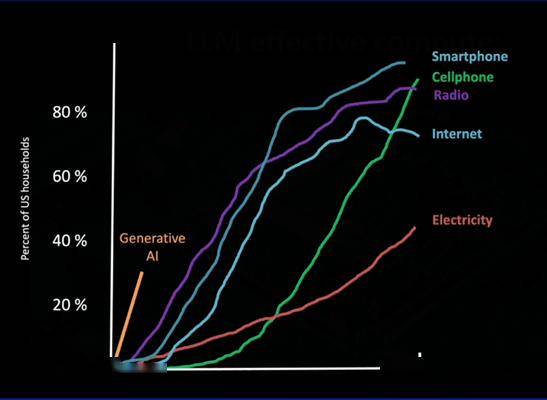
Core Viewpoint - AI is not in a bubble but is expected to replace 99.9% of white-collar jobs in the next two decades [1][5] Group 1: AI Evolution and Impact - The penetration rate of Generative AI has surpassed 30%, making it one of the fastest-adopted technologies globally [2][6] - Effective compute power is growing at an annual rate of approximately 6 to 16 times, potentially reaching 180 million times its current level in five years [3] - AI is evolving towards an "Innovator AI" stage, capable of independent work with minimal external instructions, expected to be achieved by late 2028 to early 2029 [3] Group 2: Overcoming Data Limitations - The global AI token generation is increasing at a rate of about 5 times per year, projected to reach 625 times its current scale in five years [4] - AI's ability to learn from self-generated data may help it overcome the "data wall," which refers to the limited growth of useful information on the internet [4] Group 3: AI's Role in Workforce Transformation - AI's evolution from simple chatbots to advanced reasoning and embodied intelligence indicates a shift towards "expert collaborative systems" [5][8] - By 2050, it is predicted that 90% of physical labor and 99.9% of white-collar jobs will be performed by AI, transforming human roles towards higher-level creativity and decision-making [8] Group 4: Investment Landscape and Economic Outlook - Current AI investments by major tech companies account for about 1.3% of the US GDP, with strong cash flow supporting these investments [9] - The macroeconomic environment is different from the internet bubble era, with current interest rates declining and inflation expected to stabilize around 2% [9] - Valuations of leading tech stocks are more rational compared to the peak of the internet bubble, with current P/E ratios around 30 times [9] Group 5: Future Technological Developments - Quantum computing is anticipated to be a key area of advancement, potentially enhancing computational power by millions or billions of times [10] - The next two decades may experience a "Goldilocks Economy," characterized by moderate inflation and strong economic growth [10] Group 6: Investment Strategies - The company is focusing on systematic investment strategies through index-based tools to capture technology sector growth [10][11] - A diverse range of technology-focused ETFs has been established to target high-growth sectors and capitalize on the ongoing technological transformation [10]

持续“吸金” 科技方向ETF规模大增
Shang Hai Zheng Quan Bao· 2026-01-13 18:34
Core Viewpoint - The Chinese technology sector has seen significant capital inflow in 2026, driven by strong performance in various technology-related ETFs and positive market sentiment towards the long-term growth potential of the sector [1][2][4]. Group 1: ETF Inflows - Several technology-focused ETFs have attracted substantial net inflows this year, with the Yongying Satellite ETF leading at 4.79 billion yuan, followed by the Guotai Semiconductor Equipment ETF at 3.014 billion yuan and the Fuguo Satellite ETF at 2.824 billion yuan [1][2]. - Other ETFs, including the Fuguo Hong Kong Internet ETF and Huatai-PB Hang Seng Technology ETF, have also seen significant inflows, with amounts exceeding 1 billion yuan [1][2]. Group 2: Market Performance - The performance of technology indices has been strong, with the Shenwan Computer and Shenwan Electronics indices rising by 14.13% and 5.7% respectively, while the Hang Seng Technology Index increased by 6.41% [2]. - In the U.S. market, Alibaba and Baidu stocks have outperformed the Nasdaq index, rising by 13.46% and 16.53% respectively, compared to the Nasdaq's 2.12% increase [2]. Group 3: Growth Potential - Foreign institutions express confidence in the long-term growth logic of the Chinese technology sector, highlighting the potential for continued market performance in 2026 [4]. - Key sub-sectors such as robotics, autonomous driving, and commercial aerospace are expected to experience significant growth, driven by technological advancements and increasing policy support [5][6]. Group 4: AI and Emerging Technologies - The integration of AI across various industries is anticipated to be a transformative process over the next 3 to 5 years, with core companies in the AI sector currently valued reasonably without entering bubble territory [5]. - Specific applications of AI, such as smart glasses and autonomous driving, are identified as having high growth potential, with ongoing technological breakthroughs and market expansion [6].


低利率时代投资变局:指增产品如何穿越“伪Alpha”迷雾?
Jing Ji Guan Cha Wang· 2026-01-13 09:35
Core Insights - The resurgence of equity market sentiment has led to a decline in traditional fixed-income asset yields, prompting funds to shift towards "equity-inclusive" strategies, particularly index-enhanced funds [1] - The issuance of index-enhanced funds is accelerating, with 187 new funds established in 2025, surpassing the total issuance from 2022 to 2024, amounting to over 100.45 billion yuan [1] - The performance of many index-enhanced funds is often attributed to hidden exposures to styles and sectors rather than true alpha generation, raising questions about their ability to sustain excess returns [2] Group 1: Market Dynamics - Low interest rates have attracted significant capital into the market, leading to more efficient asset pricing and a reduction in pure trading opportunities [2] - Investors are increasingly anxious for equity returns, which can lead to a focus on popular sectors and styles, creating a false sense of security regarding returns [2] - The concentration of market capitalization in a few large companies creates challenges in portfolio construction, often resulting in a "dumbbell trap" where funds are exposed to small-cap risks during market reversals [3] Group 2: Investment Strategy - The traditional classification of industries may distort risk assessments, as many companies operate across multiple sectors, complicating the identification of true risk exposures [4] - The diminishing returns from traditional fundamental analysis highlight the need for a reevaluation of how excess returns are generated, especially as information becomes more accessible [5] - A focus on achieving alpha should involve recognizing the limitations of predictive capabilities and instead capitalizing on mispricing opportunities in individual stocks [6] Group 3: Product Evolution - The development of index-enhanced products is influenced by both investor demand and regulatory policies, with a shift towards long-term value and stable returns [8] - The average holding period for investors in index-enhanced products exceeds seven months, with over 90% of those holding for more than six months outperforming benchmarks [8] - Regulatory measures are tightening the definition of performance benchmarks, emphasizing adherence to stated investment strategies [8] Group 4: Technological Integration - The application of AI in investment strategies is aimed at enhancing risk identification and management, with significant data processing capabilities [6][10] - The use of advanced models like GRU and Transformer for multi-period forecasting is part of a broader strategy to refine risk assessment and improve alpha generation [7] - The competitive landscape is shifting towards the uniqueness of data sources and the enhancement of model signal-to-noise ratios, necessitating a focus on high-quality data and effective model design [10]
碳酸锂期货突破17万元大关,化工ETF天弘(159133)近9日持续“吸金”累超2亿元,机构:碳酸锂或继续维持偏强态势
Sou Hu Cai Jing· 2026-01-13 04:10
Group 1 - The core viewpoint of the news is that lithium carbonate futures have experienced a significant price increase, reaching a limit up of 12% to 174,060 yuan/ton, marking the second consecutive day of limit up [1] - The CSI sub-sector chemical industry index (000813.CSI) rose by 1.46%, with notable increases in constituent stocks such as Kasei Bio (up over 13%), Salt Lake Co. (up over 8%), and Xingfa Group (up over 6%) [1] - The Tianhong Chemical ETF (159133) reported a trading volume of 23.516 million yuan, with a cumulative net inflow of 209 million yuan over the past nine trading days, indicating strong investor interest [1] Group 2 - The increase in lithium carbonate prices is attributed to changes in export policy expectations and improvements in supply-demand dynamics, with a notable surge in prices following the adjustment of export tax rebate policies [1] - The market anticipates a "rush to export" due to the expected cancellation of VAT export rebates for battery products starting January 1, 2027, which may further influence demand for lithium carbonate [2] - Short-term demand expectations are strengthening, suggesting that lithium carbonate prices may continue to maintain a strong trend despite potential volatility risks [2]

力鸿一号首飞成功!航空航天ETF天弘(159241)昨日净流入1.6亿元,连续两日“吸金”2.43亿元
Sou Hu Cai Jing· 2026-01-13 02:00
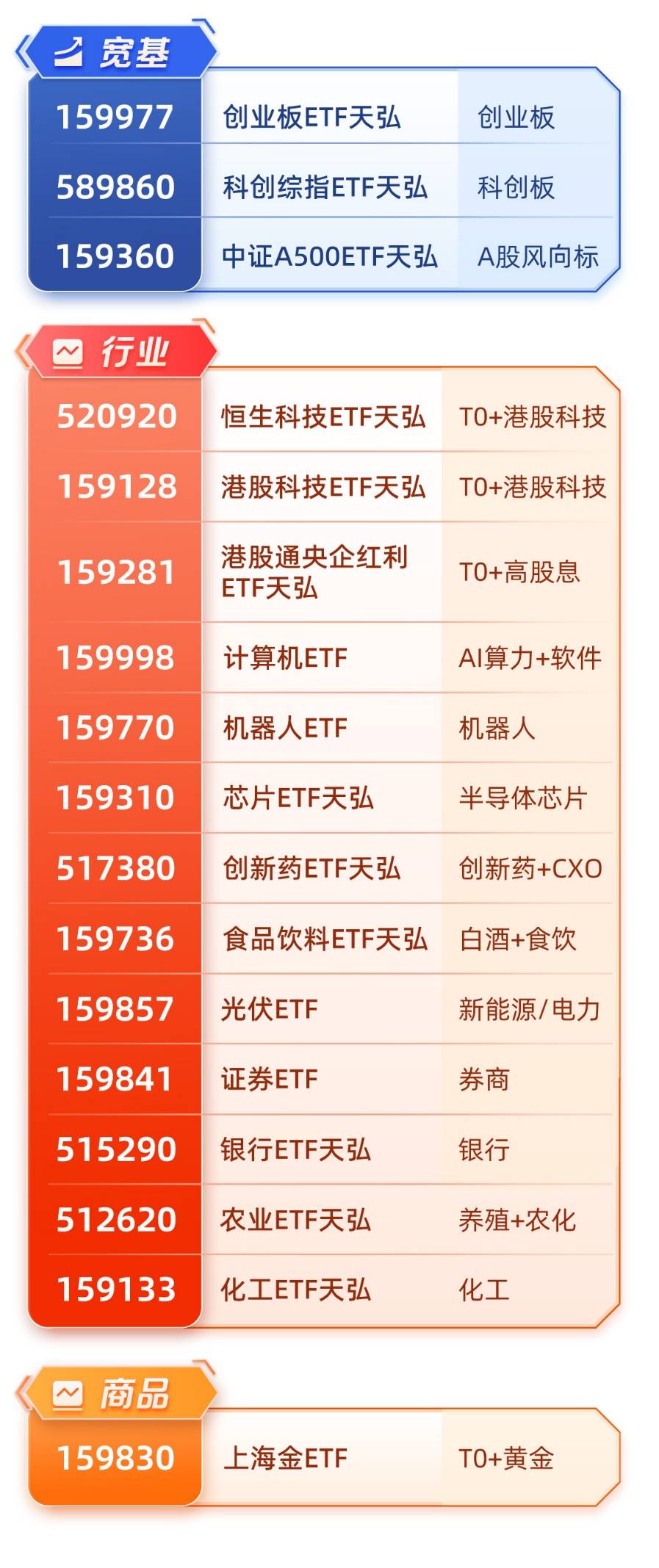
截至2026年1月13日 09:32,航空航天ETF天弘(159241)成交1281.78万元。跟踪的国证航天航空行业指数(CN5082)下跌4.22%。成 分股方面涨跌互现,中国卫星领涨2.82%,北摩高科上涨2.54%,亚光科技上涨0.50%。 截至1月12日,航空航天ETF天弘(159241)最新规模达9.28亿元,最新份额达5.50亿份,均创成立以来新高。 资金流入方面,航空航天ETF天弘(159241)最新资金净流入1.57亿元。连续两日净流入累计2.43亿元。 【产品亮点】 中泰证券认为,商业航天产业正进入新一轮高速发展期,我国商业航天企业数量已超过600家,商业航天发射工位合计25个(在 运营18个、在建7个),GW星座组网发射明显提速,可回收火箭技术即将进入关键验证阶段,太空算力建设是大势所趋。商业 航天产业拐点已现,近期板块有望迎来密集催化,建议关注商业航天方向投资机会。 【更多产品】 | 159281 | 港股通央企红利 ETF天弘 | T0+高股息 | | --- | --- | --- | | 159998 | 计算机ETF | AI算力+软件 | | 159770 | 机器人ETF ...
商业航天连涨,AI全面扩散!2026年投资抓什么?
Zhong Guo Zheng Quan Bao· 2026-01-12 23:50
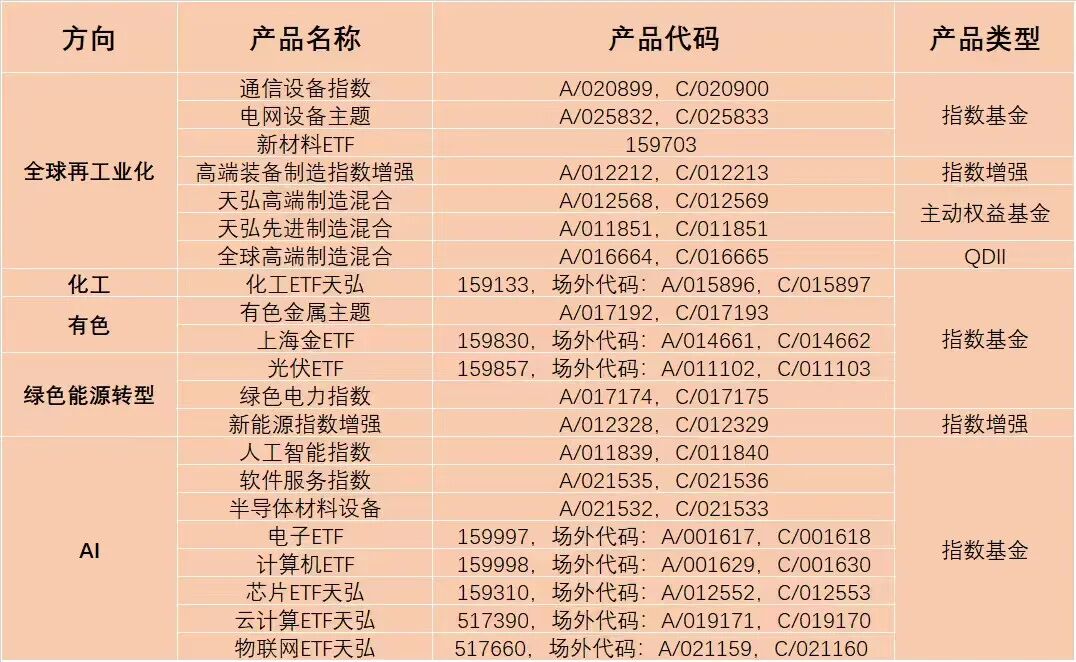
Core Viewpoint - The core investment opportunities for the next five years are centered around "global re-industrialization," driven by changes in geopolitical dynamics, the AI technology revolution, and a collective commitment to sustainable development [1][3]. Group 1: Global Re-industrialization - Global re-industrialization is driven by three main factors: geopolitical changes prompting countries to reassess supply chain security, the AI technology revolution leading to unprecedented investments in computing power and energy, and a commitment to sustainable development transforming green energy from a concept into actionable infrastructure projects [3]. - Chinese enterprises are participating in global re-industrialization through three pathways: initial type focusing on supply-side constraints, resource type extending downstream processing, and承接型 embedding into new supply chains to leverage manufacturing advantages [3][4]. Group 2: Investment Opportunities - The A-share market is expected to see a favorable investment window as industrial enterprise turnover rates and capacity utilization begin to rise, with a stable liquidity outlook for 2026 [5]. - Two main investment themes for 2026 are identified: 1. Embracing "reasonably valued winning assets," particularly manufacturing leaders with international competitiveness and stable profitability, such as those in the chemical industry [6]. 2. Exploring "potentially elastic betting assets," focusing on cyclical and certain consumer goods, where demand recovery could lead to significant price elasticity [7]. Group 3: Investment Products - A range of investment products is available for those interested in global re-industrialization, including index funds and actively managed funds targeting sectors like communication equipment, new materials, and green energy [9].
公募量化基金:2025 年度策略回顾与 2026 年度策略展望
Shenwan Hongyuan Securities· 2026-01-12 12:29
1. Report Industry Investment Rating - Not provided in the content 2. Core Viewpoints of the Report - The scale of index - enhancing products significantly increased in 2025, with A500 and non - traditional broad - based index - enhancing products growing notably. The excess returns of index - enhancing products fluctuated, and the differentiation degree within each broad - based index - enhancing category became larger [7][24]. - The scale of active quantitative funds also grew, with the full - industry quantitative stock - picking strategy and the quantitative products of the active equity team showing obvious scale growth [40]. - The market actively embraced quantitative fixed - income + funds in 2025, with the strategy pool becoming more diverse [76]. 3. Summary According to the Directory 3.1 Index - enhancing Funds - **Scale & New Issuance**: By 25Q3, the scale of index - enhancing products exceeded 2500 billion yuan, with A500 and non - traditional broad - based index - enhancing products having significant scale growth. In 2025, some non - conventional broad - based index - enhancing products in new issuances had large scale. The top 10 custodian banks and fund companies with large new - issuance scales were identified [7][10]. - **Fund Company Statistics**: As of 25Q3, 23 fund companies had index - enhancing product management scales of over 30 billion yuan. E Fund had the largest management scale. Different fund companies had different advantages in various types of index - enhancing products [13]. - **Excess Return Performance**: The Alpha effect of index - enhancing products peaked in 2020 and then declined. In 2025, the excess returns of three major types of index - enhancing products fluctuated, and the differentiation degree within each type increased. Small - cap index - enhancing products had higher excess returns [21][24]. - **High - performing Index - enhancing Products**: Some high - performing index - enhancing products had excess returns exceeding 20% in 2025. Many high - performing products had good performance adaptability in various market environments and had specific factor exposure characteristics [30][32]. - **Index - enhancing Product Watchlist**: The report selected fund products that were superior in their respective types based on multi - dimensional investment ability evaluations [36]. 3.2 Active Quantitative Funds - **Seven Strategy Types & Scale Changes**: Active quantitative funds can be divided into seven major categories. The full - industry quantitative stock - picking strategy and the quantitative products of the active equity team had obvious scale growth in 2025 [39][40]. - **Similar Index - enhancing Strategy**: The partial - equity fund index - enhancing strategy received high attention. Different products had different strategies when benchmarking the partial - equity fund index [46]. - **SmartBeta Strategy - Micro - and Small - cap**: The micro - and small - cap strategy can be classified into three major types. The difference in the degree of market - value sinking of stocks led to different returns [50][51]. - **SmartBeta Strategy - Dividend**: In 2024 and 2025, many public funds deployed dividend - strategy products. Companies sought differentiated layouts, and the investment in Hong Kong stocks had a significant impact on the performance in 2025 [53]. - **SmartBeta Strategy - Growth**: Different growth - style funds adopted different investment strategies, with different industry preferences and market - value exposures [56]. - **SmartBeta Strategy - Value**: Different value - style funds adopted different investment strategies, focusing on different aspects such as value - growth attributes and multi - strategy investment [61]. - **Full - industry Stock - picking Strategy**: The full - industry quantitative stock - picking strategy was diverse, including industry rotation, factor rotation, and multi - strategy [63]. - **Integration of Active and Quantitative**: Some fund managers actively integrated active and quantitative strategies, with different product strategies and positioning [69]. 3.3 Quantitative Fixed - income + Funds - **Scale & New Issuance**: There were about 171 quantitative fixed - income + funds in the market in 2025, with a scale increase of 36.7 billion yuan and a total scale of about 122.547 billion yuan. The market actively embraced quantitative fixed - income + strategies [76]. - **Index - enhancing Strategy**: The index - enhancing strategy in fixed - income + funds provided a tool - type product for obtaining broad - based index beta returns. The effectiveness of the strategy was related to multiple factors, and some fund companies had a large layout in this area [84]. - **Style Strategy**: The style strategy evolved from the value style to the growth style and the barbell strategy. Some companies innovated in this area to meet different market demands [88]. - **Convertible Bond Quantitative Strategy**: The convertible bond quantitative strategy was represented by E Fund's Dual - Bond Enhancement, which used a convertible bond option - pricing model for statistical arbitrage [90]. - **Market Dynamics**: Many active - management fixed - income + fund managers actively embraced quantitative investment, such as China Europe Fund, E Fund, and GF Fund [92]. - **Quantitative Fixed - income + Fund Watchlist**: The report screened out quantitative fixed - income + funds at different volatility levels based on multiple indicators [107].
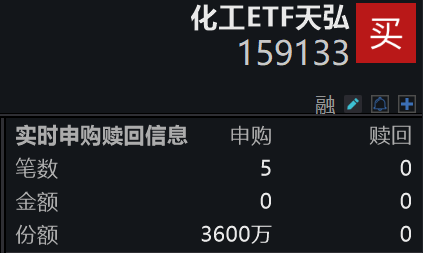
震荡整理蓄势待发!化工ETF天弘(159133)连续8日净流入,近20日“吸金”近2亿元,盘中实时净申购3600万份
Sou Hu Cai Jing· 2026-01-12 07:03
Core Viewpoint - The chemical ETF Tianhong (159133) has shown significant trading activity and net inflows, indicating strong investor interest in the chemical sector, particularly in light of recent developments in advanced manufacturing and semiconductor materials [1][2][3]. Group 1: ETF Performance - As of January 12, 2026, the chemical ETF Tianhong (159133) recorded a turnover of 3.04% with a transaction volume of 23.46 million yuan [1]. - The ETF has seen a net subscription of 36 million shares during the trading session [1]. - The latest scale of the chemical ETF Tianhong reached 776 million yuan, with a total of 678 million shares, both hitting record highs since its inception [2]. Group 2: Market Trends - The chemical ETF Tianhong has experienced continuous net inflows over the past eight days, totaling 168 million yuan, and nearly 200 million yuan over the last 20 days [2]. - The ETF tracks an index that includes 50 major stocks in the chemical industry, characterized by large market capitalization and high liquidity, with over 93% of its composition in basic chemicals, petroleum and petrochemicals, and electric equipment [2]. Group 3: Industry Developments - Shanghai has released a three-year action plan to support the transformation and upgrading of advanced manufacturing, focusing on key and emerging industries such as new-generation electronic information, intelligent connected vehicles, and advanced materials [2]. - The plan aims to foster the development of competitive enterprises in sectors like integrated circuits and low-altitude economy, which may benefit the chemical industry indirectly through increased demand for materials [2][3]. Group 4: Institutional Insights - Guohai Securities suggests that the ongoing tensions in international relations may accelerate the domestic substitution process for semiconductor materials, particularly in critical areas such as photoresists and electronic chemicals, presenting significant growth opportunities for domestic companies [3]. - The "anti-involution" policy is expected to optimize the supply side of the chemical industry, with certain segments like chromium salts experiencing a revaluation due to rising demand from AI data centers and aerospace engines [3].