奈雪的茶

Search documents
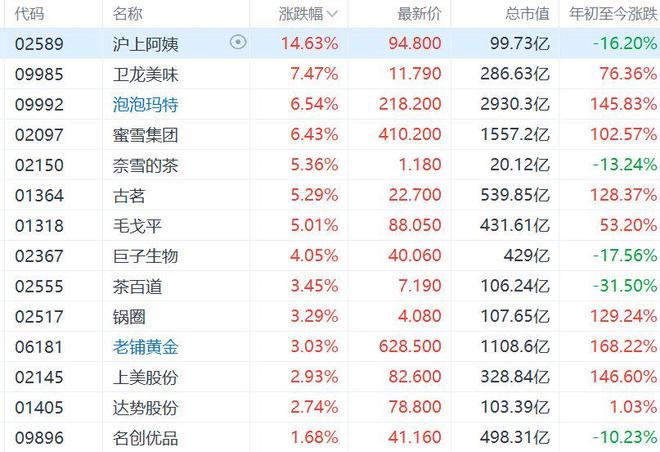
港股异动丨新消费概念股集体走强,卫龙美味涨超7%,蜜雪集团涨超6%
Ge Long Hui· 2025-11-10 04:11
Core Insights - The A-share market's consumer stocks have surged, positively impacting Hong Kong's new consumer concept stocks, with notable increases in various companies' stock prices [1] Group 1: Market Performance - Stocks such as "沪上阿姨" rose over 14%, "卫龙美味" increased over 7%, and "泡泡玛特" and "蜜雪集团" both saw gains exceeding 6% [1] - Other companies like "奈雪的茶," "古茗," and "毛戈平" experienced increases of over 5%, while "茶百道," "锅圈," and "老铺黄金" rose over 3% [1] Group 2: Economic Indicators - The National Bureau of Statistics released positive inflation data for October, indicating a 0.2% month-on-month and year-on-year increase in the Consumer Price Index (CPI), marking a shift from decline to growth [1] - The core CPI, excluding food and energy prices, rose by 1.2% year-on-year, with the growth rate expanding for the sixth consecutive month [1] Group 3: Government Policy - The Ministry of Finance plans to continue implementing measures to boost consumption, including providing financial subsidies for personal consumption loans in key sectors [1]


刚刚,直线拉升!三大利好,集中来袭!
券商中国· 2025-11-10 03:38
Core Viewpoint - The recent surge in stock prices, particularly for China Duty Free Group (中国中免), has a significant positive impact on the entire consumer sector, demonstrating strong market sentiment and potential growth opportunities [1][4]. Group 1: Market Performance - China Duty Free Group's A-shares hit the daily limit, while its H-shares rose over 12%, indicating strong investor confidence [1]. - The consumer sector saw widespread gains, with companies like Huanlejia and Kweichow Moutai also reaching their daily limits, reflecting a robust market trend [1][5]. Group 2: Positive News Drivers - Three major positive factors are stimulating the consumer sector: 1. The Ministry of Finance's report on November 7 indicates continued implementation of policies to boost consumption, including financial incentives for personal consumption loans [2][8]. 2. Positive signals in the economic fundamentals, with October's CPI showing a month-on-month increase of 0.2% and a year-on-year increase of 0.2%, alongside a core CPI increase to 1.2% [2][9]. 3. The upcoming full closure of Hainan on December 18 is expected to usher in a new development phase, enhancing trade convenience and tax benefits, which could significantly boost the duty-free market [2][10]. Group 3: Economic Indicators - The CPI's year-on-year improvement from -0.3% in September to 0.2% in October suggests a gradual recovery in consumer demand [9]. - The expansion of duty-free product categories in Hainan and the increase in shopping amounts and visitors indicate a strong recovery in the duty-free market, with a reported shopping amount of 5.06 billion yuan and a 34.86% year-on-year increase [9][10].


港股新消费概念盘初走强,沪上阿姨涨超10%
Mei Ri Jing Ji Xin Wen· 2025-11-10 03:04
Group 1 - The Hong Kong stock market for new consumption concepts showed strength at the beginning of trading on November 10, with notable gains in several stocks [1] - "Hushang Auntie" (02589.HK) surged over 10%, indicating strong investor interest [1] - "Pop Mart" (09992.HK) rebounded with an increase of over 6%, reflecting positive market sentiment [1] Group 2 - Other stocks in the sector, including "Weilong Delicious" (09985.HK), "Naixue's Tea" (02150.HK), "Chabaidao" (02555.HK), and "Mixue Group" (02097.HK), also experienced upward movement [1]
一周新消费NO.334|李锦记进军面条领域;迪桑特官宣吴磊为品牌代言人
新消费智库· 2025-11-09 13:04
Core Insights - The article highlights the latest trends and product launches in the new consumption sector, showcasing various brands and their innovative offerings [4][6][10]. New Product Launches - Huangchong launched a lightweight thermal cup weighing only 128g, designed for easy handling [6]. - Wangwang introduced a new "Black Truffle Egg Yolk Flavor Senbei," featuring a unique taste profile and approximately 29kcal per pack [6]. - Xiangpiaopiao released a new "Oriental Beauty Light Milk Tea," which contains no trans fats, artificial flavors, or vegetable fats [6]. - BeBeBus launched the "Light Enjoy Pro Waist Stool," designed for ergonomic support [6]. - Wanglaoji introduced a new "Hua Ju Hong Chen Pi" beverage, made with traditional methods and featuring zero sugar, fat, or calories [7]. - Guming launched a "Caramel Latte" that combines award-winning coffee with fresh milk and caramel [9]. - Inne introduced a liquid calcium product containing 600mg of calcium along with vitamins D3, K2, and magnesium [9]. - Guozi Shule launched a new "Cocoa Milk" series, which is free from trans fats and offers a smooth taste [9]. - Shuke Baby released a magical color-changing toothpaste for children, encouraging them to brush for two minutes [9]. Industry Events - Meituan Shangu announced plans to collaborate with thousands of brands to build official lightning warehouses, facilitating low-cost entry into instant retail [10]. - Lee Kum Kee entered the noodle market in the UK with a new original noodle series, including various types of noodles [12]. - The documentary "Joyful Mama," focusing on maternal mental health, was launched in collaboration with Beijing Television [12]. - The price of Feitian Moutai on e-commerce platforms dropped below 1600 yuan per bottle due to increased promotional efforts ahead of Double Eleven [12]. - a2 Milk Company completed the sale of its 75% stake in Mataura Valley Milk to Open Country Dairy [12]. Investment and Financing Trends - Weinan Battery announced the completion of a 670 million yuan Series C financing round, aimed at battery asset investment and technology development [17]. - The U.S. plant-based jelly brand Oddball secured $2 million in seed funding to expand retail and innovate products [19]. - Jijiashijie completed a new round of financing worth over 100 million yuan, with investments from Huawei Hubble and Huakong Fund [20]. - Kimberly-Clark announced a $48.7 billion acquisition of Kenvue, the consumer health business spun off from Johnson & Johnson [22]. - Chip Field completed nearly 100 million yuan in A+ round financing to accelerate chip development and market expansion [22]. New Consumption Trends - The article discusses the emergence of new consumption trends, including the rise of plant-based products and the focus on health and wellness in consumer goods [44][45].

8.2 万家!广东新茶饮门店数量居全国首位
Nan Fang Nong Cun Bao· 2025-11-05 09:01
Core Insights - Guangdong province leads the nation in the number of new tea beverage stores, with over 82,000 locations, contributing to a total of more than 415,000 stores across China by September 2025 [3][4][9] Industry Overview - The "2025 Ready-to-Drink Tea Industry Research Report" indicates that the industry is transitioning from rapid growth to a more systematic competitive phase after over a decade of expansion driven by capital [9][10] - The number of registered businesses in the industry saw a significant increase from 2014 to 2019, but new registrations declined sharply by 41.2% in 2022, marking a shift towards growth adjustment and structural optimization [10][11] Regional Distribution - The distribution of ready-to-drink tea stores shows a pattern of "more in the south, less in the north, and strong in the east, weak in the west," with a notable correlation between store density and population density [15][17] - Eastern regions account for 94.8% of the national GDP and 95.4% of the store distribution, with a store density of 2.9 per 10,000 people, while western regions only represent 4.6% of the stores with a density of 2.3 per 10,000 people [17][18] Factors Contributing to Guangdong's Leadership - Guangdong's dominance in the tea beverage market is attributed to a combination of climate, culture, and economic factors, including a long-standing tea-drinking tradition and a strong consumer base supported by the province's leading GDP [23][25] - The province is not only a consumer hotspot but also a breeding ground for major brands like Heytea and Nayuki, as well as local brands that incorporate regional culture into their products [27][28] Supply Chain and Logistics - Guangdong's robust supply chain system enhances the competitive edge of its new tea beverage industry, with local agricultural products ensuring stable supply and reduced costs [34][36] - The adoption of standardized central kitchens and smart processing equipment has improved production efficiency, supporting product standardization and brand expansion [36][37] - Established delivery networks through platforms like Meituan and Ele.me, along with a mature cold chain logistics system, facilitate effective market penetration and expansion for local brands [38][39]

星巴克、必胜客,加码下沉市场丨消费参考
2 1 Shi Ji Jing Ji Bao Dao· 2025-11-05 01:39
Group 1: Starbucks and Strategic Partnerships - Starbucks has announced a strategic partnership with Boyu Capital to establish a joint venture for its retail operations in China, with Boyu holding up to 60% equity and Starbucks retaining 40% [1][20] - The joint venture is based on an enterprise value of approximately $4 billion, and Starbucks expects its retail business in China to exceed $13 billion [1][20] - The new joint venture will be headquartered in Shanghai and aims to expand the number of Starbucks stores in China from 8,000 to 20,000 [1][20] Group 2: Market Trends and Performance - The trend of international restaurant brands, including Starbucks and Pizza Hut, focusing on lower-tier cities is becoming increasingly significant due to better revenue prospects in these markets [3] - Starbucks has reported that new stores opened in the last two years have contributed to same-store sales growth above average, with many of these new locations in lower-tier markets [3] - Yum China reported a 4% year-over-year revenue growth to $3.2 billion in Q3 2025, with KFC and Pizza Hut also showing positive revenue trends [3] Group 3: Consumer Behavior and Pricing - There is a noted decline in average transaction value for Starbucks, Pizza Hut, and KFC, which may benefit their expansion into lower-tier markets [5] - The overall dining market in major cities like Beijing and Shanghai is contracting, prompting brands to seek growth in less saturated markets [4]




超百万餐饮门店关停背后,品质餐饮正在穿越市场周期
Jing Ji Guan Cha Wang· 2025-11-04 10:03
Core Insights - The restaurant industry is experiencing a significant rebound during the 2025 National Day and Mid-Autumn Festival holiday, with nearly 160 stores receiving around 1.5 million customers in just eight days, indicating a strong consumer demand for quality dining experiences [1][2] - The shift towards quality consumption is becoming the main theme in the market, with consumers increasingly favoring brands that prioritize taste and ingredient quality, leading to long queues at popular restaurants [2][3] - The contrast in performance among restaurants highlights a divide between those focusing on quality and those engaging in price wars, with many traditional brands struggling due to product homogenization and poor supply chain management [5][9] Industry Performance - During the holiday period, key monitored pedestrian streets saw an 8.8% increase in foot traffic and a 6.0% increase in sales compared to the previous year, showcasing the overall growth in the restaurant sector [1] - Brands like Kuafu Fried Skewers and Nayuki Tea reported significant year-on-year revenue growth, with Kuafu achieving nearly 70% increase in sales [1] - Despite the positive holiday performance, the industry faced challenges earlier in the year, with 161,000 restaurants closing in the first half, averaging six closures per minute [1] Consumer Behavior - Consumers are now more willing to wait for quality dining experiences, as evidenced by long queues at restaurants like Banu Hot Pot, where customers prioritize quality over convenience [3][8] - The demand for high-quality ingredients and unique dining experiences is reshaping consumer preferences, with health-conscious choices becoming more prominent [4][8] - The relationship between consumers and brands is evolving into a partnership, where feedback and engagement play a crucial role in enhancing service and product quality [7][9] Company Strategies - Banu Hot Pot has distinguished itself in the competitive hot pot market by focusing on quality and service, achieving a daily table turnover rate of over eight times and capturing 3.1% of the premium hot pot market share [4][8] - The company plans to expand aggressively, with 177 new stores set to open over the next three years, aiming for an annual growth rate of 30% [4] - Banu's commitment to quality is reflected in its sourcing of premium ingredients and innovative menu offerings, such as introducing seasonal vegetables during peak periods [8]
新华网财经观察丨新茶饮十年,为何再难见爆款?
Xin Hua Wang· 2025-11-03 13:08
Core Insights - The new tea beverage industry has experienced a decline in the emergence of "hit products" over the past few years, with brands struggling to replicate past successes like cheese tea and dirty tea [2][8] - The market has evolved, and new brands are exploring different avenues for growth, while the industry faces challenges such as flavor homogenization and changing consumer preferences [8][9] Industry Growth and Trends - The new tea beverage industry saw a compound annual growth rate of 24.9% from 2017 to 2022, with the market size expected to exceed 354.7 billion yuan by 2024 and over 500,000 stores established [7] - The initial success of brands like Heytea and Naixue's Tea was driven by high-quality, freshly made products that attracted a young consumer base [4][5] Challenges in Product Innovation - The difficulty in creating new hit products is attributed to severe flavor homogenization, with many brands using similar ingredients and supply chains [8] - The rapid replication of successful products by competitors has made it challenging to develop unique offerings that can achieve widespread popularity [8][9] Consumer Behavior and Preferences - Consumers have become more discerning, with 73.09% of them sticking to 1-2 brands and showing reluctance to try new products due to perceived low value [9] - Increased health consciousness has led to a decline in the frequency of purchases, as consumers are more cautious about high-calorie drinks [9] Strategic Responses from Brands - Brands are diversifying their offerings by expanding into food and creating a full-day product ecosystem, with many introducing baked goods and light meals to complement their tea products [10][12] - Some brands are focusing on upgrading core products and optimizing supply chains to enhance cost efficiency and product quality [12] Localization and Emotional Value - Newer brands are adopting localized strategies, emphasizing regional flavors and ingredients to create unique identities [15] - Emotional value is becoming a significant factor in consumer choices, with brands like Luckin Coffee and Bawang Tea Princess successfully connecting with consumers through quality and cultural narratives [17]


奈雪的茶(02150) - 截至二零二五年十月三十一日止月份之股份发行人的证券变动月报表
2025-11-03 08:31
股份發行人及根據《上市規則》第十九B章上市的香港預託證券發行人的證券變動月報表 截至月份: 2025年10月31日 狀態: 新提交 致:香港交易及結算所有限公司 公司名稱: 奈雪的茶控股有限公司 呈交日期: 2025年11月3日 I. 法定/註冊股本變動 | 1. 股份分類 | 普通股 | 股份類別 | 不適用 | | 於香港聯交所上市 (註1) | | | 是 | | | --- | --- | --- | --- | --- | --- | --- | --- | --- | --- | | 證券代號 (如上市) | 02150 | 說明 | | | | | | | | | | | 法定/註冊股份數目 | | | 面值 | | | 法定/註冊股本 | | | 上月底結存 | | | 5,000,000,000 | USD | | 0.00005 | USD | | 250,000 | | 增加 / 減少 (-) | | | 0 | | | | USD | | 0 | | 本月底結存 | | | 5,000,000,000 | USD | | 0.00005 | USD | | 250,000 | 本月底法 ...
高光、失血与急转:喜茶加盟800天
首席商业评论· 2025-11-03 03:50
Core Viewpoint - The article discusses the challenges faced by Heytea after its rapid expansion through franchising, highlighting the conflict between brand standards and franchisee profitability, ultimately leading to a strategic pause in new franchise recruitment to reassess its business model and brand positioning [6][7][39]. Group 1: Business Model and Expansion - Heytea was not a typical tea brand, emphasizing product quality and brand image, which led to high operational costs and pressure, especially during the pandemic [6][19]. - In late 2022, Heytea opened its franchise model to accelerate growth and reach lower-tier markets, which initially contributed over 50% of its revenue in 2023 [6][10]. - However, the rapid expansion of franchises created operational challenges, leading to conflicts between the brand's strict standards and the franchisees' operational realities [6][9][29]. Group 2: Franchisee Challenges - Franchisees faced significant operational pressures, including high costs, strict operational processes, and intense market competition, leading to many reporting losses [10][12][13]. - The initial success of franchisees quickly turned into struggles, with many experiencing declining sales and profitability, prompting a wave of store closures [10][13][34]. - Franchisees expressed dissatisfaction with the lack of support from the headquarters, which failed to address their operational challenges effectively [9][10][36]. Group 3: Strategic Adjustments - In early 2024, Heytea announced a pause in its franchise recruitment to reassess its strategy and improve support for existing franchisees [36][39]. - The company shifted its focus back to high-end branding and product differentiation, moving away from aggressive price competition with lower-tier brands [36][39]. - The pause in expansion is seen as an opportunity for Heytea to strengthen its brand image and improve franchisee profitability, which is crucial for long-term sustainability [39][40].