万凯新材

Search documents
主力13天扫货106股,九成人还蒙在鼓里!
Sou Hu Cai Jing· 2025-09-15 15:15
Core Insights - The current market appears bullish with the Shanghai Composite Index above 3400 points and a strong buying trend from institutional investors, yet there are underlying complexities that suggest caution [1][2]. Group 1: Market Misconceptions - The first misconception is the "waiting for a rise" illusion, where investors assume all stocks will benefit from rising indices, but less than 50% of stocks have risen over 6% even in this bullish market [2]. - The second misconception is the "hot and cold" illusion, where certain sectors like media and new materials are favored by institutions, while retail investors chase previous hot topics [2]. - The third misconception is the "rise and fall" illusion, indicating that price movements do not necessarily reflect true market conditions; the nature of capital flow is crucial [2]. - The fourth misconception is the "high and low" illusion, where stock valuations should not be judged solely on PE ratios but also on the level of institutional investment [2]. Group 2: Anxiety in Investment - The root of anxiety in investing stems from the constant guessing of market movements, leading to a cycle of fear and uncertainty [3]. - A shift in perspective is suggested, focusing on underlying market conditions rather than short-term price fluctuations [3]. Group 3: Data-Driven Insights - A key indicator used is "institutional inventory," which reveals the true market dynamics by showing active institutional participation during stock rebounds [7]. - Stocks with sustained institutional interest tend to perform better in the long run compared to those that lose institutional support [9]. Group 4: Structural Market Characteristics - The 106 stocks that have seen continuous institutional buying are spread across various sectors, indicating a structural market characteristic rather than a broad-based rally [10]. - Specific companies like Wankai New Materials and Changjiang Media are highlighted for their strong institutional backing due to their competitive advantages and growth potential in their respective fields [10]. Group 5: Market Behavior and Recommendations - The overall market volume has not significantly increased, suggesting a strategic shift by institutions from high-flying stocks to more reasonably valued quality stocks [12]. - Investors are advised to abandon the obsession with predicting market movements, focus on the sustainability of capital flows, and develop a data-driven approach to investment [14].

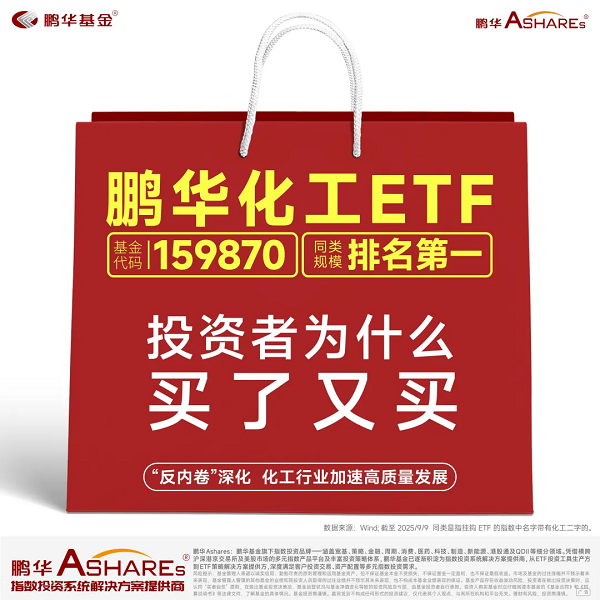
乘行业东风,鹏华化工ETF规模突破186亿的价值启示
Cai Fu Zai Xian· 2025-09-15 11:05
Core Insights - The "anti-involution" policy aims to break the cycle of meaningless competition in China's chemical industry, promoting high-quality development and innovation [3][5][10] - The rapid growth of the Penghua Chemical ETF, which increased by over 15 billion yuan in just two months, reflects investor enthusiasm and confidence in the chemical sector's transformation [12][14] Group 1: Anti-Involution Policy - The "anti-involution" concept originates from anthropology, describing a situation where internal competition leads to meaningless complexity when external expansion is not possible [3] - The chemical industry in China has experienced severe internal competition, resulting in price wars and compressed profit margins, necessitating a shift towards differentiation and value creation [5][7] - Various policies have been introduced to support this transition, including energy-saving initiatives and industry self-regulation [4][5] Group 2: Market Response - The Penghua Chemical ETF, launched in February 2021, has become the largest chemical-themed ETF, with its scale reaching 186.72 billion yuan by September 2025 [8][12] - Institutional investors, including social security funds, have increased their holdings in the chemical sector, indicating a growing recognition of its investment value [14] - The current price-to-book ratio of the CSI Chemical Index is 2.2, indicating that the sector remains undervalued compared to historical levels [14] Group 3: Industry Outlook - The chemical industry is positioned for a renaissance as it shifts from price competition to value competition, with a focus on technological innovation and differentiation [7][10] - The high technical barriers in the chemical sector mean that companies with established technological advantages are likely to thrive, while those relying on price competition may face extinction [7] - The ongoing global supply chain restructuring and the push for carbon neutrality are creating new opportunities for growth within the chemical industry [9][10]
133只个股连续5日或5日以上获融资净买入
Zheng Quan Shi Bao Wang· 2025-09-15 03:29
Core Viewpoint - As of September 12, a total of 133 stocks in the Shanghai and Shenzhen markets have experienced net financing inflows for five consecutive days or more, indicating strong investor interest in these stocks [1] Group 1: Stocks with Continuous Net Inflows - The stock with the longest consecutive net inflow is Yunnan Energy Investment, which has seen net buying for 19 consecutive trading days [1] - Other notable stocks with significant consecutive net inflows include Shanghai Bank, COFCO Sugar, Loxley Technology, Wankai New Materials, Guotou Capital, Bolong Technology, Chuzhong Technology, and China Pacific Insurance [1]


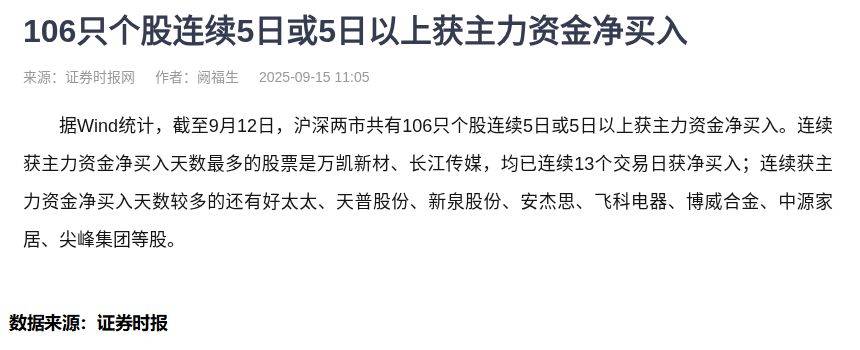
106只个股连续5日或5日以上获主力资金净买入


Zheng Quan Shi Bao Wang· 2025-09-15 03:19
Core Insights - As of September 12, a total of 106 stocks in the Shanghai and Shenzhen markets have experienced net buying from major funds for five consecutive days or more [1] - The stocks with the longest streak of net buying are Wankai New Materials and Changjiang Media, both having received net buying for 13 consecutive trading days [1] - Other notable stocks with significant net buying days include Haotaitai, Tianpu Co., Xinquan Co., Anjiasi, Feike Electric, Bowei Alloy, Zhongyuan Home, and Jianfeng Group [1]
石油化工行业周报:OPEC联盟8国实际增产低于预期,预计油价仍将维持中性区间-20250914
Shenwan Hongyuan Securities· 2025-09-14 11:43
Investment Rating - The report maintains a positive outlook on the oil and petrochemical industry, indicating a "Cautiously Optimistic" investment rating [3][4]. Core Insights - OPEC's actual production increase is lower than expected, leading to an anticipated stable oil price range of $60-70 per barrel in the medium term [4][5]. - The upstream sector shows signs of recovery with oil prices rising, while drilling day rates remain stable [4][24]. - The refining sector is experiencing mixed results, with some product margins improving while others decline [4]. - The polyester sector is expected to see a recovery in profitability as supply and demand dynamics improve [4][18]. Summary by Sections Upstream Sector - Brent crude oil futures closed at $66.99 per barrel, a week-on-week increase of 2.27%, while WTI futures rose by 1.33% to $62.69 per barrel [4][24]. - U.S. commercial crude oil inventories increased by 2.42 million barrels to 425 million barrels, remaining 4% lower than the five-year average [24][25]. - The number of active U.S. drilling rigs increased by 2 to 539, although this is a decrease of 51 rigs year-on-year [35][38]. Refining Sector - The Singapore refining margin for major products decreased to $16.66 per barrel, down by $1.41 from the previous week [4]. - The price spread between gasoline and WTI crude oil fell to $18.30 per barrel, down by $2.48 from the previous week [4]. - The report suggests that refining profitability may improve as economic recovery progresses [4]. Polyester Sector - PTA prices have declined, with the average price in East China at 4606.6 CNY per ton, down 2.02% week-on-week [4]. - The report anticipates a gradual improvement in the polyester industry as new capacity additions taper off in the coming years [4][18]. Investment Recommendations - The report recommends focusing on leading companies in the polyester sector such as Tongkun Co. and Wankai New Materials [4][18]. - In the refining sector, it suggests monitoring quality companies like Hengli Petrochemical and Sinopec [4][18]. - For upstream exploration and production, it highlights companies like CNOOC and China National Petroleum Corporation as having strong prospects [4][18].


研判2025!中国PU鞋底行业发展历程、产业链、市场规模、竞争格局及发展趋势分析:行业市场规模有望达到1800亿元[图]
Chan Ye Xin Xi Wang· 2025-09-13 02:11
Core Viewpoint - The PU sole industry in China is experiencing significant growth, with the market size expected to reach 1.38 trillion yuan in 2024, a 15% increase year-on-year, and projected to reach 1.8 trillion yuan by 2025 due to rising consumer demand for high-quality products and the rapid development of e-commerce [1][7]. Group 1: Industry Overview - The PU sole is made from polyurethane, offering advantages such as lightweight, durability, and improved performance compared to traditional rubber soles [3][5]. - The industry has evolved through three stages: initial development (1980-1990), rapid expansion (1990-2000), and maturity (2010-present), with China becoming the largest producer and consumer of PU soles globally [4][5]. Group 2: Market Dynamics - The PU sole market is characterized by intense competition, with both international giants like Lubrizol and domestic companies such as Huafeng Chemical and Anli Materials actively participating [9][10]. - The production process involves various methods, including low-pressure and high-pressure casting, which contribute to the quality and performance of the soles [4]. Group 3: Industry Trends - Technological innovation is driving product upgrades, with advancements in materials science leading to enhanced functionality, such as improved wear resistance and adaptability to environmental conditions [10][11]. - There is a growing demand for eco-friendly and sustainable PU sole materials, with companies increasingly focusing on the use of bio-based and recycled materials [11][12]. - The trend towards personalized products is rising, particularly among younger consumers, prompting companies to explore customization options and data-driven design solutions [12].






期货市场量质齐升加快国际化
Jing Ji Ri Bao· 2025-09-12 22:05
Core Insights - China's futures market is becoming a significant global player, with its crude oil futures market ranking among the top three worldwide and serving as a crucial pricing reference in the Asia-Pacific region [1][2] - The market is experiencing a dual approach of "bringing in" and "going out," with a notable increase in foreign participation and the establishment of overseas subsidiaries by Chinese futures companies [2][4] - The integration of Chinese futures prices into global trade is enhancing the pricing power of Chinese enterprises, allowing them to optimize international trade experiences [4][5] Market Scale and Internationalization - China's commodity futures trading volume accounts for over 60% of the global total, with 16 out of the 20 largest agricultural futures contracts being Chinese [2][6] - The number of new clients in the futures market increased by 410,000 in the first half of the year, with active traders from 39 countries and regions [2][6] - The China Securities Regulatory Commission has removed foreign ownership limits for futures companies, creating a more transparent and stable environment for foreign investors [2][6] Pricing Influence and Risk Management - Chinese futures prices are increasingly being used as benchmarks in international trade, with significant products like PTA and rubber being referenced globally [6][7] - Companies are leveraging futures pricing to enhance their bargaining power, stabilize raw material costs, and improve the efficiency of international deliveries [4][5] - The introduction of risk management tools and pricing mechanisms has allowed companies to expand into emerging markets with greater confidence [5][7] Future Outlook - The Chinese futures market is expected to continue expanding its product offerings and reducing institutional costs for foreign investors, while enhancing cross-border trading efficiency [8] - Technological advancements will play a key role in improving risk management and transaction efficiency in cross-border trading [8]
102只个股连续5日或5日以上获主力资金净买入
Zheng Quan Shi Bao Wang· 2025-09-12 03:01
(文章来源:证券时报网) 据Wind统计,截至9月11日,沪深两市共有102只个股连续5日或5日以上获主力资金净买入。连续获主 力资金净买入天数最多的股票是天普股份、长江传媒、华荣股份、万凯新材,均已连续12个交易日获净 买入;连续获主力资金净买入天数较多的还有好太太、美的集团、鲁信创投、安杰思、新泉股份、首钢 股份、飞科电器、莱绅通灵等股。 ...
万凯新材股价涨5.26%,摩根基金旗下1只基金位居十大流通股东,持有444.35万股浮盈赚取462.12万元
Xin Lang Cai Jing· 2025-09-11 10:19
Group 1 - The core viewpoint of the news is that Wankai New Materials has experienced a significant stock price increase, rising 5.26% to 20.82 CNY per share, with a total market capitalization of 10.727 billion CNY and a cumulative increase of 13.03% over three days [1] - Wankai New Materials, established on March 31, 2008, specializes in the research, production, and sales of polyester materials, with its main revenue sources being bottle-grade PET (97.51%) and other PET products [1] - The trading volume for Wankai New Materials reached 385 million CNY, with a turnover rate of 6.83% [1] Group 2 - Morgan Fund's Morgan Emerging Power Mixed A Fund (377240) is among the top ten circulating shareholders of Wankai New Materials, having reduced its holdings by 86,000 shares, now holding 4.4435 million shares, which is 1.56% of the circulating shares [2] - The fund has achieved a year-to-date return of 63.27% and a one-year return of 99.2%, ranking 261 out of 8177 and 362 out of 7982 respectively [2] - The fund manager, Du Meng, has a tenure of 14 years and has managed a total fund size of 11.719 billion CNY, with the best return during his tenure being 725.71% [2]
东方证券:新技术驱动下绿色聚酯行业有望迎来快速发展
Zhi Tong Cai Jing· 2025-09-11 07:05
Core Viewpoint - The green polyester industry is on the verge of significant growth due to breakthroughs in new technologies that will expand the raw material base beyond bottle flakes, potentially opening up an additional 80 million tons of market space [1][2]. Industry Overview - The current processing level of the green polyester industry using physical methods is relatively mature, but it is limited to using bottle flakes as raw materials, primarily producing short fibers and bottle flakes [2]. - The annual production of polyester fibers is 79 million tons, with polyester bottle flakes accounting for approximately 32 million tons, representing about one-third of the total polyester production [1][2]. Technological Advancements - New technologies are expected to allow green polyester to completely replace virgin materials, thus significantly increasing the market potential [2]. - The recycling technology using biological methods is gaining attention, with companies like Carbios in France and Tianjin Yuantian Bio already making strides towards industrialization [3]. Market Dynamics - The polyester recycling system is relatively mature, with low-cost waste materials, which enhances the economic viability of developing new technologies [2]. - The flexibility of biological methods, which can produce recycled PTA and ethylene glycol, allows for broader applications beyond just polyester [3]. Investment Opportunities - Companies like WanKai New Materials and New Feng Ming are positioned well within the green polyester sector, with strategic investments and developments in bio-based materials [5][6]. - WanKai New Materials has established a forward-looking layout in both major development directions of green polyester and is expected to benefit from its parent company's investments [5]. - New Feng Ming, a leading polyester filament enterprise, is also investing in bio-based materials, positioning itself as a key player in the market [5]. Emerging Trends - The development of bio-based materials, such as the use of FDCA to replace PTA, is gaining traction, with significant investments from major players in the polyester supply chain [4]. - The commercialization of bio-based polyester applications is anticipated to accelerate, driven by clear application scenarios [4].