英飞凌

Search documents
料单更新!三星、TI、ST芯片
芯世相· 2025-05-21 09:31
Core Viewpoint - The article highlights the extensive inventory and operational capabilities of a chip distribution company, emphasizing its significant stock levels and quality control measures in place. Group 1: Inventory and Facilities - The company operates a 1,600 square meter smart warehouse with over 1,000 stock models and 100 brands, totaling 50 million chips with a weight of 10 tons and a value exceeding 100 million [1] - An independent laboratory is established in Shenzhen for quality control (QC) inspections on every material [1] Group 2: Sales and Offers - The company is offering special prices on various advantageous materials, including: - Samsung K4A8G085WC-BCTD with 3,500 units from 20+ years - TI ADS1015BQDGSRQ1 with 20,000 units from 23+ years - ST STM32L010K8T6TR with 100,000 units from 23+ years - TI TPS563202DRLR with 1,000 units from 23-24+ years [2] Group 3: Procurement Needs - The company is seeking to purchase specific components, including: - Infineon DPS310 with 60,000 units - Altera EPCQ128ASI16N with 450 units - Altera 5CEFA5F23I7N with 450 units - Marvell 88E6193XA0-BXB2C000 with 1,000 units [3] Group 4: User Engagement - The company serves over 8,000 users by providing inventory listings, demand matching, and facilitating the sale of obsolete materials [4]


这个国家,也想台积电去建厂
半导体行业观察· 2025-05-21 01:37
Core Viewpoint - The Irish government has unveiled a semiconductor strategy aligned with the European Chips Act, aiming to enhance its semiconductor industry and position itself as a key player in Europe by creating high-value jobs and attracting significant investments [1][2]. Group 1: Strategic Goals - The primary objective of Ireland's semiconductor strategy is to leverage its existing semiconductor footprint to ensure the security of the European semiconductor supply chain [2]. - The strategy includes plans to attract major manufacturers like Samsung and TSMC to establish factories in Ireland [1]. - By 2040, Ireland aims to support up to 34,500 new semiconductor jobs, as stated by the Minister for Enterprise, Trade and Employment [2]. Group 2: Investment and Infrastructure - The European Chips Act promises to provide €43 billion in policy-driven investments by 2030 to support various initiatives, including next-generation technologies [1]. - Ireland's strategy involves ensuring significant industrial investments, with ambitious plans to establish a leading chip manufacturing facility, two advanced foundries, and an advanced packaging plant [2]. Group 3: Ecosystem Development - Ireland has over 130 semiconductor companies, employing 20,000 people, with an annual export value of €13.5 billion [1]. - The government is committed to enhancing research and development, supporting innovation, and fostering a collaborative open ecosystem in the semiconductor sector [3]. - A comprehensive map of the Irish semiconductor ecosystem has been released to promote connections between research and innovation clusters and to engage the education system to meet the growing talent demand [2].

安海半导体:立足国产SiC发展,推进IDM战略布局
行家说三代半· 2025-05-19 10:33
Core Viewpoint - The SiC industry is experiencing significant advancements and is expected to face new opportunities and challenges in 2025, with a focus on the development of 8-inch SiC wafers and the overall market expansion [1][2]. Industry Developments - In 2024, the SiC industry has made progress despite entering a phase of adjustment, including improved yield rates for 6-inch substrates, breakthroughs in 8-inch substrate production, and collaborations between domestic chip manufacturers and electric vehicle producers [2]. - The introduction of 12-inch SiC substrates by Shandong Tianyue marks a significant milestone in the industry [2]. Competitive Landscape - The competition in the SiC industry is intensifying, with domestic companies narrowing the gap with international giants through technological innovation and capacity expansion [3]. - The growth of the electric vehicle market and supportive policies are expected to enhance China's position in the global SiC market, although challenges such as technological barriers and supply chain dependencies remain [3]. Geopolitical Impact - The recent 301 investigation by the U.S. against Chinese SiC substrate manufacturers may increase export pressures and supply chain uncertainties in the short term, but could also catalyze the push for self-sufficiency in the SiC industry in the long term [3]. 8-Inch SiC Development - The transition from 6-inch to 8-inch SiC wafers is seen as a key development direction, with 8-inch wafers offering approximately 80% more area and potential cost reductions of over 30% per chip [4]. - Domestic manufacturers like Shandong Tianyue and Tiankai Heda have announced the mass production of 8-inch SiC substrates, indicating a shift in the industry [4][5]. Cost Challenges - Current challenges for 8-inch SiC include lower yield rates compared to 6-inch substrates and insufficient demand from downstream wafer manufacturers, leading to higher overall costs [5]. - However, the price of 8-inch SiC substrates is expected to decrease rapidly, potentially reaching parity with 6-inch prices by 2025, reinforcing the trend towards 8-inch development [5]. Future Market Focus - The company plans to focus on markets such as electric vehicles, on-board chargers (OBC), and charging stations in 2025, while also exploring opportunities in solar energy and high-end power supply markets [6].

半导体行业深度跟踪电话会议
2025-05-18 15:48
半导体行业深度跟踪电话会议 20250515 摘要 • 消费电子行业呈现弱复苏态势,但端侧创新活跃,AI 和智能汽车领域尤为 突出。预计 2024 年手机出货量同比增长,2025 年延续增长,双星政策 扩围带动需求。PC 市场 2024 年 Q4 同比持平,预计 2025 年增长,大模 型部署或拉动 PC 硬件需求。 • 服务器领域数据显示今年 1 月同比增长超 140%,环比增长约 10%,但受 春节影响波动大,建议综合一二月数据评估。全球云计算厂商对 2025 年 资本开支预期乐观,表明算力需求端市场预期依然强劲。 • 存储器市场供过于求,Q1 原厂报价松动,现货和合约价格下跌,DDR4 等老旧型号库存积压。但高端存储产品价格稳定。HBM 景气度延续,边缘 计算推动端侧存储扩容,存算一体方案加速创新。上半年或优于下半年, 但尚未脱离低谷。 • 2024 年全球半导体销售额同比增长,预计 2025 年维持增长。AMD 的 AI 芯片出货量较高,预测 2025 年全球 PC 市场中个位数增长。国内华为、 海光率先适配 DeepSeek,寒武纪、龙芯中科等公司也支持适配小参数芯 片,拉动国内算力芯片需求。 Q& ...

MCU大厂的新战场
半导体行业观察· 2025-05-17 01:54
Core Viewpoint - The article emphasizes that AI is transitioning from being a cloud-based privilege to becoming a standard feature in endpoint devices, with microcontrollers (MCUs) playing a crucial role in this shift [1][2]. Group 1: AI in Endpoint Devices - User demand is driving AI to "sink" into endpoint devices, as users prefer devices that can make decisions independently without relying on cloud processing [2]. - The AI chip market is projected to grow from $12 billion in 2019 to $43 billion by 2024, with edge AI being a significant growth driver [2]. Group 2: MCU Industry Transformation - The MCU industry is undergoing a transformation as AI capabilities are increasingly integrated at the hardware level, particularly through the integration of neural processing units (NPUs) [1][2]. - Major MCU manufacturers are moving beyond merely adding AI features in software toolkits to integrating NPUs into their hardware, marking a new era in edge intelligence [2]. Group 3: Strategies of Major MCU Players - STMicroelectronics has developed its own NPU, Neural-ART, and launched the STM32N6, which features high performance and significant AI capabilities [5][6][10]. - NXP has introduced the eIQ Neutron NPU, which supports various neural network types and has been integrated into its i.MX RT700 and S32K5 MCUs [11][13][14]. - Infineon is leveraging the Arm Ethos-U55 NPU in its PSOC Edge series, focusing on reducing AI development barriers [18][19]. - Texas Instruments has introduced the TMS320F28P55x C2000 series, the first real-time control MCU with an integrated NPU, enhancing fault detection and reducing latency [20]. - Renesas is optimizing its RA8 series MCUs for AI without an NPU, focusing on cost-effectiveness and simplicity [22]. - Silicon Labs is targeting low-power AI for IoT applications with its xG26 series, emphasizing energy efficiency [23][24]. Group 4: Domestic MCU Manufacturers - Domestic players like Guoxin Technology and Zhaoyi Innovation are developing AI-capable MCUs, with Guoxin's CCR4001S featuring a self-developed NPU for edge AI applications [25][27]. - Zhaoyi Innovation's GD32G5 series MCU is designed for AI algorithm processing, while Chengpu Microelectronics is integrating TinyML capabilities for offline voice recognition [27][28]. Group 5: Future Trends in MCU and AI - The integration of AI into MCUs is becoming inevitable, with AI expected to be a built-in capability rather than an add-on feature [29]. - The market demands for AI MCUs vary across segments, with consumer electronics prioritizing cost and ease of deployment, while automotive and industrial sectors emphasize safety and reliability [29][30]. - The shift towards mixed CPU + NPU architectures is anticipated to redefine product definitions and impact the semiconductor supply chain [30].

求购!TE、NXP、英飞凌芯片
芯世相· 2025-05-15 07:12
Core Insights - The company "Chip Superhero" operates a 1,600 square meter intelligent chip storage base with over 1,000 stock models and around 100 brands, holding a total of 50 million chips valued at over 100 million [1] Group 1 - The company has an independent laboratory in Shenzhen where each material undergoes QC inspection [1] - It serves over 8,000 users by providing inventory release, demand matching, and trading of surplus materials [3] Group 2 - The company is actively seeking to purchase specific chip models, including TE 2337019-1 (60K), NXP MIMXRT1064CVL5B (80K), and Infineon IKD10N60RATMA1 (50K) [2]



心智观察所:马来西亚半导体的“冰与火之歌”
Guan Cha Zhe Wang· 2025-05-14 07:07
Core Insights - Malaysia's Prime Minister Anwar has engaged in discussions with AMD, indicating a strategic partnership that aims to enhance the country's semiconductor industry ecosystem [1][3] - The country is focusing on leveraging its existing advantages in the global semiconductor supply chain while also aiming for upgrades in higher value-added processes [1][3] Industry Position - Malaysia has become the sixth largest semiconductor exporter globally, accounting for 23% of U.S. chip production [3] - The country holds approximately 13% of the global semiconductor packaging and assembly market, with a significant 40% share in automotive-grade chip packaging [3] - In 2023, Malaysia's semiconductor exports exceeded $120 billion, making it the largest source of chip assembly imports for the U.S. [3] - The semiconductor sector contributes 40% of Malaysia's total manufacturing exports and represents a quarter of the nation's GDP [3] Foreign Investment and Ecosystem - Major companies like Intel, Infineon, and Micron have increased investments in Malaysia, solidifying its position in the global backend packaging industry [5] - Industrial parks in Penang and Kulim host nearly 50 semiconductor factories, creating a mature OSAT (Outsourced Semiconductor Assembly and Test) ecosystem [5] - The presence of top logistics companies in Malaysia has grown in the past two years, driven by geopolitical uncertainties and the country's robust infrastructure and lower labor costs [5] Strategic Initiatives - The "Flexible New Economy Zone" initiative, set to accelerate in 2025, aims to combine Singapore's capital and advanced technology with Malaysia's land and infrastructure for mutual growth [5][8] - This initiative is part of Malaysia's national semiconductor strategy proposed in May 2024, focusing on attracting foreign investment and talent to elevate its position in the semiconductor value chain [8] - Malaysia seeks to transition from downstream packaging and testing to upstream chip design, aiming to capture a higher value in the semiconductor industry within ASEAN [8]


全球芯片巨头TOP10,最新出炉
3 6 Ke· 2025-05-13 10:34
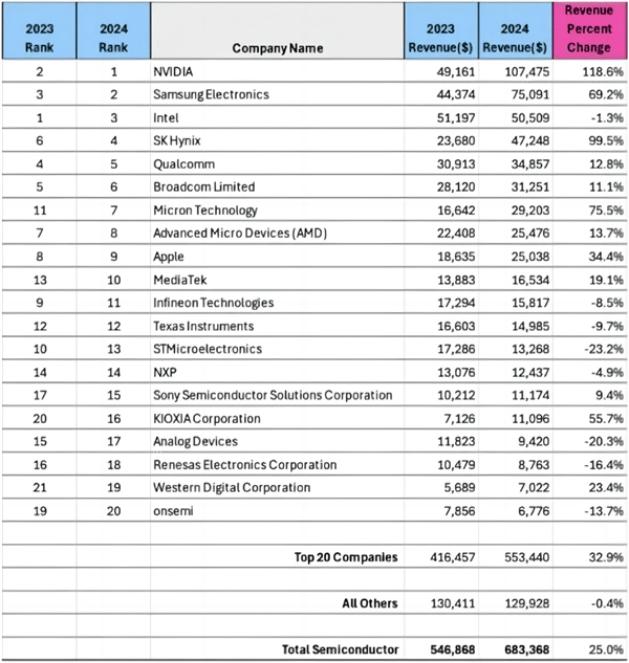
Group 1: Market Overview - The 2024 global semiconductor company rankings show significant changes, with NVIDIA rising to the top due to its strong performance in AI chips, while traditional giants like Infineon and STMicroelectronics fell out of the top ten [1][2] - The total semiconductor market revenue is projected to grow from $546.87 billion in 2023 to $683.37 billion in 2024, representing a 25% increase [2] Group 2: Company Performance - NVIDIA's revenue is expected to reach $107.475 billion in 2024, a 118.6% increase from $49.161 billion in 2023 [2] - Samsung Electronics is projected to generate $75.091 billion in revenue for 2024, up 69.2% from $44.374 billion in 2023 [2] - SK Hynix's revenue is expected to grow from $23.68 billion in 2023 to $47.248 billion in 2024, marking a significant increase [2] - Micron Technology's revenue is anticipated to rise from $16.642 billion in 2023 to $29.203 billion in 2024, a 75.5% increase [2] Group 3: Q1 Earnings Reports - NVIDIA forecasts Q1 revenue of $43 billion for 2026, exceeding market expectations [5] - Samsung's semiconductor division reported Q1 revenue of approximately $178 billion, a 9% year-over-year increase [5] - Broadcom's Q1 revenue reached $14.92 billion, a 25% increase year-over-year, driven by AI-related chip sales [5] - Intel's Q1 revenue was $12.667 billion, showing a slight decline of 0.4% [5] Group 4: Market Trends - The automotive chip market is expected to recover in the coming quarters, despite a slowdown in 2024 [14][15] - The demand for custom ASICs is on the rise, with Broadcom's AI chip revenue significantly contributing to its growth [16][17] - SK Hynix has overtaken Samsung in the DRAM market, marking a significant shift in market dynamics [11] Group 5: Future Projections - SK Hynix anticipates a 10-15% increase in DRAM bit shipments in Q2, while NAND bit shipments are expected to grow over 20% [18] - Samsung expects strong demand for AI servers in Q2, aiming to enhance its position in high-value markets [18] - Micron forecasts a record high revenue of $8.8 billion for the third fiscal quarter of 2025, driven by DRAM and NAND demand [19]


eSIM产业热点问题研究报告(2025年)
中国信通院· 2025-05-13 03:15
Investment Rating - The report does not explicitly provide an investment rating for the eSIM industry Core Insights - The eSIM technology represents a significant evolution in telecommunications, transitioning from traditional physical SIM cards to embedded SIMs, which are crucial for the Internet of Things (IoT) and 5G applications [7][8] - The report highlights the global adoption of eSIM technology, with various countries commercializing it and establishing a robust industrial ecosystem, while also addressing challenges in standardization and data security [7][8] Industry Development Overview - The report outlines the historical development of telecommunications cards, detailing the evolution from magnetic cards to IC cards, SIM, USIM, and finally to eSIM technology [15][20][22] - eSIM technology is characterized by its ability to support remote configuration and management, making it suitable for a wide range of applications in consumer electronics and IoT [23][49] Current Status of eSIM Industry Technical Standards - The GSMA has established a comprehensive standardization framework for eSIM technology, which is recognized by international organizations, facilitating its global interoperability and scalability [40][44] - The report notes that the CCSA and TAF are actively developing eSIM standards in China, aligning with international standards while promoting innovation [46][48] Application Areas - eSIM technology is increasingly utilized in consumer electronics, enabling seamless network switching for travelers and enhancing connectivity for remote work and e-commerce [49][50] - In the IoT sector, eSIM technology is gaining traction across various industries, including smart homes, healthcare, automotive, and energy management, due to its flexible configuration and efficient management capabilities [51][52] Market Size - In 2023, global eSIM chip shipments reached 446 million, with significant contributions from smartphones, tablets, and wearables [58][60] - The report forecasts that by 2025, approximately 1 billion eSIM-enabled smartphones will be connected globally, indicating a strong growth trajectory for the eSIM market [62] Industry Chain - The eSIM industry chain is well-established in the US and Europe, with key players in chip manufacturing, security certification, and product design leading the market [68]






特色工艺,台积电怎么看?
半导体行业观察· 2025-05-13 01:12
Core Viewpoint - The semiconductor industry is shifting from a singular focus on process miniaturization to diversified innovation, with advanced packaging and specialty processes becoming key drivers for performance optimization and differentiation [1][2]. Group 1: Specialty Processes and Market Growth - The global specialty process market has surpassed $50 billion, with a compound annual growth rate (CAGR) of 15%, significantly outpacing the average growth rate of the semiconductor industry [1]. - Specialty processes focus on customized and diverse process optimizations, achieving a precise balance of performance, power consumption, and cost, particularly in demanding fields like automotive electronics and IoT [1]. Group 2: TSMC's Leadership in Specialty Processes - TSMC is establishing itself as a global benchmark in specialty processes through a combination of technological breadth and ecosystem depth, expanding its capabilities across various domains including automotive and RF technologies [2][4]. - TSMC's advanced logic technologies, such as N7A, N5A, and N3A, are specifically designed for automotive applications, ensuring high reliability and long lifecycle [4]. Group 3: Innovations in Embedded Non-Volatile Memory (eNVM) - TSMC is addressing the limitations of traditional eFlash memory by advancing RRAM and MRAM technologies, which are expected to replace eFlash in automotive and IoT applications [6][8]. - The introduction of RRAM and MRAM technologies allows for significant improvements in performance, reliability, and power efficiency, with TSMC's RRAM already in mass production at 40, 28, and 22 nm nodes [7][8]. Group 4: Competitive Landscape and Future Trends - Major MCU manufacturers are collaborating with foundries to leverage specialty processes, with companies like Infineon and NXP adopting eNVM technologies to enhance their product offerings [9][16]. - The market for embedded NVM is projected to grow rapidly, with wafer production expected to increase from approximately 3 KWPM in 2023 to about 110 KWPM by 2029, indicating a strong shift towards new storage technologies [26]. Group 5: Diverse Storage Technologies - Various new storage technologies, including eRRAM, eMRAM, and ePCM, are being explored by different manufacturers, each offering unique advantages in terms of speed, power consumption, and integration capabilities [30][32]. - The trend indicates a move towards a multi-storage technology ecosystem rather than a single dominant solution, reshaping the MCU landscape in the post-eFlash era [32].