
天弘基金

Search documents
聚焦全球变局与产业升级 天弘基金2026年策略会勾勒投资新蓝图
中国基金报· 2026-01-08 08:12
Core Viewpoint - The article discusses the ongoing global economic transformation characterized by "diversification" and "restructuring," driven by the AI wave and global re-industrialization, which is reshaping supply chains and creating investment opportunities in the context of China's "14th Five-Year Plan" [2] Group 1: Equity Investment - The rapid penetration of artificial intelligence (AI) into the economy is highlighted, with the U.S. and China being at the forefront of AI development, focusing on advanced manufacturing, quantum technology, biomanufacturing, chips, new materials, and nuclear fusion [4][5] - The investment logic in AI is shifting from hardware to software and applications, with a focus on domestic chip performance improvement, semiconductor equipment, and potential breakout applications in AI [13] - Global re-industrialization is driving demand across the entire advanced manufacturing supply chain, particularly for industrial metals like copper, lithium, cobalt, aluminum, and nickel, with a favorable investment outlook for Chinese power grid equipment, chemicals, commercial vehicles, and lithium battery storage [14] Group 2: Bond Investment - The bond market is transitioning back to a "traditional" state, focusing on coupon income and stable management, as the market experiences a shift from a capital gains-driven environment to one led by banks emphasizing funding costs [16][17] - The investment outlook for bonds in 2026 is expected to improve compared to 2025, with higher short- and medium-term interest rates and more rational institutional expectations [17]


天弘基金策略会:AI投资正向应用端扩散;把握再工业化下的“铜锂”机遇
Sou Hu Cai Jing· 2026-01-08 07:52
Group 1 - The global economy is experiencing a "divergence" and "restructuring," with AI transitioning from capital expenditure to application implementation, driven by large-scale fiscal investments and manufacturing return [2] - The U.S. has positioned AI as a strategic core for scientific breakthroughs and national security, focusing on advanced manufacturing, quantum technology, biomanufacturing, chips, new materials, and nuclear fusion, which align with China's "14th Five-Year Plan" priorities [2] - Global industrial chains are undergoing profound restructuring due to geopolitical changes, technological transformations driven by AI, and sustainable development initiatives [2] Group 2 - China's outbound investment process shows similarities to Japan's in the late 1980s, indicating significant potential for further expansion [3] - In 2025, various funding channels are expected to support the A-share market, with structural highlights in China's economy benefiting public and private fund holdings [3] - Investment focus is shifting from "hard" AI to "soft" applications, with current emphasis on computing chips and infrastructure, and future expansion into AI software and green energy sectors [3] Group 3 - AI investment is moving from hardware to demand-side validation and domestic breakthroughs, with three key areas to watch: performance improvement of domestic computing chips, fundamentals of semiconductor equipment manufacturers, and the emergence of popular domestic AI applications [4] - Global re-industrialization is driving demand across the entire advanced manufacturing supply chain, particularly for industrial metals like copper, lithium, cobalt, aluminum, and nickel, making certain Chinese industries attractive for investment [4] - In 2026, opportunities in cyclical commodities and service consumption investments are expected to become more apparent compared to 2025 [5]

聚焦全球变局与产业升级 天弘基金2026年策略会勾勒投资新蓝图
Xin Lang Cai Jing· 2026-01-08 06:54
Core Insights - The global economy is experiencing a "divergence" and "restructuring," with the AI wave transitioning from capital expenditure to application implementation, driven by large-scale fiscal investments and manufacturing return [1][17] - The "14th Five-Year Plan" in China marks a year of high-quality economic development, focusing on new productive forces [1][17] Group 1: AI and Investment Opportunities - AI is penetrating the economy at an unprecedented speed, with the U.S. and China leading in AI development, particularly in advanced manufacturing, quantum technology, and other key sectors [2][19] - The expected growth of effective computing power is projected to increase by approximately 1.8 million times over the next five years, leading to widespread applications of AI [5][21] - Investment focus is shifting from hardware to software and applications, with an emphasis on domestic AI chip performance and potential breakout applications [10][26] Group 2: Global Reindustrialization - Global reindustrialization is driven by geopolitical changes, technological transformations, and sustainable development, leading to advanced manufacturing returning to the U.S. and Europe [6][22] - China is deeply involved in this process through various models, including enhancing resource countries' value and extending local industrial chains [6][22] - The demand for industrial metals like copper is expected to rise, with investment opportunities in sectors such as electric power equipment and lithium battery storage [11][27] Group 3: Market Performance and Trends - The A-share market is supported by multiple funding sources, including increased equity holdings by insurance and bank wealth management funds, leading to a favorable investment environment [8][24] - The return rates in the A-share market are expected to improve, with volatility remaining low due to structural highlights in the Chinese economy [8][24] - The investment landscape is characterized by a shift towards more pragmatic and in-depth AI investments, as well as a broad demand for advanced manufacturing across the supply chain [11][27] Group 4: Bond Market Outlook - The bond market is transitioning back to a "traditional" state, focusing on interest income and cost management, as opposed to capital gains [12][28] - The banking sector's expansion is expected to slow, leading to a supply-demand imbalance in certain areas of the bond market [15][31] - Investment returns in bond funds for 2026 are anticipated to be better than in 2025, with a focus on earning interest income first before seeking capital gains [15][31]

丰立智能股价涨5.26%,天弘基金旗下1只基金位居十大流通股东,持有79.08万股浮盈赚取254.64万元
Xin Lang Cai Jing· 2026-01-08 02:32
Group 1 - The core viewpoint of the news is that Fengli Intelligent has seen a stock price increase of 5.26%, reaching 64.44 CNY per share, with a trading volume of 244 million CNY and a turnover rate of 5.98%, resulting in a total market capitalization of 7.739 billion CNY [1] - Fengli Intelligent, established on April 23, 1995, is located in Taizhou, Zhejiang Province, and was listed on December 15, 2022. The company specializes in the research, production, and sales of small modulus gears, gearboxes, and related precision machinery [1] - The main business revenue composition of Fengli Intelligent includes gears (42.87%), precision reducers (harmonic reducers) and components (28.20%), pneumatic tools and components (23.22%), new energy transmission (4.39%), and others (1.33%) [1] Group 2 - Tianhong Fund's Tianhong CSI Robot ETF (159770) is among the top ten circulating shareholders of Fengli Intelligent, having increased its holdings by 137,500 shares to a total of 790,800 shares, representing 1.23% of the circulating shares [2] - The Tianhong CSI Robot ETF has a current scale of 9.078 billion CNY, with a year-to-date return of 1.42%, ranking 4960 out of 5493 in its category, and a one-year return of 38.53%, ranking 1921 out of 4197 [2]

“量贩零食第一股”通过港交所聆讯,食品饮料ETF天弘(159736)昨日获600万份净申购居深市同类第一
2 1 Shi Ji Jing Ji Bao Dao· 2026-01-08 01:38
Group 1 - The Shanghai Composite Index recorded a slight increase, achieving a 14-day consecutive rise, with a total trading volume of 2.85 trillion yuan in the Shanghai and Shenzhen markets [1] - The Consumer Staples Index, specifically the food and beverage sector, saw a decline of 0.49%, with stocks like Ziyuan Food hitting the daily limit and others such as Yangyuan Beverage and Huanlejia also experiencing gains [1] - The Tianhong Food and Beverage ETF (159736) had a trading volume of 25.6 million yuan, with a closing premium/discount rate of 0.24%, and it received a net subscription of 6 million units, ranking first among similar products in the Shenzhen market [1] Group 2 - The food and beverage industry is characterized as a core sector of essential consumption with strong resilience, currently at historically low valuation levels, having fully priced in expectations of a slowdown in consumer recovery [2] - The investment outlook suggests a focus on leading companies with strong brand and channel advantages, growth-oriented firms actively positioning for emerging trends, and leaders in specific categories with potential for profit improvement [2] - The recent meeting between Chinese and South Korean officials aimed to enhance food safety cooperation and facilitate bilateral agricultural product trade, indicating a strategic focus on improving trade relations in the food sector [2]

碳酸锂期货价格跳涨!化工ETF天弘(159133)昨日净申购1500万份,连续6日“吸金”超1亿元
Sou Hu Cai Jing· 2026-01-08 01:35
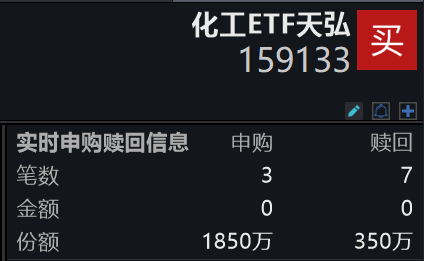
Core Viewpoint - The chemical ETF Tianhong (159133) has shown significant trading activity and net inflow, indicating investor interest in the sector, particularly in emerging fields like new energy materials and high-performance plastics [1][2]. Group 1: ETF Performance - As of January 7, 2026, the chemical ETF Tianhong (159133) had a turnover rate of 5.12% with a transaction volume of 36.0252 million yuan [1]. - The ETF experienced a net subscription of 15 million shares throughout the day, contributing to a total scale of 718 million yuan and a total share count of 622 million, both reaching new highs since its inception [2]. - Over the past six days, the ETF has seen a cumulative net inflow of 104 million yuan [2]. Group 2: Market Trends - The underlying index, the CSI Sub-Industry Chemical Theme Index (000813), declined by 0.54%, while individual stocks within the ETF showed mixed performance, with Tongcheng New Materials (603650) leading with a 10% increase [1]. - Lithium carbonate prices have surged, with the main futures contract reaching 142,300 yuan per ton, marking a 4.54% increase and continuing a trend of price recovery driven by tight supply and demand in the energy storage sector [2][3]. Group 3: Industry Outlook - The growth potential in emerging sectors such as new energy materials and bio-based chemicals is highlighted, with leading companies expected to enhance their global competitiveness through increased R&D and improved supply chain management [2]. - Market analysts suggest that the long-term demand for lithium carbonate remains robust, supported by growth in energy storage and electric vehicle applications, despite potential price volatility due to supply chain uncertainties [3][4]. - The Chinese government is expected to introduce measures to stabilize growth in the petrochemical industry, which may benefit leading companies as the industry adjusts to improved supply-demand dynamics [4].
管理费与收益率“倒挂”引争议 部分大集合产品等待转型末班车
Zhong Guo Zheng Quan Bao· 2026-01-07 22:24
Core Viewpoint - The transition of large collective asset management products to public funds is underway, with many products extending their duration to 2026, while some face liquidation. The management fees of these products remain high despite low yields, leading to market controversy [1][2][6]. Group 1: Transition of Products - By the end of 2025, most large collective asset management products are set to transition to public funds, with some extending their duration to 2026. A few products are also moving towards liquidation [1][2]. - Several products, such as the Yuekai Cash Benefit Money Market Fund, have announced extensions of their duration, with plans to convert to public funds in collaboration with fund companies [2]. - In 2025, over a hundred collective asset management plans are expected to transition to public funds, with companies like Everbright Prudential Fund and GF Fund being the major beneficiaries of this shift [3][4]. Group 2: Management Fee Controversy - Many money market funds that transitioned from large collective products to public funds have retained high management fees, leading to a situation where management fees exceed the low yields, causing disputes in the market [5][6]. - As of January 7, 2023, 13 money market funds still charge a management fee of 0.9%, while others have temporarily reduced fees due to low estimated yields [6][7]. - The high management fees are seen as unreasonable in the context of declining yields, prompting a trend towards fee reductions among various public money market funds [7][8].
部分大集合产品等待转型末班车
Zhong Guo Zheng Quan Bao· 2026-01-07 20:50
Core Viewpoint - The transition of large collective asset management products to public funds is underway, with some products extending their duration to 2026, while others face liquidation. The management fees of some converted products remain high despite low yields, leading to market controversy [1][3][4]. Group 1: Transition of Products - By the end of 2025, most existing large collective products are set to transition to public fund status, with some opting for extensions to 2026 [1][2]. - Several products, such as the Yuekai Cash Benefit and Guolian Cash Benefit, have announced extensions to their duration, indicating a strategic shift towards public fund registration [2][3]. - Over 100 collective asset management plans are expected to convert to public funds in 2025, with major fund companies like Everbright, GF Fund, and Huaxia Fund being the primary beneficiaries of this transition [3][4]. Group 2: Management Fees and Yield Concerns - Many converted money market funds maintain high management fees of 0.9%, despite having low annualized yields around 0.7%, creating a "fee-yield inversion" issue [1][6]. - Some funds have temporarily reduced their management fees due to low yields but reverted to higher rates once conditions improved, raising concerns among investors [4][6]. - Comparatively, public money market funds charge lower management fees, typically around 0.2% to 0.15%, highlighting the disparity in fee structures post-transition [6][7]. Group 3: Operational Changes Post-Transition - The operational framework of converted products has changed significantly, including management fee structures, investment scopes, and performance benchmarks [3][4]. - For instance, the transition of the Guangfa Asset Management's mixed fund involved changes in investment limits and the removal of performance fees, reflecting a shift towards more standardized public fund practices [4].
从籍籍无名中闯出天地,6万亿ETF市场5年养成
2 1 Shi Ji Jing Ji Bao Dao· 2026-01-07 12:45
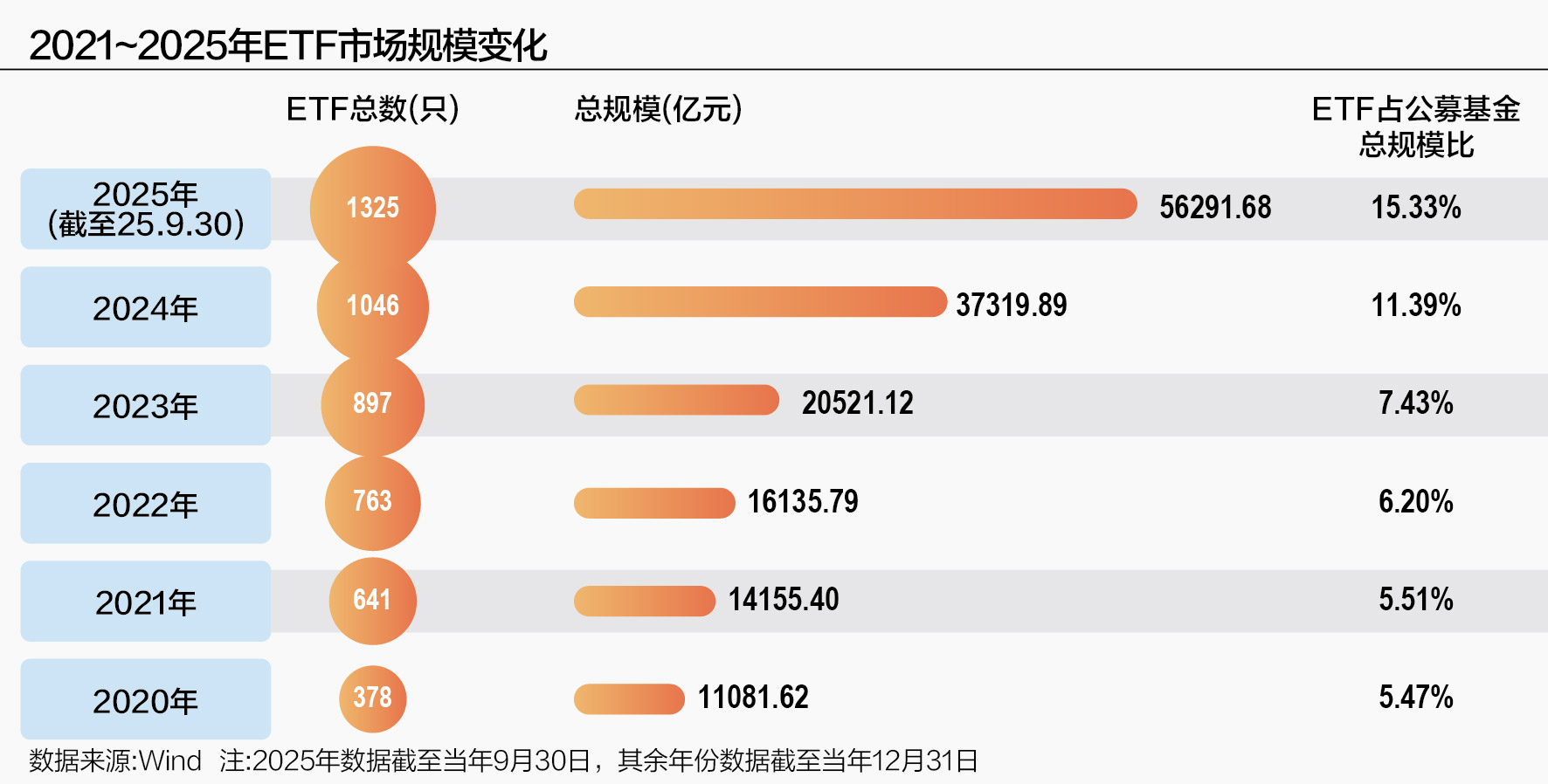
Core Insights - The ETF market in China has reached a significant milestone, with total assets surpassing 6 trillion yuan, reflecting a growth of over 60% year-on-year [3][5] - The rapid expansion of the ETF market is characterized by a shift from slow accumulation to accelerated growth, with a cumulative increase of 452.53% over the past five years [5][6] - The market is witnessing a consolidation of leading fund companies, with a clear top tier emerging in ETF management [7][10] Market Overview - As of December 2025, the total ETF market size reached 6.03 trillion yuan, with an increase of 2.29 trillion yuan within the year [3] - The number of ETF products has grown from 326 to 1402 over the past five years, with a total issuance of 1076 new products [6] - The total trading volume of ETFs has surged from 843.48 billion yuan to 3.96 trillion yuan, marking a growth of 369.51% [6] Management Competition - The top seven fund companies have maintained their positions in the ETF management scale, with 华夏基金 (China Asset Management) leading the market [7][10] - 华夏基金's ETF management scale increased from 187.9 billion yuan in 2020 to 957 billion yuan by the end of 2025 [10] - The entry threshold for the top ten ETF managers has significantly risen, with the requirement increasing from 30 billion yuan five years ago to 200 billion yuan by the end of 2025 [11] Index Performance - The 沪深300 index remains the most popular, with ETF assets linked to it reaching 1.185 trillion yuan by the end of 2025 [14] - The 中证A500 index has emerged as a new favorite, with its ETF size surpassing 300 billion yuan, reflecting a shift towards quality assets [15] - The diversification of asset classes in the top ten indices indicates changing investor preferences, with new themes and sectors gaining traction [16] Holder Structure - Institutional investors have solidified their dominance in the ETF market, increasing their share from 69.07% at the end of 2020 to 76.84% by mid-2025 [20] - The absolute scale of institutional holdings has grown from 743.8 billion yuan to 3.3 trillion yuan, indicating a fourfold increase [20] - Individual investors have shown consistent participation in equity ETFs, maintaining a net value share close to that of institutional investors [21] National Team Involvement - The "national team" has increasingly utilized ETFs as a tool for market stabilization, with significant purchases made during market fluctuations [22][23] - By the end of 2024, the central government’s holdings in ETFs had surged to over 1 trillion yuan, reflecting a strategic shift towards broader ETF investments [23][24] - The national team's involvement in ETFs is expected to play a crucial role in the future of China's capital market ecosystem [24]
安徽合力股价涨5%,天弘基金旗下1只基金重仓,持有3.41万股浮盈赚取3.58万元
Xin Lang Cai Jing· 2026-01-07 05:35
Group 1 - The core viewpoint of the news is that Anhui Heli has seen a 5% increase in stock price, reaching 22.05 yuan per share, with a trading volume of 554 million yuan and a turnover rate of 2.92%, resulting in a total market capitalization of 19.64 billion yuan [1] - Anhui Heli Co., Ltd. is located in Hefei Economic and Technological Development Zone, established on September 30, 1993, and listed on October 9, 1996. The company specializes in the research, development, manufacturing, and sales of industrial vehicles, smart logistics, and key components, along with aftermarket services such as parts service, financing leasing, vehicle leasing, maintenance services, and remanufacturing [1] - The main business revenue composition of Anhui Heli is 98.78% from forklifts and parts, while other supplementary sources account for 1.22% [1] Group 2 - From the perspective of major fund holdings, Tianhong Fund has one fund heavily invested in Anhui Heli. The Tianhong CSI Engineering Machinery Theme Index Fund A (022069) increased its holdings by 8,000 shares in the third quarter, bringing the total to 34,100 shares, which represents 2.1% of the fund's net value, ranking it as the ninth largest holding [2] - The Tianhong CSI Engineering Machinery Theme Index Fund A (022069) was established on October 29, 2024, with a latest scale of 10.033 million. Year-to-date returns are 1.87%, ranking 4,834 out of 5,488 in its category; over the past year, returns are 42.05%, ranking 1,736 out of 4,192; and since inception, returns are 31.94% [2]
