现代汽车集团

Search documents
“史无前例”关税重压下,亚洲车企利润暴跌
Hua Er Jie Jian Wen· 2025-07-24 12:04
Group 1 - The core viewpoint of the articles highlights the significant impact of Trump's tariffs on Asian automotive manufacturers, leading to a drastic decline in profits and a reshaping of the global automotive market competition [1][2]. - Mitsubishi Motors reported a near-total wipeout of its net profit for the second quarter, dropping from 29.5 billion yen (approximately 201 million USD) to almost zero, facing unprecedented challenges due to high tariffs and increased costs [2][3]. - Hyundai Motor Group experienced a 22% year-on-year decline in net profit for the second quarter, with losses attributed to tariffs amounting to 828 billion won (approximately 604 million USD), despite achieving the highest global sales since 2020 [2][3]. Group 2 - Japan successfully negotiated a reduction in automotive tariffs from a threatened 27.5% to 15%, providing significant relief for its automotive exporters, particularly benefiting companies like Mazda, Subaru, and Mitsubishi [3]. - In contrast, South Korea faces greater pressure as its automotive exports are still subject to a 25% tariff imposed by Trump, prompting the government to seek similar tariff reductions as Japan [3]. - The South Korean government is considering strategic concessions on certain agricultural imports in negotiations regarding tariffs with the U.S., indicating a complex trade dynamic [3].
汽车早报|特斯拉加州销量连续七个季度下滑 现代起亚对美电动汽车出口同比骤降88%
Xin Lang Cai Jing· 2025-07-23 00:37
Group 1: BYD and International Partnerships - BYD officially announced a three-year strategic partnership with Inter Milan, becoming the club's global automotive partner and providing approximately 70 electric vehicles [1] Group 2: Financial Performance of Automotive Companies - Jiangling Motors reported a total revenue of 18.092 billion yuan for the first half of 2025, a year-on-year increase of 0.96%, while net profit attributable to shareholders decreased by 18.17% to 733 million yuan [1] - General Motors' Q2 2025 revenue was 47.122 billion USD, a decline of 1.8%, with net profit attributable to shareholders dropping 35.4% to 1.895 billion USD [4] - Stellantis faced a loss of 2.3 billion euros (approximately 19.3 billion yuan) in the first half of the year, with a 25% year-on-year decline in North American market sales [4] - Hyundai and Kia's electric vehicle exports to the U.S. fell by 88% in the first five months of the year, with Hyundai exporting 3,906 units and Kia 3,250 units [5] Group 3: Market Trends and Changes - Tesla's vehicle registrations in California dropped to 41,138 units in Q2, marking a 21.1% year-on-year decline and the seventh consecutive quarter of decline [3] - Mitsubishi Motors announced the termination of its joint venture with Aerospace Mitsubishi due to the rapid transformation of the Chinese automotive industry [6] Group 4: New Product Launches - Wuling officially launched the 2026 model of the Wuling Xingchi, with two configurations priced at 52,800 yuan and 66,800 yuan, respectively, and cumulative sales exceeding 80,000 units since launch [2]





捷尼赛思中国CEO离职?
Mei Ri Jing Ji Xin Wen· 2025-07-16 15:48
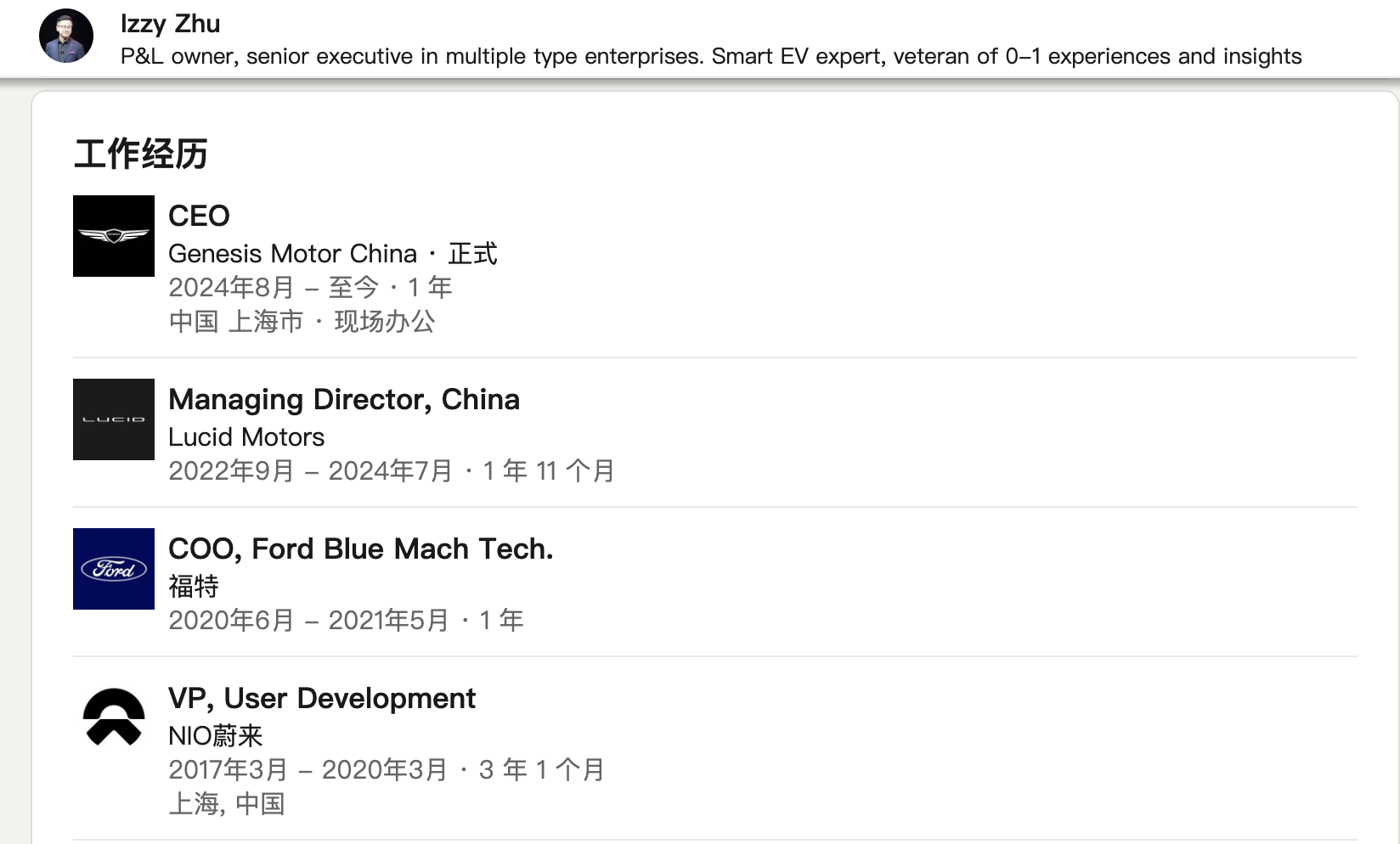
Core Viewpoint - The departure of Genesis China CEO Zhu Jiang highlights ongoing challenges for the luxury brand in the Chinese market, which has seen fluctuating sales and frequent leadership changes since its re-entry in 2021 [1][2][3]. Group 1: Leadership Changes - Zhu Jiang, the CEO of Genesis China, reportedly left the company at the end of June 2023, with no official response from Genesis regarding his departure [1]. - Zhu Jiang has a strong background in the automotive industry, having held senior positions at various international car manufacturers, including NIO and Lucid [2]. - The brand has experienced a series of leadership changes, with the previous CEO, He Ruisi, leaving in October 2023, and a temporary Korean leader, Lee Zhe, serving for nine months before Zhu Jiang's appointment [2]. Group 2: Market Performance - Genesis has struggled in the Chinese market since its third entry in 2021, with sales figures showing significant volatility: 367 units in 2021, 1,457 in 2022, 1,558 in 2023, and a projected decline to 1,328 units in 2024, representing a 24.8% year-on-year drop [3]. - The brand's market performance has prompted a shift towards local production of electric vehicles, following the announcement of a localization plan for new energy models in March 2025 [3]. Group 3: Strategic Initiatives - Currently, Genesis offers six models in China, with gasoline vehicles dominating the lineup, while only two electric models are available [4]. - The penetration rate of new energy vehicles in the domestic luxury car market reached 30.3% as of June 2025, with domestic brands achieving a much higher rate of 75.4%, indicating Genesis's lag in electric vehicle transition [4]. - In response to poor market performance, Genesis has introduced several purchase subsidy policies to stimulate sales, including tax rebates on the G80 model [4].
包括日本在内,14国集体硬刚!急得特朗普喊话中国,中美关系良好
Sou Hu Cai Jing· 2025-07-15 07:14
Group 1 - Trump's announcement of a 25% tariff on imports from 14 countries, including Japan, South Korea, and Malaysia, has sparked a global trade war, negatively impacting the U.S. economy and international standing [2] - Japan's agricultural sector is projected to lose approximately 2.3 trillion yen (around 110 billion RMB) due to the tariffs, threatening the political stability of the ruling party [3] - South Korea's automotive industry faces significant challenges, with President Yoon Suk-yeol emphasizing the need for industrial upgrades rather than being exploited by U.S. policies [3] Group 2 - In response to U.S. tariffs, 14 countries have united against the U.S., with Thailand's Deputy Prime Minister stating a preference to halt car production rather than accept high tariffs [3] - The European Union has retaliated by imposing 25% tariffs on U.S. whiskey and Harley-Davidson motorcycles, with an estimated loss of 12 billion euros for the EU automotive industry [3] - U.S. companies are already feeling the impact, with Ford halting production of the F-150 due to rare earth shortages and Boeing facing production risks from supply chain disruptions [4] Group 3 - China's response to the trade war emphasizes mutual respect and cooperation, highlighting its dominance in rare earth processing and its growing economic ties with ASEAN [8] - China controls 90% of global rare earth processing capacity, which is critical for U.S. missile guidance systems, showcasing its strategic advantage [8] - The trade war has accelerated a shift in global economic alliances, with countries increasingly turning to China for trade and investment, as seen in various agreements and partnerships [9]

日媒:韩国对美投资骤减90%,成亚洲对美国外国直接投资降幅最大国家
Huan Qiu Shi Bao· 2025-07-14 22:48
Group 1 - South Korea has experienced the largest decline in foreign direct investment (FDI) to the U.S. among Asian countries, with a staggering 90% drop in 2024 compared to the previous year [1] - In 2024, total FDI to the U.S. from Asia is projected to be $23.2 billion, a 40% decrease year-on-year, while European investments remain dominant at $96.7 billion [1] - Japan, in contrast, has increased its investment in the U.S. to $18 billion, while China's investment has decreased by 9% to $589 million [1] Group 2 - The decline in South Korean investment is attributed to several factors, including market saturation, reduced demand in key industries like electric vehicle batteries, and increased uncertainty in U.S. policies [1][2] - South Korea was previously the largest investor in the U.S., with commitments of $21.5 billion in 2023, but recent shifts in U.S. policy under the Trump administration have led to a reassessment of investment strategies [2] - Despite the overall decline, some Asian companies, such as Hyundai Motor Group, are still pursuing expansion plans, with Hyundai announcing an additional $21 billion investment in the U.S. [3]
捷尼赛思中国CEO离职?官方暂无回应,韩系豪华车品牌在华发展再陷迷局
Mei Ri Jing Ji Xin Wen· 2025-07-14 13:24
Core Viewpoint - The departure of Genesis China CEO Zhu Jiang highlights ongoing challenges for the luxury brand in the Chinese market, which has seen fluctuating sales and frequent executive changes since its re-entry in 2021 [1][3]. Group 1: Executive Changes - Zhu Jiang, the CEO of Genesis China, reportedly left the company at the end of June 2023, with no further updates shared on his social media since then [1]. - Zhu Jiang has a rich background in the automotive industry, having held senior positions at various international car manufacturers, including NIO and Lucid Motors, before joining Genesis [2]. - Genesis has experienced a series of leadership changes, with its previous CEO, He Ruisi, leaving in October 2023 after nearly four years, and a temporary Korean leader transitioning for nine months before Zhu Jiang's appointment [2]. Group 2: Market Performance - Genesis has struggled in the Chinese market, with sales figures showing significant volatility: 367 units in 2021, 1,457 in 2022, 1,558 in 2023, and a projected decline to 1,328 units in 2024, representing a 24.8% year-on-year drop [3]. - The brand's market entry attempts have been met with challenges, leading to a third re-entry in 2021 after two previous exits due to poor performance [2]. Group 3: Strategic Initiatives - In response to its market challenges, Genesis announced a plan to localize the production of its new energy vehicles by March 2025, aiming to reduce manufacturing costs and leverage local supply chains [3]. - The brand's current lineup includes six models, predominantly fuel-powered, with only two electric models, GV60 and pure electric G80, indicating a lag in adapting to the rapidly electrifying luxury car market in China [4]. - Genesis has introduced various purchase incentives to stimulate sales, although these promotions have raised concerns about inventory clearance and the brand's future in China [7]. Group 4: Future Outlook - Genesis aims to transition to 100% electric vehicles by 2030, with plans to launch eight new electric models starting in 2025, but faces significant competition from both domestic brands and traditional luxury automakers [7]. - The success of Genesis in the competitive Chinese market will depend on the effectiveness of its localization and electrification strategies [7].
在华第三位一把手被放弃,这家豪华品牌还有出路吗
汽车商业评论· 2025-07-13 15:26
Core Viewpoint - Genesis, the luxury brand of Hyundai, is struggling in the Chinese market despite its ambitions to compete with established luxury brands. The company plans to localize production and develop new energy vehicles to improve its market position and brand image [10][20][57]. Group 1: Leadership Changes - CEO Zhu Jiang of Genesis China left his position after less than a year, following the brief tenure of his predecessor, Lee Zhe, who served as Chief Executive Coordinator for only nine months [2][4][6]. - The longest-serving CEO was Markus Henne, who held the position for nearly four years [7][9]. Group 2: Market Performance - Genesis has faced significant challenges in the Chinese market, with annual sales figures of only 367 units in 2021, 1,457 units in 2022, 1,558 units in 2023, and a decline to 1,328 units in 2024 [26]. - Cumulative losses in the Chinese market reached 3 billion yuan by mid-2024, with an average marketing cost of 710,000 yuan per vehicle [28][40]. Group 3: Brand Positioning Issues - Genesis struggles with a confused brand image, attempting to position itself as both a luxury brand and a value option, leading to consumer misperceptions [29][30]. - Over 60% of consumers in major cities mistakenly view Genesis as a lesser-known brand or a Bentley imitation [31]. Group 4: Product Challenges - The GV70 model lacks essential features valued by Chinese consumers, such as a 360-degree camera and automatic parking, resulting in a perception of "high price, low configuration" [34]. - The design of Genesis vehicles does not resonate with younger Chinese consumers, with only 12% of surveyed individuals finding the design appealing [34]. Group 5: Sales and Service Network - As of 2025, Genesis has only 19 dealerships in China, primarily in first- and second-tier cities, compared to over 600 for Mercedes-Benz [35]. - Limited service availability has negatively impacted customer experience, with some customers needing to transport vehicles across provinces for repairs [35]. Group 6: Future Strategies - Genesis plans to launch localized research and manufacturing of new energy vehicles in China within the next 3-5 years, aiming for a sustainable profit model [20][41]. - The company will leverage local supply chains to reduce costs and enhance competitiveness, potentially eliminating significant import tariffs and taxes [44][46]. Group 7: Market Opportunities - The Chinese luxury car market is still growing, with increasing demand for new energy vehicles, presenting an opportunity for Genesis if it can align its products with consumer preferences [55]. - The Chinese government supports the localization of high-end new energy brands, which could benefit Genesis in its efforts to establish a stronger market presence [53].

中创新航单月装机创新高,40%环比增速领跑全球
高工锂电· 2025-07-06 11:25
Core Viewpoint - The global battery installation market is experiencing intense competition, with companies like 中创新航 (Zhongxin Innovation) achieving significant growth through diverse applications and flexible technology combinations. The company has reached a record monthly installation of 4.82 GWh in May, marking a 40% increase from April and positioning it as the fourth largest globally in cumulative installations for the first five months of 2025 [1][2]. Group 1: Installation Growth and Market Position - In the first five months of 2025, 中创新航's cumulative installation reached 16.85 GWh, ranking fourth globally [1]. - The company achieved a record monthly installation of 4.82 GWh in May, with a 40% month-over-month growth, the fastest globally [1]. - The diverse product range of 中创新航 covers multiple applications, including passenger vehicles, commercial vehicles, energy storage, ships, and aircraft, contributing to collaborative growth across various markets [1]. Group 2: International Orders and Technology Advancements - 中创新航 has secured a 30 GWh battery order from Hyundai for the IONIQ 5 model, marking a significant milestone in its international expansion [2]. - The company has also received orders from Volkswagen, planning to supply batteries to multiple subsidiaries by the end of 2027, enhancing its overseas customer base [2]. - The fast-charging technology of 中创新航 is gaining traction in the domestic passenger vehicle market, with the recent launch of the Xiaopeng G7 featuring the company's 5C ultra-fast charging AI battery [2]. Group 3: Commercial Vehicle Growth - 中创新航's commercial vehicle battery deliveries exceeded 6 GWh in the first half of 2025, representing a 280% year-over-year increase, with June deliveries surpassing 1.5 GWh for the first time [4]. - The company anticipates rapid growth in its commercial vehicle segment over the next two years, driven by the commercial viability of electric heavy trucks [4]. - In addition to passenger and commercial vehicles, 中创新航 is making strides in electric ships and overseas energy storage projects, securing significant contracts in various regions [4]. Group 4: Capacity Expansion - To meet the diverse delivery schedules, 中创新航 is accelerating its global capacity expansion, with new projects launched in Changzhou, Xiamen, and Chengdu, as well as a planned 15 GWh energy storage battery factory in Portugal [5]. - The company is in a phase of supply capacity expansion, expecting a concentrated release of delivery capabilities by 2026 [5].

李在明上台后,韩企发力“投资韩国”
Huan Qiu Shi Bao· 2025-07-02 22:48
【环球时报驻韩国特约记者 黎枳银】"会是经济复苏的征兆吗?"随着韩国新任总统李在明上任,LG率 先打响制造业复兴"第一枪",SK、现代、三星、Kakao等大型集团也陆续公布或酝酿数万亿韩元级别的 投资计划,积极响应李在明政府的"尖端战略产业"振兴的政策导向。韩联社、《韩国经济》《京乡新 闻》等韩媒近日纷纷报道,认为这些投资计划或许能成为重塑韩国制造业在全球产业供应链核心地位的 信号。同时,关于韩国企业这波大规模投资能否抢占关键产业市场先机,帮助本国克服发展危机也在韩 国国内引发热烈讨论。 现代汽车集团在今年3月宣布对美投资计划时,也同步公布总额达24.3万亿韩元的韩国本土投资方案, 涵盖研发、运营与战略性项目,年增幅达19%,创下集团历年新高。何时实施,备受关注。 三星电子虽然尚未正式公布具体计划,但会长李在镕在五大企业集团与李在明的座谈会上承诺,三星将 持续扩大在AI、半导体、生物医药领域的投资,推动传统产业与AI融合,提升生产效率并创造高质量 就业岗位。三星去年创下年度设备投资和研发投入新高,今年可能延续这一基调,推出新的本土投资项 目。 世宗大学经营学系教授金大锺指出,激活以尖端制造业为核心的区域投资, ...
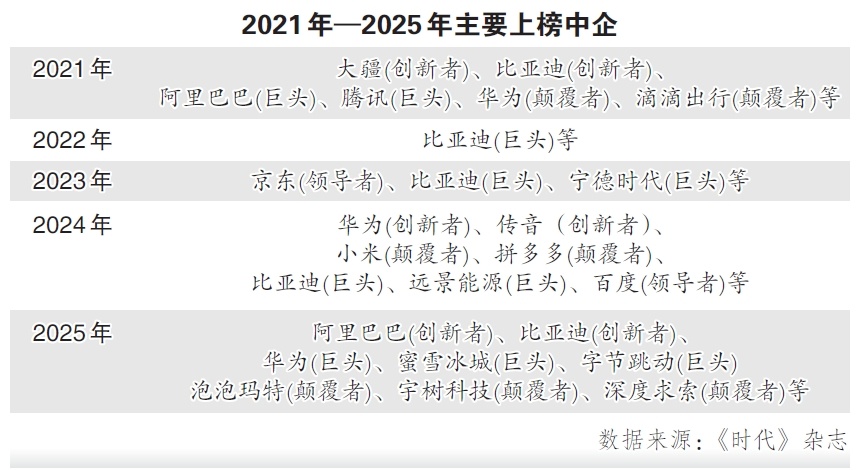
财经观察:从消费到科技,中企靠创新“突围”
Huan Qiu Wang· 2025-07-02 22:48
Core Insights - The "Global 100 Most Influential Companies" list for 2025 by Time magazine highlights several Chinese companies, indicating their significant impact across various sectors including consumption, AI, and robotics [1][2] - The selection criteria for the list emphasize a multi-dimensional evaluation of companies based on influence, innovation, strategic foresight, and business achievements rather than solely on financial metrics [1] Group 1: Company Highlights - Notable Chinese companies on the list include Alibaba, Huawei, ByteDance, BYD, and emerging tech firms like DeepSeek and Yushutech, showcasing a diverse representation across industries [2][3] - DeepSeek's AI model is noted for its competitive performance against OpenAI's latest products while significantly reducing costs, marking a pivotal moment in the global AI landscape [2][6] - Pop Mart, recognized as a "disruptor," has gained popularity with its IP "Labubu," leading to a surge in collectible toy sales and establishing 530 themed stores globally [3][6] - The tea brand Mixue Ice City, categorized as a "giant," has rapidly expanded to over 45,000 stores, becoming one of the largest restaurant chains worldwide [3][6] Group 2: Industry Trends - The list reflects a shift in the global business landscape, with Chinese companies transitioning from followers to innovators and leaders in various sectors, particularly in new consumption and AI [6][9] - The automotive sector, exemplified by BYD, is highlighted for its advancements in electric vehicle technology and solid-state battery development, positioning it as a key player in the global market [6][10] - The rise of companies from global South countries, such as those from China and the UAE, indicates a growing influence in the global market, particularly in AI and new energy sectors [9][11] Group 3: Future Outlook - The next 5 to 10 years may see a continued rise of companies from global South nations, especially in emerging fields like AI and renewable energy, while Western firms may face challenges in adapting to these changes [11] - The potential for innovation in consumption, AI applications, and the pharmaceutical sector is significant, with Chinese companies expected to lead in creating new business models and applications [10][11]