三只松鼠

Search documents
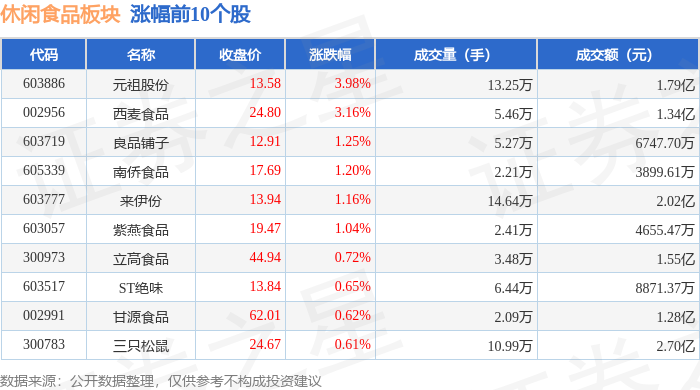
休闲食品板块11月13日涨0.21%,元祖股份领涨,主力资金净流出1.54亿元
Zheng Xing Xing Ye Ri Bao· 2025-11-13 08:44
Market Overview - The leisure food sector increased by 0.21% on November 13, with Yuanzi Co. leading the gains [1] - The Shanghai Composite Index closed at 4029.5, up 0.73%, while the Shenzhen Component Index closed at 13476.52, up 1.78% [1] Individual Stock Performance - Yuanzi Co. (603886) closed at 13.58, up 3.98% with a trading volume of 132,500 shares and a turnover of 179 million yuan [1] - Ximai Food (002956) closed at 24.80, up 3.16% with a trading volume of 54,600 shares and a turnover of 134 million yuan [1] - Other notable performers include: - Liangpinpuzi (603719) at 12.91, up 1.25% [1] - Nanjiao Food (605339) at 17.69, up 1.20% [1] - Laiyifen (603777) at 13.94, up 1.16% [1] Capital Flow Analysis - The leisure food sector experienced a net outflow of 154 million yuan from institutional investors, while retail investors saw a net inflow of 248 million yuan [2] - The capital flow for individual stocks shows: - Yuanzi Co. had a net inflow of 16.71 million yuan from institutional investors [3] - Salted Fish (002847) had a net inflow of 7.79 million yuan from institutional investors [3] - Purple Onion Food (603057) had a net inflow of 5.88 million yuan from institutional investors [3] Summary of Trading Data - The trading data for the leisure food sector indicates varied performance among stocks, with some experiencing significant gains while others faced declines [1][2] - The overall market sentiment appears positive, as indicated by the rise in major indices and the performance of leading stocks in the leisure food sector [1]



大侠后宫:“高学历转行有多猎奇?”哈哈哈哈哈哈哈哈哈哈路子够野!
猿大侠· 2025-11-13 04:11
Group 1 - The article emphasizes the importance of high education levels in achieving success in various fields [1] - It suggests that individuals with higher education are more likely to excel in their careers [1] Group 2 - There are humorous anecdotes and comments related to daily life experiences, showcasing the light-hearted nature of the content [4][5][7] - The article includes various interactions and dialogues that reflect social dynamics and consumer behavior [9][13][42]
A股鏖战4000点 多家券商看好明年慢牛行情
Zheng Quan Shi Bao· 2025-11-12 18:39
Core Viewpoint - The A-share market is experiencing significant rating adjustments by brokerages, with a total of 23 stocks upgraded and 40 downgraded since the end of October, indicating a mixed sentiment among investors and institutions [1][2]. Group 1: Rating Upgrades - A total of 23 A-share stocks have had their ratings upgraded, primarily in the electronics, pharmaceutical, food and beverage, power equipment, and automotive parts sectors [2]. - The electronics sector has the highest number of upgraded stocks, including companies like Guangli Micro (301095), Zhongwei Company, Yuanjie Technology, and Luguang Technology (301606), which are involved in high-tech fields such as semiconductors and consumer electronics [2][3]. - The upgrades are largely attributed to strong performance growth, high technical barriers, and improved industry conditions for the listed companies [2]. Group 2: Rating Downgrades - Approximately 40 A-share stocks have had their ratings or target prices downgraded, mainly in the pharmaceutical, food and beverage, electronics, power equipment, and beauty care sectors [4]. - The downgrades are primarily due to short-term performance challenges, declining gross margins, and reduced industry outlooks, leading to cautious sentiment from institutions regarding these companies' short-term profitability [4][5]. - The pharmaceutical sector has the highest proportion of downgraded stocks, including companies like Aibo Medical, Microelectrophysiology, and Mindray Medical (300760), with reasons including competitive pressures and performance pressures [4][5]. Group 3: Market Outlook - Major brokerages, including CITIC Securities and CICC, have released their 2026 annual investment strategies, generally optimistic about the A-share market's performance [7][8]. - CITIC Securities suggests that the A-share market is transitioning from a domestic focus to a global perspective, with expectations of a "slow bull" market characterized by low volatility during the "14th Five-Year Plan" period [7]. - CICC emphasizes the importance of global capital flows and domestic investment trends, suggesting a balanced market style in 2026, with a focus on growth sectors and external demand [8].
3000亿猫狗大市场,赵露思、陈冠希纷纷加入
3 6 Ke· 2025-11-12 12:14
Core Insights - The pet industry in China is experiencing significant growth, with the market size reaching 300.2 billion yuan, a year-on-year increase of 7.5% [3][4][23] - The trend of pet ownership is evolving, with younger pet owners (under 35) making up 67% of the demographic, leading to a shift towards more sophisticated and health-conscious pet care products [7][9] - The "it economy" is expanding, with various industries, including food and beverage, entering the pet market through new product lines and collaborations with celebrities [18][21] Industry Growth - The number of pet owners in urban China has reached 76.89 million, a 2.4% increase year-on-year, while the number of pets (dogs and cats) exceeds 120 million, growing by 2.1% [3][4] - The Engel coefficient for pet food spending has decreased by 2.93%, indicating a shift towards enhancing the overall quality of life for pets rather than just basic needs [3][4] E-commerce Performance - During the recent Double 11 shopping festival, pet brands saw explosive sales, with 18 brands achieving over 10 million yuan in sales within the first hour [4][11] - The sales of smart pet products have surged, with growth rates of 1560% for trackers and 250% for smart water dispensers, reflecting a trend towards integrating technology into pet care [10][11] Market Trends - New niches are emerging in the pet industry, including pet photography, therapy, and even pet funerals, indicating a broader acceptance of pets as family members [6][12] - The demand for innovative pet products is driving growth, with brands like "许翠花" rapidly gaining market share by addressing specific consumer pain points [9][19] Cross-industry Collaborations - Major brands are entering the pet market, with Adidas launching a pet apparel line and Dettol introducing pet cleaning products, showcasing the trend of cross-industry integration [11][18] - Celebrity involvement in the pet industry is increasing, with figures like Chen Guanxi and Zhao Lusi launching their own pet brands, tapping into their fan bases [18][21] Global Perspective - The global pet retail market is significantly influenced by the U.S., China, and Brazil, contributing approximately 42%, 6.5%, and 4.8% respectively [23] - The potential for growth in the Chinese pet market remains vast, with opportunities for both domestic and international brands to innovate and capture consumer interest [21][23]
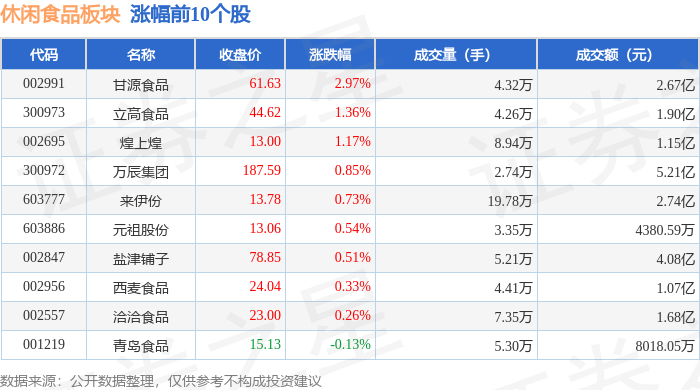
休闲食品板块11月12日跌0.01%,桂发祥领跌,主力资金净流出1.71亿元
Zheng Xing Xing Ye Ri Bao· 2025-11-12 08:42
Market Overview - The leisure food sector experienced a slight decline of 0.01% on November 12, with Gui Faxiang leading the drop [1] - The Shanghai Composite Index closed at 4000.14, down 0.07%, while the Shenzhen Component Index closed at 13240.62, down 0.36% [1] Stock Performance - Notable gainers in the leisure food sector included: - Ganyuan Food: closed at 61.63, up 2.97% with a trading volume of 43,200 lots and a transaction value of 267 million [1] - Lihai Food: closed at 44.62, up 1.36% with a trading volume of 42,600 lots and a transaction value of 206.1 million [1] - Major decliners included: - Gui Faxiang: closed at 14.30, down 2.26% with a trading volume of 273,100 lots and a transaction value of 394 million [2] - Ziyan Food: closed at 19.27, down 2.18% with a trading volume of 29,900 lots and a transaction value of 58.19 million [2] Capital Flow - The leisure food sector saw a net outflow of 171 million from institutional investors, while retail investors contributed a net inflow of 249 million [2] - Specific stock capital flows included: - Ganyuan Food: net inflow of 17.70 million from institutional investors, with a net outflow of 12.58 million from speculative funds [3] - Lihai Food: net inflow of 10.29 million from institutional investors, with a net outflow of 7.30 million from speculative funds [3]



可选消费W45周度趋势解析:海内外消费子版块均无共振,内部因素催化股价表现-20251111
Haitong Securities International· 2025-11-11 15:11
Investment Rating - The report assigns an "Outperform" rating to multiple companies including Nike, Midea Group, JD Group, Haier Smart Home, Gree Electric, Anta Sports, China Duty Free, and others [1]. Core Insights - The report highlights that domestic and overseas consumer subsectors are not showing synchronized movements, with internal factors driving stock performance [4][10]. - The performance of various sectors is analyzed, indicating that the U.S. hotel sector has outperformed others, while luxury goods and overseas cosmetics have seen significant declines [10][13]. Sector Performance Summary - **U.S. Hotels**: The sector saw a weekly increase of 7.9%, driven by strong performance from Marriott and Hilton, with Marriott's RevPAR growth meeting market expectations [5][13]. - **Pet Sector**: Increased by 1.1%, with leading brands showing significant growth in GMV despite overall sales being weak [5][13]. - **Gambling Sector**: Rose by 0.7%, with Macau's GGR exceeding expectations, indicating strong future performance [5][13]. - **Retail Sector**: Experienced a slight decline of 0.3%, with China Duty Free benefiting from new tax policies [7][13]. - **Snack Sector**: Fell by 1.9%, with competitive pressures affecting performance [7][13]. - **Gold and Jewelry Sector**: Decreased by 2.5% due to tax reforms impacting profitability [7][13]. - **Overseas Sportswear**: Dropped by 2.8%, facing tariff pressures and concerns over U.S. consumer spending [7][13]. - **Luxury Goods**: Declined by 3.0%, with concerns over upcoming earnings reports affecting stock prices [7][13]. - **Domestic Cosmetics**: Fell by 3.4%, with overall performance weaker than international brands [7][13]. - **Overseas Cosmetics**: Experienced a significant drop of 11.6%, primarily due to ELF Beauty's disappointing earnings [7][13]. Valuation Analysis - Most sectors are valued below their average over the past five years, with specific PE ratios indicating potential undervaluation [8][14]. - **Overseas Sportswear**: Expected PE of 28.6, 54% of the past five-year average [14]. - **Domestic Sportswear**: Expected PE of 14.1, 74% of the past five-year average [14]. - **Gold and Jewelry**: Expected PE of 22.1, 42% of the past five-year average [14]. - **Luxury Goods**: Expected PE of 25.6, 46% of the past five-year average [14]. - **Gambling**: Expected PE of 29.1, 47% of the past five-year average [14]. - **Overseas Cosmetics**: Expected PE of 35.5, 53% of the past five-year average [14]. - **Domestic Cosmetics**: Expected PE of 27.9, 52% of the past five-year average [14]. - **Pet Sector**: Expected PE of 40.3, 55% of the past five-year average [14]. - **Snack Sector**: Expected PE of 26.8, 65% of the past five-year average [14]. - **Retail Sector**: Expected PE of 28.6, 53% of the past five-year average [14]. - **U.S. Hotels**: Expected PE of 31.4, 19% of the past five-year average [14]. - **Credit Card Sector**: Expected PE of 28.9, 55% of the past five-year average [14].
500亿产业带的“双11”物流新解法
Bei Jing Shang Bao· 2025-11-11 12:17
Core Insights - The article highlights the rapid growth and operational challenges faced by food merchants in Zhangzhou Longhai during the "Double 11" shopping festival, emphasizing the importance of logistics providers like Jitu Express in meeting high demand [1][2]. Group 1: Industry Overview - Zhangzhou Longhai is a significant food production hub in southeastern China, with an annual output value exceeding 50 billion yuan and over a thousand factories and workshops [1]. - In the first half of the year, 196 large-scale food enterprises in Longhai achieved an output value of 20.08 billion yuan, accounting for 56.7% of the region's total industrial output [1]. Group 2: Logistics Challenges and Solutions - Jitu Express has been deeply involved in local services, expecting a 15% year-on-year increase in daily parcel volume during "Double 11" [2]. - To handle the surge in orders, Jitu Express optimized its logistics by using smaller vehicles for more frequent trips, improving efficiency by 20% compared to traditional methods [4]. - Jitu Express has implemented a tiered customer service model to provide personalized support based on order volume, ensuring that each merchant receives tailored assistance [4]. Group 3: Strategic Developments - Jitu Express aims to be more than just a logistics provider, positioning itself as an "enabler" for small and medium-sized businesses across various industrial belts in China [5]. - The company has been recognized as a preferred logistics partner for major e-commerce platforms, helping merchants reduce costs by 5%-10% during peak shopping seasons [6]. - Jitu Express has upgraded its logistics infrastructure, including the launch of a new logistics hub in the Greater Bay Area, which is the largest self-built logistics center globally [6][8]. Group 4: Future Outlook - The "Double 11" event serves as a critical test for both merchants and logistics providers, allowing them to identify areas for improvement and strengthen future collaborations [8]. - Jitu Express has transitioned from a focus on rapid growth to a strategy centered on sustainable value creation, emphasizing long-term partnerships with industry players [8].

休闲食品行业专题报告之一:大浪淘沙,沉者为金
Guoxin Securities· 2025-11-11 11:18
Investment Rating - The report maintains an "Outperform" rating for the leisure food industry and specific companies such as Wei Long Mei Wei, Yan Jin Pu Zi, Jin Zai Food, and Wan Chen Group [4][5]. Core Insights - The leisure food market in China is projected to reach 1.344 trillion yuan in 2024, with a year-on-year growth of 5.3% and a CAGR of 4.4% from 2019 to 2024, expected to increase to 5.5% from 2025 to 2029 [1][15]. - The industry is characterized by a highly fragmented competitive landscape, with the top five and ten companies holding only 5.9% and 10.4% of the market share, respectively [1][22]. - Structural changes are reshaping the industry, including the rise of new retail channels, increased health consciousness among consumers, vertical integration in supply chains, and accelerated globalization efforts by leading companies [1][2][33]. Summary by Sections Industry Overview - The leisure food sector is a multi-billion market with diverse product categories, including snacks, nuts, and baked goods, focusing on fulfilling various consumer needs beyond mere hunger [15][18]. - The market is expected to continue expanding, with significant room for growth in per capita consumption, currently at 954.4 yuan, which is substantially lower than in the US and Japan [2][15]. Competitive Landscape - The industry is marked by intense competition and low concentration, with major players like Mars and Mondelez holding a small market share compared to their counterparts in the US [22][23]. - The competitive dynamics are shifting from price wars to differentiation and efficiency battles, as consumer demands become more diverse and nuanced [2][3]. Structural Changes - New retail formats such as bulk snack stores and instant retail are emerging, challenging traditional retail channels [33][34]. - Health awareness is driving innovation in product offerings, with a notable rise in demand for healthier snack options like konjac products, which are low in calories and high in dietary fiber [66][70]. Future Outlook - The report identifies three core drivers for industry growth: product innovation, scenario extension, and international expansion [2][3]. - Leading brands are expected to strengthen their market positions, with opportunities for both manufacturing and channel-focused companies to benefit from evolving consumer preferences and retail dynamics [2][3][4]. Company-Specific Insights - Wei Long Mei Wei and Yan Jin Pu Zi are highlighted as key players in the konjac snack segment, with significant revenue growth anticipated [3][70]. - Jin Zai Food is undergoing channel reforms and launching new products, while Wan Chen Group is expanding its discount supermarket presence, indicating potential for long-term growth [3][4].
良品铺子陷“渠道萎缩+价格下降”负循环控制权转让终止后如何自救?
Xin Lang Ke Ji· 2025-11-11 09:11
Core Viewpoint - The financial performance of Liangpinpuzi has significantly deteriorated, with a revenue decline of 24.45% year-on-year and a loss of approximately 122 million yuan in the first three quarters of 2025, marking a stark contrast to a profit of 19.39 million yuan in the same period last year [1][3]. Financial Performance - In the first three quarters of 2025, Liangpinpuzi achieved revenue of approximately 4.14 billion yuan, down 24.45% year-on-year, and incurred a loss of about 122 million yuan compared to a profit of 19.39 million yuan in the previous year [1]. - The company's gross margin has decreased from nearly 29% in Q3 2023 to 24.96% in Q3 2025, indicating a continuous decline [3][4]. - The sales expense ratio reached 24.27%, contributing to a total expense ratio of 28.71% [3]. Market Position and Strategy - Liangpinpuzi, positioned as a "high-end snack" brand, has seen its growth engines of "premiumization" and "channel expansion" stall amid weak terminal demand and intense competition in the snack market [3]. - The company has initiated large-scale price reductions and closed franchise stores starting November 2023, which has led to further sales shrinkage and declining gross margins [3][4]. Channel Dynamics - The traditional e-commerce channel has become saturated, with e-commerce revenue declining nearly 40% compared to 2021 [4]. - As of mid-2023, the company closed 259 stores, reducing its total to 2,445 [4]. Shareholder Actions and Control Issues - Following a significant drop in stock price, major institutional investors have begun to reduce their holdings, with notable exits from the top shareholder list [5]. - The controlling shareholder, Ningbo Hanyi, has been reducing its stake and facing high pledge risks, with 35.23% of shares pledged as of August 2023 [5][6]. - A planned transfer of control to Guangzhou Light Industry Group was halted due to unresolved conditions, adding uncertainty to the company's governance [6]. Competitive Landscape - Liangpinpuzi's performance contrasts sharply with competitors such as Yanjinpuzi, Laiyifen, and Three Squirrels, which have recorded positive revenue growth in the same period [6].
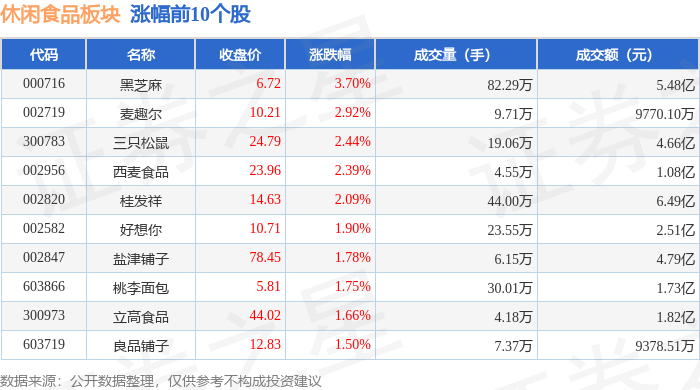
休闲食品板块11月11日涨0.93%,黑芝麻领涨,主力资金净流入3460.97万元
Zheng Xing Xing Ye Ri Bao· 2025-11-11 08:37
Market Overview - The leisure food sector increased by 0.93% on November 11, with Hei Zhima leading the gains [1] - The Shanghai Composite Index closed at 4002.76, down 0.39%, while the Shenzhen Component Index closed at 13289.0, down 1.03% [1] Stock Performance - Hei Zhima (000716) closed at 6.72, up 3.70% with a trading volume of 822,900 shares and a transaction value of 548 million [1] - Other notable performers include: - Mai Jiao Er (002719) at 10.21, up 2.92% [1] - San Zhi Song Shu (300783) at 24.79, up 2.44% [1] - Xi Mai Food (002956) at 23.96, up 2.39% [1] - Gui You Xiang (002820) at 14.63, up 2.09% [1] Capital Flow - The leisure food sector saw a net inflow of 34.61 million from main funds, while retail funds experienced a net outflow of 25.13 million [2] - The main funds' net inflow for Hei Zhima was 39.29 million, representing 7.17% of its total trading volume [3] - San Zhi Song Shu had a main fund net inflow of 30.52 million, accounting for 6.55% of its trading volume [3] Individual Stock Analysis - Hei Zhima experienced a significant net outflow from retail investors of 42.06 million, indicating a divergence in investor sentiment [3] - San Zhi Song Shu also faced a retail net outflow of 26.17 million, suggesting potential concerns among smaller investors [3] - Other stocks like Yan Jin Pu Zi (002847) and Xi Mai Food (002956) showed mixed capital flows, with Yan Jin Pu Zi having a net inflow from main funds of 13.91 million [3]