
京东集团

Search documents
京东集团(09618) - 董事会会议日期
2026-02-20 10:00
香港交易及結算所有限公司及香港聯合交易所有限公司(「香港聯交所」)對本公告的內容概不負責,對其準確性或 完整性亦不發表任何聲明,並明確表示概不會就本公告全部或任何部分內容而產生或因倚賴該等內容而引致的任 何損失承擔任何責任。 根據不同投票權架構,我們的股本包括A類普通股及B類普通股。對於提呈我們股東大會的任何決議案,A類普通 股持有人每股可投1票,而B類普通股持有人則每股可投20票,惟法律或我們的組織章程大綱及細則另行規定者除 外。股東及有意投資者務請留意投資不同投票權架構公司的潛在風險。我們的美國存託股(每股美國存託股代表 兩股A類普通股)於美國納斯達克全球精選市場上市,股份代碼為JD。 JD.com, Inc. 京東集團股份有限公司 (於開曼群島註冊成立並以不同投票權控制的有限責任公司) (股份代號:9618(港幣櫃台)及89618(人民幣櫃台)) 董事會會議日期 預先登記鏈接:https://s1.c-conf.com/diamondpass/10052883-dmzuj7.html 會議編號:10052883 1 電話重播將持續一週至2026年3月13日。撥號詳情如下: 美國: +1-855-883- ...
返乡创业带动就业市场,共绘乡村振兴新图景丨新春走基层
证券时报· 2026-02-20 09:16
返乡电商创业为乡村注入了新的活力与希望。 新春伊始,江西省吉安市泰和县的广袤大地逐渐被大自然唤醒,嫩绿的小草在微风中轻舞,星星点点的野花也 点缀其间,处处洋溢着蓬勃的希望。而在这片充满生机的土地上,一场由返乡电商创业引领的乡村振兴热潮, 正如春日暖阳般,温暖且有力地改变着乡村的面貌。 "以前想回乡创业,心里总是七上八下的,最愁的就是资金和场地问题。"返乡创业者李晓东(化名)感慨道。 李晓东曾在沿海城市从事电商运营多年,积累了丰富的经验,但家乡创业环境的种种不确定性,让他一度犹豫 不决。不过,随着乡村快递网络完善,以及一系列政策扶持,李晓东内心的顾虑逐渐消散。2022年,凭借多年 电商运营方面的经验,结合当地丰富的农产品资源,他果断回到家乡开启了自己的创业之路。 王军/摄 "在外漂泊多年,最牵挂的还是家乡的亲人。现在家乡的政策这么好,创业环境也越来越好。"李晓东的话道出 了许多返乡创业者的心声。 据李晓东介绍,他的电商平台销售的商品主要为玩具、衣服、装饰品以及家乡部分农产品等,玩具、衣服、装 饰品等主要针对海外市场,农产品等主要针对国内市场。创业之路并非一帆风顺,在刚开始运营电商平台时, 他面临着诸多困难。玩具 ...

节后首日,港股跳水!互联网大厂,集体大跌!
证券时报· 2026-02-20 09:16
Core Viewpoint - The Hong Kong stock market experienced a significant decline on the first trading day after the holiday, with major indices dropping sharply, indicating a bearish sentiment in the market [1][2]. Market Performance - The Hang Seng Index closed at 26,413.35, down 292.59 points or 1.10% [2]. - The Hang Seng Technology Index fell by 2.91% to 5,211.50 points, marking a new low in five months [4]. - The Hang Seng China Enterprises Index decreased by 1.22% to 8,959.56 points [2]. Sector Analysis - Technology stocks faced substantial losses, with major players like JD Health and Baidu dropping over 6%, while Tencent Music and Bilibili fell more than 5% [4][5]. - In contrast, AI applications and certain leading biotech companies saw gains, with some AI stocks like Zhiyuan and MiniMax experiencing significant increases in market capitalization [6]. Cryptocurrency Sector - Cryptocurrency-related stocks surged, with Star Chain Group rising over 122% [8]. - The Hong Kong Monetary Authority is evaluating applications for stablecoin issuer licenses, aiming to issue the first licenses by March [8]. Government Outlook - The Financial Secretary of Hong Kong expressed optimism about the market for the Year of the Horse, noting that historically, three out of four Horse years have seen double-digit percentage increases [9].

春节后首日,港股跳水
Shen Zhen Shang Bao· 2026-02-20 06:42
Market Performance - The Hang Seng Index and Hang Seng Tech Index opened lower, with the Hang Seng Index dropping by 1.31% at one point and currently down by 0.68%, while the Hang Seng Tech Index fell by 2.7% and is currently down by 2.02% [1] AI Application Stocks - AI application stocks in Hong Kong showed strong performance, with Haizhi Technology Group rising by 19.25%, MINIMAX-WP increasing by 11.63%, and Zhipu gaining 18.31%, bringing their market capitalization to HKD 268 billion [1] Regulatory Developments - Victory Securities saw a rise of 13.12% following the announcement that its virtual asset trading platform VDX received an operating license on February 13 from the Hong Kong Securities and Futures Commission [1] Cryptocurrency Stocks - Some Hong Kong Bitcoin-related stocks performed well, with Star Chain Group surging by 46.67%. This follows comments from Hong Kong legislator Wu Jiezhuang about the issuance of the first stablecoin licenses in March, aimed at promoting usage through airdrops [1] Technology Sector Decline - The majority of tech stocks in Hong Kong declined, with Kingdee International and Baidu Group falling over 5%, Alibaba and Bilibili down over 4%, and Netease down by 3.95%. Other companies like Tongcheng Travel, Li Auto, and Tencent Music also saw declines exceeding 3.3% [1]

春节后首日,港股跳水,百度、阿里巴巴、网易、腾讯、京东下跌!智谱大涨,市值达2600亿港元
Mei Ri Jing Ji Xin Wen· 2026-02-20 06:31
Market Performance - The Hang Seng Index and Hang Seng Tech Index opened lower, with the Hang Seng Index dropping by 1.31% at one point and currently down by 0.68%, while the Hang Seng Tech Index fell by 2.7% and is currently down by 2.02% [1] AI Application Stocks - AI application stocks in Hong Kong showed strong performance, with Haizhi Technology Group (2706.HK) rising by 19.25%, MINIMAX-WP (0100.HK) increasing by 11.63%, and Zhipu (2513.HK) gaining 18.31%, bringing their market capitalization to HKD 268 billion [1] Regulatory Developments - Victory Securities (8540.HK) saw a rise of 13.12% following the announcement that its subsidiary, VDX, received a license for operating a virtual asset trading platform on February 13 [1] Cryptocurrency Sector - Some Hong Kong-listed Bitcoin-related stocks performed well, with Star Chain Group (0399.HK) surging by 46.67%. This follows comments from a Hong Kong legislator about the issuance of the first stablecoin licenses in March, aimed at promoting usage through airdrops [1] Tech Sector Performance - The majority of tech stocks experienced declines, with Kingdee International and Baidu Group falling over 5%, Alibaba and Bilibili down over 4%, and Netease down by 3.95%. Other companies like Tongcheng Travel, Li Auto, and Tencent Music also saw declines exceeding 3.3% [2] Notable Gainers in Tech - Midea Group (000333), SenseTime, and Horizon Robotics experienced increases in their stock prices, indicating some positive movement within the tech sector despite the overall downturn [2]
来财了!超10亿元春节“礼包”持续发放!有奖发票“火了”
Xin Lang Cai Jing· 2026-02-20 05:14
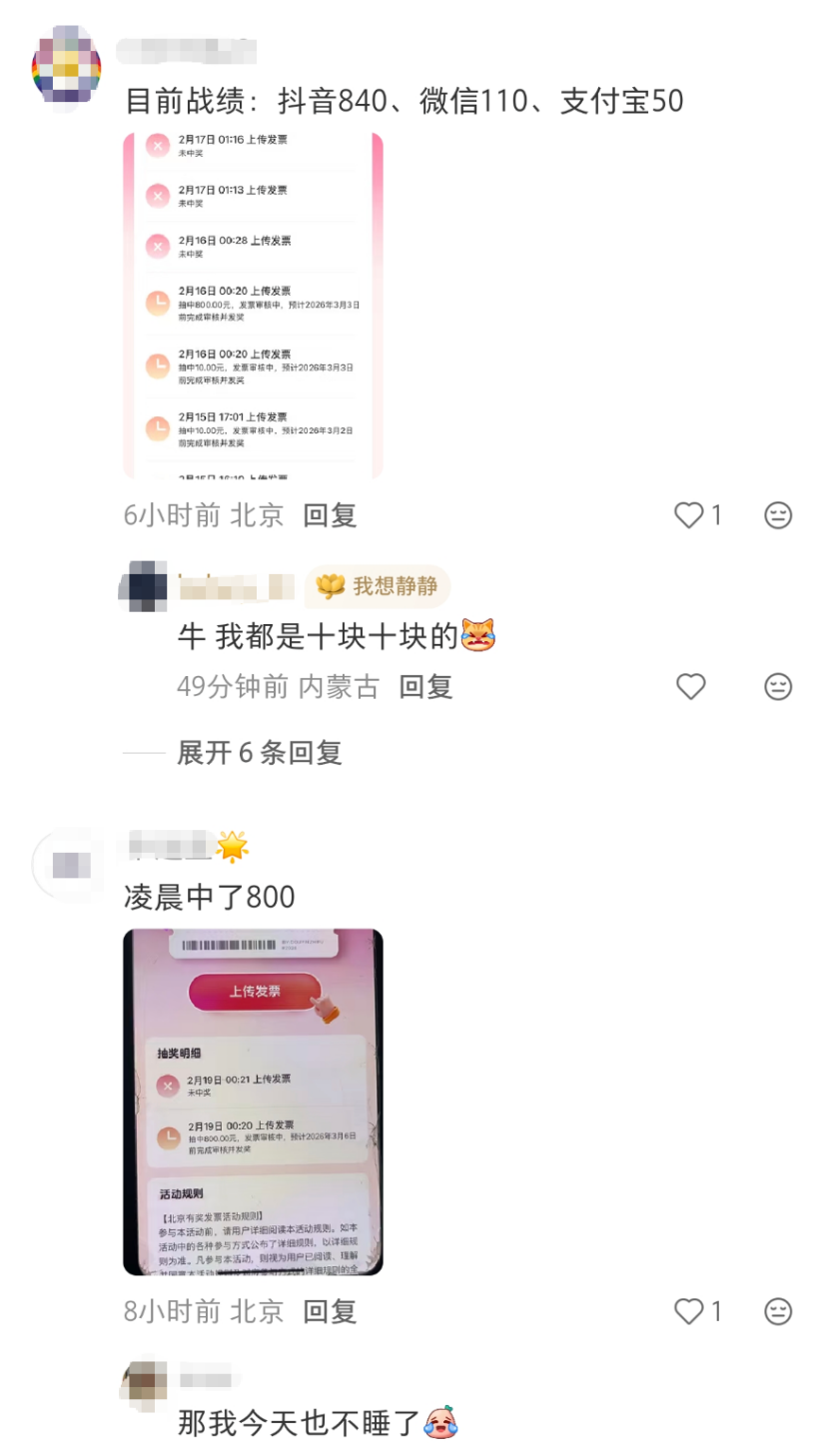
【导读】春节假期有奖发票"火了",多地公布领奖情况 这个春节假期,有奖发票"火了"! 近期,基金君在多个社交平台上发现,有大量网友晒出自己在各个平台有奖发票的中奖"成绩单"。 基金君在第一时间按照网友攻略试水,分别在微信、支付宝、银联云闪付三个渠道进行了三次抽奖,"战绩"分别为30元、50元、50元,中奖率颇高。还没 参加的朋友,可以赶紧试试。 此外,也有不少网友晒出自己的"中奖心得"及攻略,包括平台选择、城市选择、抽奖时段、发票金额等。 值得一提的是,除了线下消费获取发票外,消费者日常在各大平台、App上的消费记录,大多可通过补开发票的方式参与抽奖,大大提高了抽奖的频次和 效率。 另外,目前各大平台多将有奖发票活动置于首页或搜索关键字前列,消费者可轻易找到参与入口。 近期,多地政府部门陆续公布当地发放"红包"情况。例如,据合肥市商务局数据,截至2月17日,当地累计中奖用户数397280人,中奖发票张数为2094077 张,发放红包金额5945.51万元,有效提升了用户获得感与活动吸引力。 绍兴商务数据显示,2月14日—2月18日,市民累计上传发票近70万张,共领取奖金超848万元。 目前,主要参与平台有银联 ...
港股午评:科指半日跌2.28%,机器人及AI应用概念股逆势走高,互联网科技股表现疲软
Jin Rong Jie· 2026-02-20 04:25
Market Overview - The Hong Kong stock market experienced a decline on the first trading day of the Year of the Rabbit, with the Hang Seng Index down 0.6% to 26,544.62 points, the Hang Seng Tech Index down 2.28% to 5,245.1 points, and the National Enterprises Index down 0.59% to 9,016.99 points [1] - Major technology stocks saw significant declines, including Alibaba down 3.75%, Tencent down 1.97%, and JD Group down 1.42% [1] AI and Robotics Sector - The AI and robotics sectors saw explosive growth, with several stocks reaching historical highs. MINIMAX-WP (00100) surged over 14% to 980 HKD, marking a year-to-date increase of over 450% [2] - The company launched the MiniMax M2.5, a production-grade model designed for Agent scenarios, which has attracted significant developer interest [2] - Zhizhu (02513) opened over 5% higher at 534 HKD, with projections of a 120% compound annual growth rate in revenue from 2025 to 2028 [2] - Aixin Yuanzhi (00600) saw a rise of over 16%, nearing a market capitalization of 20 billion HKD, following the successful testing of its high-end smart driving chip M97 [2] Earnings Disparity - Suton Ju Chuang (02498) reported a significant turnaround, with a forecast of achieving its first quarterly profit of at least 60 million RMB in Q4 2025, indicating a scaling phase for its robotics business [3] - The company Wang Guo Gold Group (03939) anticipates a profit increase of 143%-161% for the 2025 fiscal year, driven by rising gold prices and increased production [3] - Conversely, Shisi Pharmaceutical Group (02005) warned of a profit decline of 45%-60% for 2025 due to factors such as the lack of a major flu outbreak and price reductions in collective procurement [3] Buybacks and Fund Movements - Xiaomi Group-W (01810) repurchased 1.5 million shares for approximately 54.7 million HKD, while NetEase Cloud Music (09899) repurchased 92,400 shares for nearly 15 million HKD [4] - Other companies like Geely Automobile and Meitu also engaged in significant share buybacks [4] - Southbound capital flows showed a mix of cautious sentiment and recovery, with expectations for a rebound in Hong Kong tech stocks amid RMB appreciation [4] Institutional Insights - According to CICC, the recent pullback in Hong Kong stocks is attributed to hawkish expectations from the Federal Reserve and concerns over AI capital expenditures, but there is potential for recovery [6] - Analysts from ING noted that the recent decline in gold prices is a corrective pause, with expectations for strong demand as liquidity in Asian markets improves [6] - Electric equipment stocks rose, with Shanghai Electric up 7.38% and Harbin Electric up 4.45%, as analysts see long-term investment opportunities in the sector due to ongoing electricity shortages in the U.S. [6]

春节后首日,港股跳水,百度、阿里、网易、腾讯、京东下跌!智谱大涨
Mei Ri Jing Ji Xin Wen· 2026-02-20 02:36
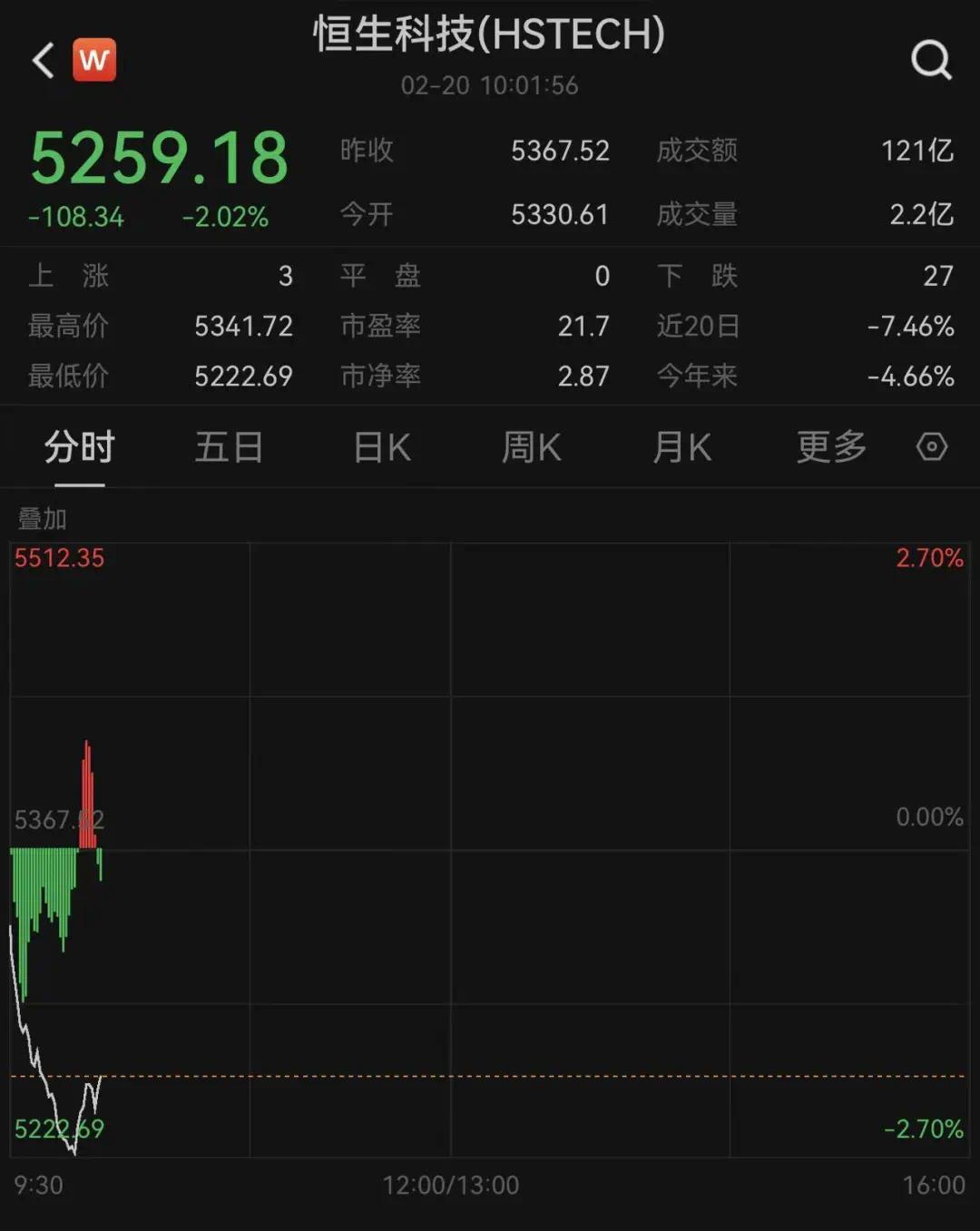
Market Overview - The Hang Seng Index and Hang Seng Tech Index opened lower, with the Hang Seng Index dropping by 1.31% at one point and currently down by 0.68% [1] - The Hang Seng Tech Index saw a decline of 2.7% at its lowest, now down by 2.02% [1] Hang Seng Tech Index Details - The Hang Seng Tech Index opened at 5330.61, with a current value of 5259.18, reflecting a decrease of 108.34 points or 2.02% [2] - The trading volume for the day is 2.2 billion, with a market capitalization rate of 21.7 [2] Hang Seng Index Details - The Hang Seng Index opened at 26657.84, currently at 26524.99, down by 180.95 points or 0.68% [3] - The trading volume is reported at 23.4 billion, with a market capitalization rate of 12.1 [3] Notable Stock Movements - Hai Zhi Technology Group (2706.HK) surged by 19.25%, while MINIMAX-WP (0100.HK) increased by 11.63%, and Zhi Pu (2513.HK) rose by 18.31%, with a total market capitalization reaching 268 billion HKD [3] - Victory Securities (8540.HK) saw a rise of 13.12% following the approval of its virtual asset trading platform [7][8] - Bitcoin-related stocks, such as Xing Tai Chain Group (0399.HK), increased by 46.67% amid news of upcoming stablecoin licenses in Hong Kong [8] Declines in Tech Stocks - Major tech stocks experienced declines, with Kingdee International and Baidu Group dropping over 5%, and Alibaba and Bilibili falling over 4% [10] - Other notable declines include Netease down by 3.95%, and Tencent Holdings down by 2.25% [10][11] Gains in Other Sectors - Midea Group, Horizon Robotics, and SenseTime saw increases, with Midea Group rising by 1.47% [12]
春节后首日,港股跳水,百度、阿里巴巴、网易、腾讯、京东下跌!智谱大涨,市值达2600亿港元|开盘播报
Mei Ri Jing Ji Xin Wen· 2026-02-20 02:21
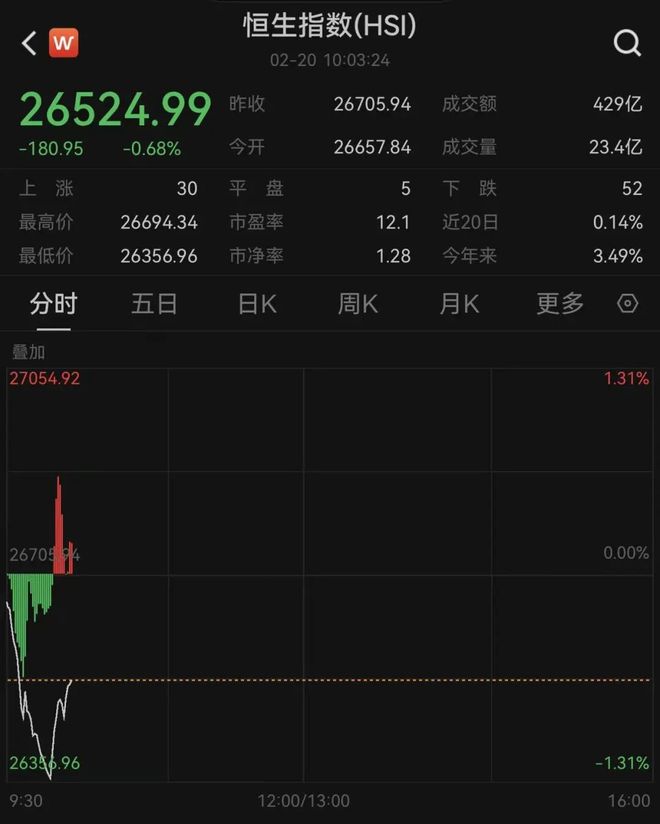
Market Overview - The Hang Seng Index and Hang Seng Tech Index opened lower, with the Hang Seng Index dropping by 1.31% at one point and currently down by 0.68% [1] - The Hang Seng Index is currently at 26,524.99, with a trading volume of 4.29 billion and a market capitalization of 429 billion [2] Stock Performance - AI application stocks in Hong Kong showed strong performance, with Haizhi Technology Group (2706.HK) rising by 19.25%, MINIMAX-WP (0100.HK) increasing by 11.63%, and Zhipu (2513.HK) up by 18.31%, bringing their market capitalization to 268 billion HKD [1] - Victory Securities (8540.HK) saw a rise of 13.12% following the approval of its virtual asset trading platform VDX by the Hong Kong Securities and Futures Commission [6] - Bitcoin-related stocks also performed well, with Star Chain Group (0399.HK) surging by 46.67% after news of the issuance of stablecoin licenses in Hong Kong [6] Declines in Tech Stocks - Many tech stocks experienced declines, with notable drops including Kingdee International and Baidu Group falling over 5%, Alibaba and Bilibili down over 4%, and Netease down by 3.95% [8] - Other companies such as Tencent Music, Meituan, and JD Group also saw declines of over 3% [8][9][10] Notable Gainers - Midea Group, Horizon Robotics, and SenseTime recorded gains, with Midea Group increasing by 1.47% [11]
告别泡沫叙事:九大关键词看懂2025中国消费
Xin Lang Cai Jing· 2026-02-20 02:07
Group 1: Chinese Consumption Market Trends in 2025 - The Chinese consumption market in 2025 is characterized by both chaos and transformation, moving away from bubble narratives towards efficiency, value, and trust as core competitive elements [1] - The delivery service battle resulted in a loss of at least 30 billion yuan in Q2 2025, significantly impacting small businesses and delivery personnel [3][4] - The pre-prepared food crisis highlighted a significant trust gap between consumers and the food industry, leading to a call for national standards [6][8] Group 2: Delivery Service Battle - The delivery service war was ignited by JD's aggressive entry into the market, leading to a fierce subsidy competition among major players like Meituan and Alibaba [3][4] - The battle resulted in a dramatic increase in active users for JD and Meituan, but ultimately led to unsustainable financial losses [3][4] - The strategic rationale for giants like Alibaba and JD was to cultivate consumer habits of ordering food through their platforms, thereby enhancing their core e-commerce businesses [4] Group 3: Pre-prepared Food Crisis - The pre-prepared food crisis began with a public dispute involving a well-known restaurant, revealing deep-seated issues in the food industry's industrial transformation [6][7] - The crisis underscored the clash between consumer rights and the interests of food enterprises, with consumers demanding transparency [8][9] - The industry is expected to undergo significant regulatory changes, with new national standards being proposed to ensure consumer awareness and rights [9][10] Group 4: Discount Retail Trends - The discount retail sector in China is experiencing rapid expansion, with new players entering the market and established brands accelerating their store openings [11][12] - Hard discount models are thriving due to their focus on private label products and supply chain efficiency, while soft discount models are struggling [11][13] - The competition has shifted from price wars to a broader focus on supply chain efficiency and operational capabilities [13][14] Group 5: Health and Wellness Trends - The market for health and wellness products, particularly those related to traditional Chinese medicine, has surpassed 370 billion yuan, indicating a growing consumer interest in health [18][19] - The product offerings in this sector are diversifying, with new ingredients being added to the list of approved health foods [19][20] - Retail channels are increasingly focusing on health products, with major retailers launching specialized health product lines [22] Group 6: International Brands Selling Out - In 2025, several international brands, including Starbucks and Burger King, opted to sell their Chinese operations to local partners, indicating a shift in market strategy [23][24] - The decline in market share for these brands is attributed to their inability to adapt to the fast-paced and competitive Chinese market [24][25] - Successful local brands have demonstrated the potential for growth and profitability in the Chinese market, contrasting with the struggles of foreign brands [26] Group 7: Middle-Class Consumer Sentiment - The middle-class consumer segment in 2025 is experiencing significant discontent, driven by rising prices and perceived value discrepancies [28][30] - This demographic is increasingly critical of brands that do not meet their expectations for quality and value, leading to a reevaluation of brand loyalty [30][31] - The notion of the middle class is being challenged, with discussions around its existence and relevance in the current economic landscape [30] Group 8: Weight Management as a National Strategy - 2025 has been designated as the "Year of Weight Management," with government initiatives promoting healthy eating and lifestyle choices [33][34] - The market for weight management products is projected to reach 326 billion yuan, with a significant increase in demand for functional foods [35][36] - The trend reflects a broader societal shift towards health consciousness, influencing various sectors including food and fitness [36] Group 9: IPO Activity in Hong Kong - The Hong Kong stock market saw a surge in IPO activity in 2025, with 111 companies raising a total of 250.56 billion yuan, surpassing previous expectations [37][38] - The consumer sector was a major focus, with numerous retail and consumption-related companies going public [38][39] - The trend of dual listings (A+H shares) is gaining momentum, indicating a strategic move by companies to enhance their market presence [40]