
友邦保险

Search documents
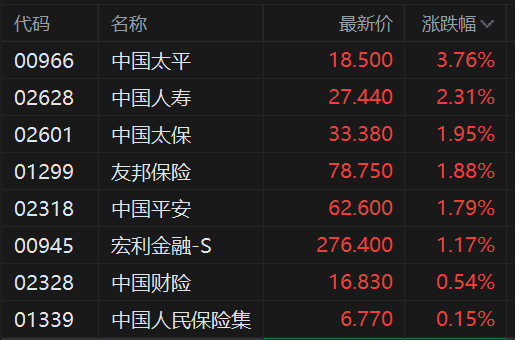
内险股普涨 中国太平涨近4% 中国平安涨近2% 机构看好保险业前景
Ge Long Hui· 2025-12-12 03:47
Core Viewpoint - The Hong Kong insurance sector experienced a collective rise, driven by positive market sentiment and favorable regulatory changes, indicating a strong outlook for the industry in both the short and long term [1] Group 1: Market Performance - On December 12, major Hong Kong insurance stocks saw significant gains, with China Taiping rising nearly 4%, China Life up 2.3%, and China Ping An, China Taibao, and AIA increasing by nearly 2% [1] - The stock prices and their respective changes include: - China Taiping: 18.500, +3.76% - China Life: 27.440, +2.31% - China Taibao: 33.380, +1.95% - AIA: 78.750, +1.88% - China Ping An: 62.600, +1.79% - China Pacific Insurance: 16.830, +0.54% - China People's Insurance: 6.770, +0.15% [2] Group 2: Industry Outlook - Guosheng Securities reported that the insurance industry will benefit from the trend of bank deposits moving to insurance products, with diverse demands in retirement, healthcare, and savings expected to drive industry expansion [1] - The smooth progress of the insurance companies' "opening red" is anticipated to boost the liability performance in 2026 [1] - The adjustment of product reservation interest rates is expected to significantly alleviate the risk of industry interest spread losses, while the "integration of reporting and operations" is promoting a reduction in internal competition and increasing concentration among leading companies [1] Group 3: Regulatory Impact - UBS highlighted that the recent notification from the National Financial Regulatory Administration, which adjusts risk factors for insurance companies, reinforces the policy direction encouraging long-term patient capital, thus enhancing market sentiment [1] - The recent rise in Chinese government bond yields and the steepening yield curve are seen as beneficial for insurance companies in the long run [1] - UBS reiterated its preference for China Ping An as the top choice in the industry, maintaining a "buy" rating with a target price of 70 HKD, citing attractive risk-reward dynamics [1]




我国金融业迈向“制度型开放”阶段
Jin Rong Shi Bao· 2025-12-12 03:36
Core Viewpoint - The opening of the International Monetary Fund's Shanghai Center marks a significant milestone in China's participation in global financial governance, transitioning to a more institutionalized and normalized phase of financial governance [1] Group 1: Financial Market Connectivity - Financial authorities have been promoting high-level openness in the financial services sector and expanding market connectivity, optimizing mechanisms like Shanghai-Hong Kong Stock Connect and Bond Connect to facilitate investment [2] - As of August 2025, nearly 1,170 foreign investors from around 80 countries have entered China's bond market, with total bond holdings reaching approximately 3.9 trillion yuan, a nearly fourfold increase since the launch of Bond Connect [2] - The People's Bank of China and other regulatory bodies have announced support for foreign institutional investors to engage in bond repurchase transactions, enhancing the attractiveness of RMB-denominated bonds [2][3] Group 2: Cross-Border Payment Improvements - The launch of the Cross-Border Payment Link in June 2025 has significantly improved the efficiency of small cross-border remittances between mainland China and Hong Kong, processing over 700,000 transactions by July 2025 [3] - The removal of restrictions on Hong Kong and Macau financial institutions investing in mainland insurance assets has been implemented, further facilitating market access [3] Group 3: RMB Internationalization - The RMB has become the largest currency for cross-border payments in China and ranks among the top three currencies for trade financing globally, with its share in the International Monetary Fund's Special Drawing Rights basket ranking third [5][6] - As of September 2025, the RMB maintained its position as the fifth most traded currency globally, with a market share of 8.5%, reflecting a 1.5 percentage point increase from 2022 [6] Group 4: Foreign Exchange Reform and Opening Up - The State Administration of Foreign Exchange has introduced a series of measures to enhance cross-border trade and investment facilitation, including the issuance of $30.8 billion in Qualified Domestic Institutional Investor (QDII) investment quotas [7] - The foreign exchange management reform has expanded the coverage of facilitation policies to include over 23,000 quality clients, significantly improving the efficiency of foreign exchange transactions for businesses [8]
2025CSR盛典暨第一财经善商业论坛正式举行
第一财经· 2025-12-12 02:07
2025 年 12 月 11 日, 2025CSR 盛典暨第一财经善商业论坛在上海世博会博物馆正式举行。本 届论坛以"韧性共生:重塑可持续竞争力新范式"为主题,邀请各机构代表、企业嘉宾、学者齐聚一 堂,共同回顾过往可持续发展的经验,搭建全球可持续对话合作平台, 探讨构建 "商业 - 环境 - 社会"三位一体的韧性体系,贡献可持续发展的 思想成果。 作为论坛主办方,第一财经长期致力于打造可持续发展平台,超越传统 CSR 逻辑,重新定义"可持 续竞争力"。 第一财经 常务 副总经理杜坚 在致辞中提到, 媒体的 责任 在于洞察趋势、凝聚共 识,更在于推动实实在在的产业变革。第一财经始终以推动可持续发展为己任 , 既是产业实践的记 录者,更是价值链接的赋能者 。 第一财经 通过专业报道与深度研究,挖掘企业创新案例,解读政 策市场趋势,搭建跨界沟通桥梁;通过 探寻 " 中国企业社会责任典范 " ,以客观标准发掘先锋样 本,让负责任的商业实践获得广泛认可 , 通过思想碰撞,为 更多 企业破解困境提供新思路。 联合国可持续发展管理学院首席代表、联合国可持续发展目标全球协作项目工作委员会主任柳云虎 带来主题演讲 《 面向未来 ...

港股股票回购一览:57只个股获公司回购
Mei Ri Jing Ji Xin Wen· 2025-12-12 01:13
Group 1 - On December 11, a total of 57 Hong Kong stocks conducted share buybacks, with 11 stocks having buyback amounts exceeding 10 million HKD [1] - Tencent Holdings, Xiaomi Group-W, and China COSCO Shipping Holdings had the largest buyback amounts, with Tencent repurchasing 636 million HKD, Xiaomi 97.2035 million HKD, and COSCO 41.3004 million HKD [1] - Year-to-date, 257 Hong Kong stocks have conducted buybacks, with 68 stocks having cumulative buyback amounts exceeding 100 million HKD [1] Group 2 - The largest cumulative buyback amounts year-to-date were by Tencent Holdings at 72.408 billion HKD, HSBC Holdings at 30.257 billion HKD, and AIA Group at 17.693 billion HKD [1]




智通港股沽空统计|12月12日
智通财经网· 2025-12-12 00:23
Group 1 - The core point of the news highlights the top short-selling ratios and amounts for various companies, indicating significant market sentiment towards these stocks [1][2]. Group 2 - The top three companies by short-selling ratio are AIA Group (81299) and JD Health (86618) at 100.00%, followed by Kuaishou (81024) at 96.79% [1][2]. - The highest short-selling amounts are Alibaba (09988) at 1.172 billion, Xiaomi (01810) at 1.070 billion, and Tencent (00700) at 876 million [1][2]. - AIA Group (81299) leads in deviation value at 32.58%, followed by Weidong (09985) at 31.69% and Jianfa Property (02156) at 31.61% [1][2].

把社会责任融入生意,如何重构下一个十年的ESG价值路线图
Di Yi Cai Jing Zi Xun· 2025-12-11 15:44
Group 1 - The core idea emphasizes the need for a clear market logic in ESG models to ensure their sustainable implementation, supported by technological innovation [1] - The discussion at the forum focused on exploring the value map of ESG 2030, identifying growth opportunities in the next decade through real business cases and insights from various stakeholders [1] Group 2 - Local governments must balance public welfare and economic development while addressing ESG demands, with technological innovations aiding this balance [2] - A case study of a domestic skincare brand illustrates how leveraging local resources can enhance both production and environmental protection [2] - The importance of integrating sustainable principles into corporate strategies is highlighted, with AIA Life's six pillars of ESG strategy ensuring sustainability is embedded in all business planning [2][3] Group 3 - AIA Life's initiatives include creating a sustainable customer experience and promoting environmental responsibility through projects like "AIA Friendly Earth," which encourages clients to opt for electronic documents [3] - Future Vision's founder encourages companies to identify their core competencies and how they can address social issues, which will guide future growth [4] Group 4 - Companies must focus on their values and ability to solve social problems to thrive in a competitive market, as illustrated by a gaming company that addressed health concerns through digital solutions [4] - The future of ESG in China is expected to evolve with a focus on rural revitalization, as both state-owned and private enterprises increasingly engage in social responsibility [4] Group 5 - Companies with overseas operations face increasing ESG-related risks, with the probability of encountering environmental and social conflicts significantly higher than in previous years [5] - It is crucial for businesses to prepare for ESG compliance and risks that cannot be covered by regulations, especially when entering foreign markets [5]
智通港股沽空统计|12月11日
智通财经网· 2025-12-11 00:26
Group 1 - The top short-selling ratios are led by China Resources Beer (80291), AIA Insurance (81299), and Anta Sports (82020), all at 100.00% [1][2] - The highest short-selling amounts are recorded for Alibaba (09988) at 1.485 billion, Tencent Holdings (00700) at 1.163 billion, and China Construction Bank (00939) at 921 million [1][2] - The highest deviation values are for China Resources Beer (80291) at 37.08%, AIA Insurance (81299) at 34.84%, and Spring Health (01858) at 34.29% [1][2] Group 2 - The top ten short-selling ratios include JD Health (86618) at 100.00%, SenseTime (80020) at 89.60%, and Lenovo Group (80992) at 87.78% [2] - The top ten short-selling amounts also feature Xiaomi Group (01810) at 914 million and Pop Mart (09992) at 826 million [2] - The top ten short-selling deviation values include Baidu Group (89888) at 32.64% and Yum China (09987) at 29.58% [2]




特稿 | 保险员工持股计划变迁:活跃、冰封到新生
Hua Xia Shi Bao· 2025-12-10 10:16
Core Viewpoint - Employee stock ownership plans (ESOPs) in the Chinese insurance industry have evolved over three decades, transitioning from a wealth creation mechanism to a complex tool that tests corporate governance and employee relations [2][21]. Historical Development - The first ESOP in the Chinese insurance sector was initiated in the early 1990s to address capital adequacy and talent retention issues, marking the beginning of employee-capital integration [3]. - By 2007, a leading insurance company had successfully listed on the A-share market, turning many employees into millionaires, which became a celebrated narrative in the industry [4]. - However, the 2008 financial crisis led to regulatory scrutiny, resulting in a halt of ESOPs due to widespread misuse and governance failures, exemplified by the scandal involving DUBANG Insurance [5][6]. Regulatory Changes - In December 2008, the China Insurance Regulatory Commission (CIRC) mandated a suspension of ESOPs across the industry, citing the need for a more structured regulatory framework [6]. - After a seven-year hiatus, the CIRC reintroduced ESOPs in 2015 with the "56 Document," establishing clear guidelines to prevent the misuse of these plans as financing tools [13][14]. Current Trends - Recent ESOPs are designed to align employee interests with long-term corporate goals, focusing on core talent retention and strategic growth [18][21]. - Companies like Taikang Insurance and Sunshine Insurance have launched new ESOPs that emphasize performance-based incentives and clear exit mechanisms, reflecting a shift towards more strategic and transparent governance [15][16]. Challenges and Recommendations - Despite improvements, challenges remain, including economic volatility and the need for flexible exit strategies that cater to younger employees' preferences for liquidity [19]. - Experts recommend establishing dynamic unlocking mechanisms tied to performance metrics, ensuring transparency in governance, and creating multiple exit pathways to accommodate diverse employee needs [20][19]. Future Outlook - The evolution of ESOPs from a mere incentive tool to a strategic asset reflects the changing dynamics of talent competition in the insurance industry, emphasizing long-term commitment and shared success [18][21].

保险员工持股计划变迁:活跃、冰封到新生
Xin Lang Cai Jing· 2025-12-10 10:11
Core Viewpoint - Employee stock ownership plans (ESOPs) in the Chinese insurance industry have evolved from a wealth creation mechanism to a complex system that requires careful governance and compliance, reflecting both opportunities and risks for employees and companies alike [3][26][22]. Historical Development - The first ESOP in the Chinese insurance industry was initiated in the early 1990s, aimed at addressing capital shortages and talent retention [4][27]. - By 2007, a notable case saw employees of a leading insurance company become millionaires after the company went public, highlighting the potential of ESOPs to create wealth [5][28]. - The period from 2008 to 2015 was marked by a regulatory freeze on ESOPs due to widespread abuses and governance failures, leading to significant employee disputes [6][30][32]. Regulatory Changes - In December 2008, the China Insurance Regulatory Commission (CIRC) mandated a halt to ESOPs across the industry, citing the need for clearer regulations and oversight [30][31]. - The reintroduction of ESOPs in 2015 was guided by the "56 Document," which established a framework for compliance, emphasizing that employee contributions must come from legitimate salaries and prohibiting companies from providing loans for stock purchases [37][38]. Current Trends - Recent ESOPs are designed to align employee interests with company performance, focusing on long-term value creation rather than short-term gains [19][22]. - Companies like Taikang Insurance and Sunshine Insurance have launched new ESOPs that emphasize risk-sharing and employee engagement, reflecting a shift towards strategic talent retention [16][38]. - The design of ESOPs is increasingly sophisticated, incorporating mechanisms for clear exit strategies and performance-based rewards to mitigate past issues of ambiguity and disputes [12][20][21]. Case Studies - Successful implementations of ESOPs, such as those by ZhongAn Insurance and AIA, demonstrate the effectiveness of aligning employee incentives with company growth, leading to lower turnover rates and enhanced organizational loyalty [38][39]. - Conversely, cases like Bai Nian Life and Fan Hua Holdings illustrate the risks associated with poorly structured ESOPs, which can devolve into illegal fundraising schemes and lead to significant financial losses for employees [10][11][33]. Future Outlook - The insurance industry is expected to continue evolving its approach to ESOPs, focusing on transparency, compliance, and the establishment of independent oversight mechanisms to protect employee interests [20][21]. - As the industry faces challenges such as economic fluctuations and talent competition, ESOPs are being redefined as strategic tools for fostering long-term partnerships between companies and their employees [19][22].

招银国际:中国平安(02318)及中国人寿(02628)均为政策受益者 保险股明年前景乐观
Zhi Tong Cai Jing· 2025-12-10 03:29
Core Viewpoint - The recent policy adjustment by the National Financial Regulatory Administration is expected to benefit major insurance companies like China Ping An and China Life, leading to an optimistic outlook for the insurance sector in 2026 [1][2] Group 1: Policy Impact - The policy reduces the solvency risk coefficients for insurance companies investing in the CSI 300 Index, the CSI Dividend Low Volatility 100 Index, and stocks on the STAR Market by 10% [1] - If the released minimum capital is fully invested in the stock market, it could bring an incremental capital of 102.6 billion RMB to the CSI 300 market [2] - The policy aims to guide insurance funds towards long-term equity investments rather than merely enhancing the overall solvency adequacy ratio [2] Group 2: Market Projections - The average allocation of insurance funds is assumed to be 50% in the CSI 300 Index, 10% in the CSI Dividend Low Volatility Index, and 5% in the STAR Market, leading to a potential release of minimum capital of 30.8 billion RMB [2] - By the end of September, the overall solvency of the insurance industry is expected to increase slightly by 1.14 percentage points to 187.4% [2] - The policy emphasizes long-term holdings in blue-chip stocks, high-dividend stocks, and growth stocks, indicating regulatory support for insurance funds investing in these areas [2] Group 3: Investment Recommendations - The report maintains an "outperform" rating for the insurance sector and recommends buying shares of China Ping An, China Life, China Pacific Insurance, and AIA Group [1]