
华润三九

Search documents
10月23日医疗健康(980016)指数跌0.3%,成份股特宝生物(688278)领跌
Sou Hu Cai Jing· 2025-10-23 09:56
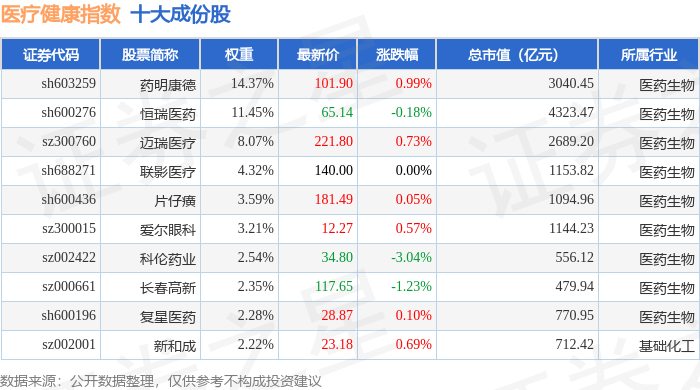
Core Viewpoint - The Medical Health Index (980016) closed at 6646.6 points, down 0.3%, with a trading volume of 19.922 billion yuan and a turnover rate of 0.75% on October 23 [1] Group 1: Index Performance - Among the constituent stocks of the Medical Health Index, 16 stocks rose while 31 stocks fell, with Kanglong Chemical leading the gainers at 1.55% and Te Bao Biological leading the decliners at 6.07% [1] - The top ten constituent stocks of the Medical Health Index include: - WuXi AppTec (14.37% weight, latest price 101.90, market cap 304.045 billion yuan) - Hengrui Medicine (11.45% weight, latest price 65.14, market cap 432.347 billion yuan) - Mindray Medical (8.07% weight, latest price 221.80, market cap 268.920 billion yuan) [1] Group 2: Capital Flow - The net outflow of main funds from the constituent stocks of the Medical Health Index totaled 1.072 billion yuan, while retail investors saw a net inflow of 955 million yuan [3] - Detailed capital flow for key stocks includes: - Mindray Medical: Main net inflow of 66.9479 million yuan, retail net inflow of 3.6088 million yuan - Te Bao Biological: Main net inflow of 29.0966 million yuan, retail net outflow of 41.3737 million yuan [3]





市场波动加剧,资金布局“补涨”!中药ETF(560080)连续16日“吸金”超6亿元,最新规模首超30亿元!机构:看好中药下半年经营改善
Xin Lang Cai Jing· 2025-10-23 07:42
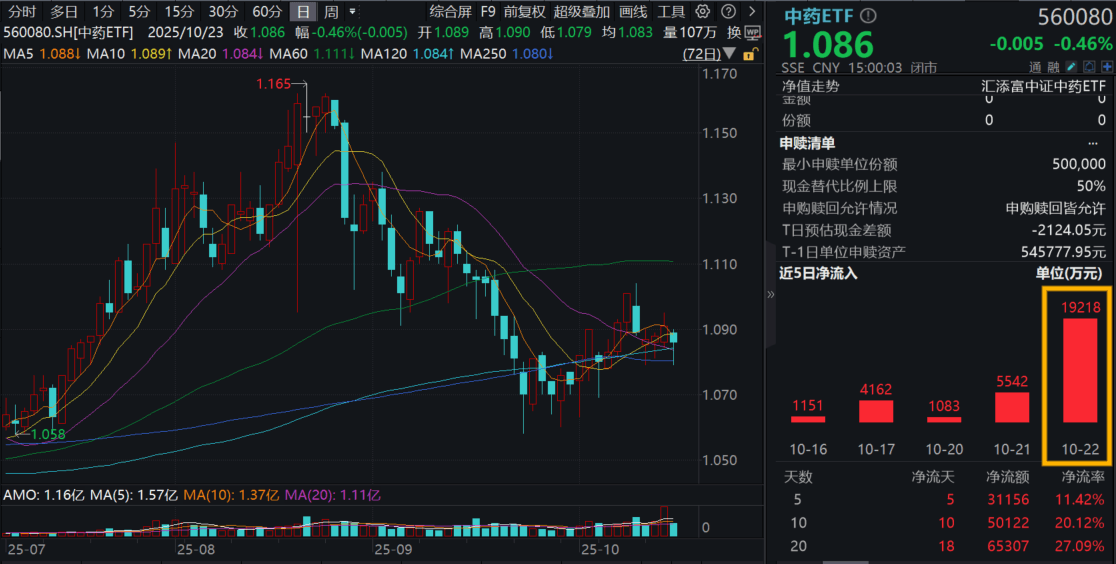
Core Viewpoint - The Chinese medicine sector is experiencing a mixed performance, with the Chinese medicine ETF (560080) showing significant net inflows and a growing fund size, despite the overall index performance being negative for the year [1][4]. Group 1: Market Performance - The Chinese medicine ETF (560080) saw a slight decline of 0.46% with a total trading volume of 116 million yuan on the day [1]. - The ETF has attracted a net inflow of 192 million yuan yesterday, ranking it among the top 9 in the market, and has seen a total net inflow exceeding 600 million yuan over the past 16 days [1]. - The Chinese medicine index has a year-to-date return of -2.53%, with a decline of 8.13% projected for 2024 [3]. Group 2: Valuation Metrics - As of October 22, the TTM price-to-earnings (PE) ratio of the Chinese medicine ETF (560080) is 25.22, indicating that the index is cheaper than 77% of the time over the past decade [4]. - The current PE ratio is close to the calculated opportunity value, suggesting a favorable valuation for potential investment [4]. Group 3: Company Performance - The component stocks of the Chinese medicine ETF exhibited mixed results, with companies like Yunnan Baiyao and Pianzaihuang showing slight increases, while others like Zhongsheng Pharmaceutical and Darentang experienced declines exceeding 4% [5]. - The performance of major brands in the OTC market is expected to improve, with companies like Huazhong Sanjiu, Dong'e Ejiao, and Yunnan Baiyao being highlighted as stable performers [8]. Group 4: Industry Outlook - The Chinese medicine sector is under short-term pressure due to various factors, but there is optimism for operational improvements in the second half of the year [7]. - The market is closely monitoring the impact of external policies, including price governance and the collection of traditional Chinese medicine, which may influence future performance [7][9]. - The industry is expected to benefit from a recovery in consumer demand, driven by macroeconomic improvements and an aging population [10].


深圳出台并购重组行动方案,深圳本地股大涨
Shen Zhen Shang Bao· 2025-10-23 04:22
受深圳出台并购重组行动方案消息刺激,22日早盘深圳本地股大幅高开。截至记者发稿时,建科院、深 赛格、广田集团、深物业A、力合科创、深纺织A、特力A等10多只本地股涨停,深水规院大涨逾11%。 《方案》提出,力争到2027年底,并购重组市场量质齐升,累计完成并购项目超200单、交易总额超 1000亿元,落地一批行业示范案例。 在丰富拓展并购重组融资渠道方面,《方案》鼓励符合条件的企业综合运用现金、股份、定向可转债、 科创债券等方式实施并购重组,用好重组股份对价分期支付、配套募集资金储架发行等机制。鼓励银行 机构通过并购贷款、银团贷款、投贷联动等方式对企业市场化兼并重组给予信贷支持。 根据深圳证监局数据,自去年"并购六条"发布以来,截至今年6月,深圳上市公司公布并购重组预案215 笔,160笔重组事项披露交易金额,合计超过450亿元。 其中,既涉及国有控股上市公司,也有民营上市公司,既有同行业并购,也有围绕补链强链开展等类 型,不仅紧紧围绕公司主营业务和战略发展方向进行,也有助于促进产业协同和提高整体产业链竞争 力。 具体来看,今年3月底,华润三九斥资62亿元收购天士力医药集团28%股份的交易完成过户,天士力成 ...

并购重组,深圳启动20万亿超级计划!
Huan Qiu Wang· 2025-10-23 03:38
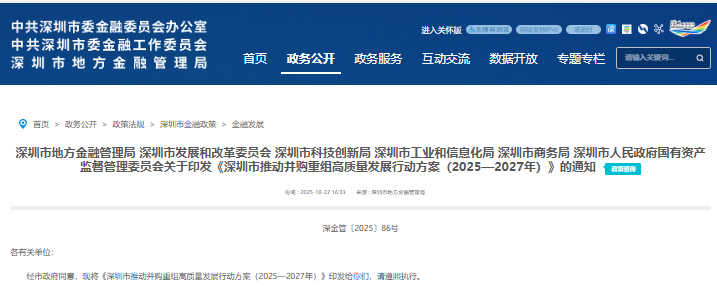
Core Points - The Shenzhen Municipal Financial Management Bureau and other departments have launched an action plan to promote high-quality development through mergers and acquisitions (M&A) for local listed companies from 2025 to 2027, aiming for a total market value of over 20 trillion yuan and the cultivation of 20 companies with a market value of over 100 billion yuan by the end of 2027 [1][2] Group 1: Focus on New Quality Productivity - The action plan emphasizes the integration of M&A with Shenzhen's "20+8" strategic emerging industry clusters, supporting leading companies in sectors like integrated circuits, artificial intelligence, new energy, and biomedicine to enhance their supply chains through acquisitions [2] - The plan aims to replicate successful M&A models seen in tech giants like Amazon and Nvidia, which have achieved growth through continuous integration and technology upgrades [2] - Successful cases such as BYD's acquisition of Jabil's mobile electronics business and Luxshare Precision's acquisition of Qorvo's semiconductor assets illustrate the value of M&A in expanding customer boundaries and deepening industry integration [2] Group 2: Building a Patient Capital System - To address funding challenges for M&A, the plan proposes a comprehensive financial support system, encouraging the use of various financing tools such as cash, shares, and convertible bonds [3] - The establishment of a "patient capital" system is highlighted, with initiatives to involve industry funds in quality M&A projects and support the cultivation of acquisition targets through angel and seed funds [3] - The plan aims to create a virtuous cycle of "exit-reinvestment" to provide stable, long-term funding for valuable M&A projects, avoiding short-term profit-seeking behaviors [3] Group 3: Connecting with Hong Kong Market - The action plan identifies the connection with the Hong Kong capital market as a key task, supporting enterprises in conducting cross-border mergers and acquisitions through various investment methods [4] - Encouragement for collaboration between Shenzhen and Hong Kong to establish equity investment funds for industrial acquisitions is included [4] - The plan also emphasizes the need for cooperation between Shenzhen Stock Exchange and Hong Kong Stock Exchange to explore interconnected mechanisms for M&A and financing [4][5]
深圳发布并购重组重磅政策,剑指上市公司总市值超20万亿
21世纪经济报道· 2025-10-22 23:22
Core Viewpoint - The article discusses the "Shenzhen Action Plan for Promoting High-Quality Development of Mergers and Acquisitions (2025-2027)", which aims to enhance the quality of listed companies and support mergers and acquisitions (M&A) in strategic emerging industries, ultimately boosting Shenzhen's economic competitiveness [1][3]. Group 1: Key Tasks and Goals - The plan outlines ten key tasks to enhance the resource allocation function of M&A, supporting listed companies in injecting quality assets and improving investment value [1]. - By the end of 2027, the goal is to increase the total market capitalization of domestic and foreign listed companies in the region to over 20 trillion yuan, cultivate 20 companies with a market value of over 100 billion yuan, and complete over 200 M&A projects with a total transaction value exceeding 100 billion yuan [1][3]. Group 2: Focus on Strategic Emerging Industries - The plan emphasizes M&A activities in strategic emerging industries such as integrated circuits, artificial intelligence, new energy, and biomedicine, encouraging leading companies to acquire quality assets that enhance the industrial chain and key technology levels [3][4]. - The article highlights that successful M&A in the U.S. tech sector, represented by companies like Amazon and Microsoft, has been crucial for their growth, suggesting a similar path for Shenzhen's emerging industries [3]. Group 3: Quality M&A Practices - The article stresses that high-quality M&A should focus on industrial synergy, strengthening the industrial chain, and facilitating corporate transformation, benefiting both individual companies and the overall capital market [4][6]. - Examples include BYD's acquisition of Jabil Inc.'s mobile electronics business in China, which enhances BYD's market position and product structure, and Luxshare Precision's acquisition of Qorvo's semiconductor assets, which strengthens its vertical integration capabilities [4]. Group 4: Support Measures for M&A - The plan proposes expanding financing channels for M&A, encouraging the use of cash, shares, and various bond instruments, and exploring innovative loan options for technology companies [8][9]. - It also aims to establish a "patient capital" system to support quality M&A projects and promote participation from social capital, including private equity and venture capital funds [9]. Group 5: Cross-Border M&A and Collaboration - The plan emphasizes the importance of connecting Shenzhen with Hong Kong's capital market to facilitate cross-border M&A and resource integration, enhancing the influence of Shenzhen's capital market [10]. - It encourages the Shenzhen Stock Exchange to build a comprehensive service platform for M&A, providing full-cycle support and training for companies [10].
深圳发布并购重组重磅政策,剑指上市公司总市值超20万亿
2 1 Shi Ji Jing Ji Bao Dao· 2025-10-22 15:12
Core Insights - Shenzhen's local financial management bureau and other departments released a significant policy document titled "Shenzhen's Action Plan for Promoting High-Quality Development of Mergers and Acquisitions (2025-2027)" to support corporate mergers and acquisitions [2] - The plan outlines ten key tasks aimed at enhancing the resource allocation function of mergers and acquisitions, supporting listed companies in Shenzhen to inject quality assets and improve investment value [2][3] - By the end of 2027, the plan aims for a comprehensive improvement in the quality of listed companies, with a total market capitalization of domestic and foreign listed companies exceeding 20 trillion yuan, and the cultivation of 20 companies with a market value of over 100 billion yuan [2] Industry Focus - The plan emphasizes the importance of mergers and acquisitions in strategic emerging industries such as integrated circuits, artificial intelligence, new energy, and biomedicine, encouraging leading companies to engage in upstream and downstream mergers and acquisitions [3] - It aims to support the acquisition of quality unprofitable assets that enhance key technology levels and strengthen industrial chains [3] Market Environment - Since the release of the "Six Guidelines for Mergers and Acquisitions" last September, the activity in the mergers and acquisitions market has significantly increased, primarily driven by industrial integration and new productivity mergers [5] - As of June this year, Shenzhen listed companies announced 215 merger and acquisition plans, with 160 disclosing transaction amounts totaling over 45 billion yuan [5] Case Studies - BYD's acquisition of Jabil Inc.'s mobile electronics manufacturing business in China exemplifies how mergers can complement existing operations and expand market opportunities [6] - Luxshare Precision's acquisition of Qorvo's semiconductor assets in China enhances its vertical integration capabilities in the electronic information industry [6] Financing and Support Measures - The plan proposes expanding financing channels for mergers and acquisitions, encouraging the use of cash, shares, and various bond instruments [8] - It also emphasizes the construction of a patient capital system to support quality mergers and acquisitions, involving local industry funds and angel investment funds [8][9] Cross-Border Collaboration - The plan highlights the importance of connecting Shenzhen with Hong Kong's capital market to facilitate cross-border mergers and acquisitions, enhancing the influence of Shenzhen's capital market [10] - It encourages the establishment of equity investment funds to invest in industrial merger projects and supports the Shenzhen Stock Exchange in building a comprehensive service platform for mergers and acquisitions [10]

10月22日深证国企ESGR(470055)指数跌0.02%,成份股广东宏大(002683)领跌
Sou Hu Cai Jing· 2025-10-22 10:12
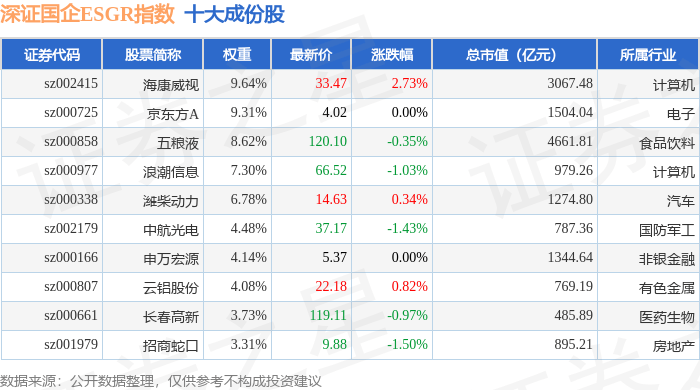
Core Points - The Shenzhen State-Owned Enterprises ESGR Index (470055) closed at 1592.08 points, down 0.02%, with a trading volume of 30.197 billion yuan and a turnover rate of 0.94% [1] - Among the index constituents, 24 stocks rose while 21 fell, with Tongyu Heavy Industry leading the gainers at 3.95% and Guangdong Hongda leading the decliners at 5.35% [1] Index Constituents Summary - The top ten constituents of the Shenzhen State-Owned Enterprises ESGR Index are as follows: - Hikvision (sz002415): Weight 9.64%, Latest Price 33.47, Change 2.73%, Market Cap 306.748 billion yuan, Industry: Computer [1] - BOE Technology Group (sz000725): Weight 9.31%, Latest Price 4.02, Change 0.00%, Market Cap 150.404 billion yuan, Industry: Electronics [1] - Wuliangye Yibin (sz000858): Weight 8.62%, Latest Price 120.10, Change -0.35%, Market Cap 466.181 billion yuan, Industry: Food & Beverage [1] - Inspur Information (sz000977): Weight 7.30%, Latest Price 66.52, Change -1.03%, Market Cap 97.926 billion yuan, Industry: Computer [1] - Weichai Power (sz000338): Weight 6.78%, Latest Price 14.63, Change 0.34%, Market Cap 127.480 billion yuan, Industry: Automotive [1] - AVIC Optoelectronics (sz002179): Weight 4.48%, Latest Price 37.17, Change -1.43%, Market Cap 78.736 billion yuan, Industry: Defense [1] - Shenwan Hongyuan (sz000166): Weight 4.14%, Latest Price 5.37, Change 0.00%, Market Cap 134.464 billion yuan, Industry: Non-Bank Financial [1] - Yunnan Aluminum (sz000807): Weight 4.08%, Latest Price 22.18, Change 0.82%, Market Cap 76.919 billion yuan, Industry: Nonferrous Metals [1] - Changchun High & New Technology (sz000661): Weight 3.73%, Latest Price 119.11, Change -0.97%, Market Cap 48.589 billion yuan, Industry: Pharmaceuticals [1] - China Merchants Shekou (sz001979): Weight 3.31%, Latest Price 9.88, Change -1.50%, Market Cap 89.521 billion yuan, Industry: Real Estate [1] Capital Flow Analysis - The net outflow of main funds from the ESGR index constituents totaled 340 million yuan, while retail investors saw a net inflow of 126 million yuan [1] - The detailed capital flow for key stocks includes: - Hikvision: Main net inflow 374 million yuan, retail net outflow 29.5 million yuan [2] - Zhongcai Technology: Main net inflow 141 million yuan, retail net outflow 18.8 million yuan [2] - Yunnan Aluminum: Main net inflow 137 million yuan, retail net outflow 121 million yuan [2] - Weichai Power: Main net inflow 27.6 million yuan, retail net outflow 2.33 million yuan [2]






中药板块10月22日涨0.16%,特一药业领涨,主力资金净流出2.37亿元
Zheng Xing Xing Ye Ri Bao· 2025-10-22 08:19
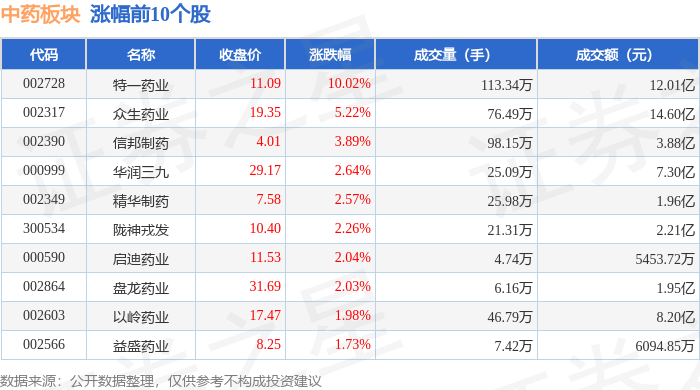
Core Insights - The traditional Chinese medicine sector experienced a slight increase of 0.16% on October 22, with Te Yi Pharmaceutical leading the gains [1] - The Shanghai Composite Index closed at 3913.76, down 0.07%, while the Shenzhen Component Index closed at 12996.61, down 0.62% [1] Stock Performance - Te Yi Pharmaceutical (002728) closed at 11.09, up 10.02% with a trading volume of 1.1334 million shares and a transaction value of 1.201 billion [1] - Other notable gainers included Zhongsheng Pharmaceutical (002317) with a 5.22% increase, closing at 19.35, and Xinbang Pharmaceutical (002390) with a 3.89% increase, closing at 4.01 [1] - Conversely, stocks like Fangsheng Pharmaceutical (603998) and ST Xiangxue (300147) saw declines of 3.06% and 2.86%, respectively [2] Capital Flow - The traditional Chinese medicine sector saw a net outflow of 237 million in institutional funds, while retail investors contributed a net inflow of 235 million [2] - The table of capital flow indicates that Te Yi Pharmaceutical had a significant net inflow of 196 million from institutional investors, despite a net outflow from retail investors [3] - Other companies like Xinbang Pharmaceutical and Zhongsheng Pharmaceutical also experienced mixed capital flows, with varying degrees of institutional and retail investor activity [3]


2025年矿物质补充剂品牌推荐:那些决定健康底牌的微量元素
Tou Bao Yan Jiu Yuan· 2025-10-21 12:01
Report Summary 1. Industry Investment Rating There is no information provided about the report's industry investment rating. 2. Core Viewpoints - The market for mineral supplements is expected to continue expanding due to increased consumer health awareness, a maturing consumption concept, and policy catalysts in the silver economy [4]. - The industry is evolving from basic nutrition supplementation to more precise and functional demands, with consumers becoming more rational in their choices [10]. - Innovation in dosage forms and absorption optimization, as well as the integration of green and sustainable concepts, are becoming key factors in the industry's development [28][29]. 3. Summary by Directory Market Background - Mineral supplements are a type of nutrient - supplement health food. The calcium - supplement market is leading, and the market for health foods is expected to grow [4][5]. - The industry has gone through a startup period (1981 - 1990), a formation period (1991 - 2000), an adjustment period (2001 - 2010), a development period (2011 - 2020), and a high - quality growth period (2021 - present) [6][7]. Market Status - Market Scale: From 2019 - 2023, the market size grew from RMB 196.365 billion to RMB 212.434 billion with a CAGR of 1.99%. It is expected to grow from RMB 218.4 billion to RMB 242.241 billion from 2024 - 2028 with a CAGR of 2.62% [8]. - Market Supply: The supply side shows structural differentiation and innovation. Upstream focuses on scale and quality control, while mid - stream faces challenges of homogenization and technology upgrading. Innovation focuses on improving bio - availability and consumer experience [9]. - Market Demand: Demand is shifting from basic nutrition to precise functional needs. Consumers choose supplements based on specific life stages and health problems [10]. Market Competition - Market Evaluation Dimensions: Companies are evaluated based on growth potential, innovation ability, cost control, and sales cost management efficiency [12][13][14][15]. - Market Competition Pattern: The industry has three echelons. The first echelon includes Lily Group and Harbin Pharmaceutical Group; the second includes Conba and Tongrentang; the third includes Yiling Pharmaceutical [16]. - Ten Brand Recommendations: Brands such as Lily Group, China Resources Sanjiu, and Shijiazhuang Pharmaceutical Group are recommended for their unique advantages in product customization, brand reputation, and raw - material control [17][18][19]. Development Trends - Precision and Functionality: The market is moving towards customized solutions for specific groups and functions, promoting value - based competition [27]. - Dosage Form Innovation and Absorption Optimization: New technologies are used to improve absorption and develop new dosage forms, enhancing compliance [28]. - Green and Sustainable Development: The industry is integrating sustainable concepts throughout the value chain, from raw materials to packaging [29].
中药ETF(159647)连续23日获净流入,关注并购整合+基药目录+集采下的投资机会
Xin Lang Cai Jing· 2025-10-21 08:54
Core Insights - Recent inflows into the traditional Chinese medicine (TCM) sector, with TCM ETF (159647) seeing a net subscription of 3.5 million units today, marking 23 consecutive days of net inflows [1][2] - The TCM industry experienced a revenue decline of 8% year-on-year in Q1 2025, with profits down 4%. However, Q2 showed a revenue decline of only 2% year-on-year, while profits increased by 7%, indicating resilience in profit performance despite revenue challenges [1] Group 1: Industry Performance - In-hospital TCM revenue continues to decline, but the rate of decline is narrowing, with profits outperforming revenues. Factors include lower flu incidence compared to last year and the impact of price reductions from the third round of centralized procurement [1][2] - OTC TCM revenue shows divergence, with profits underperforming revenues. This is attributed to a high proportion of self-paid products and weak consumer demand, particularly in cold and respiratory categories, while stable demand products like blood tonics and orthopedic items perform better [1] Group 2: Key Factors of Focus - Policy: Centralized procurement of TCM and adjustments to the basic medicine catalog are critical. The third round of procurement saw an average price drop of 63%, but major products remain relatively unaffected. A new basic medicine catalog is expected to be released in late 2025 or 2026, potentially including more TCM products [2] - Cost: Prices of TCM materials have risen since November 2022 but are expected to decline starting in the second half of 2024, currently reverting to November 2022 levels [2] - Demand: Inventory clearance in cold and respiratory categories is anticipated, with subsequent shipments aligning more closely with end-user demand, potentially signaling a turning point for related companies [2] - Industry Structure: Ongoing mergers and acquisitions are increasing industry concentration, with companies setting clear integration goals and further acquisitions expected to strengthen leading firms [2] Group 3: Market Performance - As of October 21, 2025, the CSI Traditional Chinese Medicine Index (930641) rose by 0.21%, with notable increases in component stocks such as Huasheng Technology (000790) up 3.64% and Yiling Pharmaceutical (002603) up 2.05%. The TCM ETF (159647) increased by 0.10%, with a latest price of 1.01 yuan [2][3]