
易方达基金

Search documents
原油LOF易方达:1月30日开市起至当日10:30停牌
Sou Hu Cai Jing· 2026-01-29 10:58
钛媒体App 1月29日消息,近期,易方达基金旗下易方达原油证券投资基金(QDII)A类人民币份额 (基金代码:161129,场内简称:原油LOF易方达)二级市场交易价格明显高于基金份额净值。2026年 1月27日,本基金基金份额净值为1.1315元,截至2026年1月29日,本基金在二级市场的收盘价为1.437 元,特此提示投资者关注二级市场交易价格溢价风险,投资者如果高溢价买入,可能面临重大损失。为 了保护投资者的利益,本基金将于2026年1月30日开市起至当日10:30停牌,自2026年1月30日10:30复 牌。若本基金在公告日当日二级市场交易价格溢价幅度未有效回落,本基金可根据实际情况通过向深圳 证券交易所申请盘中临时停牌、延长停牌时间等方式,向市场警示风险,具体以届时公告为准。(广角 观察) ...
再度走红!“固收+”基金规模创新高
券商中国· 2026-01-29 10:20
Core Viewpoint - The "fixed income +" funds are gaining popularity as a result of declining interest rates and a shift in residents' deposits, with the total scale reaching a historical high of 2.735 trillion yuan by the end of 2025, driven mainly by secondary bond funds [1][2]. Group 1: Fund Scale and Growth - The nominal scale of "fixed income +" funds, including primary and secondary bond funds, mixed bond funds, and convertible bond funds, has surpassed 2.735 trillion yuan, marking a historical peak [2]. - The secondary bond funds have seen significant net subscriptions, maintaining a net subscription rate around 50%, with the total scale rising to 1.58 trillion yuan [2]. - The primary bond funds have decreased to 833 billion yuan due to a reduction in pure bond products and some fund liquidations [2]. Group 2: Investment Trends - There is a growing demand from residents for assets with rights, driven by declining interest rates on fixed deposits and a recovering investment sentiment [2][3]. - The absolute scale of institutional holdings in rights-bearing investments remains low compared to historical levels, indicating substantial growth potential [3]. - The "fixed income +" strategy is positioned to fill the gap between high-yield equity funds and lower-yield pure bond funds, as the Sharpe ratios of these asset classes converge [3]. Group 3: Company and Product Performance - The growth of "fixed income +" funds is concentrated among leading companies, with a noticeable Matthew effect, where top firms dominate the market [4]. - E Fund and Invesco Great Wall are the only two companies with "fixed income +" scales exceeding 200 billion yuan, with Invesco Great Wall showing significant growth in Q4 2025 [4]. - The top-performing "fixed income +" fund in Q4 2025 was Invesco Great Wall's Jing Sheng Shuang Xin, which saw an increase of 20.836 billion yuan [4]. Group 4: Market Dynamics - The development of "fixed income +" funds is supported by a combination of declining interest rates and a recovering stock market, which enhances the return potential of these funds [6]. - By the end of 2026, a significant amount of residents' fixed deposits will mature, providing liquidity that is likely to flow into investment areas [6]. - The attractiveness of "fixed income +" products is expected to increase as they offer a safety net while also benefiting from capital market reforms and resilient earnings from quality assets [6].

资本热话 | 以“业绩”为标尺,百亿基金经理阵营加速洗牌
Sou Hu Cai Jing· 2026-01-29 08:03
从"造神"到理性回归,百亿基金经理阵营告别"光环"叙事。 一场以"业绩"为标尺的洗牌,正在公募基金主动权益"百亿俱乐部"悄然上演。 若以主动权益产品规模占在管规模60%以上为筛选标准,截至2025年底,主动权益类基金经理的数量超 过1690人,较上一季度有所减少。其中管理规模超过百亿元的达到102人,较去年三季度末减少10人。 目前,易方达基金张坤以483.83亿元的管理规模继续稳坐头把交椅,这意味着主动权益基金经理的行 业"天花板"已经降至500亿元之下。去年四季度,他管理的四只产品的平均回报为-4.91%,同期出现近 20亿份的净赎回,这也直接导致他的在管规模单季度减少了近82亿元。 紧随其后的头部基金经理规模同样承压。兴证全球基金谢治宇、中欧基金葛兰仅在"400亿+"梯队维持一 个季度,便重回300亿阵营,最新在管规模分别为386.18亿元、353.89亿元,单季度分别减少67.39亿 元、81.55亿元。 景顺长城基金刘彦春、中欧基金周蔚文则守住300亿阵营,最新管理规模分别为314.75亿元、310.04亿 元。与上一季度相比,虽有不同程度缩水,但头部阵营前五名的人员及名次保持稳定,展现出一定稳健 ...

迈为股份股价跌5.01%,易方达基金旗下1只基金位居十大流通股东,持有322.43万股浮亏损失5529.73万元
Xin Lang Cai Jing· 2026-01-29 07:24
Core Viewpoint - Maiwei Co., Ltd. experienced a 5.01% decline in stock price, closing at 325.07 CNY per share, with a trading volume of 4.807 billion CNY and a turnover rate of 7.41%, resulting in a total market capitalization of 90.826 billion CNY [1] Company Overview - Maiwei Co., Ltd. is located in Suzhou, Jiangsu Province, China, and was established on September 8, 2010, with its IPO on November 9, 2018 [1] - The company specializes in the design, research and development, production, and sales of high-end intelligent manufacturing equipment [1] - The revenue composition of the company includes 75.00% from complete solar cell production equipment, 18.10% from single machines, and 6.90% from parts and others [1] Shareholder Analysis - E Fund's Chuangye ETF (159915) is among the top ten circulating shareholders of Maiwei Co., Ltd., having reduced its holdings by 541,400 shares in the third quarter, now holding 3,224,300 shares, which accounts for 1.67% of circulating shares [2] - The estimated floating loss for E Fund's Chuangye ETF today is approximately 55.2973 million CNY [2] - The fund was established on September 20, 2011, with a current size of 100.446 billion CNY, yielding 3.85% year-to-date and 63.48% over the past year [2] Fund Performance - E Fund's Zhongzheng Photovoltaic Industry ETF (562970) holds 88,800 shares of Maiwei Co., Ltd., representing 3.01% of the fund's net value, ranking as the sixth-largest holding [4] - The estimated floating loss for this fund today is around 152,330 CNY [4] - The fund was established on October 30, 2024, with a current size of 608 million CNY, achieving a year-to-date return of 14.81% and a one-year return of 56.95% [4]
2025年公募REITs市场年度报告:政策驱动千帆竞,价值分化始见金
Da Gong Guo Ji· 2026-01-29 06:36
- The report focuses on the annual performance of public REITs in 2025, highlighting that the issuance scale and number of REITs declined year-on-year, with a total of 78 REITs listed by the end of 2025, amounting to an issuance scale of 2,109.11 billion yuan[4][5][6] - The REITs market in 2025 saw the addition of new asset categories, including municipal facilities and new infrastructure, with warehouse logistics, consumer infrastructure, and park infrastructure being the primary issuance sectors[13][14][15] - Consumer infrastructure REITs had the largest issuance scale in 2025, totaling 104.45 billion yuan, followed by warehouse logistics REITs at 103.10 billion yuan, while park infrastructure REITs maintained a stable issuance scale of 91.57 billion yuan[15][17][30] - The report highlights the operational performance of various REITs categories, noting that consumer infrastructure REITs showed significant growth in revenue and distributable income, while energy infrastructure REITs faced challenges due to policy changes and reduced electricity settlement prices[18][19][44] - The first municipal facilities REIT, focusing on municipal heating infrastructure, was launched in 2025, with its performance closely tied to seasonal characteristics[47][50] - New infrastructure REITs, launched in 2025, focused on data center facilities, benefiting from the growing demand for intelligent computing power, with tenants primarily being major telecom operators[50] - The report emphasizes the potential of commercial real estate REITs, which were introduced in late 2025, to revitalize existing commercial assets and support the transformation of the real estate industry towards a sustainable "hold-and-operate" model[11][53][54]
顶流基金经理最新持仓曝光,年回报率最高近65%
21世纪经济报道· 2026-01-29 06:13
Core Viewpoint - The article highlights the significant divergence in performance among various sectors in the Chinese stock market during Q4 2025, with technology and growth sectors like AI computing and semiconductors outperforming traditional sectors such as real estate and pharmaceuticals [1][2][4]. Summary by Sections Market Performance - In Q4 2025, the Shanghai Composite Index rose by 2.22%, while the CSI 300 Index fell by 0.23%, and the ChiNext Index decreased by 1.08%. The Hang Seng Index dropped by 4.56%, and the Hang Seng China Enterprises Index fell by 6.72% [1]. Fund Manager Strategies - Star fund managers like Fu Pengbo and Li Xiaoxing achieved significant excess returns, with Fu's Ruiyuan Growth Value Fund and Li's Yinhua Small Cap Select both rising over 60% in 2025, driven by heavy investments in AI computing and semiconductors [1][2]. - Balanced allocation funds, such as Zhu Shaoxing's Fuguo Tianhui Select Growth A, showed stable performance with over 20% annual growth, benefiting from diversified holdings across multiple sectors [2][12]. Technology Growth Focus - Funds focusing on technology growth, like those managed by Fu Pengbo and Xie Zhiyu, saw rewards for their strategies, with increased allocations to data center cooling, storage, and computing-related companies [4][5]. - Li Xiaoxing emphasized AI as a key investment theme, with a strong focus on semiconductor companies, indicating a shift towards domestic advanced processes and military-civilian integration opportunities [6]. Traditional Value Sector - Fund managers like Zhang Kun and Liu Yanhun maintained positions in traditional sectors like consumer goods and pharmaceuticals, facing significant net value pressure in Q4 2025. Liu's fund saw a decline of 5.85% in Q4, while Zhang's fund remained stable but adjusted sector allocations [8][10]. - Despite challenges, the pharmaceutical sector showed signs of improvement due to policy changes and innovation, with opportunities emerging in innovative drug chains and medical devices [9][10]. Consensus Among Fund Managers - Despite differing investment styles, fund managers shared common views on the impact of "anti-involution" policies on corporate fundamentals and the relative attractiveness of equity assets in the current market environment [16][17]. - The importance of stock selection has increased significantly, with a focus on identifying core companies with competitive advantages in both growth and value sectors [17].

罕见“落袋为安”!超1300亿,“跑了”
Zhong Guo Ji Jin Bao· 2026-01-29 06:02
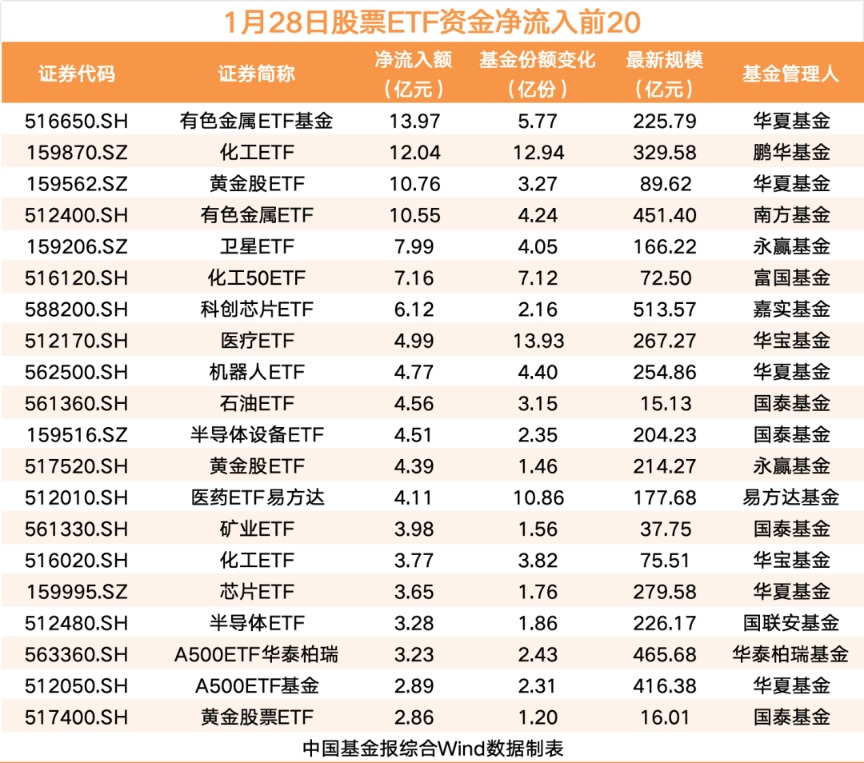
Group 1 - On January 28, the A-share market showed mixed performance with a net outflow of over 130 billion yuan from stock ETFs [1] - The total scale of 1,320 stock ETFs in the market reached 4.3 trillion yuan, with a reduction of 21.7 billion fund shares and a net outflow of approximately 131.2 billion yuan [2] - Industry-themed ETFs and commodity ETFs saw significant net inflows of 17.7 billion yuan and 7.2 billion yuan, respectively, on the same day [2] Group 2 - The SGE Gold 9999 index product had the highest net inflow on January 28, amounting to 6.4 billion yuan, with over 19.1 billion yuan flowing into it over the past five trading days [2] - A total of 53 ETFs experienced net inflows exceeding 1 billion yuan, with the top three being the Huaxia Fund's non-ferrous metals ETF, Penghua Fund's chemical ETF, and Huaxia Fund's gold stock ETF, which saw inflows of 1.4 billion yuan, 1.2 billion yuan, and 1.1 billion yuan, respectively [2][3] - Leading fund companies like E Fund continued to attract net inflows into their ETFs, including 1.1 billion yuan into the gold ETF and 410 million yuan into the pharmaceutical ETF [2] Group 3 - Broad-based ETFs experienced the largest net outflow, totaling 147.2 billion yuan, with the CSI 300 index products seeing a net outflow of 97.5 billion yuan [4] - Market sentiment at the beginning of the year is relatively high, but regulatory measures are expected to cool the market in the short term, while overall opportunities are anticipated to outweigh risks [4] - The investment outlook for A-shares remains positive, with expectations of moderate profit recovery by 2026, emphasizing the importance of dynamic asset allocation in ETFs [4]
格科微股价跌5%,易方达基金旗下1只基金位居十大流通股东,持有2848.58万股浮亏损失2449.77万元
Xin Lang Cai Jing· 2026-01-29 05:52
Group 1 - The core point of the news is that GeKomei's stock price has decreased by 5%, currently trading at 16.33 yuan per share, with a total market capitalization of 42.468 billion yuan [1] - GeKomei Co., Ltd. is located in the China (Shanghai) Free Trade Pilot Zone and was established on September 3, 2003, with its listing date on August 18, 2021 [1] - The company's main business involves the research, design, and sales of CMOS image sensors and display driver chips, with revenue composition being 80.51% from CMOS image sensors, 19.41% from display driver chips, and 0.08% from other sources [1] Group 2 - Among GeKomei's top ten circulating shareholders, E Fund's fund holds a significant position, having reduced its holdings by 3.8192 million shares, now holding 28.4858 million shares, which accounts for 1.14% of the circulating shares [2] - The E Fund's Shanghai Stock Exchange Sci-Tech Innovation Board 50 ETF (588080) has a current scale of 70.597 billion yuan, with a year-to-date return of 15.66% and a one-year return of 63.58% [2] - The fund manager Lin Weibin has a tenure of 12 years and 333 days, with a total asset scale of 119.408 billion yuan, achieving a best return of 82.52% during his tenure [3]

罕见“落袋为安”!超1300亿,“跑了”......
Zhong Guo Ji Jin Bao· 2026-01-29 05:37
Core Viewpoint - The A-share market experienced mixed performance on January 28, with significant net outflows from the stock ETF market, totaling over 130 billion yuan [1]. Group 1: ETF Market Overview - As of January 28, the total scale of 1,320 stock ETFs in the market reached 4.3 trillion yuan, with a reduction of 21.7 billion fund shares and a net outflow of approximately 131.2 billion yuan [3]. - Industry-themed ETFs and commodity ETFs saw the largest net inflows, amounting to 17.7 billion yuan and 7.2 billion yuan, respectively [3]. - The SGE Gold 9999 index product led the net inflows on January 28, with 6.4 billion yuan, and over 19.1 billion yuan flowed into this index over the past five trading days [3]. Group 2: Top Performing ETFs - On January 28, 53 ETFs recorded net inflows exceeding 1 billion yuan, with the top three being: - Huaxia Fund's Nonferrous Metals ETF: 1.4 billion yuan - Penghua Fund's Chemical ETF: 1.2 billion yuan - Huaxia Fund's Gold Stocks ETF: 1.1 billion yuan [3]. - Other notable inflows included: - Nonferrous Metals ETF: 1.1 billion yuan - Robotics ETF: 477 million yuan - Chip ETF: 365 million yuan [5]. Group 3: Outflows from Broad-based ETFs - Broad-based ETFs experienced significant net outflows, totaling 147.2 billion yuan, with the CSI 300 index products alone accounting for 97.5 billion yuan of this outflow [7]. - The top outflowing ETFs included: - E Fund's CSI 300 ETF: -28.6 billion yuan - Huatai-PB's CSI 300 ETF: -28.4 billion yuan - Huaxia's CSI 300 ETF: -24.9 billion yuan [8]. Group 4: Market Outlook - ICBC Credit Suisse Fund anticipates a cooling of the market in the short term due to increased regulatory measures, but overall market opportunities are expected to outweigh risks [8]. - Jiasai Fund's Chief Investment Officer predicts a moderate recovery in A-share market earnings by 2026, with a favorable outlook for growth styles, emphasizing the importance of dynamic asset allocation in ETFs [9].
2025年四季度指数基金季报分析:中证A500产品规模上升明显
Shenwan Hongyuan Securities· 2026-01-29 03:41
1. Report Industry Investment Rating No information provided in the content. 2. Core View of the Report - The scale of passive index funds has exceeded 7 trillion yuan, with ETFs accounting for over 80%. The scale of domestic stock broad - based ETFs has further declined, while the scale of commodity ETFs has increased due to the rise in gold prices. The gap between the top two index fund managers has widened again. The number and scale of newly - issued products have decreased, and popular themes are concentrated in applications [4]. - In the fourth quarter of 2025, the number of approved index funds decreased compared to the previous quarter. Industry - themed index funds were the most approved type, and the application enthusiasm for relevant industry themes and broad - based indexes was high [4]. - In the fourth quarter, the well - performing broad - based products were the Science and Technology Innovation 100 and CSI 2000, the industry products were mainly satellite - related ETFs, and cash - flow products in Smart Beta performed well [4]. 3. Summary by Relevant Catalogs 3.1 2025 Q4 Index Fund Market Scale Changes - By the end of Q4 2025, the total asset scale of 2960 non - monetary index funds reached 7.24 trillion yuan, an increase of 0.52 trillion yuan from the previous quarter. ETFs grew by about 0.44 trillion yuan, and their proportion exceeded 80%. The proportion of LOF decreased, and the proportion of ordinary over - the - counter products was relatively stable [4][9]. - Among the 5.8 - trillion - yuan ETFs, the proportion of domestic stock broad - based ETFs further declined to 44%, the proportion of industry - themed products remained stable below 20%, and the scale of commodity ETFs increased by over 17 billion yuan compared to 2024 [4][13]. - The top ten target indexes with the largest index fund scale accounted for 42.68% of the total index fund scale, slightly up from the previous quarter. The proportion of CSI 300 decreased, while that of CSI A500 rebounded to over 4% [4][18]. - The top ten index fund managers managed 67.94% of the total index fund scale, with a slightly lower concentration than the previous quarter. Guotai surpassed Fuguo in the ranking, and the gap between Huaxia and E Fund widened to nearly 50 billion yuan [4][19]. - The top ten index funds in terms of scale were all ETFs, with gold ETFs entering the top ten, and the top four being CSI 300 ETFs [21][22]. - Among 2616 non - linked index products, less than half (1151) had positive scale growth. The top ten index funds with scale growth were mainly ETFs tracking AAA science and technology innovation bonds, gold, and CSI A500, while some Hong Kong - related technology products had outflows [24][25]. 3.2 Q4 Index Fund Raising and Application Situation - In Q4 2025, 195 index funds were newly established, raising a total of 108.001 billion yuan, a decrease in both the number and scale compared to the previous quarter. The main decline came from domestic stock index funds, while QDII passive index funds had a slight increase in the number but a decrease in scale. Bond index funds also had a significant decline in scale [30][34]. - From the perspective of product form, the number and scale of ETFs, ordinary index funds, and ETF linkages all decreased compared to the previous quarter. From the perspective of target index types, except for cross - border products, all other types of products had varying degrees of decline, with bonds having the largest decline in the number of issuances [35]. - In Q4 2025, 164 index funds were approved, a decrease from the previous quarter. Industry - themed index funds were the most approved type, with the main target indexes being non - ferrous metals, Hong Kong - stock - connected automobiles, science and technology innovation board artificial intelligence, etc. The application enthusiasm for relevant industry themes and broad - based indexes was high, and the application of strategy index products mainly focused on dividend - quality - related indexes [40]. 3.3 Q4 ETF Market Performance - In domestic stock ETFs, the top five products in terms of Q4 yield included three tracking the CSI 2000 index, and the highest - yielding product was Fuguo Shanghai Stock Exchange Science and Technology Innovation 100 ETF with a yield of 7.98% [41]. - In cross - border broad - based ETFs, E Fund Nikkei 225 ETF performed the best with a quarterly yield of 7.27%, and other top - ranked products also had yields above 6% [41]. - In industry - themed ETFs, the top five products in terms of Q4 yield mainly tracked the CSI Satellite Industry Index, with the highest - yielding product being GF CSI Satellite Industry ETF with a yield of 48.05% [41]. - In Smart Beta ETFs, the top five products in terms of Q4 yield were all cash - flow factor products, with the highest - yielding product being Penghua CSI 800 Free Cash Flow ETF with a yield of 10.20% [42]. - In terms of Q4 average daily trading volume, the top five domestic broad - based index funds were all CSI A500 ETFs. In cross - border broad - based ETFs, GF Nasdaq 100 ETF and Guotai Nasdaq 100 ETF had high trading volumes. In industry - themed ETFs, E Fund CSI Hong Kong Securities Investment Theme ETF had the largest trading volume. In Smart Beta ETFs, four of the top five products were dividend - strategy ETFs and one was a free - cash - flow ETF [43][44][46].