
商品ETF

Search documents
基金双周报:ETF市场跟踪报告-20260323
Ping An Securities· 2026-03-23 07:26
1. Report Industry Investment Rating No information about the industry investment rating is provided in the content. 2. Core Viewpoints of the Report - The performance of ETF products in the past two weeks was poor. Among domestic major broad - based ETFs, CSI A50 had the smallest decline, and among industry and theme products, new energy theme ETFs had the largest increase [2][9]. - In the past two weeks, among domestic major broad - based ETFs, the net inflow of funds into Science and Technology Innovation 50, SSE 50, CSI 500, and SSE - SZSE 300 ETFs ranked among the top [2][9]. - The net outflow of funds from major broad - based ETFs in the past two weeks slowed down. The funds of SSE - SZSE 300, SSE 50, and CSI 500 ETFs turned into net inflow, the net outflow of funds from CSI 1000/CSI 2000 and Science and Technology Innovation/ChiNext ETFs slowed down, and the net outflow of funds from A - series ETFs accelerated [10]. - In 2025, the technology theme ETF had a large cumulative net inflow of funds. Since this year, the technology and cyclical theme ETFs have had a large net inflow of funds. In the past two weeks, the inflow of funds into pharmaceutical, military, and new energy ETFs slowed down, the funds of dividend, consumption, and other large - manufacturing ETFs turned into net inflow, and the funds of cyclical, financial real - estate, and technology ETFs turned into net outflow [15]. - Since 2025, the credit bond ETF has had a large net inflow of funds, followed by the treasury bond ETF. In the past two weeks, the short - term financing ETF's funds turned into net inflow, the local government bond ETF's funds accelerated net inflow, the convertible bond ETF's funds turned into net outflow, the credit bond and treasury bond ETF's funds accelerated outflow, and the net outflow of funds from the policy - financial bond ETF slowed down [15]. - The daily average trading volume of pharmaceutical and new energy ETFs increased significantly in the past two weeks, the daily average trading volume of consumption and financial real - estate ETFs increased, and the daily average trading volume of other large - manufacturing, military, technology, and cyclical ETFs decreased [18]. - As of March 20, 20 new ETFs were newly established in the market in the past two weeks, with a total issuance share of 6715 million, all of which were stock ETFs. Compared with the end of 2025, the scale of commodity ETFs, industry + dividend ETFs, and QDII - ETFs increased by 32.78%, 13.10%, and 2.11% respectively, while the scale of bond ETFs and broad - based ETFs decreased by 12.51% and 43.21% respectively [22]. - As of March 20, Huaxia Fund had the largest on - exchange ETF scale, reaching 70.3557 billion yuan; the ETF management scale of Guotai Fund has expanded by more than 2.7 billion yuan since the beginning of this year [23]. 3. Summary According to the Directory 3.1 ETF Market Review - **Performance and Fund Flow**: As of March 20, the performance of ETF products in the past two weeks was poor. Among domestic major broad - based ETFs, CSI A50 had the smallest decline, and among industry and theme products, new energy theme ETFs had the largest increase. In the past two weeks, among domestic major broad - based ETFs, the net inflow of funds into Science and Technology Innovation 50, SSE 50, CSI 500, and SSE - SZSE 300 ETFs ranked among the top. The inflow of funds into pharmaceutical, military, and new energy ETFs slowed down, the funds of dividend, consumption, and other large - manufacturing ETFs turned into net inflow, the funds of cyclical, financial real - estate, and technology ETFs turned into net outflow. For bond ETFs, the short - term financing ETF's funds turned into net inflow, the local government bond ETF's funds accelerated net inflow, the convertible bond ETF's funds turned into net outflow, the credit bond and treasury bond ETF's funds accelerated outflow, and the net outflow of funds from the policy - financial bond ETF slowed down [2][9][15]. - **Product Structure Distribution**: As of March 20, 20 new ETFs were newly established in the market in the past two weeks, with a total issuance share of 6715 million, all of which were stock ETFs. Compared with the end of 2025, the scale of commodity ETFs, industry + dividend ETFs, and QDII - ETFs increased by 32.78%, 13.10%, and 2.11% respectively, while the scale of bond ETFs and broad - based ETFs decreased by 12.51% and 43.21% respectively [22]. - **Fund Manager Scale Distribution**: As of March 20, Huaxia Fund had the largest on - exchange ETF scale, reaching 70.3557 billion yuan; the ETF management scale of Guotai Fund has expanded by more than 2.7 billion yuan since the beginning of this year [23]. 3.2 Classification - based ETF Tracking - **Technology Theme ETF**: Products tracking the Hang Seng Technology Index had the highest net inflow of funds in the past two weeks, while products tracking the Hong Kong Stock Connect Internet Index had a net outflow of funds [29]. - **Dividend Theme ETF**: Products tracking the Dividend Low - Volatility Index had the highest net inflow of funds in the past two weeks, while products tracking the Guoxin Hong Kong Stock Connect Central Enterprise Dividend Index had a net outflow of funds [31]. - **Consumption Theme ETF**: Products tracking the S&P 500 Consumer Select Index had a relatively high premium rate; ETFs tracking the CSI Agriculture Index had the highest net inflow of funds in the past two weeks, while products tracking the CSI 800 Consumption Index had a net outflow of funds [34]. - **Pharmaceutical Theme ETF**: ETFs tracking the CSI Medical Index had the highest net inflow of funds in the past two weeks, while products tracking the medical device index had a net outflow of funds [36]. - **Large - Manufacturing Theme ETF**: Products tracking the power index had the highest net inflow of funds in the past two weeks, while products tracking the CS Battery Index had a net outflow of funds [39]. - **QDII ETF**: Products tracking the Hang Seng Technology Index had the highest net inflow of funds in the past two weeks, while ETF products tracking the Hang Seng China Enterprises Index had a net outflow of funds [42]. 3.3 Popular Theme ETF Tracking - **AI Theme ETF**: The average return of AI theme products in the past two weeks was - 2.89%, and the funds had a net outflow of 4.218 billion yuan. The products with a relatively high proportion of AI - themed stocks were those tracking the Hong Kong Stock Connect Internet, Hang Seng Internet Technology, CS Artificial Intelligence, etc. [48][53]. - **Robot Theme ETF**: The average return of robot theme products in the past two weeks was - 6.81%, and the funds had a net outflow of 488 million yuan. The products with a relatively high proportion of robot - themed stocks were those tracking the robot and robot industry [55][56]. - **New Energy Theme ETF**: The average return of new energy theme products in the past two weeks was 3.27%, and the funds had a net inflow of 1.126 billion yuan. The products with a relatively high proportion of new - energy - themed stocks were those tracking new energy batteries, CS batteries, etc. [58][59]. - **Satellite and Commercial Space Theme ETF**: The average return of satellite and commercial space theme products in the past two weeks was - 9.35%, and the funds had a net outflow of 661 million yuan. The products tracking satellite communication, satellite industry, and Guozheng Aerospace had such characteristics [60][64]. - **Commodity ETF**: The average return of commodity ETFs in the past two weeks was - 0.89%, and the funds had a net inflow of 6.011 billion yuan. Products tracking gold, non - ferrous metal futures, etc. were included. Since the beginning of this year, gold ETFs have had a large net inflow of funds, with a large net outflow on February 3 [65][70]. - **Central Huijin, Guoxin, and Chengtong Holdings ETF**: As of the middle of 2025, the scale of ETFs held by Central Huijin, Guoxin, and Chengtong was 39.1336 billion shares in total; in the past two weeks, the funds had a net outflow of 2.3474 billion yuan [73].
Oil Surged 33% in a Week: 3 Commodity ETFs to Buy as the Hormuz Crisis Deepens
247Wallst· 2026-03-17 12:44
Core Point - Iran has announced the closure of the Strait of Hormuz starting March 4, 2026, and has begun attacking ships that attempt to transit oil and other commodities [1] Group 1 - The closure of the Strait of Hormuz is a significant geopolitical event that could impact global oil supply and shipping routes [1] - The attacks on ships indicate a heightened level of military aggression from Iran, which may escalate tensions in the region [1]


2025年中国ETF市场资金流全景——规模屡创新高,资金流结构更趋均衡
Morningstar晨星· 2026-03-12 01:05
Core Insights - The Chinese ETF market experienced explosive growth in 2025, surpassing 5 trillion yuan in assets under management, making it the largest ETF market in Asia, overtaking Japan [1][4] - The total net inflow of funds into the ETF market was approximately 1.38 trillion yuan, slightly down from the peak of 1.43 trillion yuan in 2024 [1][6] - By the end of 2025, the total assets under management for ETFs reached about 5.85 trillion yuan, with 1,375 products available, including 1,305 equity ETFs, 53 bond ETFs, and 17 commodity ETFs [1][4] ETF Market Development Overview - The asset management scale of equity ETFs reached approximately 4.77 trillion yuan by the end of 2025, marking a 44% year-on-year increase [4] - Bond ETFs saw a significant surge, with assets growing from 180 billion yuan at the end of 2024 to 829.2 billion yuan by the end of 2025, increasing their market share from 5% to 14% [5] - Commodity ETFs, primarily driven by soaring gold prices, saw their assets rise from 761 million yuan at the end of 2024 to 2.51 billion yuan by the end of 2025 [5] Fund Flow Analysis - In 2025, bond ETFs became the largest asset category for net inflows, achieving a net inflow of 642.1 billion yuan, surpassing equity ETFs which had a net inflow of 619.5 billion yuan [6] - The total net inflow for the ETF market exceeded 1 trillion yuan, supported by policy initiatives and favorable market conditions [6] - The rapid growth of bond ETFs was attributed to the issuance of 32 new credit bond ETFs, which significantly boosted their market presence [6][12] New Product Overview - A record 363 new ETFs were launched in 2025, with 331 being equity ETFs and 32 bond ETFs, marking the highest number of new launches in history [10] - The number of ETFs that were liquidated was notably low, with only 7 funds being closed, all of which were equity ETFs [10] - The majority of new bond ETFs were credit bond ETFs, which attracted substantial capital inflows, accounting for over 70% of the total funds raised from new products [12] Competitive Landscape - The top 20 ETF products in 2025 included new entrants from the Hong Kong stock and credit bond categories, reflecting a more balanced inflow of funds across different product types [25] - Major ETF providers like Huaxia Fund, E Fund, and Huatai-PB maintained their positions at the top, but the market saw a shift towards more diversified fund flows [27] - The market concentration among the top three ETF providers decreased from 48.4% to 42.1%, indicating a trend towards increased competition and diversification in the ETF market [27][28]

A股节后怎么投资?多家券商发“干货”
证券时报· 2026-02-18 09:50
Core Viewpoint - The article emphasizes the investment opportunities in the AI application industry, highlighting the potential for significant growth and profitability by 2026, as well as the importance of diversified asset allocation in the current market environment [4][7][8]. Group 1: AI Application Industry - The AI application industry is expected to establish a strong trend, with a potential "double hit" in 2026, as companies see AI orders and revenue constituting 10% or more of their overall income [4]. - Four key directions for investment in AI applications are identified: 1. Super entry points with large models acting as dual hubs for traffic and commercialization 2. AI infrastructure that defines software-driven computing power, ensuring stable returns 3. High growth areas where AI technology enhances marketing and content creation 4. High barriers in sectors like healthcare and manufacturing due to data and workflow integration [5][6]. Group 2: Market Analysis and Asset Allocation - The A-share market is currently at a historically low valuation, presenting a cost-effective investment opportunity compared to global markets [4][8]. - Various asset classes are analyzed: - Cash assets are under pressure from low interest rates but provide liquidity advantages, with money market funds and short-term deposits yielding around 1.5%-2% annually [8]. - Bond assets are reasonably valued, but long-term bonds may face pressure, while high-grade bonds offer stable yields [8]. - Stock assets, particularly high-dividend sectors like utilities, are seen as reasonably valued, while tech growth stocks are entering a favorable allocation zone after adjustments [8]. - Gold is supported by declining real interest rates and the dynamics of U.S. dollar credit, although short-term volatility may occur [8]. Group 3: Investment Strategy Recommendations - The article suggests a pyramid model for asset allocation, adjusting weights dynamically based on 2026 characteristics: - Base layer (40%-50% of investable assets) should focus on high-grade bonds and stable income products - Growth layer (30%-40%) should prioritize utility and consumer goods leaders, emphasizing "AI empowerment" and "domestic substitution" themes - Opportunity layer (10%-20%) should involve moderate participation in industrial metals and frontier sectors like commercial aerospace and AI applications through thematic funds, with strict loss control measures [8].




A股节后怎么投资?多家券商发“干货”!
天天基金网· 2026-02-18 07:30
Core Viewpoint - The article emphasizes the ongoing investment opportunities in the A-share market, particularly in AI applications and various asset classes, despite the market being closed during the Spring Festival [4][5][6][7]. Group 1: AI Applications - The AI application industry is expected to establish a trend, with a potential "double hit" by 2026, as some companies have over 10% of their revenue from AI orders [5]. - Four key directions for investment in AI applications are identified: super entry points, AI infrastructure, high growth sectors, and high barrier industries [5]. - The production paradigm of animated dramas is being restructured by AI, marking a "golden window period" for this sector [6]. Group 2: Asset Class Analysis - Cash assets are under pressure due to low interest rates, with annual returns around 1.5%-2%, but they provide liquidity advantages [6]. - Bond assets are reasonably valued, but there is pressure on long-term yields; high-grade bonds can offer stable returns [6]. - A-shares are currently at historically low valuations, making them attractive compared to global markets, while high-dividend sectors are also seen as reasonable [6][7]. Group 3: Investment Strategy - The trend of converting household savings into investments continues, with a conservative risk appetite favoring high-dividend and stable bonds [7]. - A pyramid model for asset allocation is suggested, with 40%-50% in stable assets, 30%-40% in growth assets focusing on utility and consumer leaders, and 10%-20% in opportunities like industrial metals and frontier sectors [7]. - The article encourages dynamic adjustment of asset weights based on the characteristics of 2026 [7].

A股节后怎么投资?多家券商发“干货”!
Xin Lang Cai Jing· 2026-02-18 03:39
Group 1 - The core viewpoint of the articles emphasizes that A-shares are currently undervalued compared to historical levels, presenting a global comparative advantage [1][2][6] - Guotai Junan Securities predicts that the AI application industry will establish a trend, with a potential "double hit" expected in 2026, as some companies see AI orders/revenue/ARR constituting over 10% of total revenue [1][6] - The report identifies four key directions for AI applications: super entry points, AI infrastructure, high growth sectors, and high barrier industries [1][6] Group 2 - The analysis from Dongfang Caifu Securities indicates that 2026 will be a phase of "structural repair" and "new momentum cultivation," necessitating asset diversification to manage uncertainties [2][7] - The report discusses various asset classes: cash assets are under pressure in a low-interest environment but provide liquidity; bond assets are reasonably valued but face pressure on long-term yields; stock assets are seen as undervalued, particularly in high-dividend sectors [2][7][8] - The recommendation includes a pyramid model for asset allocation, with a focus on high-grade bonds and utility stocks, while also suggesting participation in industrial metals and frontier sectors like commercial aerospace and AI applications [8]
全球秩序重构下的“慢牛”与配置主线 | 策马点金
Qi Huo Ri Bao· 2026-02-17 23:45
Core Viewpoint - The global financial market is at a critical juncture, with the long-term debt cycle under pressure and a restructuring of global order and reserve assets expected to influence market trends in 2026 [1][2]. Macro Context - The current global economy is at the tail end of a long-term debt cycle, with government debt as a percentage of GDP at historically high levels and diminishing marginal effects of traditional monetary policy [2][3]. - The international monetary system dominated by the US dollar faces challenges, with international trade shifting from globalization to regionalization and increased protectionism of key technologies and resources [2]. Commodity Market Outlook - The downward pressure on the commodity market is expected to ease, with prices gradually rising, although sector differentiation will continue [2][4]. - Gold is anticipated to maintain a strong oscillating pattern due to ongoing diversified purchases by central banks and geopolitical uncertainties [4]. - Copper and aluminum are seen as leading indicators of structural market trends, driven by demand from infrastructure upgrades related to electric grids and new energy vehicles [4]. - The oversupply pressure in the oil market is gradually being digested, with OPEC's production increase slowing down, which may push oil prices higher [4]. Agricultural Products - Agricultural prices are likely to continue a pattern of oscillation, with current prices at low levels and cost support gradually emerging [5]. A-Share Market - The A-share market is expected to exhibit a "low volatility, slow bull" characteristic in 2026, with opportunities arising from three main lines: upstream resource companies benefiting from fiscal expansion, companies achieving breakthroughs in key technologies, and undervalued defensive sectors [6][8]. Investment Strategy - The asset allocation strategy for 2026 should focus on flexibility and structure, moving from traditional balanced approaches to more aggressive strategies [10]. - Long-term opportunities in the commodity market, particularly in gold, copper, and aluminum, are highlighted as core investment options [10]. Differentiated Investment Strategies - Conservative investors should focus on high-grade bonds, deposits, and money market funds, with limited exposure to equities and commodities [12]. - Moderate investors are advised to balance their portfolios with a tilt towards equities, while aggressive investors should increase their allocations to stocks and commodities [12].

“基”中生智ETF的投资策略(上)
Sou Hu Cai Jing· 2026-02-09 03:54
Core Viewpoint - The article discusses various investment strategies using ETFs (Exchange-Traded Funds) tailored to different life stages and financial needs, emphasizing the importance of asset allocation based on individual circumstances and market conditions. Group 1: Asset Allocation Strategies - Asset allocation should be adjusted according to different life stages, considering factors like age, income, and risk tolerance [1][2]. - For daily expenses, liquidity and safety are paramount, suggesting the use of money ETFs for such funds [4][5]. - Fixed expenses require a balance of safety and liquidity, recommending bond ETFs, particularly government bond ETFs, for stable returns [5][6]. - Long-term investments should focus on wealth preservation and growth, allowing for a mix of stock ETFs, bond ETFs, commodity ETFs, and potentially cross-border ETFs [5][6]. Group 2: Life Cycle Considerations - The life cycle is divided into three main phases: education (under 20), career (20-60), and retirement (60 and above), with income typically being lower than expenses in the first and last phases [6][8]. - During the career phase, individuals should focus on preparing for retirement while managing family expenses and debts [6][8]. - Investment strategies should evolve with age, with younger investors (20-30) having a higher risk tolerance and older investors (60+) needing to prioritize safety and income [9][10]. Group 3: Investment Strategies by Age Group - Young investors (20-30) are advised to allocate 70% to stock ETFs and 30% to bond ETFs, adjusting based on personal financial needs [8][9]. - Middle-aged investors (30-60) should reduce stock ETF allocations and increase bond ETF investments as financial responsibilities grow [9][10]. - Older investors (60+) should keep stock ETF investments below 40% and increase bond ETF investments to over 55%, maintaining some liquidity with money ETFs [10][11]. Group 4: Dollar-Cost Averaging Strategy - The dollar-cost averaging strategy involves regular, fixed-amount investments in ETFs to mitigate market volatility and emotional decision-making [11][12]. - This strategy simplifies investment decisions and encourages disciplined saving habits, making it suitable for new and busy investors [18][19]. - Regular assessments of the investment plan are necessary to adapt to market conditions and personal financial situations [20][21].

大力发展ETF市场,引导增量资金入市
Xin Lang Cai Jing· 2026-02-07 14:38
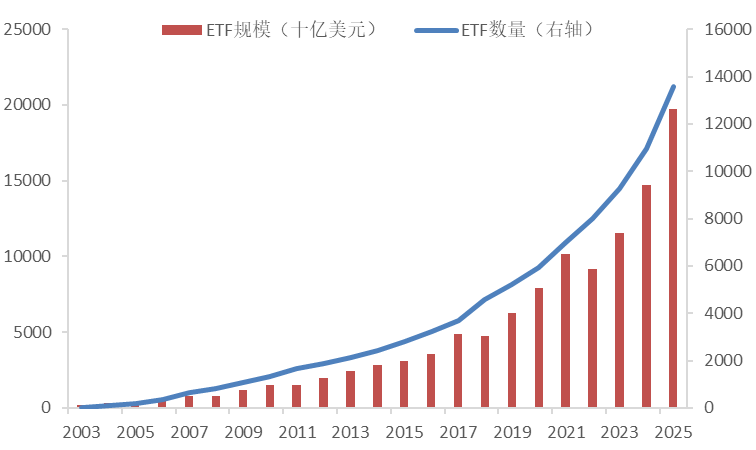
Core Insights - The report highlights the rapid growth and development of the ETF market in 2025, driven by various government policies aimed at enhancing market efficiency and attracting long-term capital [1][2][3] Global ETF Development Overview - By the end of 2025, the global ETF market reached an asset size of over $19.7 trillion, marking a 31% increase from the previous year [6][10] - The U.S. ETF market accounted for approximately $13.5 trillion, representing about 68% of the global market [10][11] - Stock ETFs dominated the asset categories, comprising about 77.7% of the total ETF market [7][9] Domestic ETF Market Development - The domestic ETF market in China surpassed ¥6 trillion by the end of 2025, becoming the largest ETF market in Asia [1][18] - The number of listed ETFs in China reached 1,381, a 35.7% increase from 2024 [18] - The net inflow of funds into domestic ETFs exceeded ¥1.16 trillion, with bond ETFs attracting the highest net inflow of ¥552.7 billion [18][19] Shanghai Stock Exchange ETF Development - The Shanghai Stock Exchange ETF market saw its size grow from ¥2.72 trillion to ¥4.22 trillion, a 55% increase [21][22] - The number of new ETF products listed on the Shanghai Stock Exchange doubled compared to 2024, with significant contributions from broad-based ETFs [22][25] - Institutional investors held 65% of the ETF market by the end of 2025, indicating a shift towards more stable, long-term investment strategies [22][32] Product Innovation and Market Structure - The report emphasizes the continuous innovation in ETF products, including the introduction of 355 new ETFs in 2025, with a focus on broad-based and thematic ETFs [19][26] - The development of green ETFs and products related to state-owned enterprises reflects a strategic alignment with national priorities [29][27] Future Outlook for the ETF Market - The ETF market is expected to continue its growth trajectory, with a focus on enhancing product offerings and improving market mechanisms to attract long-term capital [35][36] - The Shanghai Stock Exchange aims to strengthen its international presence and regulatory framework to support the sustainable development of the ETF market [41][40]
增长55%!2025年沪市ETF规模4.22万亿元
Zhong Guo Jing Ying Bao· 2026-02-07 04:00
Core Insights - The Shanghai Stock Exchange (SSE) ETF market experienced significant growth in 2025, with the total ETF scale increasing from 2.72 trillion yuan to 4.22 trillion yuan, marking a 55% increase [1] ETF Market Overview - By the end of 2025, the scale of various ETFs on the SSE included: - Stock ETFs: 2.72 trillion yuan (up 30% from 2024) - Bond ETFs: 0.6 trillion yuan (up 291%) - Cross-border ETFs: 0.57 trillion yuan (up 106%) - Commodity ETFs: 0.16 trillion yuan (up 289%) [1] Fund Flows and New Listings - The net inflow of funds into SSE ETFs for the year reached 770.5 billion yuan, with over 65% coming from domestic sources [1] - The number of listed ETFs increased from 602 to 797, adding 195 new ETFs, which is more than double the number added in 2024 [1] Large-scale ETFs - By the end of 2025, there were five ETFs with a scale exceeding 100 billion yuan, all of which were broad-based ETFs, and 77 ETFs with a scale exceeding 10 billion yuan, representing an 80% increase from the end of 2024 [1] New Issuance and Contribution to Growth - The issuance scale of newly listed ETFs was 162.3 billion yuan, with a total scale of 384.2 billion yuan, nearly three times the issuance scale of 2024 [1] - New ETFs contributed over 25% to the total scale growth, with stable income products such as broad-based ETFs, dividend ETFs, cash flow ETFs, and bond ETFs accounting for over 75% of the new issuance scale [1]