药明康德

Search documents
最高超10倍!A股公司 业绩大幅预增
Zhong Guo Zheng Quan Bao· 2026-01-23 15:18
Wind数据显示,截至1月23日21时,A股共有957家上市公司披露2025年年度业绩预告。其中,346家预 喜,78家净利润实现"翻倍式"增长。从预喜的上市公司所在行业来看,有色金属、半导体、生物医药、 硬件设备、化工、汽车与零配件等行业表现亮眼。 1月23日晚,有174家上市公司披露2025年业绩预告。新强联预计2025年净利润同比增长1093.07%— 1307.21%。此外,永创智能、通达股份、联化科技、甘化科工、福达合金、神工股份、力生制药等公 司,预计2025年净利润增幅下限超过100%。 78家公司净利润"翻倍式"增长 已披露2025年全年业绩预告的957家上市公司中,46家略增,67家扭亏,4家续盈,229家预增。已披露 业绩预告的上市公司业绩整体表现分化。 净利润增幅方面,剔除扭亏影响,共有373家上市公司预计2025年归属于上市公司股东的净利润同比增 长幅度下限超过10%,78家预计超过100%,南方精工、新强联、上海谊众、金安国纪、深南电A、利民 股份、上汽集团等公司预计2025年归属于上市公司股东的净利润同比增幅居前。 新强联1月23日晚公告称,公司预计2025年度归属于上市公司股东的 ...
药明康德:公司持续聚焦自身独特的CRDMO业务模式
Zheng Quan Ri Bao Zhi Sheng· 2026-01-23 12:23
Core Viewpoint - WuXi AppTec focuses on its unique CRDMO business model to efficiently serve global clients and benefit patients worldwide [1] Group 1 - The company emphasizes the importance of its CRDMO business model in generating industry insights quickly [1] - The CRDMO model allows the company to respond promptly to new molecular demands from clients [1] - The commitment to the CRDMO business model is seen as a strategy to ensure the company's long-term development [1]

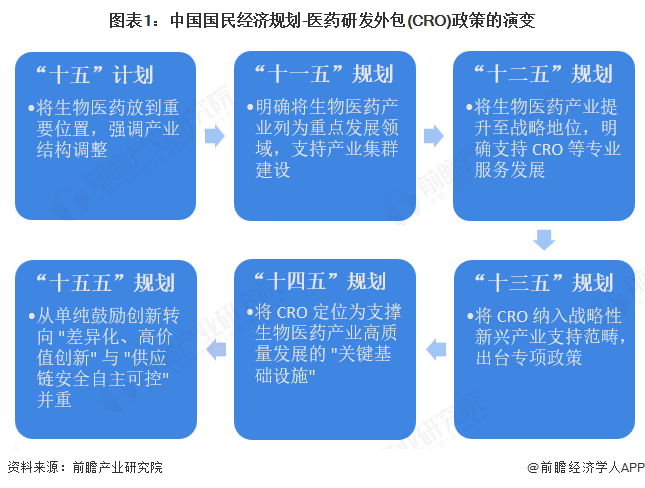
2025年中国医药研发外包(CRO)行业政策分析 药审改革推动行业发展提速【组图】
Qian Zhan Wang· 2026-01-23 09:08
Core Viewpoint - The report highlights the significant growth and development of China's Contract Research Organization (CRO) industry, driven by a comprehensive policy framework and regulatory reforms that enhance innovation and operational efficiency in the pharmaceutical sector [1][3][9]. Group 1: Industry Overview - The main listed companies in China's CRO industry include WuXi AppTec (603259.SH), Kanglong Chemical (300759.SZ), Tigermed (300347.SZ), Kelaiying (002821.SZ), Zhaoyan New Drug (603127.SH), Jiuzhou Pharmaceutical (603456.SH), Haoyuan Pharmaceutical (688131.SH), Boteng Co., Ltd. (300363.SZ), Chengdu XianDao (688222.SH), and Yaoshi Technology (300725.SZ) [1]. - The CRO industry is recognized as a strategic emerging industry that supports pharmaceutical innovation, transitioning China from a major pharmaceutical market to a strong one [1]. Group 2: Policy Framework - The policy framework for the CRO industry is centered around the National Medical Products Administration (NMPA) and includes collaboration with other regulatory bodies such as the National Health Commission (NHC) and the Drug Administration (CDR) [3]. - Key regulatory measures include the Marketing Authorization Holder (MAH) system, implicit licensing for clinical trials, Good Laboratory Practice (GLP) and Good Clinical Practice (GCP) certifications, and priority review and approval processes [3]. Group 3: Industry Support Policies - National policies provide financial support through initiatives like the "Major New Drug Creation" program, tax reductions for high-tech enterprises, and increased deductions for R&D expenses, which lower operational costs for the industry [6]. - Local governments implement differentiated policies that align with regional industrial characteristics, including subsidies for innovative drug development and funding for CRO platform construction [6]. Group 4: Drug Review Reforms - Recent reforms in drug review processes have significantly improved approval efficiency, reducing the average clinical trial review time from 420 days to 30 days in pilot areas, and addressing a backlog of 22,000 cases [9][12]. - The definition of new drugs has shifted from "China New" to "Global New," aligning with international standards and enhancing the quality of innovation [12]. Group 5: Future Trends - The future of the CRO industry in China is expected to be driven by a robust policy framework, with trends including deeper collaboration in service models, increased application of AI and digital platforms, and a focus on specialized market segments [13]. - The competitive landscape is anticipated to evolve with the rise of domestic leaders and accelerated internationalization, benefiting from improved mechanisms for mutual recognition of clinical trial data [13].




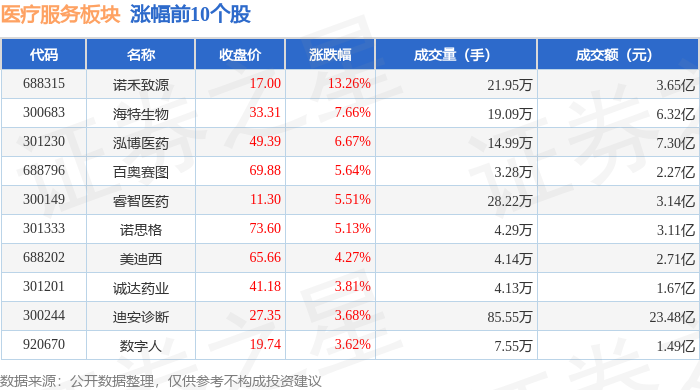
医疗服务板块1月23日涨1.19%,诺禾致源领涨,主力资金净流入9.91亿元
Zheng Xing Xing Ye Ri Bao· 2026-01-23 09:04
Core Viewpoint - The medical services sector experienced a rise of 1.19% on January 23, with notable gains from companies like Nuohua Zhiyuan, which led the sector's performance [1]. Group 1: Market Performance - The Shanghai Composite Index closed at 4136.16, up 0.33%, while the Shenzhen Component Index closed at 14439.66, up 0.79% [1]. - The medical services sector saw significant individual stock movements, with Nuohua Zhiyuan (688315) closing at 17.00, up 13.26%, and Hai Te Biological (300683) closing at 33.31, up 7.66% [1]. Group 2: Trading Volume and Value - Nuohua Zhiyuan had a trading volume of 219,500 shares and a transaction value of 365 million yuan [1]. - Hai Te Biological recorded a trading volume of 190,900 shares with a transaction value of 632 million yuan [1]. Group 3: Capital Flow - The medical services sector saw a net inflow of 999.1 million yuan from institutional investors, while retail investors experienced a net outflow of 1.069 billion yuan [2]. - The capital flow data indicates that major stocks like Diyan Diagnosis (300244) had a net inflow of 288 million yuan from institutional investors [3].





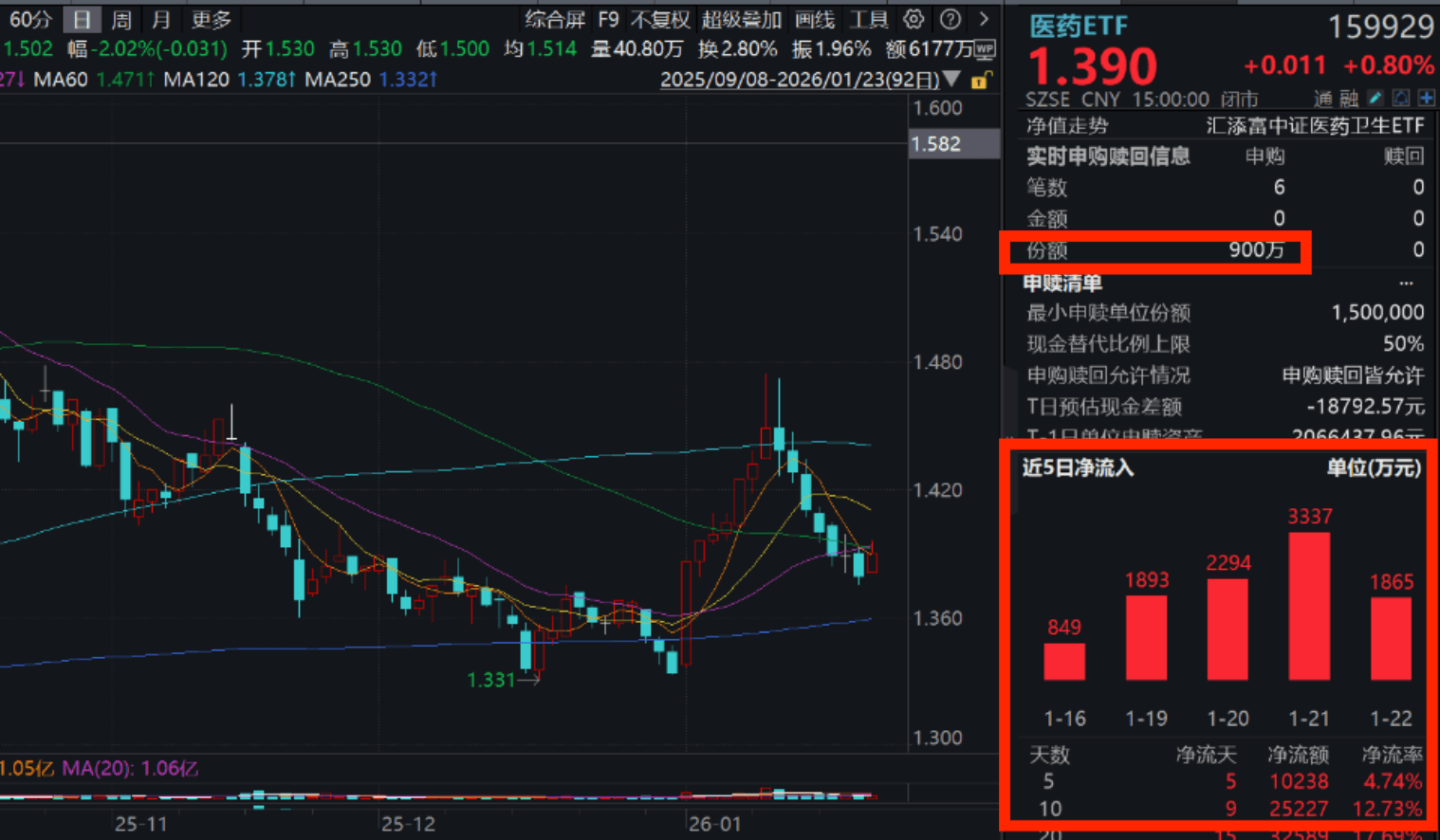
医药果然反弹!医药ETF(159929)收涨近1%,近5日狂揽超1亿元!关注创新、出海、困境反转脉冲三大产业演绎脉络!
Sou Hu Cai Jing· 2026-01-23 07:43
Core Viewpoint - The pharmaceutical sector is experiencing a rebound, with the pharmaceutical ETF (159929) rising by 0.8% and a total trading volume exceeding 86 million yuan, indicating strong investor interest and capital inflow [1]. Group 1: Market Performance - The pharmaceutical ETF (159929) has seen a capital inflow of over 320 million yuan in the last 20 days, with 15 of those days showing increased funding [1]. - The latest financing balance has surged to over 75 million yuan, reflecting continued leverage in the market [1]. - Major stocks within the ETF, such as Mindray Medical and United Imaging, have shown positive performance, with several stocks rising over 1% [4]. Group 2: Sector Analysis - The report highlights a shift in focus within the pharmaceutical sector towards innovative fields such as AI healthcare and medical robotics, moving away from previously strong areas like brain-computer interfaces [3]. - The CRO (Contract Research Organization) sector has also shown some performance, driven by market sentiment and expectations of turning points in the industry [3]. - The top three investment directions identified for 2026 include BD 2.0, small nucleic acids, and supply chain (CXO and upstream), emphasizing the importance of innovation and international expansion [5]. Group 3: Company Highlights - Key companies in the ETF include WuXi AppTec, with an estimated weight of 10.77%, and Hengrui Medicine, with a weight of 9.41%, both of which are significant players in the pharmaceutical industry [2]. - Tempus AI reported a revenue of approximately 1.27 billion USD for 2025, marking an 83% year-on-year growth, showcasing the commercial viability of AI in healthcare [6]. - NVIDIA and Eli Lilly announced a partnership to establish an AI innovation lab, investing up to 1 billion USD over five years to address challenges in drug discovery and development [5].
医药生物行业周报:九部门发文促进药品零售行业高质量发展,期待药店经营拐点-20260123
BOHAI SECURITIES· 2026-01-23 07:28
Investment Rating - The industry is rated as "Neutral" [8][60] - Specific company ratings include "Buy" for 恒瑞医药 (Hengrui Medicine) and "Increase" for 药明康德 (WuXi AppTec) [8][60] Core Insights - The report highlights the issuance of opinions by nine departments, including the Ministry of Commerce, aimed at promoting high-quality development in the pharmaceutical retail industry, indicating a potential turning point for pharmacy operations [8][16] - The report emphasizes the expected benefits for leading chain pharmacies from policy support and increased industry concentration [8][16] - The inclusion of the drug替尔泊肽 (Tirzepatide) as a breakthrough therapy for treating metabolic-associated fatty liver disease is noted as a significant development [8][16] Industry News - The National Medical Insurance Administration issued a guideline for the pricing of surgical and treatment auxiliary services, consolidating existing price projects into 37 items [16] - The report discusses the promotion of pharmaceutical retail industry transformation towards a "health service hub" through enhanced pharmacy services and optimized purchasing experiences [16][17] - The report mentions the ongoing development of AI applications in healthcare and pharmaceuticals, suggesting investment opportunities in AI-related companies [8][58] Industry Data - As of January 22, 2026, the price index for traditional Chinese medicine shows a year-on-year decline of 14%, with specific herbs like 连翘 (Forsythia) and 党参 (Codonopsis) experiencing significant price drops of 31% and 36% respectively [18][23] - The SW pharmaceutical industry’s price-to-earnings ratio (TTM) is reported at 52.01 times, with a valuation premium of 266% relative to the CSI 300 index [52] Company Announcements - 恒瑞医药 (Hengrui Medicine) received clinical trial approval for multiple drugs, including SHR-7787 and 阿得贝利 (Adalimumab) [30] - 百利天恒 (Baili Tianheng) has had its drug application for treating recurrent or metastatic esophageal squamous cell carcinoma accepted [31] - 复星医药 (Fosun Pharma) announced plans to spin off a subsidiary for listing and received clinical trial approval for a drug targeting advanced colorectal cancer [35]

中欧基金葛兰:一季度医药板块有望延续结构性行情,看好创新药械产业链出海、消费医疗等投资机会
Sou Hu Cai Jing· 2026-01-23 06:53
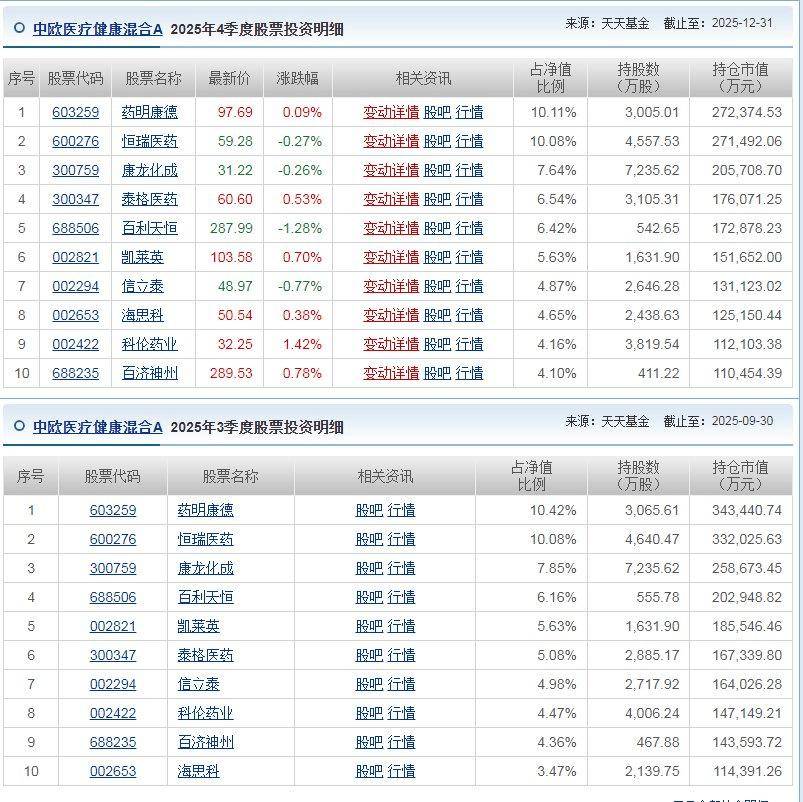
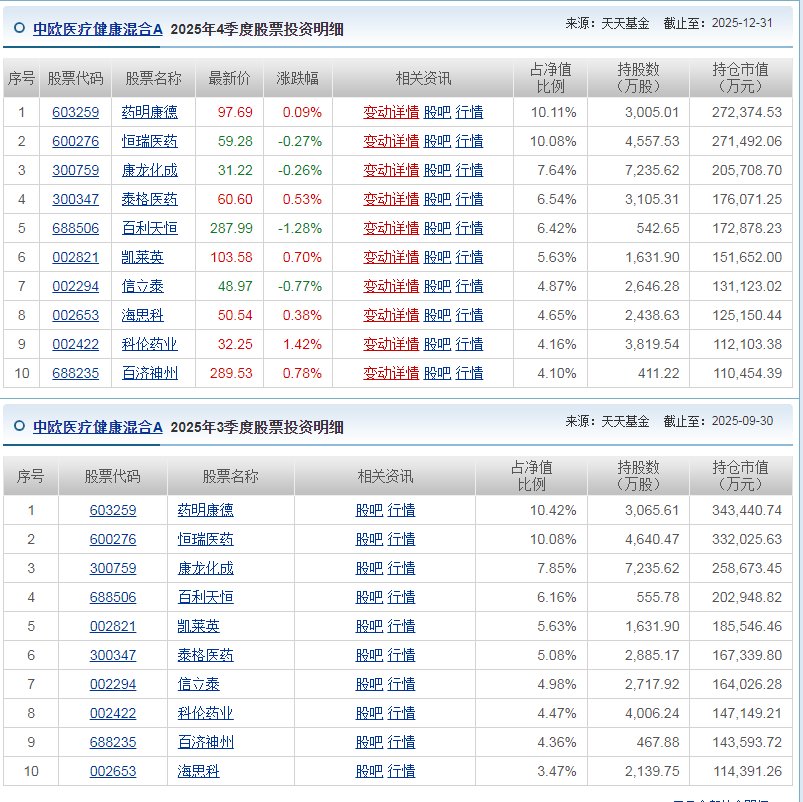
Core Viewpoint - The report highlights the performance of the China Europe Medical Health Mixed Fund managed by Ge Lan and Zhao Lei, indicating a decline in total fund size and negative returns compared to benchmarks [1][4]. Fund Performance - As of December 31, 2025, the total size of the funds managed by Ge Lan decreased from 43.544 billion to 35.389 billion yuan [1]. - The A-class share of the China Europe Medical Health Mixed Fund recorded a net value growth rate of -14.81%, while the C-class share saw a decline of -14.98%, both underperforming the benchmark return of -8.21% [1][3]. Holdings Overview - The top ten holdings of the China Europe Medical Health Fund include WuXi AppTec, Heng Rui Medicine, and Kanglong Chemical, with notable increases in holdings for Hai Si Ke and Tai Ge Medicine, while reductions were seen in stocks like Ke Lun Pharmaceutical and Xin Li Tai [1][2]. Market Context - In Q4 2025, the CSI Pharmaceutical Index fell by 12.7%, underperforming the CSI 300 Index, which declined by only 0.2%. The report notes significant differentiation within sub-sectors, with innovative industries experiencing corrections while traditional Chinese medicine and pharmaceutical commerce remained relatively stable [3]. Future Outlook - Looking ahead to Q1 2026, improvements in global liquidity are expected to boost investment and financing in innovative pharmaceuticals, supported by domestic policy enhancements. The innovative drug and device industry is anticipated to maintain a high level of activity, with several key domestic drugs approaching critical data readouts [4][5]. - The report suggests that the pharmaceutical sector may continue to experience structural trends due to macroeconomic improvements, supportive industry policies, and ongoing innovation, with investment opportunities focusing on the progress of innovative drug and device exports, domestic substitution in equipment, and recovery in consumer healthcare demand [5].

中欧基金葛兰:一季度医药板块有望延续结构性行情 看好创新药械产业链出海、消费医疗等投资机会
Zhi Tong Cai Jing· 2026-01-23 06:33
Core Viewpoint - The report highlights the performance of the China Europe Medical Health Mixed Fund, managed by Ge Lan and Zhao Lei, indicating a decline in total fund size and negative returns compared to benchmarks for the fourth quarter of 2025 [1][4]. Fund Performance - As of December 31, 2025, the total size of funds managed by Ge Lan decreased from 43.544 billion to 35.389 billion yuan [1]. - The net value growth rate for Class A shares of the China Europe Medical Health Mixed Fund was -14.81%, while the benchmark return was -8.21% [1]. - Class C shares experienced a net value growth rate of -14.98%, also underperforming the benchmark [1]. Holdings Overview - The top ten holdings of the China Europe Medical Health Mixed Fund include WuXi AppTec, Heng Rui Medicine, and Kanglong Chemical, with notable increases in holdings for Hai Si Ke and Tai Ge Medicine, while reductions were seen in stocks like Ke Lun Pharmaceutical and Xin Li Tai [1][2]. - The largest holding, WuXi AppTec, accounted for 10.11% of the fund's net value, with a market value of approximately 2.724 billion yuan [2]. Market Context - The CSI Medical Index fell by 12.7% in the fourth quarter of 2025, underperforming the Shanghai and Shenzhen 300 Index, which declined by only 0.2% [3]. - There was significant differentiation within sub-sectors, with the innovative industry chain entering a correction phase after previous gains, while traditional Chinese medicine and pharmaceutical commerce showed relative stability [3]. Future Outlook - Looking ahead to the first quarter of 2026, improvements in global liquidity are expected to boost investment and financing in innovative drugs, supported by domestic policy enhancements [4]. - The innovative drug and medical device industry chain is anticipated to maintain high levels of activity, with several key domestic drugs approaching critical data readout points [5]. - The CXO sector is expected to benefit from a recovery in biotechnology financing, leading to improved order conditions [5]. - The pharmaceutical sector is projected to experience structural trends driven by macroeconomic improvements, supportive industry policies, and ongoing innovation [5].
百川发布循证增强医疗大模型M3 Plus,医疗创新ETF(516820)连续5天净流入
Sou Hu Cai Jing· 2026-01-23 05:56
Group 1 - The core viewpoint of the news highlights the performance of the medical innovation sector, with the China Securities Medical and Medical Device Innovation Index (931484) rising by 0.51% and notable increases in constituent stocks such as Ganli Pharmaceutical (3.05%) and Zhejiang Pharmaceutical (2.29%) [1] - The Medical Innovation ETF (516820) has seen a net inflow of funds over the past five days, with a peak single-day net inflow of 40.537 million yuan, totaling 62.4623 million yuan, averaging a daily net inflow of 12.4925 million yuan [1] - Baichuan Intelligent has launched the Baichuan-M3 Plus evidence-enhanced medical model, achieving a hallucination rate of 2.6%, the lowest globally, and introduced the "Evidence Anchoring" technology to provide citation sources for medical conclusions [1] Group 2 - Everbright Securities emphasizes that the AI+ healthcare sector should focus on several core areas: AI drug development, AI medical imaging, AI chronic disease management, and AI surgical robots, highlighting the strong willingness of pharmaceutical companies to invest in AI drug development due to its potential to significantly shorten drug development cycles [2] - The China Securities Medical and Medical Device Innovation Index selects 30 publicly listed companies with good profitability and growth potential from the pharmaceutical and healthcare sector, reflecting the overall performance of profitable and growth-oriented companies [2] - As of December 31, 2025, the top ten weighted stocks in the index include WuXi AppTec, Hengrui Medicine, Mindray Medical, and others, accounting for 63.75% of the total index weight [2]


AI医疗爆发,多股年内涨超30%
21世纪经济报道· 2026-01-23 04:53
Core Viewpoint - The AI healthcare sector is experiencing significant growth and interest in 2026, with the AI healthcare index rising over 11% in just 14 trading days, indicating a clear trend in capital market enthusiasm for this sector [1][2]. Market Performance - As of January 22, 2026, the AI healthcare index increased by over 11%, while the CSI Medical Index and Hang Seng Healthcare Index rose by 7.68% and 10.65%, respectively [1]. - Companies like Di'an Diagnostics and Baolait have seen their stock prices surge over 60%, with others like Weining Health and Chengdu Xian Dao also experiencing gains exceeding 30% [1]. Industry Growth Projections - According to Frost & Sullivan, the AI healthcare market in China is projected to grow from 8.8 billion yuan in 2023 to 315.7 billion yuan by 2033, with a compound annual growth rate (CAGR) of 43.1% [1]. Technological Advancements - Major tech companies are actively entering the AI healthcare space, with OpenAI launching a healthcare version of ChatGPT and other firms like Ant Group, Tencent, JD, and ByteDance developing AI healthcare models and applications [5][6]. - AI drug development is identified as the fastest-growing segment within AI healthcare, with companies like Insilico Medicine and WuXi AppTec significantly reducing drug development timelines [6][7]. Commercialization Challenges - Despite the enthusiasm, the commercialization of AI healthcare products is facing challenges, with many companies reporting losses. For instance, 24 out of 47 biomedicine companies forecasted losses or reduced profits for 2025 [10]. - Companies like KingMed Diagnostics and Anbiping are experiencing significant revenue declines, with Anbiping reporting a 28.29% drop in revenue year-on-year [10][11]. Regulatory Developments - Recent government policies are seen as a positive signal for the AI healthcare sector, with initiatives aimed at promoting and standardizing AI applications in healthcare [15][16]. - The National Healthcare Security Administration has clarified pricing for AI-assisted diagnostic services, which is expected to facilitate the integration of AI into routine clinical practice [15][16]. Future Outlook - Industry experts predict that 2026 will be a pivotal year for AI healthcare, with clearer payment structures and stronger financial backing expected to enhance commercialization prospects [16].