
中航沈飞

Search documents
重大催化!逆势上涨
Ge Long Hui A P P· 2025-11-17 09:31
Core Viewpoint - The military industry sector is experiencing a significant rise due to increasing geopolitical risks, with the aerospace index leading the gains among military-themed indices [1][2]. Group 1: Short-term Catalysts - The military sector's strength is primarily driven by geopolitical factors, including recent provocative statements from Japan and renewed large-scale airstrikes by Russia on Ukraine, which have heightened global uncertainty [4]. - The upcoming maiden flight of China's reusable rocket "Zhuque-3" in mid-November is also a notable event that could attract market attention [4]. Group 2: Long-term Catalysts - The "14th Five-Year Plan" laid the groundwork for the military industry, achieving significant milestones in weapon systems development, transitioning from research to small-scale production [8]. - The "15th Five-Year Plan" focuses on large-scale production and systematic combat capabilities, indicating a shift towards mass production of previously developed equipment [9]. - The emphasis on "high-quality transformation" in the military sector will drive demand for advanced technologies and materials, particularly in critical areas like high-end chips and aerospace engines [11][12]. Group 3: Performance Metrics - The military sector has shown a recovery trend, with a reported 16.99% year-on-year increase in revenue and a 14.01% increase in net profit for the third quarter of 2025 [15]. - Various sub-sectors, including defense information, aerospace, and commercial space, are also showing signs of recovery [15]. Group 4: Institutional Holdings - Institutional investment in the military sector remains at historical lows, with a total market value of 101.36 billion yuan, ranking 14th among primary industries [21]. - There is a notable structural adjustment within institutional holdings, with active funds reducing their total positions while passive funds maintain stable increases [22]. Group 5: Strategic Opportunities - The military trade sector is expected to provide substantial growth opportunities, with exports of military equipment showing significant increases, such as a 30.6% year-on-year growth in September 2025 [20]. - The diversification of weapon procurement sources by various countries presents a strategic opportunity for China's military exports [20]. Group 6: Focus Areas - The aerospace index is highlighted as a key area of focus, with the aerospace ETF (159227) showing significant inflows and a strong performance in the market [34]. - The ETF's top holdings reflect the core supply chain of the aerospace industry, aligning with national strategic needs in defense and aerospace [34].

军工行业周复盘、前瞻:迪拜航展即将开幕,四川舰顺利完成首次航行试验
CMS· 2025-11-17 08:02
Investment Rating - The report maintains a "Strong Buy" rating for several key companies in the military industry, including 中航西飞, 中航光电, 航天彩虹, and others, indicating a strong expectation for their stock price to outperform the benchmark index by over 20% [8]. Core Insights - The military industry is highlighted as a crucial area for investment, particularly in aerospace and defense sectors, with a focus on companies that are positioned to benefit from increased military spending and technological advancements [2][3]. - The report emphasizes the potential of commercial aerospace, particularly low-orbit satellite applications, which are expected to have significant military and civilian applications [3]. - The upcoming Dubai Airshow is anticipated to be a major event, showcasing over 200 aircraft and new technologies, which could serve as a catalyst for the industry [20][22]. Industry Overview - The military industry index has shown a performance of -3.8% over the past month, but a positive trend of 12.1% over six months and 13.2% over twelve months, indicating a recovery and growth potential [5][11]. - As of November 14, 2025, the SW National Defense and Military Industry Index has increased by 13.35% year-to-date, although it has underperformed the Shanghai and Shenzhen 300 Index by 4.27% [11][12]. - The report notes that the industry consists of 119 listed companies with a total market capitalization of approximately 2060.9 billion [3]. Key Events and Catalysts - Significant geopolitical events, such as Japan's escalating rhetoric regarding Taiwan, are noted as influencing factors in the military sector, potentially impacting defense spending and strategic priorities [18][19]. - The successful completion of the first sea trial of the Navy's 四川舰 (Sichuan Ship) is highlighted as a key development, showcasing advancements in naval capabilities [22]. - The report identifies several key companies that are expected to benefit from increased demand in military trade and domestic military needs, including 中航沈飞, 中航西飞, and others [7].


超60亿元资金抢筹!三重逻辑共振,这一赛道迎来价值重估
Zheng Quan Shi Bao Wang· 2025-11-17 07:53
Core Viewpoint - The military industry is positioned as a high-potential investment sector driven by national security needs, military trade exports, and technological innovation through civil-military integration [1][3][4] Industry Dynamics - The military industry is experiencing a positive trend characterized by "economic recovery, value reassessment, and event-driven catalysts" [3] - The defense industry reported a revenue growth of 6.7% year-on-year in the first three quarters, reversing a decline of 0.57% in the first half of the year [3] - The net profit attributable to shareholders improved from -8.59% in the first half to 0.02% in the third quarter, indicating a recovery in industry performance [3] Investment Opportunities - The military trade export structure has shifted from reliance on imports to high-value exports, with a significant decrease in import share from 4.3% in 2015 to 0.2% in 2024 [4] - The 2025 defense budget is projected at 1.78 trillion yuan, with a consistent growth rate of 7.2%, indicating a stable growth foundation for defense investments [3] Valuation Insights - The current price-to-earnings ratio (TTM) for the military industry is approximately 85.77, significantly higher than the overall market average of 22.59 [5][6] - The valuation premium in the military sector is attributed to high barriers to entry and the long-term investment required for core technology development [6] Investment Tools - The military industry presents complexities and information asymmetries, making it challenging for ordinary investors to participate directly [8] - The military leader ETF (code: 512710) offers a transparent and accessible investment vehicle, tracking the military leader index that focuses on leading companies across the military supply chain [8][9] Market Sentiment - As of October 30, the military leader ETF has seen a net inflow of 6.413 billion yuan this year, with a total scale of 13.735 billion yuan, reflecting strong market recognition [2][10] - The investment in the military sector is viewed as a long-term confidence in national technological strength and security, aligning with national strategies [10]
超60亿元资金抢筹!三重逻辑共振,这一赛道迎来价值重估
券商中国· 2025-11-17 07:43
Core Viewpoint - The military industry is positioned as a high-potential investment sector, driven by national security needs, military trade exports, and technological innovation through military-civilian integration, highlighting its long-term investment value as the country transitions from the "14th Five-Year Plan" to the "15th Five-Year Plan" [1] Group 1: Industry Dynamics - The military industry is experiencing a positive trend characterized by "economic recovery, value reassessment, and event-driven catalysts" [4] - The defense and military sector's revenue for the first three quarters showed a year-on-year growth of 6.7%, reversing a decline of 0.57% in the first half of the year [4] - The 2025 national defense budget is projected at 1.78 trillion yuan, with a consistent growth rate of 7.2%, indicating a stable foundation for continued investment [4] Group 2: Military Trade and Technological Integration - Military trade exports are a key variable for value reassessment, with China's military trade export structure shifting towards high-value areas such as drones and stealth fighters [5] - The integration of military and civilian technologies is creating new growth paths, with military high-tech accelerating its transition into civilian sectors like commercial aerospace and logistics [5] Group 3: Valuation and Market Perception - The current price-to-earnings ratio (TTM) for the A-share military industry is approximately 85.77, significantly higher than the overall market average of 22.59, raising concerns about overvaluation [7] - The valuation of military enterprises should consider their strategic importance, technological barriers, and profit certainty, rather than relying solely on traditional metrics [7] - The global military industry valuation logic is being restructured, with a shift from traditional manufacturing to technology-driven platforms, emphasizing long-term growth potential [8] Group 4: Investment Strategies for Ordinary Investors - The military industry presents significant complexity and information asymmetry, making direct investment challenging for ordinary investors [11] - The military leader ETF (code: 512710) offers a transparent and accessible investment tool, tracking the military leader index that focuses on leading enterprises across the military supply chain [11][13] - The military leader index includes key players from all segments of the military industry, providing a diversified investment approach that mitigates individual stock risks [12][13]

多因素影响,军工板块再度起飞!机构预测多股全年业绩大增
Zheng Quan Shi Bao· 2025-11-17 05:28
Core Viewpoint - The defense and military industry is expected to experience another upward trend due to multiple influencing factors, including geopolitical risks, technological advancements, and policy support [1]. Group 1: Market Performance - The military sector has continued its strong performance, with notable stocks such as Aerospace Development (000547) and Great Wall Military (601606) showing significant gains, including a net inflow of 1.828 billion yuan [1]. - The average stock price increase for military concept stocks this year is 30.94%, with North China Long Dragon leading with a 342.24% increase [2]. - Six military concept stocks have received institutional research attention in November, indicating strong interest from investors [2]. Group 2: Company Performance - Major companies in the military sector, including China Shipbuilding (600150) and AVIC Chengfei (302132), reported net profits exceeding 1 billion yuan in the first three quarters [3]. - Several companies, such as Zhenray Technology and North China Long Dragon, have turned losses into profits, with some achieving over 100% year-on-year profit growth [3]. - Institutions predict that nine military stocks will see significant profit increases by 2025, with expected growth rates exceeding 100% [3]. Group 3: Future Outlook - The military industry is poised to benefit from rising geopolitical risks, modernization goals, and expanding military trade markets, with high-end weapon exports expected to increase [1]. - Technological innovations, such as 3D printing and recyclable rockets, are anticipated to drive growth in the sector [1].


军工本周观点:高质量推进国防和军队现代化:国防军工-20251117
Huafu Securities· 2025-11-17 03:45
Investment Rating - The industry rating is "Outperform the Market" [5] Core Viewpoints - The report emphasizes the importance of high-quality advancement in national defense and military modernization, aligning with the "14th Five-Year Plan" and the goal of achieving a strong military by 2027 [43][44] - It highlights the need for efficient resource utilization and cost control in military modernization efforts, advocating for a sustainable development approach [4][45] - The report anticipates significant growth in both domestic and international demand for military products and services, driven by multiple catalysts including the "14th Five-Year Plan" and rapid military trade development [10][47] Summary by Sections Industry Investment Rating - The military industry is rated as "Outperform the Market," indicating expected returns above the market benchmark [5] Key Points from the Report - The report outlines the fundamental requirements for military modernization during the "14th Five-Year Plan" period, focusing on advanced combat capabilities and military governance modernization [43][44] - It stresses the integration of new production capabilities with combat capabilities, enhancing the national strategic system and capabilities [44] - The report also discusses the necessity of policy support to address challenges in planning and cross-domain collaboration [4][45] Market Performance - The military industry index decreased by 2.15% from November 10 to November 14, underperforming compared to the Shanghai Composite Index, which fell by 1.08% [12][18] - The military index has increased by 13.35% since 2025, while the Shanghai Composite Index has risen by 17.62%, indicating a relative underperformance of 4.27% [20] Stock Performance - Notable stock performances include Tian'ao Electronics and Shanghai HuGong, which saw increases of 12.63% and 12.35% respectively, while stocks like Chunzong Technology and Lais Information experienced declines of 17.43% and 15.39% [24][26] Fund Flows and Valuation - The report notes a decrease in passive fund sizes but an increase in fund shares, with a net inflow of 4.57 billion yuan into military ETFs during the week [28] - As of November 14, the military sector's price-to-earnings ratio (TTM) stands at 68.88, indicating a high valuation relative to historical levels, but with expectations of recovery in 2026 [46][37]
军工板块三季度归母净利润同比增长73.2%!军工ETF龙头(512680)盘中涨超2%,外部环境不确定性带动国际军贸需求增长
Xin Lang Cai Jing· 2025-11-17 03:09
Group 1 - The A-share military industry sector experienced a significant surge, with companies like Great Wall Military and Jianglong Shipbuilding seeing substantial gains, indicating strong market interest and potential growth in the sector [1] - The military industry is benefiting from the "14th Five-Year Plan" completion and preparations for the "15th Five-Year Plan," with key drivers including high-end military trade, state-owned enterprise reforms, and large-scale AI deployment [1] - The upcoming launch of China's reusable rocket "Zhuque-3" is expected to lower launch costs and accelerate the development of domestic satellite internet constellations, marking a milestone for commercial aerospace [1][2] Group 2 - The military sector reported a notable increase in performance, with net profit reaching 24.453 billion yuan in the first three quarters of 2025, a 17.29% increase year-on-year [2] - The third quarter alone saw a net profit of 8.927 billion yuan, reflecting a significant 73.2% year-on-year growth, indicating a positive trend in quarterly performance [2] - The military ETF index showed strong performance, with a 2.10% increase on November 17, 2025, and a 12.88% rise over the past six months, highlighting investor confidence in the sector [2][3] Group 3 - The leading military ETF reached a scale of 7.571 billion yuan as of November 14, 2025, with a substantial increase in shares by 70.4 million over the past two weeks [3] - The ETF has seen continuous net inflows, with a peak single-day inflow of 41.8467 million yuan, totaling 1.25 billion yuan in net inflows recently, indicating strong investor interest [3] Group 4 - Investors can access military ETF opportunities through various off-market connection classes, providing additional avenues for investment in the military sector [4]
军工含量第一的航空航天ETF涨超2%,近20日“吸金”超7亿元
Ge Long Hui A P P· 2025-11-17 02:33
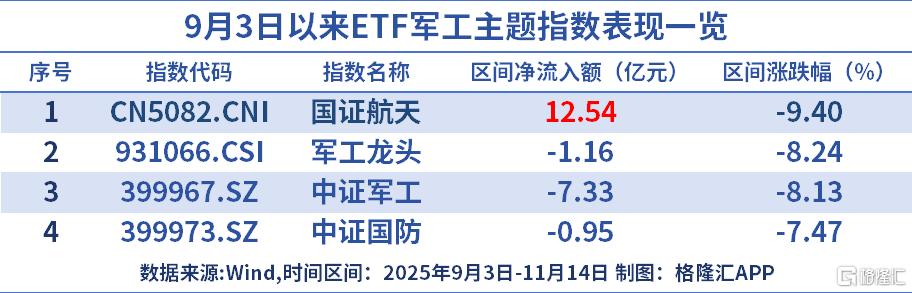
Group 1 - The military industry sector continues its strong performance, with aerospace development achieving two consecutive trading limits and Great Wall Aerospace hitting the daily limit, driving the Aerospace ETF up by 2.51% [1] - Recent geopolitical tensions, including inappropriate remarks from Japan's Prime Minister and military exercises in the Yellow Sea, have increased uncertainty in the global landscape, acting as direct catalysts for the sector [2] - The defense and military sector has shown significant profit growth, with a year-on-year increase of 17.29% in net profit attributable to shareholders in the first three quarters, and a remarkable 73.2% increase in the third quarter alone [2] Group 2 - The National Aerospace Index has experienced a cumulative decline of over 9% since September 3, indicating a technical demand for rebound [3] - The "14th Five-Year Plan" has established "building a strong aerospace nation" as an independent goal, marking a shift from technological breakthroughs to systematic national construction, positioning the aerospace industry as a core support for modernization and technological self-reliance [3] - The Aerospace ETF (159227) has attracted over 700 million yuan in capital over the past 20 days, with a high concentration of military-related stocks, accounting for 98.2% of the index [4]
第144期:军贸高端化破局是板块年底前的占优主线:激浊扬清,周观军工
Changjiang Securities· 2025-11-17 01:33
Investment Rating - The report maintains a "Positive" investment rating for the defense industry [2] Core Insights - The high-end military trade breakthrough is the dominant theme for the sector before the end of the year [1] - The signing of the defense agreement between Saudi Arabia and Pakistan indicates a steady advancement in China's high-end military trade [8][16] - China's military trade is entering a new era of high-quality self-researched equipment, moving away from reliance on imported Soviet-style equipment [27][30] Summary by Sections Section 1: Saudi Arabia and Pakistan Defense Agreement - Saudi Arabia is the largest military trade customer in the Middle East, holding a 23.97% market share from 1985 to 2024 [16] - The defense agreement may signify Saudi Arabia's deeper integration into the Chinese equipment system [16][26] Section 2: Pakistan as a Key Client - Pakistan is China's primary military trade export destination, with 62.17% of China's military exports going to Pakistan from 2015 to 2024 [19] Section 3: Military Trade Growth Factors - The report highlights that recent global conflicts, such as the Russia-Ukraine and Israel-Palestine conflicts, are increasing overall military trade demand [38] - The supply side is improving, with China moving towards high-end self-sufficiency in military equipment [38] Section 4: Profitability in Military Trade - Military trade enterprises have significantly higher profit margins compared to main equipment manufacturers, indicating potential for margin improvement [33][37] Section 5: Company-Specific Insights - Guangdong Hongda is diversifying its business across mining, civil explosives, and defense equipment, with defense equipment expected to grow significantly in the coming years [47][51] - AVIC Shenyang Aircraft Corporation is advancing with the introduction of the electromagnetic catapult aircraft carrier, enhancing its capabilities in unmanned aerial vehicles [64][70]

军工周报:关注“十五五”推进国防和军队现代化建设任务-20251116
NORTHEAST SECURITIES· 2025-11-16 14:55
Investment Rating - The report maintains an "Outperform" rating for the defense and military industry [7] Core Insights - The report emphasizes the focus on high-quality advancement in national defense and military modernization during the "14th Five-Year Plan" period, with a core goal of enhancing strategic capabilities to safeguard national sovereignty and security [2][39] - The defense and military sector is expected to experience sustained growth due to the release of new orders and the execution of backlog orders from the previous plan, particularly in main battle equipment and emerging domains [3][43][44] Summary by Sections Market Review - The Shenwan Defense and Military Index fell by 2.15% last week, ranking 27th among 31 Shenwan primary industries [15] - As of last Friday's close, the PE (TTM) for the Shenwan Defense and Military sector was 77.31 times, with aerospace equipment at 305.96 times and military electronics at 105.17 times [24] Key Recommendations - Recommended companies include: AVIC Chengfei, Hongdu Aviation, AVIC Shenyang, AVIC Xifei for downstream mainframe manufacturers; Lianchuang Optoelectronics, Guangqi Technology, Zhongjian Technology for military new technologies; and others in missile industry chains and underwater equipment [4] Industry Dynamics - The report highlights the importance of the "15th Five-Year Plan" in driving modernization efforts, with a focus on advanced weaponry and military training [39][41] - The unveiling of the J-20 and drone collaboration showcases advancements in military capabilities, emphasizing the strategic advantages of unmanned systems [3][42] Future Outlook - The report anticipates a positive outlook for the defense and military sector in 2026, driven by the release of new orders and the completion of backlog orders from the previous plan [43] - The international geopolitical landscape is evolving, creating opportunities for the expansion of China's military trade market, with a notable shift towards high-end military equipment [44]
