
华夏基金

Search documents
某基金公司违规营销,或改变基金营销格局
Xin Lang Cai Jing· 2026-02-01 02:28
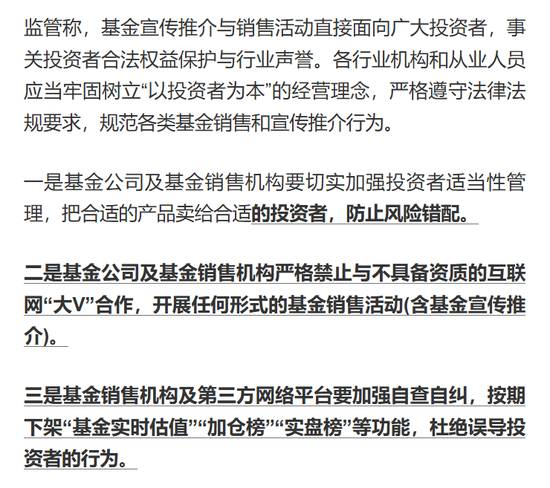
Core Viewpoint - The rise of internet marketing in the financial sector, particularly in fund sales, has led to both opportunities and challenges, including regulatory scrutiny due to improper marketing practices by some fund companies [1][35][36]. Group 1: Internet Marketing in Finance - The proliferation of 4G and 5G has facilitated the growth of internet marketing across various industries, including finance, where fund companies have leveraged these technologies for promotion and investor education [1][34]. - Fund products, like other consumer goods, can be marketed effectively online, but they are unique financial products that carry the risk of loss, making responsible marketing essential [1][35]. Group 2: Regulatory Concerns - Recent incidents of improper marketing by a fund company have prompted regulatory responses, highlighting the need for compliance in financial product promotion [1][35][36]. - The regulatory framework emphasizes the importance of selling suitable products to appropriate investors and prohibits unqualified influencers from participating in fund marketing [2][37]. Group 3: Role of Influencers and Advisors - Unqualified influencers, referred to as "Big Vs," are banned from engaging in fund marketing due to the potential for misleading investors [8][42]. - Fund companies are assessing whether influencers are qualified professionals, with some influencers considering obtaining advisory licenses to comply with regulations [44][47]. Group 4: Future Trends and Compliance - The industry anticipates that the implementation of new regulations will lead to a clearer separation between advisory roles and marketing activities, reducing conflicts of interest [19][66]. - There is a growing trend for influencers to focus on investor education, brand building, and team development rather than promoting specific fund products [58][69].

【固收】二级市场价格波动上涨,首批商业不动产REITs已申报——REITs周度观察(20260126-20260130)(张旭/秦方好)
光大证券研究· 2026-02-01 00:04
Market Overview - The secondary market for publicly listed REITs in China showed an upward trend from January 26 to January 30, 2026, with the China Securities REIT Index closing at 809.56 and the total return index at 1052.42, yielding returns of 0.35% and 0.47% respectively [4] - Compared to other major asset classes, the return rates ranked as follows: crude oil > REITs > pure bonds > US stocks > A-shares > gold > convertible bonds [4] - Among REITs, property and concession REITs saw price increases, with property REITs returning 0.27% and concession REITs returning 0.68% [4] - The best-performing underlying asset types were water conservancy facilities, energy, and transportation infrastructure [4] Trading Activity - The total trading volume for public REITs was 3.18 billion yuan, with an average daily turnover rate of 0.68% [5] - The top three REITs by trading volume were Huaxia Hefei High-tech REIT, Bosera Shekou Industrial Park REIT, and Harvest JD Warehouse Infrastructure REIT, with volumes of 0.41, 0.36, and 0.30 billion units respectively [5] - The main net inflow for the week was 149.1 million yuan, indicating a decrease in market trading enthusiasm compared to the previous week [5] - The leading net inflow categories were consumer infrastructure, park infrastructure, and energy infrastructure REITs [5] Block Trading - The total amount of block trading for the week was 366 million yuan, showing a decline from the previous week [6] - The highest single-day block trading amount was 108.06 million yuan on January 28, 2026 [6] Primary Market - No new REIT products were listed during the week, but the status of 10 existing REIT projects was updated [8]

首批商业不动产REITs项目申报
ZHONGTAI SECURITIES· 2026-01-31 14:49
Investment Rating - The report does not provide a specific investment rating for the industry [2] Core Insights - The REITs index experienced a decline of 0.36% this week, while the Shanghai Composite Index fell by 0.57% and the CSI 300 Index decreased by 0.57% [5][15] - The total market capitalization of the industry is approximately 2225.68 billion yuan, with a circulating market value of 1247.05 billion yuan [2] - Recent developments include the submission of several commercial real estate REIT projects, indicating ongoing activity in the sector [7][12] Industry Overview - The report highlights that 78 companies are listed in the REITs sector, with a total market value of 2225.68 billion yuan [2] - The trading volume for the week was 29.3 billion yuan, reflecting a decrease of 17.6% compared to the previous week [41] - The average turnover rate for the week was 0.5%, down by 0.1 percentage points [41] Market Performance - The report notes that 29 REITs increased in value, while 49 decreased, resulting in an overall decline of 0.36% for the REITs market [19] - The largest gain was seen in the Jia Shi Wu Mei Consumption REIT, which rose by 3.59%, while the largest decline was in the Hua Xia Nanjing Expressway REIT, which fell by 4.14% [19] - The correlation between the REITs index and various stock indices is noted, with the highest correlation observed in the warehousing and logistics sector [24] Trading Activity - The report details the trading activity across different sectors, with significant declines in trading volumes for consumption REITs, which fell by 40.5% [41] - Specific sectors such as ecological protection and warehousing logistics showed mixed performance, with ecological protection increasing by 4.3% while warehousing logistics rose by 2.7% [41] Valuation Metrics - The report provides valuation metrics, indicating that the estimated yield for certain REITs ranges from -1.03% to 10.87%, with the highest yield observed in Ping An Guangzhou Guanghe REIT [43] - The P/NAV ratio for the sector varies, with the highest being 1.84 for Jia Shi Wu Mei Consumption REIT and the lowest at 0.72 for Yi Fang Da Guang Kai REIT [43]
懵了,黄金史诗级崩盘,黄金基金紧急出手
Zhong Guo Ji Jin Bao· 2026-01-31 07:08
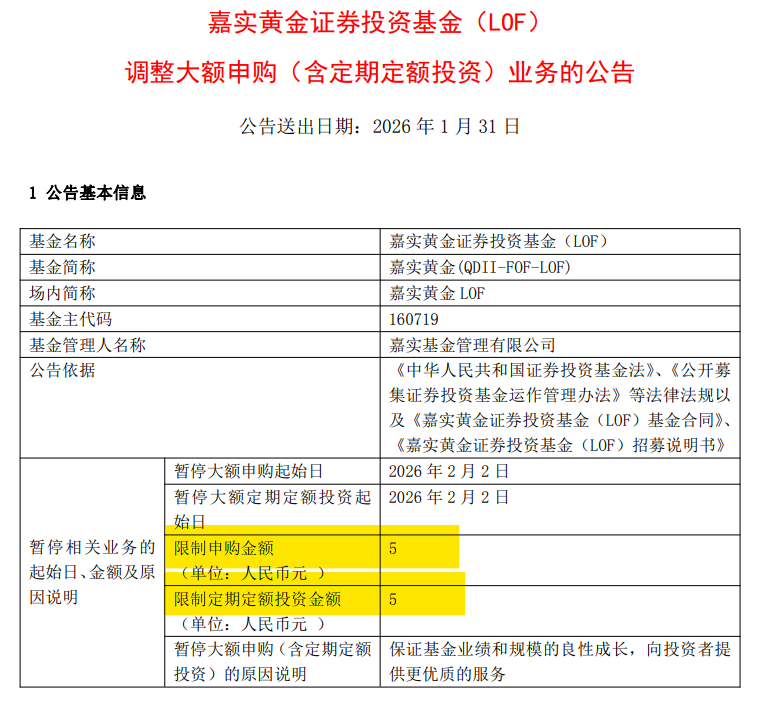
Core Viewpoint - The recent volatility in commodity markets has led to multiple LOF funds for gold and oil announcing significant purchase limits, with some funds setting daily purchase caps as low as 2 yuan [1][3]. Group 1: Fund Purchase Limits - Several funds, including 嘉实黄金 LOF and 嘉实原油 LOF, have announced that starting February 2, 2026, the maximum purchase amount per fund account per day will be limited to 5 yuan [4][6]. - 华安石油基金 LOF has implemented even stricter limits, reducing the daily purchase cap from 10 yuan to 2 yuan starting January 30 [7]. - Other funds, such as 华宝油气 LOF, have also announced limits, with a daily investment cap set at 200 yuan starting February 3 [7]. Group 2: Market Analysis - Industry insiders indicate that the imposition of purchase limits is aimed at ensuring healthy growth of fund performance and scale, while protecting investor interests [2][6]. - The recent sharp declines in gold and silver prices have been attributed to an overheated market, with significant risks accumulating due to large trading volumes prior to the downturn [2][11]. - The price of gold fell over 12% to a low of 4682 USD/oz, closing down 9.25% at 4880 USD/oz, while silver experienced a historic drop of over 36%, closing down 26.42% at 85.259 USD/oz [9][11]. Group 3: Investor Caution - Analysts warn that the precious metals market is currently in an overbought state, with increased volatility and profit-taking pressures [13]. - The upcoming Chinese New Year holiday may serve as a critical test for the silver market, as trading will be halted for two weeks, potentially impacting short-term traders [13]. - Investors are advised to remain rational and avoid blindly chasing high prices, as the rapid price increases in gold and silver are likely to lead to corrections [2][13].
懵了,黄金史诗级崩盘!黄金基金,紧急出手
Xin Lang Cai Jing· 2026-01-31 03:35
Group 1 - Multiple commodity LOF funds, including gold and oil, have announced limits on large subscriptions, with some funds setting daily purchase limits as low as 2 yuan [1][3][6] - The limits are intended to ensure the healthy growth of fund performance and scale, protecting investor interests amid increased market volatility [2][17] - The recent sharp declines in gold and silver prices have been attributed to an overheated market, with significant risks accumulated due to crowded trading [2][10][20] Group 2 - On January 30, the Jiashi Gold LOF announced a subscription limit of 5 yuan per account starting February 2, with similar restrictions applied to Jiashi Oil LOF [3][5][13] - Other funds, such as Huabao Oil and Gas LOF, have also implemented subscription limits, with Huazhong Oil Fund reducing its limit from 10 yuan to 2 yuan [6][16] - The premium rates for Huazhong Oil Fund LOF and Guangfa Oil Fund LOF reached 32.84% and 32.57% respectively, prompting the need for subscription limits to mitigate high premiums [17] Group 3 - On January 30, gold prices fell over 12%, closing down 9.25% at 4,880 USD per ounce, while silver experienced a historic drop of over 36% [8][20] - Analysts suggest that the rapid price increases in gold and silver have led to heightened technical correction risks, especially with the Federal Reserve maintaining interest rates [10][20] - The upcoming Chinese New Year holiday may impact silver demand, as industrial users may seek alternatives and price-sensitive consumers may reduce purchases [21]
紧急公告!多只LOF基金,暂停大额申购!
证券时报· 2026-01-31 03:01
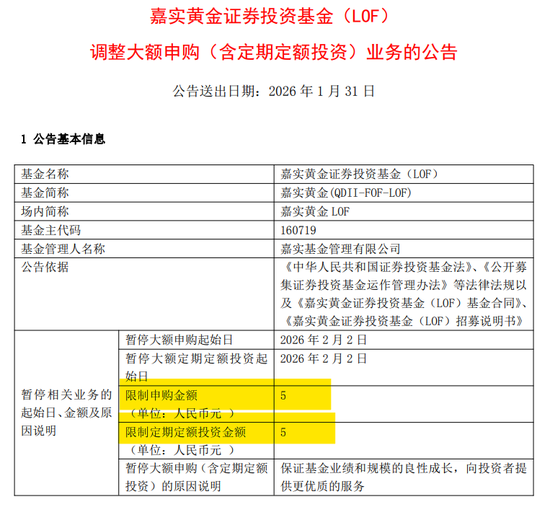
Core Viewpoint - The article highlights the recent trend of strict purchase limits on cross-border LOF funds, particularly those related to commodities like gold and oil, due to market volatility and increased speculative investments [1][2]. Group 1: Fund Purchase Limits - Several funds, including the Jiashi Gold LOF and Jiashi Oil LOF, have announced significant purchase limits, with some funds capping daily investments to as low as 2 yuan [3]. - The imposition of these limits is a response to the influx of speculative capital during market downturns, which can lead to cash being idled if it exceeds the fund's investment capacity [3]. Group 2: Market Performance and Analysis - On January 30, the market saw a sharp decline in commodity-related stocks, particularly in the precious metals sector, with declines of 8% to 9% observed in various ETFs [5]. - The Jiashi Gold LOF experienced a 7.5% drop on the same day, although it still recorded a year-to-date increase of 15.75% [6]. Group 3: Factors Influencing Market Movements - The decline in gold and silver prices is attributed to several factors, including anticipated changes in the Federal Reserve's leadership and increased margin requirements for trading in precious metals [7]. - The market is also reacting to high leverage positions being liquidated, which has contributed to the overall downturn in the precious metals sector [7]. Group 4: Future Outlook - Despite the short-term corrections, some institutions remain optimistic about the long-term potential of gold, citing historical data that suggests rebounds typically follow significant short-term declines [9]. - The article notes that geopolitical tensions and structural supply-demand gaps are expected to support the prices of precious metals in the medium to long term [10].

紧急公告!多只LOF基金,暂停大额申购!
券商中国· 2026-01-31 00:48
Core Viewpoint - The article highlights the recent trend of strict purchase limits on cross-border LOF funds, particularly those related to commodities like gold and oil, due to market volatility and increased speculative investments [1][2]. Group 1: Fund Purchase Limits - Multiple funds, including the Jiashi Gold LOF and Jiashi Oil LOF, have announced significant purchase limits, with some funds capping daily investments to as low as 2 yuan [2]. - The imposition of these limits is attributed to the influx of short-term speculative capital during market downturns, which can lead to cash being idled if it exceeds the fund's investment capacity [2]. Group 2: Market Performance and Analysis - On January 30, the market saw a significant drop in commodity-related stocks, particularly in the precious metals sector, with declines of 8% to 9% observed in various ETFs [3]. - The Jiashi Gold LOF experienced a 7.5% drop on the same day, although it still recorded a year-to-date increase of 15.75% [4]. Group 3: Factors Influencing Market Movements - The market downturn is influenced by several factors, including anticipated changes in the Federal Reserve's leadership, which may affect interest rate expectations [5]. - High leverage positions were forced to liquidate due to increased margin requirements for futures contracts, contributing to market volatility [6]. - Technical indicators suggest that the market is currently crowded, with the gold-silver ratio reaching a low not seen since 2011, indicating potential price imbalances [6]. Group 4: Future Outlook - Despite the short-term corrections, some institutions remain optimistic about the long-term potential of gold and other precious metals, citing historical trends of recovery following sharp declines [7]. - The geopolitical landscape and structural supply-demand gaps are expected to support the prices of gold and other metals in the medium to long term [8]. - The article suggests that current market conditions may present a window of opportunity for reassessing the value of investments in precious metals like gold, silver, and copper [8].

保租房市场迈向新生态
Zheng Quan Ri Bao· 2026-01-30 16:26
Core Viewpoint - The article emphasizes the ongoing development and transformation of the affordable rental housing market in China, highlighting the shift from basic support to quality upgrades, driven by policy enhancements and financial innovations. Group 1: Policy Developments - Since 2026, various regions have announced supply plans and regulatory details for affordable rental housing, aiming to address housing difficulties for new citizens and youth, with policies continuously optimized to improve supply accuracy and operational professionalism [1] - Key policies implemented since 2025, such as the Housing Rental Regulations and local initiatives, have cleared obstacles for industry development and significantly boosted market confidence [1] - The acquisition of the base project by Dinghui Investment for 650 million yuan exemplifies successful transformation of commercial properties into affordable rental housing, showcasing a replicable model [1] Group 2: Financial Innovations - The introduction of affordable rental housing REITs has become a core mechanism for revitalizing existing assets and meeting public housing needs, facilitating the transition from a purely social project to a profitable market-oriented business [2] - By the end of 2025, eight affordable rental housing REITs had been issued, with most maintaining over 95% occupancy rates, indicating strong market performance [2] - The financial innovation through public REITs has enabled a closed-loop system for investment and management, allowing for rapid capital recycling and continuous project development [3] Group 3: Market Dynamics - The affordable rental housing market is evolving with diverse participants, including local state-owned enterprises and financial institutions, leading to a richer variety of underlying assets [3] - Policies supporting the conversion of existing properties into affordable rental housing have expanded the asset pool, allowing for greater flexibility in asset types [3] - Collaboration between financial institutions and professional operators in repurposing idle office spaces has proven effective, indicating a shift towards a more diversified asset base in the affordable rental housing sector [3] Group 4: Future Outlook - The essential nature of affordable rental housing as a social service remains, with a need to balance capital involvement to prevent rent increases while ensuring sustainable project operations [4] - Current market operations show that capital entry can lower overall industry costs, with rental prices in Shanghai being 15% to 20% lower than surrounding market-rate apartments, achieving a balance between public welfare and market operations [4] - As the policy framework for affordable rental housing becomes more refined, the industry is expected to transition from standardized supply to personalized solutions, aligning with the evolving needs of new citizens [4]
1/30财经夜宵:得知基金净值排名及选基策略,赶紧告知大家
Sou Hu Cai Jing· 2026-01-30 15:57
写在文章前的声明:在本文之前的说明:本文中所列的投资信息,只是一个对基金资产净值进行排行的客观描述,并无主观倾向性,也不是投资建议,纯属 娱乐性质。 一顿操作猛如虎,基金净值已更新,谁是基金中的王者,谁又垫底,请看数据: | 基金简称 PK | | | 最新净度以号含就能质量人 | | | --- | --- | --- | --- | --- | | 1 | 国泰优选领...F) | 1.7001 | 6.88% | 4 | | | 013279 | 2026-1-28 | | | | 2 | 浦银安盛数... A | 1.4112 | 6.79% | | | | 025421 | 2026-1-30 | | | | 3 | 浦银安盛数 ... C | 1.4096 | 6.78% | 7 | | | 025422 | 2026-1-30 | | | | 4 | 长城久祥混合A | 1.7830 | 5.78% | 13 | | | 001613 | 2026-1-30 | | | | 5 | 长城久祥混合C | 1.7508 | 5.78% | | | | 017462 | 2026-1-30 | | | ...

“降费潮”席卷全市场 公募基金行业生态或迎重塑
Xin Lang Cai Jing· 2026-01-30 15:35
Core Viewpoint - The public fund industry is experiencing a wave of fee rate adjustments, marking the entry into an era where management fees can reach as low as 0.15%, significantly reshaping the asset management industry's ecosystem and profit models [1][6]. Group 1: Fee Rate Adjustments - Seven fund companies, including Huaxia and Tianhong, have announced reductions in management fees for over ten products, with Huaxia's Financial Technology ETF management fee dropping from 0.5% to 0.15% and custody fees to 0.05%, reaching the industry's "floor price" [1][2]. - The reduction in bond fund fees has exceeded market expectations, with Tianhong's management fee for its six-month holding mixed fund decreasing from 0.7% to 0.3%, a drop of over 57% [1][2]. - The average scale of initiated funds is approximately 107 million yuan, with about 60% of products having scales below 100 million yuan, prompting companies to lower fees to attract more capital [3]. Group 2: Driving Forces Behind Fee Reductions - The fee reduction is driven by three main forces: regulatory guidance, market competition, and investor awareness [4][6]. - Regulatory guidance is a core driving force, with the China Securities Regulatory Commission's new regulations expected to generate annual savings of 30 billion yuan for investors [4][6]. - Market competition is a significant catalyst, as the number of fund products has exceeded 13,600, while the average scale of single products has decreased by 10% compared to the previous year [4][6]. Group 3: Impact on the Industry - The reduction of management fees to 0.15% will profoundly impact the public fund industry's ecosystem, leading to a restructuring of income sources for fund companies [6]. - For example, a mid-sized company managing 100 billion yuan could see annual income drop by 810 million yuan if management fees fall from 1.5% to 0.15%, with profit margins decreasing from 25% to below 5% [6]. - The fee reduction trend is expected to accelerate industry consolidation, with at least 30 fund companies projected to be merged or exit the market due to losses over the next three years [6]. Group 4: Future Trends - The industry is likely to see a tiered fee structure, with broad-based ETFs entering the 0.1% fee era, while actively managed equity funds maintain fees between 0.8% and 1.2% [7]. - Fund companies are expected to focus on professionalization, outsourcing sales and operations to third-party platforms, and becoming "boutique" firms rather than "department stores" [7]. - The proportion of institutional investors holding ETFs is anticipated to rise from 35% to 55% over the next three years, indicating a shift towards lower-fee products [7].