安踏

Search documents
创始人接连出走、找虞书欣代言被喷,MAIA ACTIVE变味儿了?
3 6 Ke· 2025-06-10 10:20
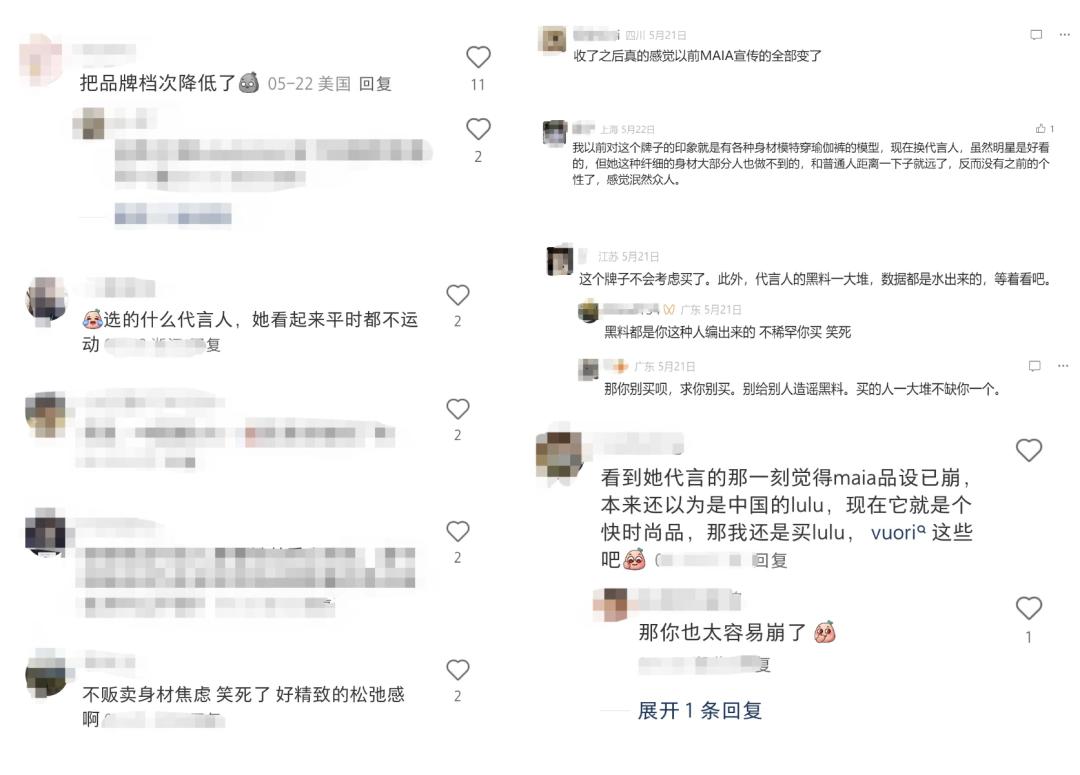
Core Viewpoint - MAIA Active, a women's activewear brand, faces backlash from loyal customers after signing a new celebrity spokesperson, indicating a potential shift in brand identity and consumer perception [2][4][12] Company Overview - Founded in 2016, MAIA Active targets independent, diverse new middle-class women and gained popularity with products like "waist-slimming pants" and "cloud pants" [1][4] - The brand achieved over 100 million in sales within three years and became profitable within six years, boasting a triple-digit annual growth rate and multiple rounds of financing [4][7] Recent Developments - MAIA was acquired by Anta in 2023, leading to the exit of its two founders, which has resulted in a stagnation of brand activities and a lack of new product launches [4][12] - The brand's sales growth has significantly declined, dropping from 60% in 2022 to just 4% in Q1 2023, contrasting sharply with lululemon's 61% growth in the same period [7][11] Market Position and Challenges - MAIA aimed to emulate lululemon but now faces challenges similar to those of its predecessor, as the new consumption wave fades and competition intensifies [5][11] - The brand's initial success was driven by a clear focus on high-quality, affordable yoga apparel for Asian women, but increased competition has led to product homogenization and a struggle to maintain brand identity [11][12] Consumer Sentiment - The decision to hire a celebrity spokesperson has angered long-time fans, who feel it undermines the brand's original message of inclusivity and empowerment [2][4] - The backlash reflects broader consumer trends, where the new middle class is now more price-sensitive and less willing to pay a premium for brand identity [12] Future Outlook - The acquisition by Anta could provide MAIA with resources to revitalize its brand, but the challenge remains to balance the expectations of loyal customers with the need to attract a broader audience [14][15] - The brand's ability to navigate this transition and restore its unique value proposition will be critical for its long-term success [14]

安奈儿易主背后:实控人夫妇合计减持套现超10亿元 股价“先知先觉”
Xin Lang Zheng Quan· 2025-06-10 10:20
Core Viewpoint - Anner's major shareholder and actual controller are changing, with Shenzhen Xinchuangyuan Investment Partnership acquiring significant stakes from the founders, marking a pivotal shift in the company's ownership structure [1][3]. Group 1: Shareholder Changes - On June 9, Anner announced that its controlling shareholder would become Shenzhen Xinchuangyuan Investment Partnership, with Huang Tao as the new actual controller [1]. - Founders Cao Zhang and Wang Jianqing signed a share transfer agreement to sell 4.78% and 8.25% of their shares at a price of 15.21 yuan per share, totaling 422 million yuan [1]. - Following the transfer, Cao Zhang voluntarily relinquished voting rights for the remaining 14.35% of shares, effectively exiting the company's core operations [1]. Group 2: Financial Performance - Anner, once known as the "first children's clothing stock" in A-shares, has faced significant challenges since its IPO in 2017, with revenue plummeting from 1.327 billion yuan in 2019 to 639 million yuan in 2024, resulting in cumulative losses of 505 million yuan over five years [1]. - The number of Anner's stores has halved, indicating a shrinking market presence amid competition from brands like Semir's Balabala and Anta Children's [1]. Group 3: Market Reactions - The stock price of Anner showed a notable increase prior to the announcement of the ownership change, with a cumulative rise of 17.69% from May 28 to May 30, 2024 [3]. - On May 30, the stock reached a closing price of 16.90 yuan per share, reflecting a 10.03% increase and a total market capitalization of 3.6 billion yuan [3]. Group 4: Historical Context - Anner's journey from a small shop in Huaqiangbei to a publicly listed company valued at 3.6 billion yuan illustrates its initial commercial success, but the company has lost its way amid capital market challenges [3].

「日本版安踏」,在中国「杀」疯了
36氪· 2025-06-08 09:16
以下文章来源于书单SHUDAN ,作者书单 书单SHUDAN . 对世界的另一种关注。 短短几年,亚瑟士何以逆袭? 文 | 笔下长青 编辑 | 宋函 来源| 书单SHUDAN(ID:SHUDAN20150423) 封面来源 | 视觉中国 名气不如耐克阿迪,但在地铁通勤、公园晨跑、马拉松比赛却经常人脚一双,有着"日本版安踏"之称的跑鞋之王亚瑟士,近两年在国内似乎越来越火。 亚瑟士的国际化战略,和今天的安踏特别像。亚瑟士2006年进入中国市场,将近20年来不但存在感弱,大部分时间还在亏损。然而这两年亚瑟士营收逆袭, 2024年全球销售额约349亿元人民币,同比增长近19%;其中,大中华区营收达48.23亿元,同比增长近30%,增速已经超过前两大市场欧洲和北美。 短短几年,亚瑟士何以逆袭? 只要发亚瑟士的内容 流量就比平时高 "我只要发亚瑟士的内容,流量就比平时高。"资深球鞋博主阿泰如此说:"上个月发的亚瑟士V16,其实是很老的一款鞋,只因为一个新的配色,就引来很 多人咨询,尽管这个配色实际上已经是去年的配色了。" 他是亲身感受到了亚瑟士近一两年在国内的走红,在他这些年对鞋子的研究中,看到不止一个国产品牌的鞋子在对 ...
品牌老去,市场年轻:蛇吞象的商业密码
Sou Hu Cai Jing· 2025-06-07 12:51
Core Insights - The article discusses a recurring business phenomenon where once-prominent international brands like FILA, Arc'teryx, Volvo, and Wirtgen experience decline in their home markets, leading to low-cost acquisitions by Chinese companies such as Anta, Geely, and China Railway, which then revitalize these brands, resulting in soaring sales and market value [1][2][3] Group 1: Acquisition Stories - Anta acquired FILA's China business for approximately HKD 600 million in 2009, transforming it from a loss-making brand to a profit generator with annual revenue exceeding CNY 20 billion and over 2,000 stores [2] - Geely's acquisition of Volvo for USD 1.8 billion in 2010 led to a tenfold increase in its market value, with sales rising from 450,000 to 700,000 vehicles, significantly driven by the Chinese market [2] - China Railway's low-cost acquisition of Wirtgen's technology allowed it to become a global leader in the shield tunneling machine market, showcasing a shift from a technology follower to a leader [2][3] Group 2: Decline of International Brands - International brands like Volvo, FILA, Arc'teryx, and Wirtgen face structural decline due to reduced demand in the aging and conservative European and American markets, leading to a loss of growth potential [3][5] - The financial crisis of 2008 severely impacted Volvo's sales, while FILA struggled with limited channels and a shrinking consumer base in Europe [3][5] Group 3: Revitalization in China - The Chinese market is characterized as a unique "amplifier" for international brands, with a large and expanding middle class driving demand for quality and brand [5][6] - China's superior channel capabilities and retail networks, along with the rise of e-commerce platforms, enable brands to reach broader consumer bases [5][6] - The complete industrial chain and cost efficiency in China facilitate the rebirth of these brands, allowing for significant reductions in production costs and increased profit margins [5][6] Group 4: Growth Mechanism - The success of these acquisitions is attributed to the ability of Chinese companies to effectively reposition and operate the acquired brands, transforming them to meet new market demands [7][8] - The growth strategy involves redefining brand positioning, expanding product lines, and leveraging China's manufacturing advantages to reduce costs [8][9] - Chinese companies excel in utilizing modern marketing strategies, such as social media and live streaming, to enhance brand visibility and consumer engagement [9] Group 5: Future Trends - The article predicts that the trend of "snake swallowing elephant" acquisitions will continue, driven by the structural shifts in global economic power and the rebalancing of brand value chains [10][11] - The future will see Chinese companies acting as accelerators for global brand growth, moving beyond mere acquisitions to comprehensive brand revitalization [12][13]

福建县城,诞生了多少「中式豪门」?
36氪· 2025-06-04 12:09
Core Viewpoint - The article explores the phenomenon of "霸总" (tycoons) in Jinjiang, highlighting the region's unique economic landscape and the intertwining of family ties and business ventures, suggesting that the essence of Jinjiang's narrative resembles that of a documentary rather than fiction [10][11]. Group 1: Economic Landscape of Jinjiang - Jinjiang is home to over a thousand enterprises with a valuation exceeding 1 billion, producing a total wealth of 750 billion RMB [6]. - The region boasts an impressive statistic where, on average, 1 in 7 people is a business owner, and 1 in 21 owns a company [12][13]. - In 2022, over half of the individuals from Jinjiang entered the Hurun Rich List, showcasing the concentration of wealth in the area [14]. Group 2: Industry and Production - Jinjiang is recognized as a major hub for sportswear, with brands like Anta, Xtep, and Peak originating from the region, producing 1 in 5 pairs of sports shoes globally [15][16]. - The umbrella industry in Jinjiang includes a diverse range of products, with the umbrella industry alone generating a total output value of nearly 13 billion RMB in 2022 [26]. - Jinjiang has developed multiple industrial clusters, including a shoe and clothing cluster worth over 200 billion RMB and several others exceeding 100 billion RMB [31]. Group 3: Family Ties and Business Collaborations - The article discusses the phenomenon of family marriages among the wealthy in Jinjiang, which often serve as strategic business alliances [38][63]. - Notable recent marriages, such as that of the second daughter of Xtep and the second son of Seven Wolves, highlight the financial magnitude of these unions, with reported dowries reaching 1.8 billion RMB [44]. - The interconnectedness of families through marriage creates a network of collaboration among businesses, enhancing their market power and operational efficiency [76][78]. Group 4: Cultural and Historical Context - The entrepreneurial spirit in Jinjiang is rooted in the personal histories of its tycoons, many of whom come from humble beginnings and have built their fortunes through hard work and innovation [85][88]. - The local economy is characterized by a "one village, one product" model, where communities specialize in specific industries, fostering a collaborative environment [89][90]. - The article emphasizes that the success of Jinjiang's businesses is not just about wealth but also about a culture of cooperation and mutual support among local entrepreneurs [110].

一笔漂亮的退出:93亿卖始祖鸟股份
36氪· 2025-06-04 09:00
Core Viewpoint - The article discusses the significant share reduction by FountainVest, a major shareholder of Amer Sports, which is seeking to sell half of its stake for approximately $1.3 billion, highlighting the company's growth and investment opportunities in the sports goods sector [4][20]. Group 1: Company Background - Amer Sports, known as the "Rolls-Royce of sports goods," owns high-end brands such as Arc'teryx and Salomon, and has gained popularity in China, being referred to as a new social currency among the middle class [4]. - The company was originally founded in 1950 as a tobacco company and transitioned to the sports goods industry in 1974 after acquiring a hockey equipment brand [7][9]. - Amer Sports has expanded through a series of acquisitions, now owning 13 brands across various sports, focusing on mid to high-end markets [10][12]. Group 2: Financial Performance - In 2024, Amer Sports reported total revenue of $5.183 billion, with Arc'teryx generating over $2 billion, making it a key asset for the company [13]. - Following a major acquisition in 2018, Amer Sports underwent significant restructuring, leading to a compound annual growth rate of 20.4% from 2020 to 2022 [13]. - The company went public in 2024, achieving a market capitalization of $6.492 billion, and has seen its stock price increase significantly since its IPO [13][19]. Group 3: Shareholder Actions - FountainVest's decision to sell half of its stake comes after a substantial increase in Amer Sports' market value, allowing the firm to realize significant profits from its initial investment [20]. - After the sale, FountainVest will still hold 6.2% of Amer Sports, valued at approximately $1.267 billion [21]. - The recent surge in consumer interest in outdoor sports has positively impacted Amer Sports' performance, leading to a notable increase in both revenue and stock price [17][18].
福建县城,诞生多少豪门
投资界· 2025-06-04 08:34
Core Viewpoint - The article explores the phenomenon of "霸总" (tycoons) in Fujian's Jinjiang, highlighting the region's unique economic landscape, family business dynamics, and the intertwining of wealth and social relationships through marriage alliances [3][4][10]. Group 1: Economic Landscape - Jinjiang has over a thousand enterprises with a valuation exceeding one billion, producing a total wealth of 750 billion RMB [3][5]. - The region is known for its dominance in the sportswear industry, with brands like Anta, Xtep, and 361° being major players, producing one in every five pairs of sports shoes globally [6][10]. - Jinjiang's GDP ranks third among China's top 100 counties, with a total market value of nearly 4 trillion RMB and a significant number of listed companies [11][12]. Group 2: Family Business Dynamics - The business landscape in Jinjiang is characterized by family-run enterprises, with a strong emphasis on local connections and family ties [3][4]. - The article notes that over half of the entrepreneurs in the 2022 Hurun Rich List from Quanzhou are from Jinjiang, indicating a concentration of wealth and influence [5]. - The region's businesses often collaborate through family alliances, leading to a network of interrelated companies that support each other [25][24]. Group 3: Marriage Alliances - Marriages among the wealthy families in Jinjiang are strategic, often involving significant financial transactions, such as a reported 1.8 billion RMB in wedding gifts [15][16]. - The article describes how these alliances are not just personal but also serve to strengthen business ties and create synergies among companies [20][24]. - The social dynamics of these marriages often reflect a preference for partners within the same socioeconomic background, emphasizing the importance of local language and culture [20][22]. Group 4: Historical Context - Many of Jinjiang's tycoons are self-made, having risen from humble beginnings, which reflects the entrepreneurial spirit of the region [27][28]. - The development of Jinjiang's economy is attributed to a model of specialization, where different towns focus on specific industries, enhancing efficiency and reducing costs [28][29]. - The article highlights the role of overseas Chinese communities in supporting local businesses, contributing to the wealth accumulation in Jinjiang [31].

福建县城,诞生了多少「中式豪门」?
首席商业评论· 2025-06-04 03:36
Core Viewpoint - The article explores the phenomenon of wealth and business success in Jinjiang, Fujian, highlighting its unique characteristics and the prevalence of family-run enterprises and "bosses" in the region. Group 1: Wealth and Business Landscape - Jinjiang has over a thousand enterprises with a valuation exceeding 100 million, producing 26 super-rich individuals with a total wealth of 750 billion yuan [5] - The region is known for its significant contribution to the sportswear industry, with one in every five pairs of sports shoes globally produced in Jinjiang [12] - Jinjiang is home to numerous well-known brands such as Anta, Xtep, and Peak, which dominate the sportswear market [13][14] - In 2022, over half of the new entrants in the Hurun Rich List from Quanzhou were from Jinjiang [11] Group 2: Family and Business Connections - The business community in Jinjiang often relies on family connections for collaboration, with many enterprises being family-run [7] - Marriages among the wealthy families in Jinjiang are strategic, often involving significant dowries and business partnerships [30][34] - The article describes a high-profile wedding where the bride's dowry was rumored to be 1.8 billion yuan, showcasing the intertwining of wealth and family ties [34] Group 3: Economic Growth and Development - Jinjiang's GDP is projected to reach 350 billion yuan in 2024, ranking third among China's top 100 counties [27][28] - The region has developed specialized industrial clusters, including a shoe and clothing industry worth over 200 billion yuan [25] - Jinjiang's economic model emphasizes "one village, one product" and "one town, one industry," fostering a collaborative business environment [75][76] Group 4: Cultural and Social Dynamics - The article contrasts the romanticized portrayals of wealth in Jinjiang literature with the practical realities of business operations in the region [68][89] - Jinjiang's business leaders often come from humble beginnings, emphasizing hard work and community support in their success stories [71][72] - The social fabric of Jinjiang is characterized by strong community ties, with local businesses often collaborating and supporting each other [93][94]



始祖鸟母公司,被资本悄悄抛弃了?
阿尔法工场研究院· 2025-06-03 16:19
Core Viewpoint - FountainVest's decision to sell half of its stake in Amer Sports for approximately $1.3 billion (around 935 million RMB) highlights the lucrative returns from investments in the consumer sector, particularly in high-end sports brands like Arc'teryx and Salomon, which have gained popularity among middle-class consumers [1][3]. Group 1: Investment and Financial Performance - FountainVest acquired a stake in Amer Sports in 2018 for about 77 billion RMB, and the recent sale allows them to recover their investment and achieve significant profits [3][10]. - Amer Sports reported a revenue of $5.183 billion in 2024, with Arc'teryx contributing over $2 billion, marking it as a key asset for the company [7][8]. - The company experienced a compound annual growth rate of 20.4% from 2020 to 2022, indicating strong recovery and growth post-pandemic [8]. Group 2: Company History and Transformation - Amer Sports, originally founded as a tobacco company in 1950, transitioned to the sports goods industry through a series of acquisitions, including brands like Wilson and Atomic [5][6]. - The major turning point for Amer Sports occurred in 2018 when it was acquired by a consortium led by Anta Sports for €4.6 billion (approximately 360 billion RMB), marking the largest outbound acquisition by Chinese capital that year [7][8]. Group 3: Market Trends and Future Prospects - The recent surge in outdoor and leisure sports has significantly boosted Amer Sports' market position, with the brand Arc'teryx becoming a sought-after item in the outdoor sports market [8][10]. - Following a successful IPO in 2024, Amer Sports' market capitalization reached $6.492 billion (approximately 46.6 billion RMB), and its stock price has seen substantial growth since its listing [8][9]. - The consumer investment landscape is becoming increasingly competitive, with private equity firms like FountainVest actively seeking new opportunities in the sector, supported by the capital raised from their recent stake sale [11][12].

一笔漂亮的退出:93亿卖始祖鸟股份
华尔街见闻· 2025-06-02 11:33
Core Viewpoint - The article discusses the significant share reduction by FountainVest, a major shareholder of Amer Sports, which is seeking to sell half of its stake for approximately $1.3 billion, highlighting the company's growth and market position in the sports goods industry [3][12]. Group 1: Company Background - Amer Sports, known as the "Rolls-Royce of sports goods," owns high-end brands such as Arc'teryx, Salomon, Wilson, and Atomic, and has gained popularity in China alongside Lululemon as a new social currency [3]. - The company was originally founded in 1950 as a tobacco company and transitioned to the sports goods industry after acquiring a hockey equipment brand in 1974 [4][5]. - Amer Sports has expanded its brand portfolio through numerous acquisitions, including Wilson and Atomic, and fully shifted its focus to sports goods by divesting its tobacco business in 2004 [5][6]. Group 2: Financial Performance - In 2024, Amer Sports reported total revenue of $5.183 billion, with Arc'teryx alone generating over $2 billion, making it a key asset for the company [7]. - Following a major acquisition in 2018, Amer Sports underwent significant restructuring, focusing on core brands and achieving a compound annual growth rate of 20.4% from 2020 to 2022 [7][10]. - The company went public in 2024 with an initial share price of $13, reaching a market capitalization of $6.492 billion, and has since seen its stock price increase significantly [7][10]. Group 3: Shareholder Actions - FountainVest's decision to sell half of its stake comes after a period of substantial growth for Amer Sports, with the firm realizing a return on investment that exceeds its initial purchase price [12][13]. - The sale allows FountainVest to recover its investment cost while also providing liquidity for future investments in the consumer sector, as the market for consumer goods has seen renewed interest [15][17]. - Following the sale, FountainVest retains a 6.2% stake in Amer Sports, valued at approximately $1.267 billion [13].