
盐津铺子

Search documents
可选消费W45周度趋势解析:海内外消费子版块均无共振,内部因素催化股价表现-20251111
Haitong Securities International· 2025-11-11 15:11
Investment Rating - The report assigns an "Outperform" rating to multiple companies including Nike, Midea Group, JD Group, Haier Smart Home, Gree Electric, Anta Sports, China Duty Free, and others [1]. Core Insights - The report highlights that domestic and overseas consumer subsectors are not showing synchronized movements, with internal factors driving stock performance [4][10]. - The performance of various sectors is analyzed, indicating that the U.S. hotel sector has outperformed others, while luxury goods and overseas cosmetics have seen significant declines [10][13]. Sector Performance Summary - **U.S. Hotels**: The sector saw a weekly increase of 7.9%, driven by strong performance from Marriott and Hilton, with Marriott's RevPAR growth meeting market expectations [5][13]. - **Pet Sector**: Increased by 1.1%, with leading brands showing significant growth in GMV despite overall sales being weak [5][13]. - **Gambling Sector**: Rose by 0.7%, with Macau's GGR exceeding expectations, indicating strong future performance [5][13]. - **Retail Sector**: Experienced a slight decline of 0.3%, with China Duty Free benefiting from new tax policies [7][13]. - **Snack Sector**: Fell by 1.9%, with competitive pressures affecting performance [7][13]. - **Gold and Jewelry Sector**: Decreased by 2.5% due to tax reforms impacting profitability [7][13]. - **Overseas Sportswear**: Dropped by 2.8%, facing tariff pressures and concerns over U.S. consumer spending [7][13]. - **Luxury Goods**: Declined by 3.0%, with concerns over upcoming earnings reports affecting stock prices [7][13]. - **Domestic Cosmetics**: Fell by 3.4%, with overall performance weaker than international brands [7][13]. - **Overseas Cosmetics**: Experienced a significant drop of 11.6%, primarily due to ELF Beauty's disappointing earnings [7][13]. Valuation Analysis - Most sectors are valued below their average over the past five years, with specific PE ratios indicating potential undervaluation [8][14]. - **Overseas Sportswear**: Expected PE of 28.6, 54% of the past five-year average [14]. - **Domestic Sportswear**: Expected PE of 14.1, 74% of the past five-year average [14]. - **Gold and Jewelry**: Expected PE of 22.1, 42% of the past five-year average [14]. - **Luxury Goods**: Expected PE of 25.6, 46% of the past five-year average [14]. - **Gambling**: Expected PE of 29.1, 47% of the past five-year average [14]. - **Overseas Cosmetics**: Expected PE of 35.5, 53% of the past five-year average [14]. - **Domestic Cosmetics**: Expected PE of 27.9, 52% of the past five-year average [14]. - **Pet Sector**: Expected PE of 40.3, 55% of the past five-year average [14]. - **Snack Sector**: Expected PE of 26.8, 65% of the past five-year average [14]. - **Retail Sector**: Expected PE of 28.6, 53% of the past five-year average [14]. - **U.S. Hotels**: Expected PE of 31.4, 19% of the past five-year average [14]. - **Credit Card Sector**: Expected PE of 28.9, 55% of the past five-year average [14].
休闲食品行业专题报告之一:大浪淘沙,沉者为金
Guoxin Securities· 2025-11-11 11:18
Investment Rating - The report maintains an "Outperform" rating for the leisure food industry and specific companies such as Wei Long Mei Wei, Yan Jin Pu Zi, Jin Zai Food, and Wan Chen Group [4][5]. Core Insights - The leisure food market in China is projected to reach 1.344 trillion yuan in 2024, with a year-on-year growth of 5.3% and a CAGR of 4.4% from 2019 to 2024, expected to increase to 5.5% from 2025 to 2029 [1][15]. - The industry is characterized by a highly fragmented competitive landscape, with the top five and ten companies holding only 5.9% and 10.4% of the market share, respectively [1][22]. - Structural changes are reshaping the industry, including the rise of new retail channels, increased health consciousness among consumers, vertical integration in supply chains, and accelerated globalization efforts by leading companies [1][2][33]. Summary by Sections Industry Overview - The leisure food sector is a multi-billion market with diverse product categories, including snacks, nuts, and baked goods, focusing on fulfilling various consumer needs beyond mere hunger [15][18]. - The market is expected to continue expanding, with significant room for growth in per capita consumption, currently at 954.4 yuan, which is substantially lower than in the US and Japan [2][15]. Competitive Landscape - The industry is marked by intense competition and low concentration, with major players like Mars and Mondelez holding a small market share compared to their counterparts in the US [22][23]. - The competitive dynamics are shifting from price wars to differentiation and efficiency battles, as consumer demands become more diverse and nuanced [2][3]. Structural Changes - New retail formats such as bulk snack stores and instant retail are emerging, challenging traditional retail channels [33][34]. - Health awareness is driving innovation in product offerings, with a notable rise in demand for healthier snack options like konjac products, which are low in calories and high in dietary fiber [66][70]. Future Outlook - The report identifies three core drivers for industry growth: product innovation, scenario extension, and international expansion [2][3]. - Leading brands are expected to strengthen their market positions, with opportunities for both manufacturing and channel-focused companies to benefit from evolving consumer preferences and retail dynamics [2][3][4]. Company-Specific Insights - Wei Long Mei Wei and Yan Jin Pu Zi are highlighted as key players in the konjac snack segment, with significant revenue growth anticipated [3][70]. - Jin Zai Food is undergoing channel reforms and launching new products, while Wan Chen Group is expanding its discount supermarket presence, indicating potential for long-term growth [3][4].
食品饮料行业第三季报总结报告:酒类渠道包袱加速去化,大众品类表现分化
Guoxin Securities· 2025-11-11 11:13
Core Insights - The leading companies in the mass-market segment are stabilizing, while the liquor industry is experiencing accelerated pressure release, reinforcing market share logic [4][19][39] - The food and beverage sector is expected to show stable overall growth with structural differentiation by 2025, with Q1/Q2/Q3 revenues growing by +2.5%/+2.4%/-4.77% year-on-year, and net profits declining by +0.3%/-2.1%/-14.6% [4][12] - The liquor sector is entering a phase of adjustment, with a consensus on deceleration in 2024, as many companies are adjusting their strategies amid increasing channel pressures [4][19][39] Liquor Sector - In Q3 2025, the liquor sector's revenue and net profit declines have widened, with total revenue of 3,202 billion yuan, down 5.8% year-on-year, and net profit of 1,126 billion yuan, down 6.9% year-on-year [19][35] - Major liquor companies are experiencing significant revenue drops, with only a few, such as Moutai and Fenjiu, showing positive growth [20][21] - The sector is facing increased competition, leading companies to prioritize market share over profitability, resulting in a decrease in gross profit margins [33][39] Mass-Market Segment - The mass-market segment is benefiting from proactive inventory reduction and macroeconomic policy support, leading to improved operations for leading companies in 2025 [4][12] - Specific categories such as sugar-free tea, functional beverages, and snacks are showing high growth rates, with companies like Nongfu Spring and Dongpeng leading the charge [4][12] - The snack segment reported a revenue increase of 22.4% year-on-year in Q3 2025, despite rising costs in certain product categories [4][12] Investment Recommendations - The report suggests focusing on liquor and restaurant supply chains, particularly companies like Moutai, Luzhou Laojiao, and Fenjiu, which are expected to benefit from policy sensitivity [4][12] - Stronger companies in the mass-market segment, such as Nongfu Spring and Yanjing Beer, are recommended for investment due to their robust performance [4][12] Financial Performance - The liquor sector's cash flow is under pressure, with many companies reporting negative operating cash flows, indicating a slowdown in business activity [40] - The overall net profit margin for the liquor sector has decreased, with only Moutai showing an improvement in gross profit margin due to better product mix [39][40]




食品饮料行业第三季报总结报告:酒类渠道包袱加速去化,大众品品类表现分化
Guoxin Securities· 2025-11-11 09:48
Core Insights - The leading companies in the mass-market segment are stabilizing, while the liquor industry is experiencing accelerated pressure release, reinforcing market share logic [4][10][19] - The food and beverage industry is expected to show stable overall volume with structural differentiation by 2025, with Q1/Q2/Q3 revenues growing by +2.5%/+2.4%/-4.77% year-on-year, and net profits declining by +0.3%/-2.1%/-14.6% [4][12] - The liquor sector is entering an adjustment phase, with a consensus on deceleration in 2024, as most companies face declining performance in Q3 [4][19][39] Liquor Sector - In Q3 2025, the liquor sector's revenue and net profit declines are widening, with total revenue of 3,202 billion yuan, down 5.8% year-on-year, and net profit of 1,126 billion yuan, down 6.9% year-on-year [19][35] - The Q3 revenue for the liquor sector dropped to 787.2 billion yuan, a year-on-year decline of 18.4%, with net profit at 280.1 billion yuan, down 22.2% [19][39] - Major liquor companies are experiencing cash flow pressures, with a significant drop in sales receipts, indicating a slowdown in operational pace [40] Mass-Market Segment - The mass-market segment is benefiting from proactive inventory reduction and macro policy support, leading to improved operations for leading companies in 2025 [4][12] - Specific high-demand categories such as sugar-free tea, functional beverages, and bulk snacks are showing strong growth, with leading companies like Nongfu Spring and Dongpeng Beverage achieving significant revenue increases [4][12] - The snack sector reported a Q3 revenue growth of 22.4% year-on-year, despite rising costs from raw materials [4][12] Investment Recommendations - The report suggests focusing on liquor and restaurant supply chains, particularly companies like Kweichow Moutai, Luzhou Laojiao, and Shanxi Fenjiu, which are expected to benefit from policy sensitivity [4][12] - Stronger companies in the mass-market segment, such as Nongfu Spring and Yanjing Beer, are also recommended for investment due to their robust performance [4][12] Financial Performance - The Q3 2025 financial performance of major liquor companies shows a significant decline in net profit margins, with only Kweichow Moutai recording a slight improvement in net profit margin due to better gross margin management [35][39] - The overall gross margin for the liquor sector has decreased, reflecting intensified competition and a shift in product mix towards lower-priced offerings [31][33]

良品铺子陷“渠道萎缩+价格下降”负循环控制权转让终止后如何自救?
Xin Lang Ke Ji· 2025-11-11 09:11
Core Viewpoint - The financial performance of Liangpinpuzi has significantly deteriorated, with a revenue decline of 24.45% year-on-year and a loss of approximately 122 million yuan in the first three quarters of 2025, marking a stark contrast to a profit of 19.39 million yuan in the same period last year [1][3]. Financial Performance - In the first three quarters of 2025, Liangpinpuzi achieved revenue of approximately 4.14 billion yuan, down 24.45% year-on-year, and incurred a loss of about 122 million yuan compared to a profit of 19.39 million yuan in the previous year [1]. - The company's gross margin has decreased from nearly 29% in Q3 2023 to 24.96% in Q3 2025, indicating a continuous decline [3][4]. - The sales expense ratio reached 24.27%, contributing to a total expense ratio of 28.71% [3]. Market Position and Strategy - Liangpinpuzi, positioned as a "high-end snack" brand, has seen its growth engines of "premiumization" and "channel expansion" stall amid weak terminal demand and intense competition in the snack market [3]. - The company has initiated large-scale price reductions and closed franchise stores starting November 2023, which has led to further sales shrinkage and declining gross margins [3][4]. Channel Dynamics - The traditional e-commerce channel has become saturated, with e-commerce revenue declining nearly 40% compared to 2021 [4]. - As of mid-2023, the company closed 259 stores, reducing its total to 2,445 [4]. Shareholder Actions and Control Issues - Following a significant drop in stock price, major institutional investors have begun to reduce their holdings, with notable exits from the top shareholder list [5]. - The controlling shareholder, Ningbo Hanyi, has been reducing its stake and facing high pledge risks, with 35.23% of shares pledged as of August 2023 [5][6]. - A planned transfer of control to Guangzhou Light Industry Group was halted due to unresolved conditions, adding uncertainty to the company's governance [6]. Competitive Landscape - Liangpinpuzi's performance contrasts sharply with competitors such as Yanjinpuzi, Laiyifen, and Three Squirrels, which have recorded positive revenue growth in the same period [6].

休闲食品板块11月11日涨0.93%,黑芝麻领涨,主力资金净流入3460.97万元
Zheng Xing Xing Ye Ri Bao· 2025-11-11 08:37
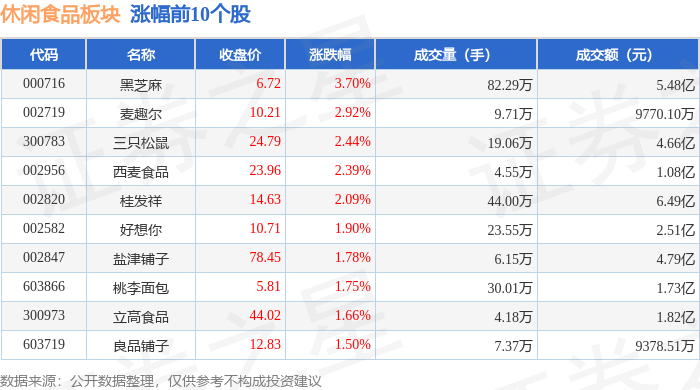
Market Overview - The leisure food sector increased by 0.93% on November 11, with Hei Zhima leading the gains [1] - The Shanghai Composite Index closed at 4002.76, down 0.39%, while the Shenzhen Component Index closed at 13289.0, down 1.03% [1] Stock Performance - Hei Zhima (000716) closed at 6.72, up 3.70% with a trading volume of 822,900 shares and a transaction value of 548 million [1] - Other notable performers include: - Mai Jiao Er (002719) at 10.21, up 2.92% [1] - San Zhi Song Shu (300783) at 24.79, up 2.44% [1] - Xi Mai Food (002956) at 23.96, up 2.39% [1] - Gui You Xiang (002820) at 14.63, up 2.09% [1] Capital Flow - The leisure food sector saw a net inflow of 34.61 million from main funds, while retail funds experienced a net outflow of 25.13 million [2] - The main funds' net inflow for Hei Zhima was 39.29 million, representing 7.17% of its total trading volume [3] - San Zhi Song Shu had a main fund net inflow of 30.52 million, accounting for 6.55% of its trading volume [3] Individual Stock Analysis - Hei Zhima experienced a significant net outflow from retail investors of 42.06 million, indicating a divergence in investor sentiment [3] - San Zhi Song Shu also faced a retail net outflow of 26.17 million, suggesting potential concerns among smaller investors [3] - Other stocks like Yan Jin Pu Zi (002847) and Xi Mai Food (002956) showed mixed capital flows, with Yan Jin Pu Zi having a net inflow from main funds of 13.91 million [3]


良品铺子陷“渠道萎缩+价格下降”负循环 控制权转让终止后如何自救?
Xin Lang Cai Jing· 2025-11-11 08:17
Core Viewpoint - The company, Liangpinpuzi, reported a significant decline in revenue and net profit for the first three quarters of 2025, indicating a continuous downward trend in performance and raising concerns about its financial stability [1][2]. Financial Performance - For the first three quarters of 2025, Liangpinpuzi achieved revenue of approximately 4.14 billion yuan, a year-on-year decrease of 24.45%, and incurred a loss of about 122 million yuan, compared to a profit of 19.39 million yuan in the same period last year [1][2]. - The company's gross margin fell from nearly 29% in Q3 2023 to 24.96% in Q3 2025, while the sales expense ratio reached 24.27%, leading to a total expense ratio of 28.71% [2][3]. - Inventory and accounts receivable did not decrease in tandem with the declining revenue, with accounts receivable increasing by 6% to 281 million yuan, and inventory remaining stable at 394 million yuan [4]. Market Position and Strategy - Liangpinpuzi has positioned itself as a "high-end snack" brand since 2018, but has faced challenges due to weak terminal demand and intense competition in the snack market, leading to a halt in its growth engines of "premiumization" and "channel expansion" [2][3]. - The company has initiated large-scale price reductions and the closure of franchise stores starting November 2023, which has directly contributed to sales shrinkage and further decline in gross margin [2][3]. Ownership and Control Issues - Following a significant drop in stock price, major investors have begun to reduce their holdings, with the total market value of Liangpinpuzi falling from over 30 billion yuan at its peak to around 5 billion yuan currently [5][6]. - The planned transfer of control from the current major shareholder, Ningbo Hanyi, to Guangzhou Light Industry Group was terminated due to unmet conditions, adding uncertainty to the company's governance [7]. - The current major shareholder has a high percentage of pledged shares, raising concerns about potential risks associated with shareholding stability [6][7].
从北斗应用到零碳园区:解码湖南金融赋能新质生产力的实践样本
Zhong Guo Jin Rong Xin Xi Wang· 2025-11-11 03:21
Group 1: Financial Empowerment in Technological Innovation - Hunan's financial system is increasingly acting as a "strategic partner" in supporting technological innovation and industrial upgrades through a service ecosystem tailored to these needs [1][2] - Agricultural Bank of China in Zhuzhou completed a credit approval of 1.97 billion yuan in just 20 days during the initial phase of the Beidou Industrial Park, marking a historical high for the bank [2] - China Railway Construction Heavy Industry Group received 3.88 billion yuan in loans from the National Development Bank to tackle key technologies in high-end tunnel boring machines (TBM), maintaining a leading market share in China [5] Group 2: Innovations in Transportation and Energy - The North Cloud Bus developed by CRRC Times Electric Co., Ltd. utilizes the Beidou system for real-time positioning and intelligent scheduling, showcasing significant technological advantages [4] - Hunan's financial institutions are supporting projects like the Dazeh Lake low-carbon demonstration park, which aims to create a clean energy system through geothermal energy [7][9] - Hunan Junxin Environmental Protection Co., Ltd. has built a leading environmental park with support from China Merchants Bank, processing nearly 10,000 tons of waste daily and achieving significant carbon reduction [10] Group 3: Support for Traditional Industries and Sustainable Development - The Chang-Zhu-Tan logistics hub project is a key national initiative aimed at transforming traditional logistics into a smart and low-carbon model, with a credit line of 1.45 billion yuan from the Bank of Communications [11] - Long-term partnerships between banks and companies, such as the 20-year collaboration between Changsha Bank and Salted Snack Manufacturer, illustrate the role of financial support in transitioning from traditional to smart manufacturing [13] - Hunan Liyu Environmental Energy Co., Ltd. has received 576 million yuan in loans since 2019, enabling it to provide approximately 11.9 billion kWh of green electricity annually and expand into international markets [10]

吃喝板块暴力拉升,主力狂买超百亿元!食品ETF(515710)大涨3.64%,估值低位布局正当时?
Xin Lang Ji Jin· 2025-11-10 12:09
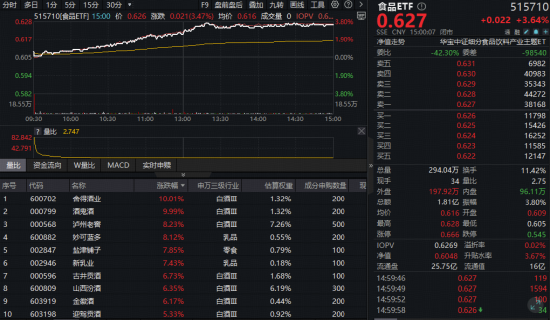
Group 1: Market Performance - The food and beverage sector has shown strong performance, leading the market with a 3.64% increase in the food ETF (515710) as of the close on November 10 [1][3] - Major liquor stocks experienced significant gains, with Shede Liquor and Jiu Gui Liquor hitting the daily limit, and Luzhou Laojiao rising by 8.23% [1][3] Group 2: Capital Inflow - The food and beverage sector attracted over 10 billion CNY in net inflows from main funds in a single day, ranking first among 30 sectors [3][4] - The food ETF (515710) has seen a net inflow of over 1.2 billion CNY in the last five trading days and more than 2.4 billion CNY in the last ten trading days [4][5] Group 3: Valuation and Investment Opportunities - The valuation of the food and beverage sector is currently at a historical low, with the food ETF's underlying index PE ratio at 20.59, indicating a good entry point for long-term investments [6][7] - Analysts suggest that the food and beverage industry is gradually bottoming out, with opportunities to invest in liquor stocks at low prices [7][8]


食品饮料周报(25年第41周):如何看待2026年投资机会?-20251110
Guoxin Securities· 2025-11-10 09:40
Investment Rating - The report maintains an "Outperform the Market" rating for the food and beverage sector [4][5][15]. Core Views - The food and beverage sector is expected to perform well in 2026, driven by low valuations, low institutional holdings, and a low base effect. The sector has underperformed the CSI 300 index for three consecutive years, and any changes in supply and demand dynamics could catalyze stock price increases [15][17]. - The report identifies three key judgments for 2026: 1) The sector's dividend attributes are becoming evident, with room for valuation expansion; 2) C-end consumption remains the industry’s foundation, but B-end and business scenarios may recover faster; 3) Health-focused innovative products and digital supply chains will be core growth drivers [15][16]. Summary by Sections 1. Sector Overview - The food and beverage sector saw a slight decline of 0.38% this week, with A-shares down 0.54% and H-shares up 1.88%. The top gainers included Anji Food (+13.87%) and Huifa Food (+13.07%) [1][3]. 2. Sub-sector Analysis - **Alcohol**: The sector is in a left-side layout phase, with recommendations for companies like Luzhou Laojiao and Shanxi Fenjiu, which are expected to benefit from national expansion [2][10]. - **Beverages**: The beverage sector is experiencing continued growth, with strong performance from leading companies like Nongfu Spring and Dongpeng Beverage. The report recommends focusing on dairy products, particularly Yili, due to stable demand recovery [2][14]. - **Food**: The snack segment shows strong growth potential, particularly in konjac snacks, with leading companies like Weidong and Yanjin Puhui demonstrating competitive advantages [2][12]. 3. Investment Recommendations - The report recommends maintaining the investment portfolio, which includes Guizhou Moutai, Baba Food, Dongpeng Beverage, Weidong, and Luzhou Laojiao, as these companies are expected to outperform the market [3][18]. 4. Earnings Forecasts - Guizhou Moutai is projected to have a revenue of CNY 183.52 billion in 2025, with a net profit of CNY 90.59 billion, reflecting a growth of 5.4% year-on-year [19][20]. - Luzhou Laojiao is expected to see revenue growth of 3.1% in 2026, with a net profit forecasted to increase by 4.3% [20]. 5. Market Trends and Catalysts - Recent industry catalysts include the Central Economic Work Conference and various alcohol distributor conferences, which are expected to influence market dynamics positively [3][10].
