锦江酒店

Search documents
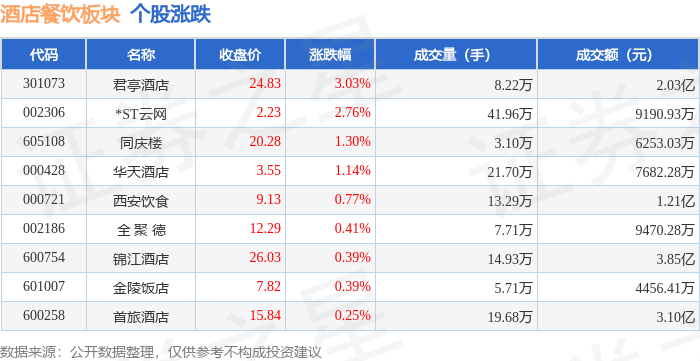
酒店餐饮板块11月17日涨0.72%,君亭酒店领涨,主力资金净流出2527.52万元
Zheng Xing Xing Ye Ri Bao· 2025-11-17 08:49
Market Overview - The hotel and catering sector increased by 0.72% on November 17, with Junting Hotel leading the gains [1] - The Shanghai Composite Index closed at 3972.03, down 0.46%, while the Shenzhen Component Index closed at 13202.0, down 0.11% [1] Stock Performance - Junting Hotel (301073) closed at 24.83, up 3.03% with a trading volume of 82,200 lots and a transaction value of 203 million [1] - Other notable performers included *ST Yunwang (002306) with a 2.76% increase, and Tongqinglou (605108) with a 1.30% increase [1] - The overall trading data for the hotel and catering sector is summarized in a table, highlighting various stocks' closing prices, percentage changes, trading volumes, and transaction values [1] Capital Flow - The hotel and catering sector experienced a net outflow of 25.28 million from institutional investors and 14.91 million from retail investors, while individual investors saw a net inflow of 40.19 million [1] - Detailed capital flow data for individual stocks indicates varying levels of net inflow and outflow among different companies, with Junting Hotel showing a net inflow of 8.03 million from institutional investors [2] - Notably, Qianjude (002186) had a significant net outflow of 9.79 million from institutional investors, while Shoulu Hotel (600258) saw a net inflow of 22.35 million from retail investors [2]



AI CRM迎来中国首标:中国信通院牵头制定行业新基准
Sou Hu Cai Jing· 2025-11-17 08:14
Core Insights - The article discusses the transformation of Customer Relationship Management (CRM) into an AI-driven system, emphasizing its role as a central nervous system for enterprises in the digital age [2][5] - SalesEase, a leader in the industry, has collaborated with the China Academy of Information and Communications Technology (CAICT) to establish the first AI CRM research report and selection standard framework in China, marking a significant milestone in the digital transformation of enterprises [5][10] Industry Overview - The evolution of CRM over the past two decades reflects the broader digitalization journey of enterprises, transitioning from a "record system" to a "process system," and now to an "intelligent partner" powered by AI [5][6] - Traditional CRM focuses on efficiency, while AI CRM emphasizes growth through dynamic customer profiling, predictive modeling, and automated task execution [5][6] AI CRM Characteristics - AI CRM differs from traditional CRM in several dimensions, including a shift from process-driven to insight-driven paradigms, and from static data to integrated, dynamic data [6] - The article outlines the "pain point triangle" for AI CRM selection, highlighting the need for standards to define AI CRM, assess its intelligence level, and guide product selection [7] SalesEase's Role - SalesEase has been recognized as a standard setter in the CRM industry, having established a comprehensive AI CRM evaluation model in collaboration with CAICT, which includes a multi-dimensional assessment framework [10][13] - The company has a long-standing commitment to AI, having built a native AI platform that integrates seamlessly with enterprise data and processes, ensuring data security and compliance [8][9] Technological Integration - The integration of AI capabilities within SalesEase's CRM system is based on a PaaS architecture, allowing for continuous learning and evolution of the AI system [11][12] - The collaboration with Tencent enhances SalesEase's AI CRM capabilities, providing advanced model training, knowledge enhancement, and security features [11][12] Market Impact - SalesEase's AI CRM has been successfully implemented in various leading enterprises, demonstrating its effectiveness in transforming AI from a concept into a tangible productivity tool [10][13] - The establishment of standards by CAICT and SalesEase is seen as a guiding signal for the future of enterprise-level AI in China, positioning the country as a reference point in the global intelligent CRM landscape [13]

可选消费W46周度趋势解析:A/H高股息和中高端消费回升带动子板块关注度提升-20251117
Haitong Securities International· 2025-11-17 07:49
Investment Rating - The report assigns an "Outperform" rating to multiple companies in the discretionary sector, including Nike, Midea Group, JD Group, Haier Smart Home, Gree Electric, Anta Sports, and others [1]. Core Insights - The report highlights a recovery in mid-to-high-end consumption and increased focus on high-dividend A/H stocks, which has driven attention to sub-sectors within discretionary consumption [1][4]. - Various sub-sectors have shown different performance trends, with overseas sportswear leading the gains, followed by luxury goods and domestic sportswear [4][12]. Performance Review by Sub-Sector - **Weekly Performance**: Overseas sportswear increased by 6.8%, luxury goods by 5.2%, and domestic sportswear by 3.8%. In contrast, the pet sector saw a decline of 5.8% [4][12]. - **Monthly Performance**: The gambling sector led with an 8.4% increase, while domestic cosmetics experienced a significant decline of 14.3% [12]. - **Year-to-Date Performance**: The gold and jewelry sector outperformed with a 137.2% increase, while overseas sportswear saw a decline of 21.5% [12]. Sub-Sector Analysis - **Overseas Sportswear**: Notable gains driven by strong Q3 FY25 earnings, particularly in EMEA and Asia-Pacific regions, alleviating market concerns [6][15]. - **Luxury Goods**: Companies like Samsonite and Burberry reported better-than-expected earnings, boosting market confidence [6][15]. - **Domestic Sportswear**: OEM companies confirmed growth expectations for 2026 orders, contributing to positive stock performance [6][15]. - **Gold and Jewelry**: The sector benefited from rising international gold prices and favorable tax regulations in Hong Kong and Macau [8][15]. - **Pet Sector**: Experienced a decline post Double Eleven sales, with increased competition among brands [15]. Valuation Analysis - The report indicates that most sub-sectors are trading below their historical five-year average P/E ratios, suggesting potential undervaluation [9][16]. - **Projected P/E Ratios for 2025**: - Overseas sportswear: 29.1x (55% of historical average) - Domestic sportswear: 14.8x (78% of historical average) - Gold and jewelry: 23.8x (45% of historical average) - Luxury goods: 27.0x (49% of historical average) [9][16].
10月社零数据如何?
China Post Securities· 2025-11-17 03:45
Investment Rating - The industry investment rating is "Outperform the Market" and is maintained [1] Core Viewpoints - The overall retail sales growth continues to slow down, but consumption excluding automobiles is accelerating, with service retail showing steady growth. In October, the retail sales growth rate was 2.9%, a slight decline of 0.1 percentage points from the previous month, primarily due to weak automobile sales, marking the lowest growth rate of the year. However, retail sales excluding automobiles grew by 4.0%, an increase of 0.8 percentage points from the previous month. Service retail sales increased by 5.3% year-on-year from January to October, outpacing the growth of goods retail sales by 0.9 percentage points [5][11][12]. Summary by Sections Industry Basic Situation - The closing index level is 2427.56, with a 52-week high of 2501.51 and a low of 1877.67 [1]. Recent Retail Data - In October, the total retail sales of consumer goods reached 462.91 billion yuan, a year-on-year increase of 2.9%. From January to October, the total retail sales amounted to 4121.69 billion yuan, growing by 4.3% [4][5]. Online vs Offline Sales - Online retail sales from January to October increased by 9.6%, with physical goods online retail sales growing by 6.3%, which is 2 percentage points higher than the overall retail sales growth. Offline retail sales for stores above a certain threshold grew by 3.1% [6]. Consumption Trends - Essential goods showed significant improvement, with food-related items like grains and oils growing by 9.1%, beverages by 7.1%, and tobacco and alcohol by 4.1%. In contrast, discretionary spending showed mixed results, with home appliances experiencing a slowdown due to high base effects [8][9]. Investment Recommendations - The report suggests a cautious optimism regarding consumer recovery, indicating that the worst is over. It recommends focusing on both new consumption opportunities in sectors like trendy toys and gold jewelry, as well as cyclical sectors such as liquor and travel, which may benefit from ongoing consumption stimulus policies [13].
品牌工程指数 上周报2019.62点
Zhong Guo Zheng Quan Bao· 2025-11-16 22:28
Core Viewpoint - The market experienced fluctuations last week, but several component stocks in the brand index rose against the trend, indicating potential resilience in certain sectors and a positive outlook for the A-share market as companies may enter a performance release phase [1][4]. Market Performance - The market saw a decline with the Shanghai Composite Index down 0.18%, Shenzhen Component Index down 1.40%, and ChiNext Index down 3.01%. The brand index fell 0.11% to 2019.62 points [2]. - Notable gainers included Jinjiang Hotels, which rose 13.13%, Yiling Pharmaceutical up 12.45%, and China Duty Free up 11.76%. Other stocks like Xintai, Luzhou Laojiao, and several others also saw increases of over 5% [2]. Year-to-Date Performance - Since the beginning of the second half, stocks like Zhongji Xuchuang have surged 217.63%, followed by Sunshine Power at 174.76%, and Yiwei Lithium Energy at 80.90%. Other companies also reported significant gains, with many stocks increasing over 60% [3]. Future Outlook - Analysts from Xingshi Investment suggest that the domestic economic momentum is recovering, and companies are likely to enter a performance release phase, shifting the market's main driving force from valuation to performance [4]. - Huatai Bairui Fund noted that economic data from October shows continued production resilience, with expectations for stable domestic fundamentals and liquidity in the fourth quarter. There is potential for improved corporate performance driven by domestic policy [4].






品牌工程指数上周报2019.62点
Zhong Guo Zheng Quan Bao· 2025-11-16 20:13
Market Performance - The market experienced fluctuations last week, with the China Securities Xinhua National Brand Index closing at 2019.62 points, down 0.11% [1] - Major indices such as the Shanghai Composite Index fell by 0.18%, the Shenzhen Component Index by 1.40%, and the ChiNext Index by 3.01% [1] Stock Performance - Several constituent stocks of the brand index rose against the market trend, with Jinjiang Hotels increasing by 13.13%, Yiling Pharmaceutical by 12.45%, and China National Pharmaceutical by 11.76% [1] - Other notable gainers included Xintai, Luzhou Laojiao, and several others, with increases exceeding 5% [1] Mid-Year Trends - Since the beginning of the second half, stocks like Zhongji Xuchuang have surged by 217.63%, followed by Sunshine Power at 174.76%, and Yiwei Lithium Energy at 80.90% [2] - A number of companies, including Iwubio and Zhaoyi Innovation, have also seen significant gains, with many stocks rising over 60% [2] Future Outlook - Starstone Investment anticipates that the domestic economic momentum is recovering, and listed companies are expected to enter a performance release period, shifting the market's main driving force from valuation to earnings [2] - The firm suggests that the A-share market remains on an upward trajectory, with a focus on consumer and dividend sectors as year-end approaches [3] Economic Indicators - Huatai-PB Fund notes that October economic data shows continued production resilience and a steady improvement trend [3] - The firm expects stable domestic fundamentals and liquidity in the fourth quarter, with potential for upward revisions in corporate earnings due to improving external demand [3]
消费行业4季度个股精选
2025-11-16 15:36
Summary of Key Points from Conference Call Records Industry Overview - **Consumer Industry**: The conference call discusses various segments within the consumer industry, including snack retail, pet products, scientific research services, and food services, highlighting growth opportunities and challenges across these sectors. Key Company Insights Wanchen Group - **Expansion**: Wanchen Group is expanding its snack retail channel, with nearly 20,000 signed stores and plans to open 300 new stores this year. [4] - **Profit Growth**: The company reported a 360% year-on-year increase in net profit attributable to shareholders in Q3. [4] - **Future Projections**: Expected revenue growth of 70% and profit growth of 300% in 2025, maintaining a buy rating with a projected PE of 28x. [4] Pet Products Sector - **Discount Trends**: During the Double Eleven shopping festival, discount rates decreased to 80%-85%, allowing for better profit margins for retailers. [5][6] - **Market Leaders**: Royal Canin and Mai Fu Di lead the pet food rankings on JD, while Xian Lao and Fuli Jiate lead on Tmall. [6] - **Growth of Zhongchong Co.**: The company anticipates a 25%-30% compound annual growth rate for its proprietary brands over the next three years, with overseas sales expected to grow over 50%. [7][8] Scientific Research Services - **Performance**: The sector is benefiting from the trend of domestic innovative drugs going overseas, with many companies achieving double-digit growth. [9] - **Market Dynamics**: The demand for high-quality fillers has increased, alleviating previous pressures on the sector. [10] - **Key Players**: Companies like Saifen Technology and Yaokang Bio are showing strong performance and potential for overseas market growth. [11] Babi Food - **Sales Recovery**: Babi Food has seen positive same-store sales and plans to expand its store count to 20-30 by the end of 2025. [12][13] - **New Store Formats**: The introduction of new store formats has significantly improved revenue and profit margins. [12] Hotel Industry - **Market Recovery**: The hotel sector is experiencing increased attention post-Q3 reports, with companies like Huazhu, Jinjiang, and Shoulu Hotel showing promising recovery signs. [14][17] - **Demand Trends**: Business demand remains stable, while tourism demand is growing, indicating a balanced supply-demand relationship. [15][16] Xiaogoods City - **Profit Growth**: The opening of new markets has led to profit doubling, with strong cash flow expected to continue over the next three years. [18][19] - **Future Projections**: Expected net profits of 4.7 billion yuan in 2025 and 6.3 billion yuan in 2026, with a focus on expanding digital services. [19] TCL Electronics - **Market Position**: As a leading player in the domestic TV market, TCL is projected to achieve a 45% growth in annual performance. [23][24] - **Innovation and Governance**: The company is benefiting from a global expansion cycle and innovations in Mini LED products, alongside improved corporate governance. [24] LeShuShi - **Market Leadership**: LeShuShi is the leading brand in the African hygiene products market, with a strong growth trajectory driven by demographic trends and market penetration. [25][26] Additional Insights - **Investment Opportunities**: The conference highlights several companies with strong growth potential, including Xiaogoods City and Focus Technology, suggesting they are worth monitoring for investment. [22] - **Overall Market Sentiment**: The consumer sector is viewed as having significant opportunities for selective stock picking, especially in light of recent economic trends and consumer behavior shifts. [3]
社服与消费视角点评:社零稳步缓增长,文旅服务消费表现良好
Bank of China Securities· 2025-11-16 11:52
Investment Rating - The industry investment rating is "Outperform the Market" [1] Core Insights - The overall consumption data for October 2025 shows steady performance, with retail sales reaching 4.63 trillion yuan, a year-on-year increase of 2.9%. Excluding automotive sales, the growth rate is 4.0% [1][5] - The restaurant sector reported revenues of 519.9 billion yuan in October, reflecting a year-on-year growth of 3.8%, indicating an improvement in competition and market conditions [5] - The service sector, particularly in cultural and tourism-related consumption, has performed well, with service retail sales growing by 5.3% year-on-year from January to October 2025 [5] Summary by Sections Domestic Macro Data - Retail sales in October reached 4.6 trillion yuan, with a year-on-year growth of 2.9%. Restaurant income was 519.9 billion yuan, up 3.8% year-on-year. The service sector PMI was at 50.2%, indicating stability [1][5] - The consumer confidence index showed slight improvement but remains low, with the unemployment rate at 5.1%, down 0.1 percentage points from the previous month [5] Investment Recommendations - Focus on companies likely to benefit from the recovery in tourism and travel demand, such as Lingnan Holdings and Tongcheng Travel. Other recommended companies include Miaow Exhibition, Tianmuhu, Lijiang Co., Songcheng Performance, and various hotel chains [3][5] - Companies in the catering sector, such as Tongqilou, and those in the performance industry, like Fengshang Culture and Dafeng Industrial, are also highlighted as potential investment opportunities [3][5]
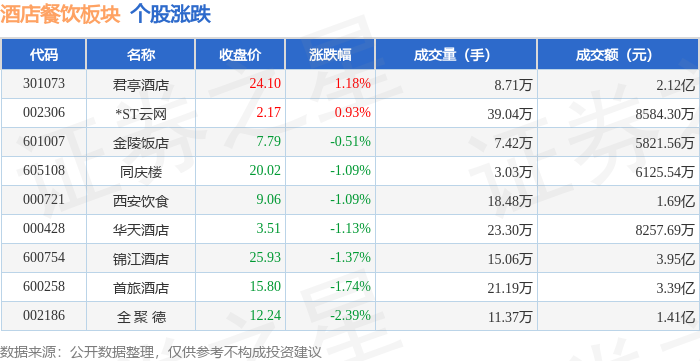
酒店餐饮板块11月14日跌1.22%,全聚德领跌,主力资金净流出3346.64万元
Zheng Xing Xing Ye Ri Bao· 2025-11-14 08:58
Market Overview - The hotel and catering sector experienced a decline of 1.22% on November 14, with Quanjude leading the drop [1] - The Shanghai Composite Index closed at 3990.49, down 0.97%, while the Shenzhen Component Index closed at 13216.03, down 1.93% [1] Stock Performance - Key stocks in the hotel and catering sector showed varied performance, with Junting Hotel increasing by 1.18% to a closing price of 24.10, while Quanjude fell by 2.39% to 112.24 [1] - The trading volume and turnover for Junting Hotel were 87,100 shares and 212 million yuan, respectively [1] Capital Flow - The hotel and catering sector saw a net outflow of 33.47 million yuan from institutional investors and 24.86 million yuan from retail investors, while retail investors had a net inflow of 58.33 million yuan [1] - Specific stock capital flows indicated that Quanjude had a significant net outflow of 16.11 million yuan from institutional investors, while retail investors contributed a net inflow of 30.62 million yuan [2]

社会服务行业 2025 年三季度业绩综述:回暖动能持续增强,细分领域机遇凸显
Changjiang Securities· 2025-11-14 05:54
Investment Rating - The report maintains a "Positive" investment rating for the social services industry [10] Core Insights - In the first three quarters of 2025, the overall revenue of the social services industry increased by 1.8% year-on-year, with positive growth in all sub-sectors except for duty-free and hotel sectors [2][19] - The overall net profit excluding non-recurring items decreased by 6.51% year-on-year, with significant variations across sectors; hotels and human resources sectors showed increases of 13.51% and 5.41% respectively, while sectors like tourism, education, dining, duty-free, and outbound tourism experienced declines [2][19] - The third quarter showed a marginal improvement with a revenue increase of 3.64% year-on-year and a net profit decrease of 4.28% [2][19] Summary by Relevant Sections Revenue Overview - The overall revenue growth for the social services industry was 1.8% year-on-year in the first three quarters of 2025, with a notable increase of 3.64% in the third quarter [19] - Sub-sectors such as outbound tourism, human resources, education, and scenic spots saw revenue growth rates of 10.53%, 9.57%, 4.41%, and 1.41% respectively, while dining and duty-free sectors faced declines [20][22] Profitability Analysis - The overall net profit excluding non-recurring items for the industry decreased by 6.51% year-on-year, with hotels and human resources sectors showing positive growth [23][24] - The hotel sector benefited from effective cost control, while other sectors like scenic spots, education, dining, and duty-free faced significant profit declines [23][24] Cash Flow Insights - The cash flow situation showed signs of improvement, with human resources, dining, and scenic spots experiencing increases in net cash flow [34] - The overall cash flow performance remained weak, with several sectors showing declines in cash flow relative to revenue [34] Sector-Specific Opportunities - In the education sector, high-quality institutions are expected to see stable growth, particularly with the integration of AI technologies [7][41] - The human resources sector is experiencing structural recovery, supported by employment policies and AI technology [7][41] - The hotel sector is witnessing a recovery in RevPAR, with leading hotel groups resuming rapid expansion [7][41] - The duty-free sector is seeing a narrowing of sales declines, with expectations for new policies to stimulate growth [8][41] - The dining sector is currently facing challenges due to regulatory impacts, but some companies are managing to maintain stable growth [7][41] - The scenic spots sector is benefiting from increased domestic tourism, particularly among rural residents [7][41]