建信基金

Search documents
ETF午评 | CPO板块大爆发,创业板人工智能ETF大成涨7%
Ge Long Hui· 2026-02-09 06:57
Group 1 - The three major A-share indices collectively rose in the morning session, with the Shanghai Composite Index up 1.17%, the Shenzhen Component Index up 2.07%, and the ChiNext Index up 3.11% [1] - The total trading volume in the Shanghai, Shenzhen, and Beijing markets reached 1,504.5 billion yuan, an increase of 109.6 billion yuan compared to the previous day [1] - Over 4,400 stocks in the market experienced gains, indicating a broad-based rally [1] Group 2 - The CPO sector saw significant gains, with the AI ETFs on the ChiNext rising by 7.08%, 6.94%, and 6.91% respectively [1] - The film and television sector was active, with the Silver Hua Fund Film ETF and the Guotai Fund Film ETF increasing by 6% and 5.73% respectively [1] - The photovoltaic sector also performed well, with the Guotai Photovoltaic ETF and the E Fund Photovoltaic ETF both rising by 4.46% [1] Group 3 - The white wine sector underperformed, with the wine ETF and consumer ETF declining by 0.54% and 0.38% respectively [2] - The basic ETF from Jianxin fell by 1% [2]

宏信证券ETF日报-20260205
Hongxin Security· 2026-02-05 09:01
Report Summary on February 5, 2026 1. Market Overview - The Shanghai Composite Index fell 0.64% to close at 4075.92 points, the Shenzhen Component Index dropped 1.44% to close at 13952.71 points, and the ChiNext Index declined 1.55% to close at 3260.28 points. The total trading volume of A - shares in the two markets was 21945 billion yuan. The top - rising sectors were beauty care (3.21%), banking (1.57%), and food and beverage (1.31%), while the top - falling sectors were non - ferrous metals (-4.57%), power equipment (-3.41%), and communication (-2.39%) [2][6] 2. Stock ETFs - The top - trading volume stock ETFs: Huaxia CSI A500ETF fell 1.37% with a discount rate of -1.23%; Huatai - Ber瑞 CSI A500ETF dropped 1.22% with a discount rate of -1.16%; Southern CSI 500ETF declined 2.04% with a discount rate of -1.90% [3][7] - The top ten stock ETFs by trading volume are presented in detail in Chart 1, including their codes, prices, price changes, tracking indices, and other information [8] 3. Bond ETFs - The top - trading volume bond ETFs: Haifutong CSI Short - Term Financing Bond ETF remained unchanged with a discount rate of 0.00%; Bosera CSI Convertible and Exchangeable Bond ETF fell 0.63% with a discount rate of -0.78%; E Fund Shanghai Stock Exchange Benchmark Market - Making Corporate Bond ETF dropped 0.04% with a discount rate of -0.16% [4][9] - The top five bond ETFs by trading volume are shown in Chart 2, including their codes, prices, price changes, and trading volumes [10] 4. Gold ETFs - Today, gold AU9999 fell 3.05% and Shanghai Gold dropped 3.15%. The top - trading volume gold ETFs: Huaan Gold ETF fell 3.17% with a discount rate of -3.35%; Bosera Gold ETF dropped 3.29% with a discount rate of -3.46%; E Fund Gold ETF declined 3.30% with a discount rate of -3.50% [12] - The top five gold ETFs by trading volume are presented in Chart 3, including their codes, prices, price changes, trading volumes, and other information [13] 5. Commodity Futures ETFs - Dacheng Non - Ferrous Metals Futures ETF fell 3.70% with a discount rate of -3.83%; Jianxin Yisheng Zhengzhou Commodity Exchange Energy and Chemical Futures ETF dropped 1.70% with a discount rate of -1.36%; Huaxia Feed Soybean Meal Futures ETF rose 0.25% with a discount rate of 5.21% [13] - Information on commodity futures ETFs, including their codes, prices, price changes, trading volumes, and tracking indices, is presented in Chart 4 [14] 6. Cross - border ETFs - The previous trading day, the Dow Jones Industrial Average rose 0.53%, the Nasdaq Composite declined 1.51%, the S&P 500 dropped 0.51%, and the German DAX fell 0.72%. Today, the Hang Seng Index rose 0.14% and the Hang Seng China Enterprises Index rose 0.50%. The top - trading volume cross - border ETFs: E Fund CSI Hong Kong Securities Investment Theme ETF fell 1.20% with a discount rate of -0.88%; Huaxia Hang Seng Tech ETF dropped 0.42% with a discount rate of 0.38%; Huatai - Ber瑞 Hang Seng Tech ETF declined 0.57% with a discount rate of 0.26% [15] - The top five cross - border ETFs by trading volume are shown in Chart 5, including their codes, trading volumes, price changes, and discount rates [16] 7. Money ETFs - The top - trading volume money ETFs are Yin Hua Ri Li ETF, Hua Bao Tian Yi ETF, and Money ETF Jian Xin [17] - The top three money ETFs by trading volume are presented in Chart 6, including their codes and trading volumes [18]
机构称 14万亿存款或将搬家
2 1 Shi Ji Jing Ji Bao Dao· 2026-02-05 00:55
Core Viewpoint - The upcoming maturity of a significant amount of deposits in China, estimated at 55 to 60 trillion yuan by 2026, will create a historical peak in the banking system, leading to a potential reallocation of funds and a "re-pricing" wave in deposits [2][14]. Group 1: Deposit Rates and Trends - Major banks are offering low interest rates on large time deposits, with rates around 1.4% to 1.55%, a stark contrast to rates above 5% prior to 2021 [1][13]. - The deposit renewal rate has been approximately 90% in recent years, but a decline to 80% could result in a potential outflow of around 14 trillion yuan, while maintaining the current rate could lead to about 7 trillion yuan [3][15]. Group 2: Impact of Market Conditions - The surge in household savings, exceeding 17 trillion yuan annually during 2022-2023, was driven by market volatility, leading to a significant accumulation of "excess savings" locked in long-term deposits [2][14]. - The reallocation pressure from these long-term deposits will peak in 2026, coinciding with a changing interest rate environment [2][14]. Group 3: Fund Allocation Predictions - It is anticipated that over 90% of maturing deposits will remain in the banking system as new time deposits, but an estimated 2 to 4 trillion yuan may flow into wealth management products and public funds, with 300 to 600 billion yuan expected to enter public funds [3][15]. - The shift in funds is expected to primarily favor low-risk assets, reflecting a cautious approach from residents towards higher-risk investments [5][17]. Group 4: Public Fund Strategies - Public funds are likely to attract maturing deposits through conservative products, particularly money market funds and short-term pure bond funds, which offer liquidity similar to demand deposits [6][18]. - The total scale of public funds is projected to reach 37.71 trillion yuan by the end of 2025, with money market funds comprising a significant portion [6][18]. Group 5: Misconceptions about Deposit Movements - There is a misconception that maturing deposits will lead to significant outflows into the capital market; however, most funds are expected to remain within the banking system for marginal optimization [11][23]. - The release of large deposits does not necessarily correlate with increased consumer spending, as a cautious mindset persists among residents [11][23].




机构称14万亿存款或将搬家
Xin Lang Cai Jing· 2026-02-05 00:55
Core Viewpoint - The upcoming maturity of a significant amount of deposits in China, estimated at 55 trillion to 60 trillion yuan by 2026, will lead to a major reconfiguration of the banking system and investment landscape, with implications for asset management and financial products [3][16]. Group 1: Deposit Maturity and Market Impact - By 2026, approximately 55 trillion to 60 trillion yuan in deposits will reach maturity, marking a historic peak for the banking system [3][16]. - The surge in household deposits, exceeding 17 trillion yuan annually since 2022, has created about 8 trillion yuan in excess savings, primarily locked in one to three-year term deposits [3][16]. - The reconfiguration pressure from these maturing deposits will intensify as they face a different interest rate environment compared to when they were deposited [3][16]. Group 2: Deposit Reallocation Predictions - If the deposit renewal rate drops to 80%, around 14 trillion yuan may be reallocated, while maintaining a 90% renewal rate would result in about 7 trillion yuan being reallocated [2][15]. - It is anticipated that over 90% of maturing deposits will remain in the banking system as new term deposits, with an estimated 2 trillion to 4 trillion yuan potentially flowing into wealth management products and public funds [4][17]. Group 3: Asset Management Industry Response - The asset management industry is expected to see a structural optimization rather than a massive influx of new capital, as the reallocation primarily targets low-risk assets similar to deposits [6][19]. - Public funds are likely to attract the incoming capital, particularly through conservative risk products such as money market funds and short-term pure bond funds, which are favored for their liquidity and expected returns [20][21]. - Fund companies are focusing on safety and have established mechanisms to manage risk and returns effectively, with a range of products tailored to different risk appetites [21][23]. Group 4: Misconceptions About Deposit Migration - There is a misconception that maturing deposits will lead to significant capital outflows into the market; however, much of the capital will remain within the banking system for marginal optimization [12][25]. - The release of large deposits does not necessarily correlate with a surge in consumer spending, as a cautious mindset persists among residents [12][25]. - Historical data indicates no direct relationship between the maturity of deposits and stock market performance, suggesting that the impact on equity markets may be limited [12][25].
机构称14万亿存款或将搬家
21世纪经济报道· 2026-02-05 00:50
Core Viewpoint - The article discusses the impending maturity of a significant amount of deposits in China, estimated to be between 55 trillion to 60 trillion yuan by 2026, which will lead to a reallocation of funds within the banking system and potentially impact various financial products [3][4]. Group 1: Deposit Rates and Trends - Major banks are offering low interest rates on large deposits, with rates around 1.4% to 1.55%, a stark contrast to rates above 5% seen in 2021 [1][2]. - The shift to lower interest rates has led to a psychological erosion among savers, prompting a significant influx of funds back into fixed-term deposits as a safe haven amid market volatility [1][3]. Group 2: Future Implications of Deposit Maturity - By 2026, a large volume of deposits will mature, creating a potential "repricing" and "reallocation" wave in the banking sector, with estimates suggesting that if the renewal rate drops to 80%, around 14 trillion yuan could be at risk of moving out of banks [3][4]. - The People's Bank of China has indicated that the upcoming maturity of long-term deposits will occur in a very different interest rate environment compared to when they were initially deposited [3][4]. Group 3: Fund Reallocation and Market Impact - It is anticipated that over 90% of maturing deposits will remain within the banking system, but an estimated 2 trillion to 4 trillion yuan may flow into wealth management products and public funds, with public funds expected to attract 300 billion to 600 billion yuan [5][4]. - The reallocation of funds is expected to be more of a structural optimization rather than a massive outflow into higher-risk assets, as residents' risk preferences will dictate their investment choices [7][4]. Group 4: Public Fund Strategies - Public funds that are likely to attract the reallocated deposits include money market funds and short-term pure bond funds, which offer liquidity similar to demand deposits and typically yield better returns than one-year fixed deposits [9][4]. - The "fixed income plus" fund products are being tailored to meet varying risk appetites, with a focus on maintaining low volatility and predictable returns [10][11]. Group 5: Misconceptions About Deposit Movements - There are misconceptions regarding the relationship between maturing deposits and "funds moving out" or entering the capital market, as much of the maturing funds will remain within the banking system for marginal optimization [15][4]. - The release of large deposits does not necessarily correlate with increased consumer spending or stock market performance, as historical data shows no significant relationship between the two [15][4].

2026年省税额度已更新
中国建设银行· 2026-02-04 09:09
Core Viewpoint - The article emphasizes the importance of early investment in personal pension accounts to maximize tax benefits and long-term returns in the A-share market, which has shown a significant recovery with the Shanghai Composite Index surpassing 4100 points, reflecting a 23.85% increase from January 1, 2025, to January 28, 2026 [2]. Group 1: Market Performance - The Shanghai Composite Index has reached a new high, breaking the 4100-point mark, indicating a positive trend in the A-share market [2]. - The index's performance from January 1, 2025, to January 28, 2026, shows a notable increase of 23.85% [2]. Group 2: Personal Pension Benefits - The updated personal pension tax deduction allows individuals to save up to 5400 yuan annually [5]. - The maximum annual contribution limit for personal pensions has been refreshed to 2000 yuan, which increases tax savings for higher income brackets [6]. - The article outlines various marginal tax rates and corresponding tax savings based on annual taxable income, highlighting that individuals with an annual taxable income exceeding 95,000 yuan can save up to 5400 yuan [7]. Group 3: Investment Products - The article promotes specific pension investment products, such as the "建信优享进取养老目标五年持有(FOF)" with a year-to-date return of 22.19% [3]. - Another product mentioned is the "贝嘉目标风险稳健型固定收益类理财产品," which has a projected return of 3.95% from July 18, 2023, to December 31, 2025 [3]. Group 4: Promotional Activities - A promotional campaign for personal pension accounts is set to run from February 1, 2026, to March 31, 2026, offering various rewards for new account holders and referrals [9]. - Specific rewards include bonuses for initial contributions and for inviting friends to open accounts, with potential rewards reaching up to 380 yuan [10].

仍有平台、博主“顶风”,“基金实时估值”悄转私域
2 1 Shi Ji Jing Ji Bao Dao· 2026-02-03 13:23
Core Viewpoint - The recent incident involving Debang Fund's rapid capital inflow of 12 billion yuan has highlighted the chaotic internet marketing practices within the fund industry, prompting regulatory scrutiny on misleading tools like real-time valuation and ranking lists [1][19]. Group 1: Regulatory Response - Regulators have emphasized the need for fund sales institutions and third-party platforms to conduct self-examinations and remove misleading tools that could mislead investors [1]. - This is not the first regulatory action; in June 2023, regulators had already mandated the removal of real-time valuation features due to risks of significant discrepancies between estimated and actual net values [13][19]. - The case of Debang Fund serves as a catalyst for renewed regulatory focus on the potential harm caused by misleading valuation data and its impact on investor behavior [19][20]. Group 2: Market Dynamics - Since February, there has been a surge in posts sharing fund valuation tools on social media platforms, with some influencers directing followers to private groups for access [4][12]. - Some self-media accounts have begun selling real-time valuation software, with prices ranging from a few yuan to over ten yuan [4]. - Despite regulatory requirements to remove certain features, some platforms have continued to offer modified versions of these tools, indicating a reluctance to fully comply with regulations [9][10]. Group 3: Investor Behavior and Risks - The rapid dissemination of distorted valuation data through social networks can create herd behavior among investors, leading to irrational trading decisions [18]. - The discrepancy between real-time valuation and actual net value can mislead investors, as seen in the case of Debang Fund, where the reported real-time increase was significantly higher than the actual net value increase [19]. - There is a strong demand from investors for more data and tools to bridge the information gap, which may lead to further regulatory challenges as platforms seek to meet this demand while remaining compliant [16][22].
新金路股价涨5.1%,建信基金旗下1只基金重仓,持有65.49万股浮盈赚取49.12万元
Xin Lang Cai Jing· 2026-02-03 02:26
Group 1 - The core point of the article highlights the recent performance of Xinjin Road, which saw a 5.1% increase in stock price, reaching 15.47 yuan per share, with a trading volume of 525 million yuan and a turnover rate of 5.74%, resulting in a total market capitalization of 10.033 billion yuan [1] - Xinjin Road Group, established on April 18, 1992, and listed on May 7, 1993, is located in Deyang, Sichuan Province, and primarily engages in the production and operation of chlor-alkali chemicals and plastic products [1] - The revenue composition of Xinjin Road's main business includes resin products at 41.61%, alkali products at 38.43%, and other products at 19.97% [1] Group 2 - From the perspective of major fund holdings, data indicates that a fund under Jianxin Fund has a significant position in Xinjin Road, with Jianxin New Materials Select Stock Fund A (018194) holding 654,900 shares, accounting for 2.93% of the fund's net value, making it the eighth largest holding [2] - The Jianxin New Materials Select Stock Fund A, established on August 22, 2023, has a latest scale of 625.691 million yuan, with a year-to-date return of 7.72%, ranking 709 out of 5562 in its category; over the past year, it achieved a return of 67.59%, ranking 363 out of 4285 [2] - The fund manager, Tian Yuanquan, has a tenure of 5 years and 233 days, with the total asset scale of the fund at 5.21 billion yuan, achieving the best return of 109.46% and the worst return of -16.27% during his tenure [2]

千亿级ETF 跌停
Shang Hai Zheng Quan Bao· 2026-02-02 23:16
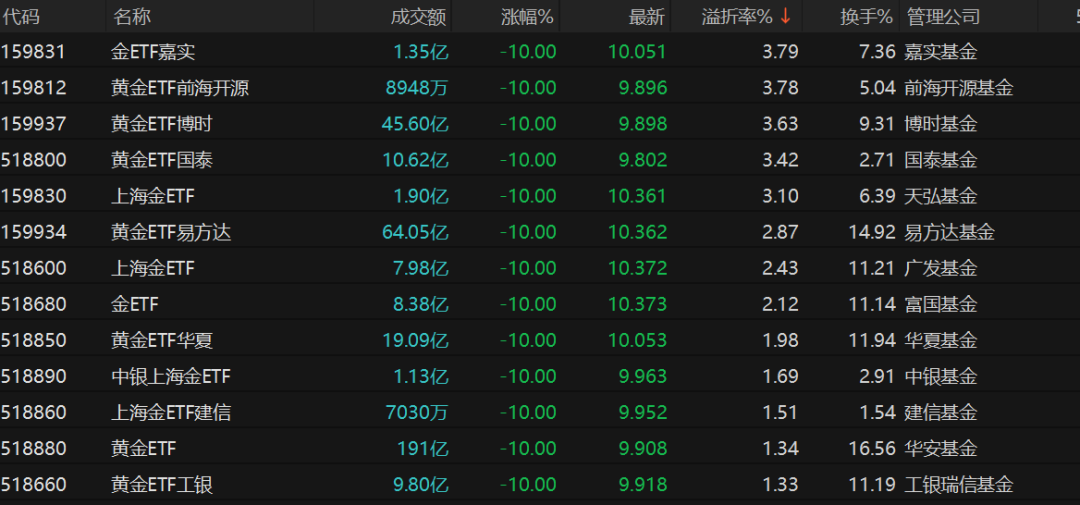
Group 1: Market Overview - Gold-related ETFs experienced significant declines, with multiple ETFs hitting the daily limit down [2][5] - The Huashan Gold ETF recorded a trading volume of 19.1 billion yuan, marking the third-highest trading day since its inception in 2013 [2][4] - The total scale of gold-related commodity ETFs reached 333.3 billion yuan as of January 30, up from 70.4 billion yuan at the beginning of 2025 [4] Group 2: Trading Performance - Several gold ETFs, including E Fund Gold ETF and Bosera Gold ETF, also saw high trading volumes, with E Fund Gold ETF at 6.4 billion yuan and Bosera Gold ETF exceeding 4.5 billion yuan [2][3] - The performance of various gold-related ETFs showed a uniform decline of 10% on the trading day [3][6] Group 3: Investor Sentiment and Recommendations - Analysts suggest that the recent drop in gold prices is a short-term technical adjustment and emotional release, emphasizing the importance of avoiding irrational trading behaviors [8] - Investment firms recommend that investors focus on long-term strategies and be cautious of leverage risks, especially in a high-volatility environment [8]