格力电器

Search documents
中国消费行业:2026 年 GCC 会议要点 -估值仍具吸引力,消费复苏迹象显现-China Consumer Sector_ 2026 GCC takeaways_ Sector valuation remains attractive with signs of consumption recovery
2026-01-26 02:50
Summary of Key Points from the Conference Call Industry Overview - **Sector**: China Consumer Sector - **Key Insights**: The sector shows signs of consumption recovery despite a near-term property market downturn. Valuation remains attractive, approximately 1 standard deviation below 10-year averages, indicating that a consumption recovery is not yet priced in [2][21]. Consumer Staples - **Baijiu**: Anticipated demand support for mid-end baijiu due to easing alcohol bans and private consumption growth. Companies are expected to accelerate channel transformations for sustainable EPS growth [3][8]. - **Beer**: Premiumization continues through product diversification and in-home channel expansion, despite on-trade softness. CR Beer expects low-single-digit volume growth in 2025, with Heineken volumes projected to grow by 20% YoY [3][8]. - **Dairy**: Liquid milk sales are expected to recover modestly in 2026, driven by marketing and innovation, despite a weak 2025. Fresh milk shows resilience with double-digit growth [3][8]. - **Freshly-Made Beverages (FMB)**: Guming is expected to maintain steady SSSG in 2026 through category expansion and dine-in growth, despite the phase-out of delivery subsidies [3][8][19]. - **Condiments**: Sequentially improving demand is expected, with Haitian focusing on multi-product categories and Jonjee anticipating a cleaner 2026 after a weak 4Q25 [3][8]. Consumer Discretionary - **Home Appliances**: Companies like Midea and Haier expect higher overseas growth compared to domestic markets in 2026. Strategies include price hikes and operational efficiencies [4][10]. - **Jewelry**: Brands with unique designs may consolidate post-VAT reform. Laopu is expected to achieve strong sales growth due to increased focus on value-added services [4][10]. - **Restaurants**: Intense competition leads to divergent strategies, with some companies lowering prices while others upgrade offerings. DPC Dash is on track for expansion despite market uncertainties [4][10]. Stock Implications - **Most Preferred Stocks**: CR Beer, Guming, MIXUE, China Foods, YUM China, among others, are highlighted as preferred investments due to their growth potential [5]. - **Least Preferred Stocks**: Companies like Swellfun, Nongfu, and Gree are noted as less favorable due to various challenges [5]. Key Risks - Risks include demand recovery uncertainties, cost inflation or deflation, and changes in the competitive landscape. These factors could significantly impact the consumer sector's performance [21]. Additional Insights - **Pet Food**: The industry is shifting towards online sales, with over 85% of sales occurring digitally. Competition is intensifying, pushing brands towards innovation and product differentiation [13]. - **Snack Sector**: Rapid category diversification and channel restructuring are creating growth opportunities, particularly through snack discounters [9][12]. This summary encapsulates the essential insights and projections from the conference call, providing a comprehensive overview of the current state and future outlook of the China consumer sector.





铝研究-从家电领域看铝代铜前景分析与展望
2026-01-26 02:49
Summary of Aluminum Replacement for Copper in the Air Conditioning Industry Industry Overview - The focus is on the air conditioning industry and the trend of replacing copper with aluminum in heat exchangers due to cost advantages and resource security [1][6]. Key Points and Arguments 1. **Cost Advantage**: Aluminum prices are approximately one-fourth of copper prices, leading to significant cost savings in air conditioning production [1][6]. 2. **Performance Efficiency**: Full aluminum microchannel heat exchangers can improve thermal conversion efficiency by about 10% compared to full copper, while also reducing weight by half and refrigerant usage by nearly half [1][3]. 3. **Technical Feasibility**: Aluminum heat exchangers can achieve 90% of copper's performance, with potential improvements to 96%-98% through structural optimization and the addition of rare earth alloys [1][10]. 4. **Market Adoption**: Major air conditioning companies like Haier, Midea, Gree, Xiaomi, and Aux have begun mass production of aluminum products, with Haier having a high export ratio [1][11]. 5. **Projected Growth**: The penetration rate of aluminum replacement technology is expected to reach over 80% by 2027, driven by price advantages and the plans of leading companies [2][22]. Additional Important Content 1. **Material Comparison**: Four main technical paths for heat exchanger materials are identified: aluminum replacing copper, non-wing (plate-type) heat exchangers, and aluminum-copper composite heat exchangers, each with distinct advantages and disadvantages [2][5]. 2. **Environmental Impact**: The use of aluminum or composite materials contributes to lightweight design, enhancing energy efficiency and reducing refrigerant usage, thus promoting environmental sustainability [7]. 3. **Standardization Efforts**: Ongoing efforts in the industry include the establishment of technical standards, testing and validation of new materials, and collaboration among leading brands to ensure product reliability and performance consistency [7][8]. 4. **Consumer Acceptance**: Consumer acceptance of aluminum components varies, with lower acceptance in high-end markets compared to mid-range and low-end markets [18]. 5. **Challenges**: Key challenges include higher maintenance costs and potential reductions in product lifespan, with estimates suggesting a decrease of 20% in lifespan when using aluminum instead of copper [16][20]. Conclusion The air conditioning industry is poised for a significant shift towards aluminum as a replacement for copper in heat exchangers, driven by cost efficiency, performance improvements, and environmental considerations. Major players are already adapting their strategies to align with this trend, indicating a robust future for aluminum technology in this sector.
自由现金流ETF(159201)冲击6连涨,最新规模达113.78亿元,创成立以来新高
Xin Lang Cai Jing· 2026-01-26 02:13
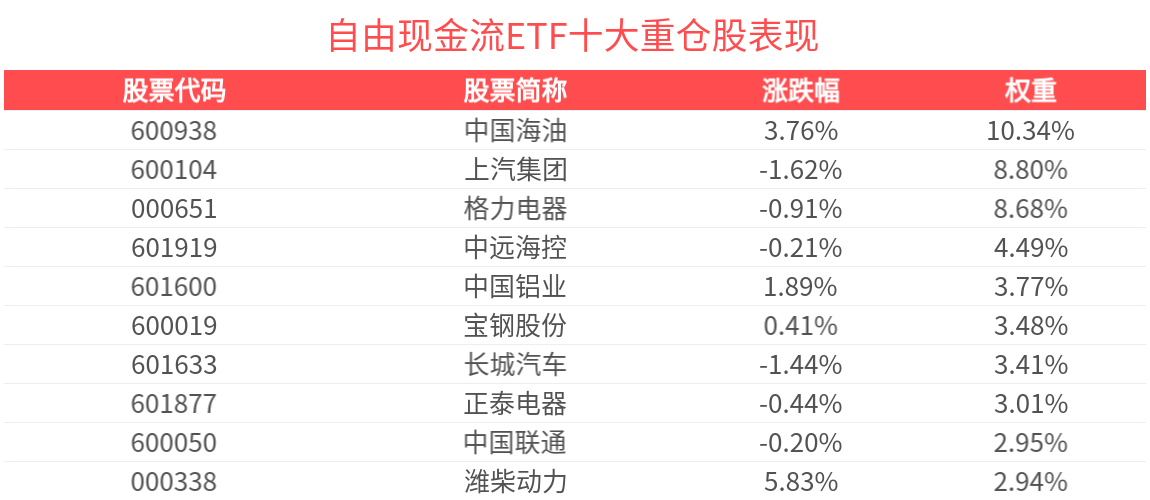
Core Viewpoint - The National Index of Free Cash Flow has shown positive performance, with significant increases in both the index and its constituent stocks, indicating strong investor interest and liquidity in the market [1][2]. Group 1: Market Performance - As of January 26, 2026, the National Index of Free Cash Flow rose by 0.59%, with notable increases in constituent stocks such as Silver Nonferrous (+8.68%), Weichai Power (+5.83%), and China National Offshore Oil Corporation (+3.76%) [1]. - The Free Cash Flow ETF (159201) has experienced a 0.30% increase, marking its sixth consecutive rise, with a trading volume of 1.84 billion yuan [1]. - Over the past week, the Free Cash Flow ETF has averaged daily transactions of 6.16 billion yuan, reflecting strong liquidity [1]. Group 2: Fund Inflows and Performance - The Free Cash Flow ETF has seen continuous net inflows over the past six days, with a peak single-day net inflow of 672 million yuan, totaling 1.402 billion yuan in net inflows [1]. - The latest share count for the Free Cash Flow ETF reached 8.709 billion shares, with a total scale of 11.378 billion yuan, setting a new record since its inception [1]. - The ETF has recorded a financing net purchase amount of 3.3297 million yuan this month, with a current financing balance of 137 million yuan [1]. Group 3: Historical Returns - Since its inception, the Free Cash Flow ETF has achieved a maximum monthly return of 7%, with the longest streak of consecutive monthly gains being six months and a total gain of 22.69% [2]. - The ETF has an 80% monthly profit percentage and a 100% probability of profitability over a six-month holding period [2]. - As of January 23, 2026, the ETF outperformed its benchmark with an annualized excess return of 5.21% over the past six months [2]. Group 4: Index Composition - The top ten weighted stocks in the National Index of Free Cash Flow as of December 31, 2025, include China National Offshore Oil Corporation, SAIC Motor, and Gree Electric Appliances, collectively accounting for 51.95% of the index [2]. - The index reflects the price changes of listed companies with high and stable free cash flow levels in the Shanghai and Shenzhen stock exchanges [2].

《2026/01/19-2026/01/23》家电周报:亿田智能发布 2025 年业绩预告,石头科技发布新品-20260125
Shenwan Hongyuan Securities· 2026-01-25 13:24
Investment Rating - The report maintains a positive outlook on the home appliance sector, particularly recommending leading companies with low valuations, high dividends, and stable growth potential [2][3]. Core Insights - The home appliance industry is experiencing a decline in sales across both air conditioning and kitchen appliances, with significant drops in both online and offline retail volumes [33][34]. - The report highlights three main investment themes: 1. **Dividend**: Leading white and black appliance companies are characterized by low valuations, high dividends, and stable growth, providing a high margin of safety and elasticity in stock prices. The domestic market is expected to remain stable due to the continued effects of the trade-in policy, while export opportunities are bolstered by global production base layouts and strong demand in emerging markets [2][3]. 2. **Technology**: Core component manufacturers are diversifying into emerging tech fields such as robotics and data center temperature control, seeking cross-industry transformation [2][3]. 3. **Demand Recovery**: The report anticipates a recovery in external demand and sustained high demand for new products in the domestic market, particularly for robotic vacuum cleaners [2][3]. Summary by Sections Sales Data - Air conditioning sales saw a significant decline in December 2025, with online retail volume down 38.5% year-on-year and offline retail volume down 42.9%. The average price for online sales decreased by 4.2% to 2981 RMB per unit, while offline prices fell by 20.1% to 3801 RMB per unit [33]. - Kitchen appliances also faced declines, with online sales of range hoods down 16.8% and dishwashers down 10.2% year-on-year. The average price for online range hoods increased by 14.4% to 1739 RMB per unit, while offline prices decreased by 14.4% to 3813 RMB per unit [34][38]. Company Dynamics - Major companies such as Haier, Midea, and Gree are recommended for their current low valuations and strong dividend yields. The report also highlights the potential of companies like Dong'an Environment and Huaxiang Co. in emerging tech sectors [2][3]. - The report notes that the home appliance sector outperformed the Shanghai and Shenzhen 300 Index, with companies like Aojiahua and Hisense leading in stock performance [5][8]. Industry Trends - The report indicates that raw material prices for copper and aluminum have risen, with copper prices up 34.79% year-on-year and aluminum prices up 19.36% year-on-year as of January 23, 2026 [12]. - The report also mentions that the sales of rotary compressors decreased by 13.6% year-on-year, while refrigerator compressor sales increased by 7.2% [27][28]. Economic Environment - As of January 23, 2026, the exchange rate of the US dollar to the Chinese yuan has decreased by 0.51% since the beginning of the year [42]. - The report highlights a decline in the sales area of commercial housing, with residential existing homes down 6.33% and new homes down 24.55% year-on-year [44].
宁德时代落子北京;湖南裕能单季净利暴涨500%;璞泰来业绩预喜;五粮液储能项目第二次开标;天华新能港股IPO;刚果(金)向美提供矿产清单
起点锂电· 2026-01-25 11:00
Group 1 - CATL launched the "Tianxing II" light commercial series solution, introducing the first intelligent battery management application for the light commercial vehicle industry, aiming to break the standardization bottleneck and promote customized operations in the new energy light commercial vehicle sector [3] - CATL is rapidly advancing the construction of a 15GWh battery factory in Beijing with an investment of 4 billion yuan, indicating imminent project implementation [5] - CATL, along with partners, established Beijing Times Power Battery Co., Ltd. with a registered capital of 1 billion yuan, where CATL holds a 51% stake responsible for the factory's construction and operation [6] Group 2 - Penghui Energy expects to turn a profit in 2025 with a projected net profit of 170 million to 230 million yuan, driven by increased sales orders and revenue growth [7] - The second phase of the Xiamen Times project is set to produce 30GWh of battery cells, with construction expected to be completed by Q2 of this year [8] - The Chongqing project by Ruipu Lanjun-Saike Technology aims for an initial capacity of 12GWh, with total investment of 10 billion yuan and expected annual output value of 26 billion yuan upon full production [9] Group 3 - EVE Energy was recognized as the world's first cylindrical battery lighthouse factory, achieving certification for its advanced manufacturing and digital solutions [10][11] - Portugal signed six investment agreements totaling 30.77 billion euros, with four projects related to battery materials and electric vehicles, aimed at promoting energy transition [12] - Xiamen New Energy and Quan Feng Holdings signed a strategic cooperation memorandum to focus on lithium battery technology innovations [13] Group 4 - The Xiangdong lithium battery project in Hebei has been publicly accepted, with a total investment of 1.35 billion yuan and plans for a production capacity of 4GW [14] - Trina Solar signed two major projects, including a 250 MW/1 GWh energy storage project in Italy and a supply contract for battery storage systems in Latin America totaling 1.203 GWh [15][16] - Tianhua New Energy is planning an IPO in Hong Kong to enhance its international strategy and financing capabilities [18] Group 5 - Tianqi Lithium is expanding its lithium hexafluorophosphate project with an investment of 300 million yuan, increasing production capacity from 150,000 tons to 280,000 tons [19] - Hunan Youneng expects a significant increase in net profit for 2025, projecting a rise of 93.75% to 135.87% year-on-year [20] - Purtai's net profit for 2025 is expected to increase by 93.18% to 101.58%, driven by strong demand in the energy storage market [21] Group 6 - Rontgen High-Tech's production capacity for its core product has been fully sold out in Q1 2026, prompting the company to seek financing for new production lines [22] - The Democratic Republic of Congo submitted a shortlist of state-owned mineral assets to the U.S. for evaluation, including various mining projects [23] - Wanhua Chemical is advancing two lithium battery material projects with a total production capacity of 85,000 tons of lithium iron phosphate [24] Group 7 - Hunan Youneng is increasing its production capacity through a stock issuance, raising up to 4.788 billion yuan for new projects [25] - Lichi Intelligent passed the IPO review for its listing on the Growth Enterprise Market [27] - Efei Laser signed a 158 million yuan contract for lithium battery equipment, which is expected to positively impact future financial performance [30]


家电周报:亿田智能发布2025年业绩预告,石头科技发布新品-20260125
Shenwan Hongyuan Securities· 2026-01-25 09:28
Investment Rating - The report maintains a positive outlook on the home appliance industry, particularly on leading companies in the white and black goods sectors, highlighting their low valuations, high dividends, and stable growth potential [2][3]. Core Insights - The report identifies three main investment themes: 1. **Dividend and Growth**: Leading companies in the white and black goods sectors are characterized by low valuations, high dividends, and stable growth, providing a high safety margin and significant price elasticity. The impact of the trade-in policy is expected to continue positively into 2026 [2][3]. 2. **Technological Transition**: Key upstream component manufacturers are diversifying into emerging technology sectors such as robotics, data center temperature control, and semiconductors, seeking cross-industry transformation [2][3]. 3. **Market Demand**: Both domestic and international markets show promising demand, with established companies expanding production bases globally to mitigate trade fluctuations and capture growth in emerging markets [2][3]. Sales Data Summary - **Air Conditioning**: In December 2025, online retail sales volume was 720,000 units, a year-on-year decrease of 38.5%, while offline sales volume was 162,000 units, down 42.9%. The average online retail price decreased by 4.2% to 2,981 yuan per unit, and the offline average price fell by 20.1% to 3,801 yuan per unit [2][3][35]. - **Kitchen Appliances**: - **Range Hoods**: Online sales volume was 443,000 units, down 16.8%, while offline sales were 57,000 units, down 32.1%. The online average price increased by 14.4% to 1,739 yuan per unit, while the offline average price decreased by 14.4% to 3,813 yuan per unit [3][41]. - **Dishwashers**: Online sales volume was 49,000 units, down 10.2%, and offline sales were 5,000 units, down 44.2%. The online average price decreased by 1.1% to 4,245 yuan per unit, while the offline average price increased by 1.4% to 7,990 yuan per unit [3][41]. Company Updates - **Yitian Intelligent**: Forecasts a net loss of 186 to 152 million yuan for 2025, compared to a profit of 26.54 million yuan in 2024 [5][11]. - **Roborock Technology**: Launched new products including the G30S Pro and P20 Ultra, featuring advanced cleaning technologies and high efficiency [5][12]. - **Stock Performance**: The home appliance sector outperformed the CSI 300 index, with notable gains from companies like Aojiahua (10.1%) and Hisense Visual (5.7%) [5][6][8]. Macro Economic Environment - As of January 23, 2026, the USD to RMB exchange rate was 6.9929, reflecting a decrease of 0.51% since the beginning of the year [46][48]. - In December 2025, the total retail sales of consumer goods reached 45,135.90 billion yuan, a year-on-year increase of 0.86% [48][49].




家电行业 2026W04 周报:家电基金持仓略有下降,欧盟对割草机进口展开登记-20260125
GUOTAI HAITONG SECURITIES· 2026-01-25 07:47
Investment Rating - The report assigns an "Accumulate" rating for the home appliance industry [4]. Core Insights - The report highlights a slight decline in fund holdings in the home appliance sector, with a 2.6% allocation in actively managed equity funds for Q4 2025, down 0.2 percentage points from Q3 [2][4]. - The report notes that the production of household air conditioners in December 2025 was 14.782 million units, a year-on-year decrease of 18.7%, with domestic sales down 26.7% and exports down 13.2% [2][4]. - The report mentions that the EU has mandated registration for imports of robotic lawn mowers from China, with potential anti-dumping duties estimated between 21.4% and 57.4% [2][4]. Summary by Sections Investment Recommendations - The report suggests that national subsidies are expected to transition smoothly, and recommends several companies for investment based on their stable operations and high dividends, including Midea Group (13.1X), Haier Smart Home (11.4X), TCL Electronics (12.7X), and Hisense Visual (12.7X) [4]. - It highlights the core drivers for smart home appliances' overseas expansion, recommending leading robotic vacuum companies Roborock (20.3X) and Ecovacs (22.5X) [4]. - The report also recommends companies with stable performance and upward potential, such as Ninebot (19.9X), Anfu Technology (56.8X), Hailong Cold Chain (15.9X), and Beiding Co. (35.3X) [4]. - Additionally, it points out companies expanding into new business lines, recommending Rongtai Health (21.3X) and Wanlong Magnetic Plastic (21.9X) [4]. Market Data - The report provides data on the top five holdings in the home appliance sector, with Midea Group valued at 19.9 billion, Haier Smart Home at 6 billion, and others showing varying changes in market value [4]. - It notes that the overall retail sales of home appliances in December 2025 were 97.1 billion, a year-on-year decrease of 18.7% [2][4]. - The report indicates that the total domestic sales volume for the air conditioning industry in 2025 was 10.521 million units, a slight increase of 0.7% year-on-year, while total exports were 9.318 million units, down 3.4% [2][4].



知名基金经理最新持股曝光!睿远基金赵枫:关注中国企业出海
Shang Hai Zheng Quan Bao· 2026-01-25 00:03
Group 1 - The core viewpoint of the article highlights significant adjustments in fund managers' portfolios, indicating a generally optimistic outlook for the market [1] Group 2 - Fund manager Fu Pengbo increased the equity investment in the Ruiyuan Growth Value Mixed Fund to 90.48% of total assets by the end of 2025, up from 89.93% at the end of the third quarter [2] - The top ten holdings now account for 70.38% of the fund's net asset value, an increase of 4.34 percentage points from 66.04% in the previous quarter [2] - Notably, China Mobile has exited the top ten holdings, replaced by high-performing companies in the photovoltaic and semiconductor equipment sectors [2] - Fu Pengbo is preparing for 2026 by reducing positions in companies with weak fundamentals and increasing investments in data center liquid cooling, storage, and computing-related companies [3] - Fu Pengbo remains optimistic about sectors like AI, non-ferrous metals, and lithium battery materials, expecting high growth in these areas [3] Group 3 - Fund manager Zhao Feng's Ruiyuan Balanced Value Three-Year Holding Mixed Fund maintains a high equity investment ratio of 90.66% [4] - Zhao Feng has reduced positions in overvalued stocks while increasing holdings in quality leading companies with lower valuations [4] - The expected static return from cash flow-rich companies is around 5%, with potential growth leading to returns exceeding 10% for some leading firms [4] - Zhao Feng emphasizes the importance of domestic leading companies expanding overseas, transitioning from simple exports to local manufacturing and services [5] - These companies are expected to see significant revenue growth from overseas markets over the next five to ten years, driven by improved service and brand recognition [5] Group 4 - Fund manager Yang Jinjing has made substantial adjustments in the Jiao Yin Shi Luo De Rui Yuan Three-Year Regular Open Mixed Fund, increasing exposure to cyclical sectors [6] - New additions to the top ten holdings include several airline stocks, while multiple power sector stocks have exited [6] - Yang Jinjing is focusing on industry leaders that are experiencing or about to experience turning points, estimating that only 20%-30% of these leaders will emerge early from the downturn [6][7] - The expectation is that industry leaders will achieve long-term turning points through competitive advantages, leading to profit upgrades and valuation increases [7]
华夏新机遇混合A:2025年第四季度利润57.08万元 净值增长率1.37%
Sou Hu Cai Jing· 2026-01-24 11:00
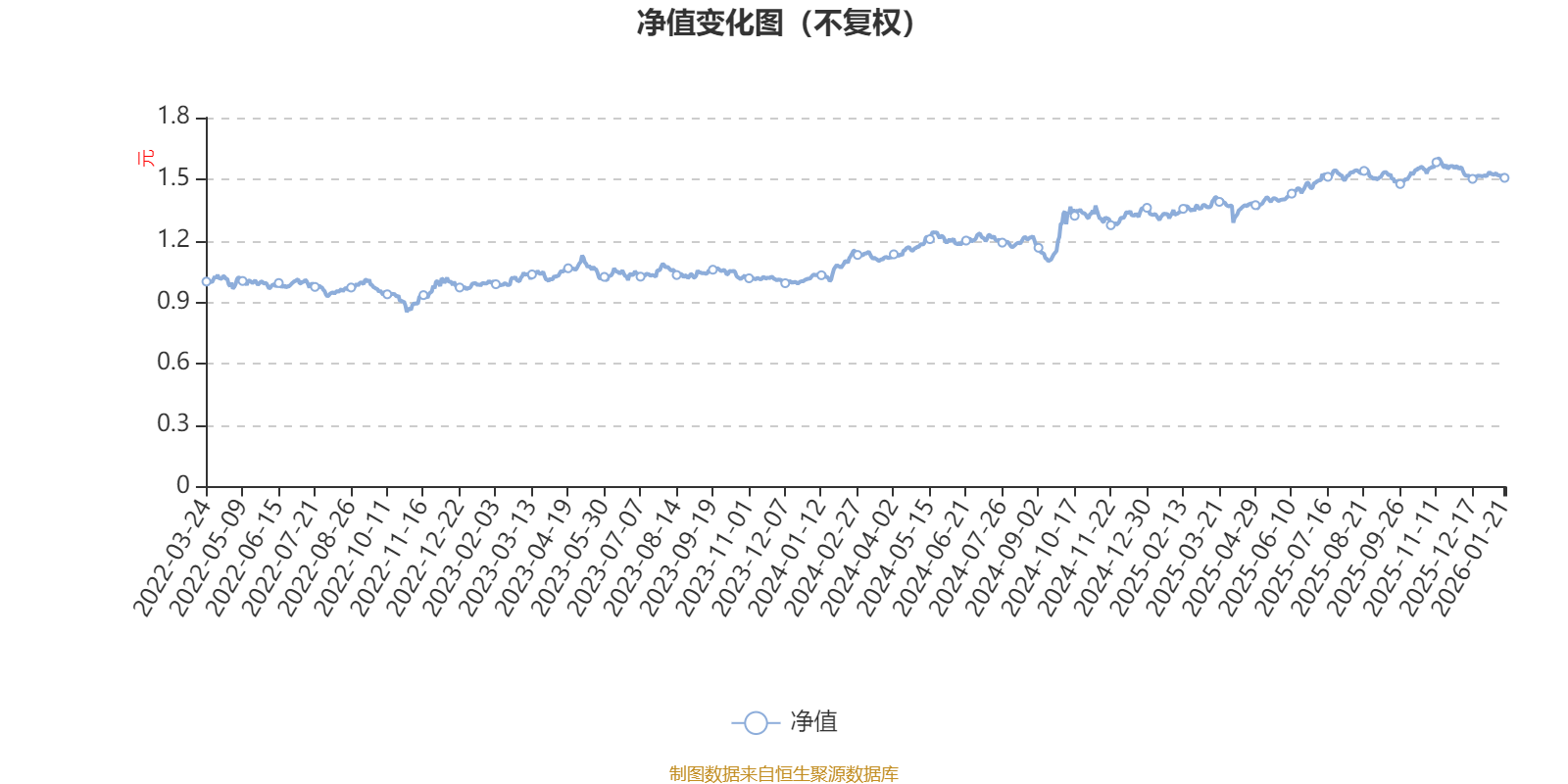
该基金属于灵活配置型基金。截至1月22日,单位净值为1.519元。基金经理是孙然晔,目前管理9只基金。其中,截至1月22日,华夏创业板综合ETF近一年 复权单位净值增长率最高,达50.28%;华夏鼎淳债券A最低,为3.06%。 基金管理人在四季报中表示,基金投资运作方面,本基金以多因子量化投资策略为主,在依据量化模型进行股票投资决策之外,还积极参与了科创板、创业 板新股申购,以获取收益增厚的机会。同时,本基金秉承尽职尽责的态度,认真应对投资者日常申购、赎回等工作。 截至1月22日,华夏新机遇混合A近三个月复权单位净值增长率为4.83%,位于同类可比基金859/1286;近半年复权单位净值增长率为19.42%,位于同类可比 基金697/1286;近一年复权单位净值增长率为34.43%,位于同类可比基金607/1286;近三年复权单位净值增长率为43.46%,位于同类可比基金232/1286。 通过所选区间该基金净值增长率分位图,可以观察该基金与同类基金业绩比较情况。图为坐标原点到区间内某时点的净值增长率在同类基金中的分位数。 AI基金华夏新机遇混合A(002411)披露2025年四季报,第四季度基金利润57.0 ...
中泰红利优选一年持有混合发起:2025年第四季度利润1689.01万元 净值增长率1.74%
Sou Hu Cai Jing· 2026-01-24 09:50
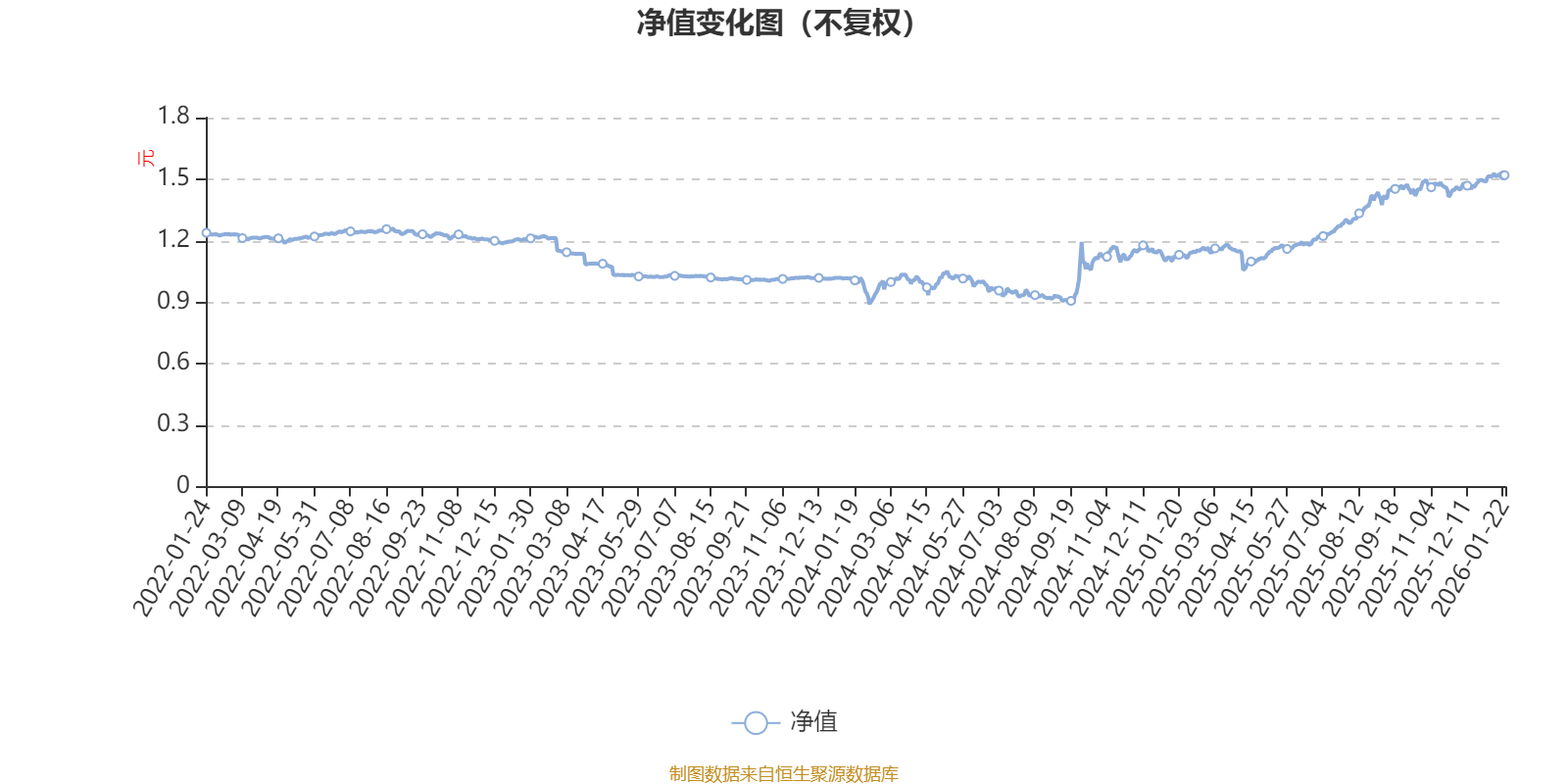
通过所选区间该基金净值增长率分位图,可以观察该基金与同类基金业绩比较情况。图为坐标原点到区间内某时点的净值增长率在同类基金中的分位数。 AI基金中泰红利优选一年持有混合发起(014771)披露2025年四季报,第四季度基金利润1689.01万元,加权平均基金份额本期利润0.0249元。报告期内, 基金净值增长率为1.74%,截至四季度末,基金规模为10.37亿元。 该基金属于偏股混合型基金。截至1月21日,单位净值为1.506元。基金经理是姜诚和王桃,目前共同管理的2只基金近一年均为正收益。其中,截至1月21 日,中泰红利优选一年持有混合发起近一年复权单位净值增长率最高,达13.49%;中泰红利价值一年持有混合发起最低,为13.19%。 基金管理人在四季报中表示,我们深知投资收益高低与投资决策的难度并没有显著的相关性,我们红利策略追求的是高置信度前提下的高胜率。在认知构建 层面,我们秉持开放勤奋的态度,通过持续学习不断外扩能力圈的边界;但回到投资决策,我们恪守严苛的标准和纪律,保持高度的克制与定力,兜住下 限、并努力提高长期投资回报。感谢大家的信任。 截至1月21日,中泰红利优选一年持有混合发起近三个月复权单 ...