Figure

Search documents
突破百万台!亚马逊机器人数量接近人类员工数,机器人ETF基金(159213)跌超1%,机器人板块持续回调,什么情况?后市关注这一重点!
Sou Hu Cai Jing· 2025-07-04 03:14
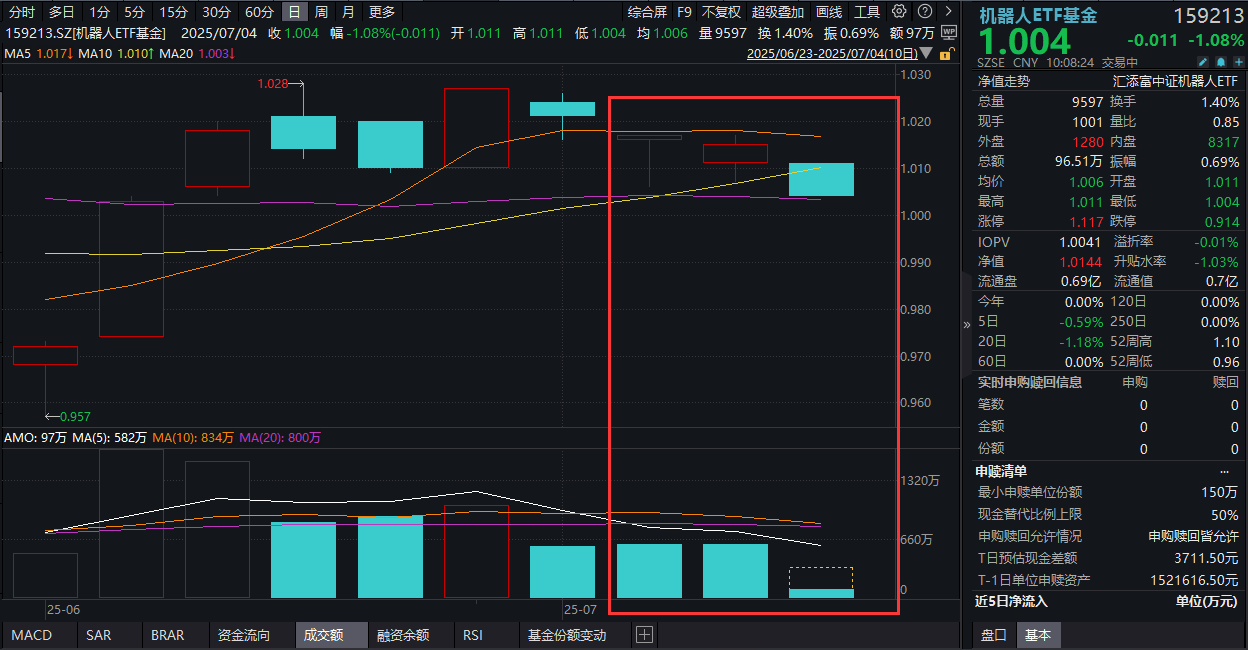
Core Viewpoint - The A-share market is experiencing fluctuations, with cyclical sectors like steel, coal, and banking rising, while the robotics sector is declining, as evidenced by the performance of the robotics ETF fund [1]. Group 1: Market Performance - As of 10:10 AM on July 4, the robotics ETF fund (159213) is down over 1% [1]. - The majority of the index components of the robotics ETF fund are experiencing a pullback, with notable declines in companies like 汇川技术 (down 1.37%) and 大族激光 (down 1.22%) [4]. Group 2: Industry Developments - Amazon has deployed over 1 million robots in its facilities, nearing the number of human employees, with approximately 75% of its global delivery operations utilizing some form of robotic assistance [2]. - Major companies are increasing investments in the unmanned logistics sector, with collaborations such as KION Group partnering with NVIDIA and Accenture to enhance warehouse management through robotics [3]. - The robotics sector is seeing a significant focus on the practical application of robots in logistics, with companies like 智元机器人 entering strategic partnerships to develop humanoid robots for data-driven operational scenarios [3]. Group 3: Future Outlook - The year 2025 is anticipated to be a breakthrough year for humanoid robots, with expected mass production leading to significant growth in the downstream supply chain [6]. - The humanoid robot industry is projected to transition from formation to expansion, with an estimated demand of approximately 2.03 million units in the U.S. and China by 2030, representing a market space of about 318.5 billion RMB [6]. - The industry is expected to benefit from advancements in AGI technology, improved supply chain dynamics, and increasing downstream application demands, positioning humanoid robots as a key growth area in high-end manufacturing [6].


全球AI创业图谱:CB Insights发布AI百强榜单 | Jinqiu Select
锦秋集· 2025-07-03 15:49
Core Insights - The AI sector has experienced an unprecedented entrepreneurial wave in 2024, with over 1,700 new companies and total funding exceeding $170 billion. CB Insights released its annual AI 100 list, identifying 100 promising AI startups from over 17,000 candidates based on various evaluation criteria [1] Group 1: Market Potential and Categories - The Industrial and Physical AI categories lead the market potential assessment, with "General-purpose humanoids" scoring 865, followed by "Aerospace and Defense" at 836, and "Autonomous Driving and Mobility" at 835 [2] - Vertical AI companies are the most advanced in commercial maturity, with 43% in the "Scaling" phase, compared to 41% for Horizontal AI and 38% for AI Infrastructure [5][6] Group 2: Growth Dynamics - The voice AI platform Cartesia achieved the largest annual increase in Mosaic Score, with a growth of +321 points, followed closely by Moonvalley (+290), LiveKit (+279), Nillion (+263), and Iconic (+262) [6] Group 3: M&A Predictions - Physics X, an AI company in manufacturing, has a 60% probability of being acquired in the next two years, with other high-probability candidates including Vejil (58%), Rembrand (57%), DEFCON AI (57%), and Evinced (57%) [9] Group 4: Investment Landscape - 29% of the AI 100 companies received investments from major tech firms, with Nvidia leading with 13 investments, followed by Amazon (12), Google (10), and Microsoft (8), collectively contributing to 43 investments [12] - Venture capital firms are also significant supporters, with General Catalyst investing in 12 AI 100 companies, followed by NVentures (10) and Lightspeed (8) [16] Group 5: Funding Insights - Physical AI companies dominate funding amounts, with Wayve leading at $1.3 billion, followed by Figure ($854 million), Saronic ($830 million), and Helsing ($829 million) [19][20] Group 6: Talent Efficiency - Sierra leads in "valuation per employee" with an impressive $22 million per employee, significantly higher than others, with together.ai at $17 million and Figure and Hippocratic AI both at $11 million [20] Group 7: Geographic Distribution - The AI 100 list shows a clear geographic distribution of innovation, with the US holding 66 companies, followed by the UK (10) and France (5), together accounting for 81% of the total [23][24] Group 8: Partnership Networks - LangChain stands out in partnership networks with 23 partnerships, nearly double that of the second-ranked Atropos Health with 13 partnerships, and Apptronik with 10 [27]

国泰海通:多家龙头企业加码无人物流赛道 看好叉车无人化、智能化前景
智通财经网· 2025-07-03 09:10
Group 1 - The rapid development of embodied intelligence is benefiting domestic and international forklift, e-commerce logistics, and robotics companies in the smart logistics sector, with a clear trend towards unmanned forklifts and embodied handling robots [1] - Amazon has deployed over one million robots globally, with new warehouse robot Vulcan capable of performing 75% of tasks at fulfillment centers, matching the efficiency of frontline workers [1] - The report highlights the potential of unmanned and intelligent development in the forklift industry, recommending companies such as Anhui Heli (600761.SH), Hangcha Group (603298.SH), and Zhongli Co., Ltd. (603194.SH) [1] Group 2 - Since 2025, several leading companies have intensified their investments in the unmanned logistics sector, including KION Group collaborating with NVIDIA and Accenture to enhance warehouse management [2] - Figure 02, developed by Figure, autonomously completes package picking tasks, showcasing advancements in robotics for logistics [2] - The partnership between Zhiyuan Robotics and Dematic Group aims to establish a humanoid robot data collection factory, indicating a shift towards data-driven applications in logistics [2] Group 3 - Domestic forklift leaders are accelerating their unmanned logistics initiatives, with Anhui Heli collaborating with Huawei on digital transformation and signing agreements with SF Express and JD.com [3] - Hangcha Group is expanding its presence in the U.S. by establishing a smart logistics company and exploring innovative collaborations in the "smart robot + logistics" field [3] - Zhongli Co., Ltd. is launching new products in smart warehousing and robotics, indicating a clear trend towards unmanned operations in the forklift and warehousing logistics sectors [3]



谷歌拍了拍Figure说,“起来卷”
虎嗅APP· 2025-06-28 14:23
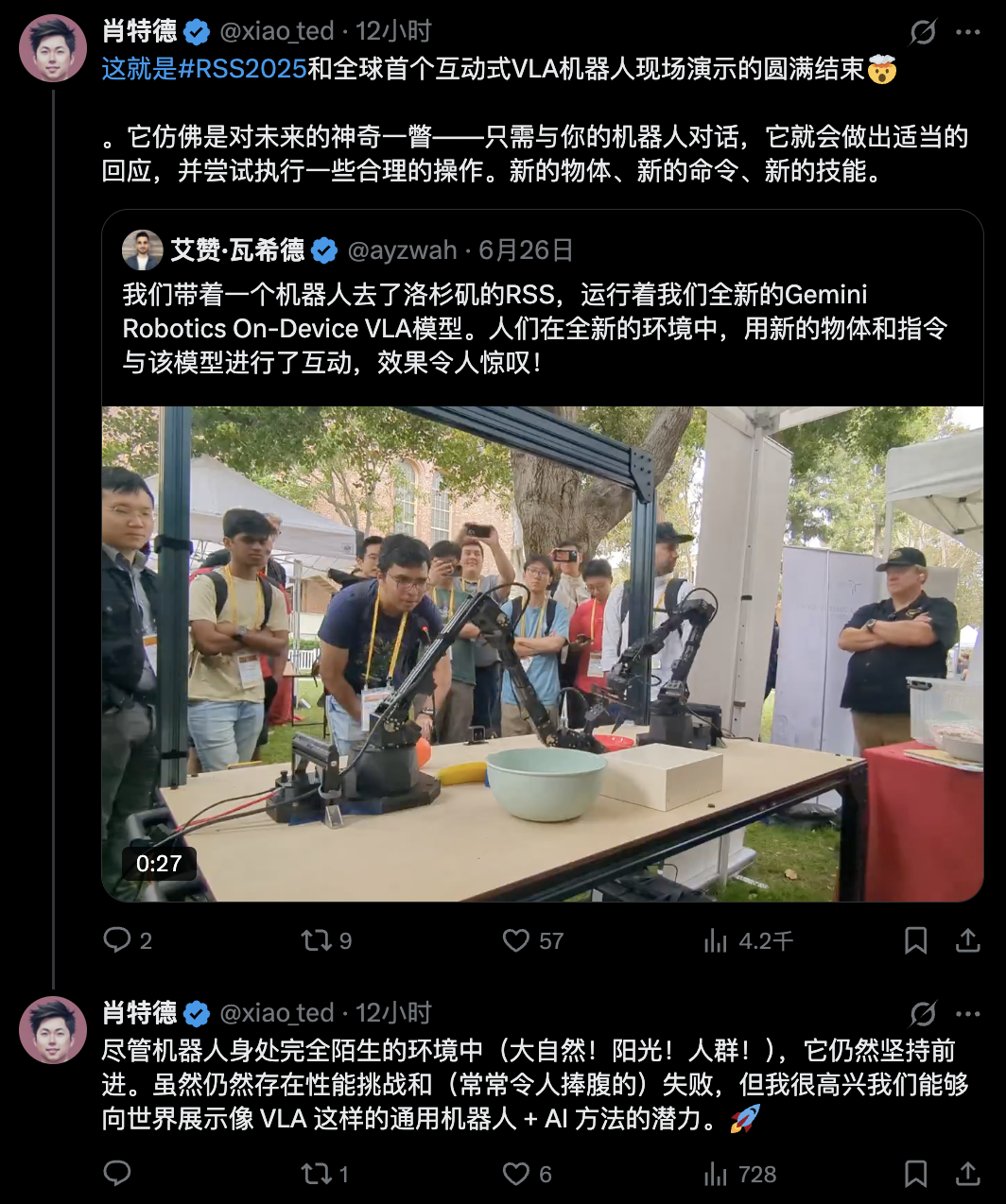
Core Viewpoint - The article discusses the advancements in robotics powered by Google's Gemini AI technology, highlighting its ability to perform tasks without continuous internet connectivity and its potential impact on the robotics industry [2][6][24]. Group 1: Gemini Robotics On-Device Model - The Gemini Robotics On-Device model was released on June 24, enabling robots to operate offline, which is beneficial for applications sensitive to latency and ensures robustness in intermittent or zero connectivity environments [6][7]. - This model aims to enhance robots' adaptability to new tasks and environments, addressing issues such as dexterous manipulation, fine-tuning for new tasks, and low-latency inference based on local operation [9][20]. - In performance comparisons, Gemini Robotics On-Device showed significant improvements over previous offline models, although slightly lower than the flagship Gemini Robotics model [14][16]. Group 2: Task Performance and Adaptability - The model demonstrated strong visual, semantic, and behavioral generalization capabilities, successfully completing tasks like placing blocks and opening drawers based solely on natural language commands [13][20]. - After being trained with 50 to 100 examples, the model exhibited impressive adaptability, allowing developers to fine-tune it for new tasks quickly [20]. - The model was tested on dual-arm robots, successfully executing complex tasks that require precision and dexterity, such as folding clothes and industrial assembly [20][22]. Group 3: Industry Implications and Comparisons - The introduction of Google's offline AI robots has the potential to change the game in the robotics sector, although there are questions about how it compares to Tesla's robot designs and Meta's work [24]. - The article emphasizes the diversity and richness of technological approaches in the robotics and embodied intelligence field, all aiming to enable AI to establish genuine causal understanding in the physical world [24].


谷歌拍了拍Figure说,“起来卷”
Hu Xiu· 2025-06-28 06:50
Core Insights - Google's Gemini Robotics On-Device model showcases the ability of robots to adapt quickly to new tasks and environments without continuous internet connectivity, marking a significant advancement in offline AI robotics [3][5][16] - The model is designed to enhance the efficiency and speed of robots in performing tasks through a "visual-language-action" framework, allowing for robust performance even in intermittent connectivity scenarios [3][5][19] Group 1: Model Features and Performance - The Gemini Robotics On-Device model was launched on June 24 and is the first of its kind to operate independently of data networks, which is beneficial for latency-sensitive applications [3][5] - It addresses three main challenges: dexterous manipulation, fine-tuning for new tasks, and low-latency reasoning based on local operation [5][12] - In demonstrations, the model successfully completed tasks such as placing blocks and opening drawers using natural language commands, indicating strong visual, semantic, and behavioral generalization capabilities [8][10] Group 2: Comparison with Other Technologies - The Gemini Robotics On-Device model, while slightly lower in performance than the flagship Gemini Robotics model, significantly outperforms previous best offline models [8][10] - It offers developers the option to fine-tune the model with as few as 50 to 100 demonstrations, enhancing its adaptability to new tasks [12][14] - The model has been tested on various robotic platforms, including the dual-arm Franka and Apptronik's Apollo humanoid robot, demonstrating its versatility in handling previously unseen objects and tasks [14][17] Group 3: Industry Context and Implications - The advancements in Gemini Robotics highlight the competitive landscape in the robotics and embodied intelligence sector, where various companies are exploring diverse technological approaches to enable AI to understand and interact with the physical world [19] - The ongoing developments suggest a potential shift in the robotics industry, with Google's offline AI robots being seen as game-changers by some observers [16][19] - The discourse around the technology raises questions about its differentiation from competitors like Tesla and Meta, indicating a vibrant and competitive environment in AI robotics [18][19]
五洲新春募资10亿,剑指7万台人形机器人量产|21新智人
2 1 Shi Ji Jing Ji Bao Dao· 2025-06-17 11:46
Core Viewpoint - Wuzhou Xinchun (603667.SH) announced a refinancing plan aimed at mass production of key robot components, raising up to 1 billion yuan, with 700 million yuan allocated for the development and industrialization of core components for humanoid robots and automotive intelligent driving [1][2]. Group 1: Investment and Production Capacity - The total investment plan for Wuzhou Xinchun is 1.055 billion yuan, with production capacity designed to include 980,000 sets of planetary roller screws, 2.1 million sets of micro ball screws, 70,000 sets of general-purpose robot bearings, and additional automotive steering and brake system components [2][3]. - The investment is expected to supply linear actuators and dexterous hand components for approximately 70,000 humanoid robots, with specific component requirements outlined for the robots [3][4]. Group 2: Market Context and Competition - The humanoid robot market is projected to grow significantly, with Tesla planning to produce between 1,000 to 10,000 units of its Optimus robot by 2026, and another company, Figure, aiming to deliver 100,000 humanoid robots over the next four years [5][6]. - Other companies, including Yushutech and various listed firms, are also ramping up production capacity in anticipation of a surge in demand for humanoid robots [6][7]. Group 3: Industry Growth Projections - The global humanoid robot market is expected to reach 1.017 billion USD in 2024 and grow to 15 billion USD by 2030, with a compound annual growth rate exceeding 56% from 2024 to 2030 [7]. - Sales forecasts indicate that the global humanoid robot market could see sales of 12,400 units by 2025 and approach 340,000 units by 2030, with long-term projections suggesting over 5 million units sold by 2035 [7].

拆解特斯拉机器人供应链:30 多位从业者看到的泡沫和希望
芯世相· 2025-06-13 10:30
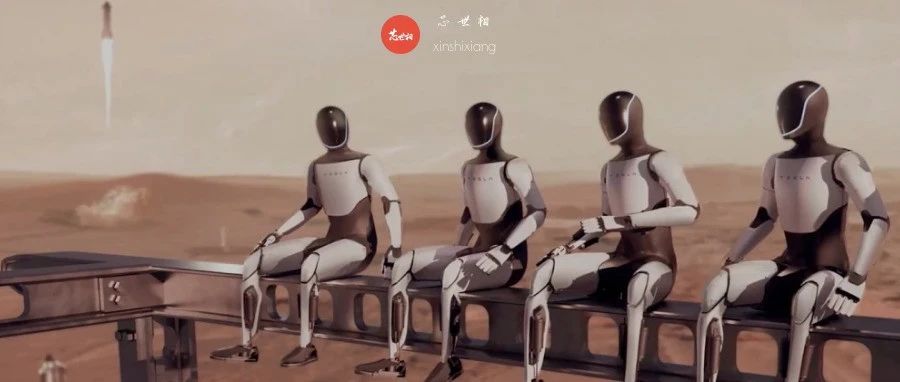
Core Viewpoint - The article discusses the current state and future potential of humanoid robots, particularly focusing on Tesla's efforts in this field, highlighting both the technological challenges and market expectations surrounding humanoid robots [2][3][4]. Group 1: Market Dynamics - Since Tesla showcased its humanoid robot in October 2022, the A-share robot concept sector has surged by 93%, while the Shanghai and Shenzhen 300 Index only increased by about 1% [2]. - Global investors and suppliers have invested over 100 billion yuan in humanoid robots since Tesla's announcement, indicating strong market interest and speculation [3]. - The global humanoid robot industry is expected to ship nearly 20,000 units this year, which is comparable to the weekly production of Rolex watches [4]. Group 2: Technological Challenges - Humanoid robots currently rely on approximately 30 actuators to perform movements, which is significantly less complex than the human body that utilizes over 600 muscles [7]. - The use of planetary roller screws in Tesla's robots allows for greater load capacity and precision, essential for humanoid functionality [12]. - The current humanoid robots cannot walk quietly, and many companies are exploring various solutions to improve their locomotion capabilities [15]. Group 3: Supply Chain and Production - Tesla has engaged hundreds of global suppliers to develop specific components for humanoid robots, with many companies realizing the unusual nature of these orders only after the robot's public debut [22][23]. - The supply chain for humanoid robots has evolved significantly, with companies like Sanhua Intelligent Control and Top Group benefiting from their partnerships with Tesla [23]. - The production of Tesla's humanoid robots is currently focused on specific tasks within the factory, such as moving battery packs, which raises questions about the broader application of these robots [46]. Group 4: Cost and Economic Viability - The estimated cost of Tesla's latest humanoid robot is around $60,000, which is significantly higher than the target of $20,000 to $30,000 set by Elon Musk [27]. - The operational cost of a humanoid robot is comparable to the salary of a human worker, making it economically challenging to replace human labor in many scenarios [46]. - The lifespan of critical components in humanoid robots is limited, leading to high maintenance costs that could offset initial savings from automation [31]. Group 5: Future Prospects - The humanoid robot industry is exploring AI and software solutions to enhance hardware capabilities, with hopes of achieving greater efficiency and functionality [32][39]. - Companies are investing in developing models that can learn and adapt to various tasks, similar to advancements seen in AI language models [38]. - Despite the optimism in the market, the practical applications of humanoid robots remain limited, with many companies still facing significant technological hurdles [45].

Figure自曝完整技术:60分钟不间断打工,我们的机器人如何做到?
量子位· 2025-06-13 05:07
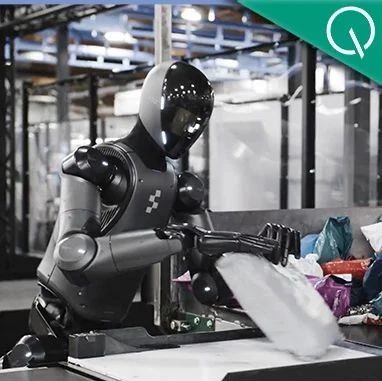
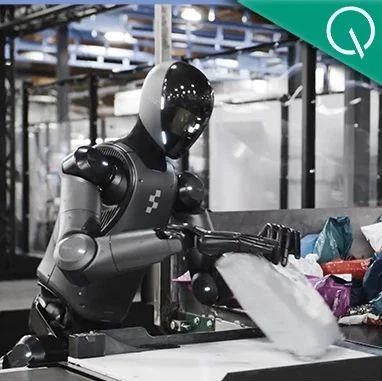
Core Viewpoint - The article highlights the advancements in robotics, particularly focusing on the capabilities of the Helix system developed by Figure, showcasing its ability to handle a wider variety of packages with improved efficiency and accuracy [1][7][19]. Technical Improvements - The Helix system has undergone significant enhancements due to the expansion of high-quality demonstration datasets and architectural improvements in its visuo-motor policy, leading to increased stability under high-speed workloads [7][20]. - The introduction of state awareness and force sensing has enhanced the robustness and adaptability of the robots without sacrificing efficiency [8]. Data Expansion - The range of packages that the Helix system can handle has expanded to include not only standard cardboard boxes but also polyethylene bags, envelopes, and other flexible or crumpled items [10]. - The system has developed adaptive strategies for different package shapes, such as flipping cardboard boxes with both hands or gently pinching the edges of envelopes [13][15]. Performance Metrics - The average processing speed for packages is approximately 4.05 seconds, with throughput increasing by 58% and barcode success rates rising from 88.2% to 94.4% [17][30]. - The improvements indicate a more agile and reliable system capable of operating at speeds and accuracy levels closer to human performance [19]. Architectural Enhancements - The Helix system's architecture has been improved with new memory and sensing modules, enhancing its ability to perceive environmental changes [20]. - Key components include: - **Visual Memory**: Allows the robot to recall previous frames to locate barcodes effectively [22][25]. - **State History**: Enables the robot to maintain context during actions, improving its ability to correct movements quickly [26][27]. - **Force Feedback**: Provides tactile feedback to adjust movements dynamically, enhancing control and adaptability [28]. Human Interaction - The Helix system can autonomously sort packages and establish human-robot interaction without separate programming, recognizing cues from humans to hand over items [31][33]. Community Response - The release of the unedited 60-minute video has generated significant interest and discussion among viewers, with varied opinions on the implications of robotics in logistics and the future of human jobs [34][37][38].
Figure自曝完整技术:60分钟不间断打工,我们的机器人如何做到?
量子位· 2025-06-13 05:07
Core Insights - The article highlights the advancements in robotics, particularly focusing on the capabilities of the Helix system developed by Figure, which showcases improved performance in handling various types of packages in logistics [1][7][19]. Technical Improvements - The Helix system has undergone significant enhancements due to the expansion of high-quality demonstration datasets and architectural improvements in its visuo-motor policy, leading to increased stability under high-speed workloads [7][19]. - The system can now handle a wider variety of package shapes and materials, including polyethylene bags and envelopes, demonstrating its adaptability [10][17]. - The introduction of real-time data observation allows the robot to learn and adjust its actions dynamically, improving its efficiency and accuracy [2][8]. Performance Metrics - The average processing speed for packages is approximately 4.05 seconds, with throughput increasing by 58% and barcode scanning success rates rising from 88.2% to 94.4% [17][30]. - The Helix system's new strategies have led to a success rate of 94% for barcode orientation and maintained an accuracy of over 92% [30]. System Architecture - The Helix system incorporates three main components: visual memory, state history, and force feedback, enhancing its ability to perceive and interact with its environment [20][22]. - Visual memory allows the robot to recall previous frames to locate barcodes effectively, while state history helps maintain context during operations [23][27]. - Force feedback enables the robot to adjust its movements based on tactile information, improving control and adaptability to different package weights and shapes [28]. Human Interaction - The Helix system can seamlessly engage in human-robot interaction without the need for separate programming, recognizing cues from humans to hand over packages [31][33]. Community Reactions - The release of the unedited 60-minute video showcasing the robot's capabilities has sparked discussions among viewers, with some praising the transparency and others questioning the implications for human labor in logistics [34][37][38].
腾讯研究院AI速递 20250612
腾讯研究院· 2025-06-11 14:31
Group 1: OpenAI and Mistral AI Developments - OpenAI released the inference model o3-pro, which is marketed as having the strongest reasoning ability but the slowest speed, with input pricing at $20 per million tokens and output at $80 per million tokens [1] - User tests indicate that o3-pro excels in complex reasoning tasks and environmental awareness but is not suitable for simple problems due to its slow inference speed, targeting professional users [1] - Mistral AI launched the strong inference model Magistral, which includes an enterprise version Medium and an open-source version Small (24B parameters), showing excellent performance in multiple tests [2] - Magistral achieves a token throughput that is 10 times faster than competitors, with a pricing strategy of $2 per million tokens for input and $5 per million tokens for output [2] Group 2: Figma and Krea AI Innovations - Figma introduced the official MCP service, allowing direct import of design file variables, components, and layouts into IDEs, achieving a higher fidelity than third-party MCPs [3] - Krea AI launched its first native model Krea 1, focusing on solving issues of AI image "homogenization" and "plasticity," providing high aesthetic control and professional-grade output [4][5] - Krea 1 supports style reference and custom training, with native support for 1.5K resolution expandable to 4K, aimed at accelerating digital art creation processes [5] Group 3: ByteDance and Tolan AI Applications - ByteDance released the Doubao large model 1.6 series, which includes multiple versions supporting 256k context and multimodal reasoning, with a 63% reduction in comprehensive costs [6] - Tolan, an alien AI companion application, has achieved 5 million downloads and $4 million ARR, emphasizing a non-romantic, non-tool-like companionship experience [7] - Tolan's design integrates companionship with gamification, allowing users to customize their alien companion's appearance and develop unique planetary environments [7] Group 4: Li Auto and Figure Robotics Strategy - Li Auto established two new departments, "Space Robotics" and "Wearable Robotics," to enhance its AI strategy, focusing on creating a smart in-car experience [8] - Figure aims to provide a complete "labor force" system with humanoid robots, emphasizing fully autonomous operation and a production line capable of producing 12,000 units annually [9] - Figure plans to deliver 100,000 units over the next four years, targeting both commercial and home markets, while utilizing a shared neural network for collective learning [9] Group 5: Altman's Predictions and OpenAI Codex Insights - Altman predicts that by 2025, AI will be capable of cognitive work, with significant productivity boosts expected by 2030 as AI becomes more affordable [10] - OpenAI Codex is shifting software development from synchronous "pair programming" to asynchronous "task delegation," anticipating a transformation in developer roles by 2025 [11] - The team envisions a future where the interaction interface merges synchronous and asynchronous experiences, potentially evolving into a "TikTok"-like information flow for developers [11]