歌尔股份

Search documents
对话理想范皓宇、陈伟:1699元的AI眼镜,要成为理想汽车的最强辅件
雷峰网· 2025-12-03 13:05
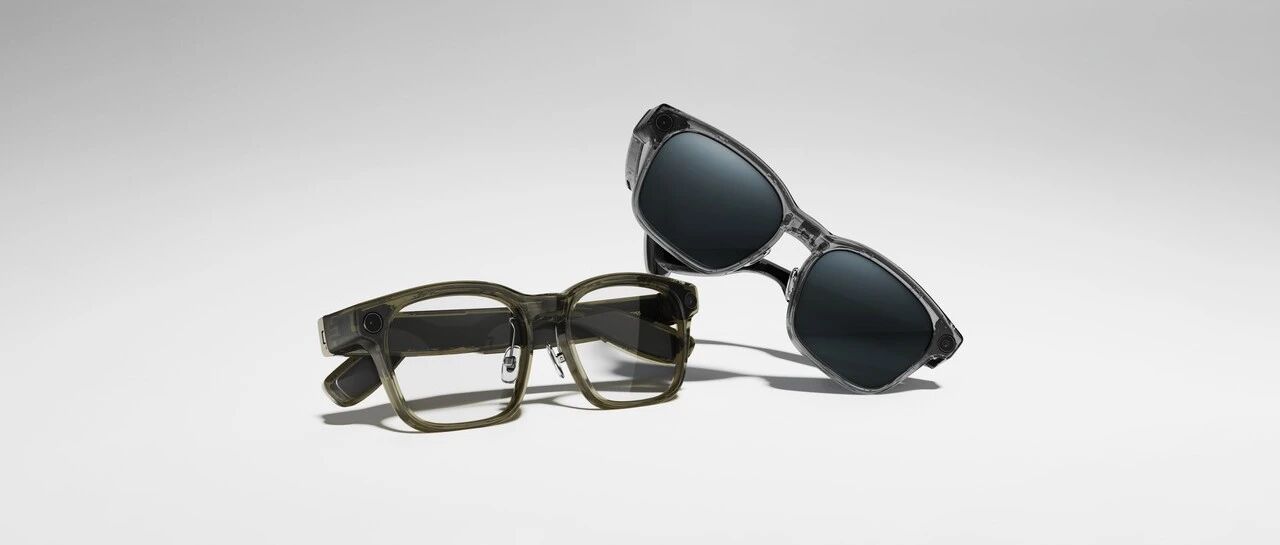
Core Viewpoint - The company emphasizes that AI is a goal and purpose, not merely a tool for market value management, focusing on product quality instead [1][17]. Group 1: Product Launch and Market Context - On December 3, the company launched its first-generation AI glasses, Livis, priced at 1999 yuan, with a post-subsidy price starting at 1699 yuan, marking its entry into the wearable smart device market [2]. - The global smart glasses market is projected to see a 110% year-on-year increase in shipments in the first half of 2025, with AI glasses dominating, particularly in China, which is expected to grow by 107% [2][12]. - The AI glasses market faces significant consumer pain points, particularly in balancing battery life, weight, and performance [2]. Group 2: Technical Specifications and Features - Livis boasts an average battery life of 18.8 hours and a standby time of 78 hours, significantly outperforming the average of 8 hours for AI glasses, achieved through a 240mAh graphene battery and a proprietary power management system [3][5]. - The glasses weigh 36 grams, lighter than competitors, due to the use of TR90 material and titanium alloy components [5]. - Livis features voice control for vehicle functions, with an end-to-end response time of 800 milliseconds, significantly faster than using a smartphone [5]. - The glasses run on a self-developed RTOS, ensuring speed and efficiency, and support features like real-time audio recording and 1080P video capture [5][6]. Group 3: Target Audience and Future Plans - The initial target audience for Livis includes approximately 1.5 million existing car owners and tech enthusiasts, with plans to expand the user base over time [9][40]. - Future iterations of the AI glasses will include models with display capabilities and independent communication features, with development having begun as early as June of the previous year [10][12]. - The company aims to create a comprehensive ecosystem around AI capabilities, integrating various devices and enhancing user experience [11][12]. Group 4: Strategic Vision and Market Positioning - The company views the development of AI glasses as part of a broader strategy to integrate AI into both automotive and wearable technologies, focusing on user-centric design and functionality [11][56]. - The company believes that addressing fundamental issues such as battery life, comfort, and responsiveness will lead to positive market feedback and sustainable revenue [52][55]. - The company does not prioritize market share but rather aims to solve basic user needs effectively, positioning itself as a leader in the AI glasses market [52][55].


“豆包AI手机”一天卖断货,四类AI应用端ETF或可关注
Xin Lang Cai Jing· 2025-12-03 10:06
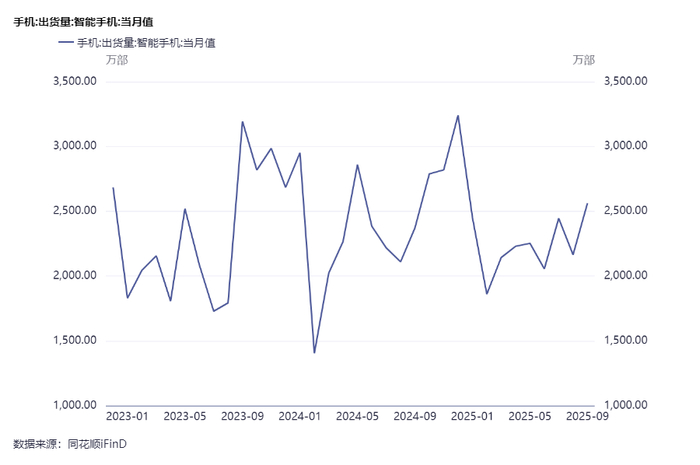
Core Insights - The introduction of Doubao AI phone by ByteDance aims to disrupt the smartphone industry by integrating AI in a way that transcends traditional app functionalities [1][4] - The smartphone market has seen stagnant growth, with monthly shipments remaining around 25 million units over the past three years, indicating a shift in consumer behavior towards longer upgrade cycles [1] - The success of Doubao AI phone is attributed to its innovative approach, which contrasts with previous attempts by brands like Honor that failed to resonate with consumers [1] Smartphone Market Dynamics - Traditional smartphone upgrades have slowed, with average replacement cycles extending from 18 months to 40 months as consumers prioritize essential spending [1] - The smartphone market's monthly shipment figures have plateaued, reflecting a lack of significant growth in the industry [1] AI Integration in Smartphones - Doubao's model redefines the role of apps and UI, focusing on modular services that can be called upon by AI as needed, thus minimizing user awareness of the AI's presence [4] - The future of smartphone advancement may hinge on the ability of AI to handle a majority of routine tasks seamlessly, shifting the competitive landscape [4] Investment Opportunities - The launch of Doubao AI phone has sparked interest in AI-related stocks, with companies like ZTE experiencing significant stock price increases following the announcement [6] - Investors are encouraged to explore various ETFs related to AI applications, with categories including gaming, media, consumer electronics, and VR [5][7][8][12][14] ETF Categories - **Gaming ETFs**: The gaming sector is expected to benefit from the rise of AI applications, with specific indices like the Zhongzheng Animation and Gaming Index capturing a significant portion of the market [7] - **Media ETFs**: Media companies are also poised to gain from AI advancements, particularly in advertising and content creation, with indices like the Zhongzheng Media Index being relevant for investors [8][11] - **Consumer Electronics ETFs**: The consumer electronics sector is likely to see growth due to the AI phone trend, with major indices covering a wide range of related companies [12][13] - **VR ETFs**: Virtual reality is highlighted as a niche within consumer electronics, with specific indices focusing on VR applications and gaming [14]
消费电子跟踪报告:豆包AI助手问世,端侧硬件有望迎来爆发
GUOTAI HAITONG SECURITIES· 2025-12-03 09:31
Investment Rating - The report assigns an "Accumulate" rating for the industry [6] Core Insights - The launch of the AI mobile assistant by Doubao marks a significant step towards the era of AI smartphones, enhancing the hardware ecosystem [2][6] - Doubao's AI assistant integrates deeply with the operating system, allowing for complex command execution and seamless user interaction across applications [6] - The report highlights the potential for Doubao to provide AI capabilities to mid-range smartphone manufacturers, enhancing their competitiveness in the AI era [6] Summary by Sections Industry Overview - The report discusses the rapid emergence of AI smartphones and the growing ecosystem of edge hardware, driven by innovations from major manufacturers [2][6] Investment Recommendations - Recommended stocks include Luxshare Precision, GoerTek, and Pengding Holdings, with related stocks being Transsion Holdings, Lens Technology, and Haopeng Technology [6][7] Technology Insights - Doubao's AI assistant can understand and interact with the content displayed on the user's screen, facilitating complex tasks such as price comparisons and travel planning [6] - The assistant operates without interrupting ongoing app processes, enhancing user experience [6] Market Potential - The report emphasizes the opportunity for Doubao to collaborate with smartphone manufacturers, creating a business model that combines AI capabilities with hardware [6] - The edge hardware ecosystem is expected to grow rapidly, with Doubao's technology enabling usability in devices like AI glasses and TWS earbuds [6]




培育钻石大涨,消费电子下挫,赛维电子跌近20%,外资看好中国股市
2 1 Shi Ji Jing Ji Bao Dao· 2025-12-03 08:05
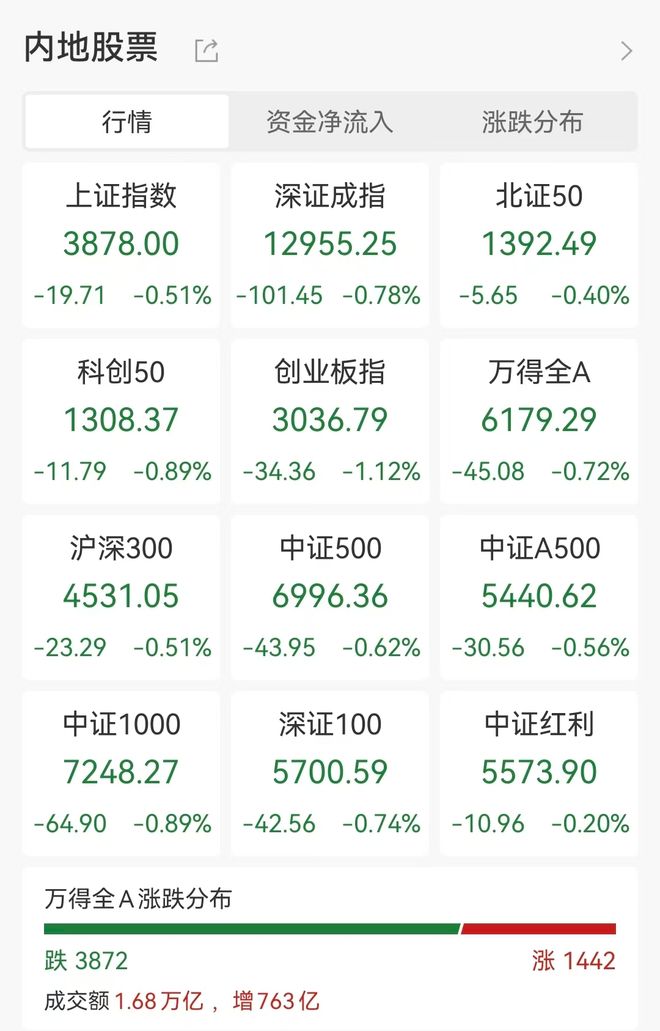
Market Overview - The A-share market experienced fluctuations, with the Shanghai Composite Index closing down 0.51%, the Shenzhen Component down 0.78%, and the ChiNext Index down 1.12% after an early gain of over 1% [1] - The total trading volume in the Shanghai and Shenzhen markets reached 1.68 trillion yuan, an increase of 763 billion yuan compared to the previous trading day, with over 3,800 stocks declining [1] Sector Performance - The coal sector showed strength, with companies like Antai Group and Dayou Energy hitting the daily limit, while the wind power sector also rose significantly with companies like Daikin Heavy Industries and Delijia reaching the daily limit [3] - The cultivated diamond sector saw a surge, with stocks like Sifangda and Huifeng Diamond rising over 10%, driven by the upcoming 2025 Cultivated Diamond Industry Conference [3] - Conversely, the AI application sector faced a collective decline, with stocks like Fushi Holdings and Yinsai Group experiencing significant drops [3] Individual Stock Highlights - China Uranium Industry, known as the "first stock of uranium," saw a dramatic increase of nearly 350% during its debut, reaching a peak of 80 yuan per share, with a current price of 67.99 yuan, resulting in a potential profit of approximately 31,000 yuan for investors [4] - Jinfu Technology closed at the daily limit down, following a series of consecutive gains over the past seven trading days [4] Foreign Investment Trends - UBS Securities highlighted a positive outlook for Chinese stocks, projecting that the overall A-share profit growth could rise from 6% this year to 8% in 2026, supported by macro policies and a recovery in profit margins [6] - Foreign capital inflow into the Chinese stock market reached 50.6 billion USD in the first ten months of 2025, significantly surpassing the total of 11.4 billion USD for the entire year of 2024, with a focus on the technology sector [7] - Recent data indicated substantial inflows from both domestic and foreign investors into the Chinese stock market, with foreign capital inflowing 22.57 million USD in the past week [7]
培育钻石大涨,消费电子下挫,赛维电子跌近20%,外资看好中国股市
21世纪经济报道· 2025-12-03 08:01
Market Overview - The A-share market experienced fluctuations on December 3, with the Shanghai Composite Index falling by 0.51% to close at 3878.00, and the Shenzhen Component Index down 0.78% at 12955.25. The ChiNext Index dropped 1.12% to 3036.79. The total trading volume reached 1.68 trillion yuan, an increase of 763 billion yuan compared to the previous trading day, with over 3800 stocks declining [1]. Sector Performance - The sectors that performed well included cultivated diamonds, coal, and wind power equipment, while AI applications and lithium mining saw significant declines. The coal sector showed strength with companies like Antai Group and Dayou Energy hitting the daily limit up. The wind power sector also surged, with companies like Daikin Heavy Industries and Delijia reaching the daily limit up. In the cultivated diamond sector, stocks like Sifangda and Huifeng Diamond rose over 10% [2]. Individual Stock Highlights - China Uranium Industry, known as the "first stock of uranium," saw a dramatic increase of nearly 350% on its debut, reaching a peak of 80 yuan per share, and closing at 67.99 yuan, up 280.04% from its issue price of 17.89 yuan. Investors could potentially earn around 31,000 yuan per lot based on the peak price [3]. Foreign Investment Trends - UBS's China stock strategy analyst Meng Lei indicated that the nominal GDP growth and narrowing PPI decline are expected to boost corporate revenue growth, with A-share earnings growth projected to rise from 6% this year to 8% by 2026. Factors such as macro policy support, accelerated A-share earnings growth, and continuous inflow of long-term capital are anticipated to drive further valuation increases in the A-share market [6]. - Data from the International Financial Association revealed that foreign capital inflow into the Chinese stock market reached 50.6 billion USD in the first ten months of 2025, significantly surpassing the 11.4 billion USD for the entire year of 2024. The technology sector has become a focal point for foreign investment, with the market value of foreign holdings in the electronic sector rising to 391.5 billion yuan [7].

这个板块“老树发新芽”,180亿资金闻风而动丨每日研选
Shang Hai Zheng Quan Bao· 2025-12-03 01:20
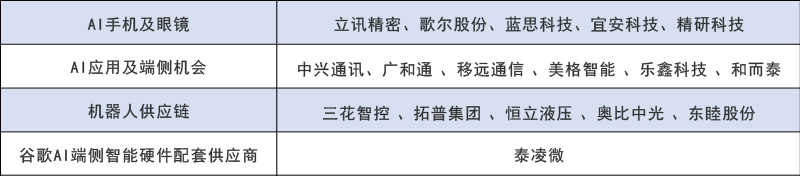
Core Insights - Apple is aggressively pursuing AI technology, competing with ByteDance, Google, and Alibaba, as the sector sees significant capital inflow, exceeding 18 billion yuan over six consecutive trading days [1] - The consumer electronics sector is experiencing a revival, driven by the integration of AI technology with smart hardware, leading to structural opportunities [1] - The global smartphone market is entering an AI-native era, with predictions of AI smartphone penetration rising from approximately 18% in 2024 to nearly 60% by 2029 [1] Group 1: AI Smartphone and Market Trends - The smartphone market is transitioning to an AI-native phase, with major brands like Apple and Huawei leveraging generative AI as a core selling point to shorten upgrade cycles [1] - AI smartphone shipment penetration is expected to increase significantly, indicating a robust growth trajectory for the sector [1] Group 2: AI Smart Glasses - AI smart glasses are emerging as a key platform for AI applications, with products like Ray-Ban Meta gaining market acceptance [2] - The decline in hardware costs and the maturation of the supply chain are expected to position AI glasses as the next major wearable product after TWS earbuds [2] Group 3: Robotics and Supply Chain Opportunities - Traditional consumer electronics component manufacturers are actively entering the robotics sector, driven by the high demand for precision components in humanoid robots [2] - Companies like Lens Technology are leveraging their manufacturing expertise to tap into the robotics supply chain, anticipating a significant increase in humanoid robot shipments [2] Group 4: Expanding AI Ecosystem - The AI ecosystem is continuously expanding, with Apple's Siri evolving towards an AI Agent model, potentially driving a wave of smartphone upgrades and AR glasses adoption [2] - Collaboration between terminal manufacturers and AI companies is enhancing ecosystem development, facilitating deeper integration of computing power, hardware, and application scenarios [2] Group 5: Investment Recommendations - Focus on AI smartphones and AR glasses penetration opportunities, recommending companies like Luxshare Precision, GoerTek, Lens Technology, Yian Technology, and Jien Technology [3] - Highlight AI applications and edge opportunities, with recommendations for ZTE, Guanghetong, and others [3] - Emphasize the robotics supply chain, identifying key suppliers like Sanhua Intelligent Controls and Top Group as potential beneficiaries [3] - Pay attention to Google AI edge hardware suppliers like Tailin Microelectronics, which are integrated into major platforms [3][4]

消费电子爆发!5大龙头股深度回调超30%,证金社保北向资金却逆势重仓
Sou Hu Cai Jing· 2025-12-02 20:40
这波行情背后是政策端和产品端的双重利好共振:工信部等六部门近日联合印发《关于增强消费品供需适配性进一步促进消费的实施方案》,明确推动人工 智能在消费电子全领域全过程应用;同时,科技巨头在AI手机、AI眼镜等端侧硬件上密集创新,中兴通讯与字节跳动豆包合作推出AI手机工程样机,阿里 巴巴发布自研AI眼镜,理想汽车也宣布入局"百镜大战"。 更引人注目的是,尽管这些消费电子龙头股此前跌幅普遍超过25%,但证金公司、社保基金和北向资金却逆势加仓,显示出机构投资者对板块后市的强烈信 心。 消费电子板块的强势表现从早盘就开始显现。 12月1日,立讯精密突然直线封板,最高封单金额超过46亿元,引爆整个消费电子赛道。 苹果概念股集体拉升,工业富联、歌尔股份、蓝思科技等多只个股跟涨,消费电子板块整体表现相当强劲。 截至午间收盘,沪指重返3900点上方,深成指、创业板指盘中均涨超1%,全市场超3600只个股上涨。 这种强势格局延续到了午后,消费电子板块涨幅进一步扩大,沪深两市成交额较上一个交易日放量2881亿元,达到1.87万亿元。 最近,消费电子板块成了A股市场最耀眼的明星。 12月1日,消费电子方向集体爆发,中兴通讯、博通集成 ...
12月2日内地消费电子(983105)指数跌0.04%,成份股美图公司(01357)领跌
Sou Hu Cai Jing· 2025-12-02 16:15
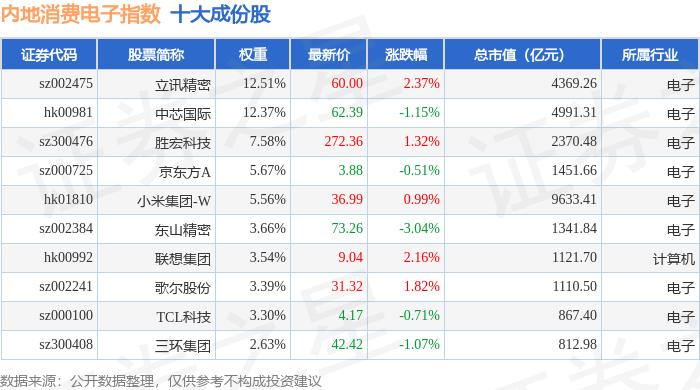
Core Points - The mainland consumer electronics index (983105) closed at 4679.66 points, down 0.04%, with a trading volume of 75.462 billion yuan and a turnover rate of 1.56% [1] - Among the index constituents, 20 stocks rose while 29 fell, with AAC Technologies leading the gainers at 3.95% and Meitu leading the decliners at 6.0% [1] Index Constituents Summary - The top ten constituents of the mainland consumer electronics index are as follows: - Luxshare Precision (sz002475) holds a weight of 12.51%, latest price at 60.00 yuan, with a market cap of 436.926 billion yuan and a rise of 2.37% [1] - SMIC (hk00981) has a weight of 12.37%, latest price at 62.39 yuan, with a market cap of 499.131 billion yuan and a decline of 1.15% [1] - Other notable constituents include BOE Technology (sz000725) with a weight of 5.67% and a market cap of 145.166 billion yuan, and Xiaomi (hk01810) with a weight of 5.56% and a market cap of 963.341 billion yuan [1] Capital Flow Analysis - The net inflow of main funds into the index constituents totaled 775 million yuan, while retail funds saw a net outflow of 347 million yuan [3] - Key stocks with significant fund flows include: - Luxshare Precision with a net inflow of 604 million yuan, accounting for 5.53% of the main funds [3] - Other stocks like GoerTek (sz002241) and Shenghong Technology (300476) also experienced notable fund movements [3]



青岛“十四五”期间GDP连续跨越五个千亿级台阶
Zhong Guo Jing Ji Wang· 2025-12-02 14:48
Economic Growth - Qingdao's GDP is expected to exceed 1.7 trillion yuan this year, with an average annual growth rate of 5.9%, ranking among the top in similar cities [1] - The total retail sales of consumer goods have an average annual growth of 6.4%, surpassing 650 billion yuan, second only to Beijing among northern cities [1] - The total import and export volume has an average annual growth of 9.1%, exceeding 900 billion yuan, accounting for over 2% of the national total [1] Industrial Development - Qingdao focuses on the real economy during the 14th Five-Year Plan, accelerating the construction of the "10+1" innovative industrial system and the "4+4+2" modern marine industry system [2] - High-tech manufacturing added value has an average annual growth of 15.9%, with the ranking of advanced manufacturing cities rising from 11th in 2020 to 6th in 2024 [2] - The service sector's added value has surpassed 1 trillion yuan, with an average annual growth of 6.5%, contributing approximately 65% to economic growth [2] Technological Innovation - Qingdao places significant emphasis on technological innovation, with annual R&D expenditure growth averaging 11.6% over the past four years [3] - The number of high-tech enterprises and technology-based SMEs has reached 8,683 and 9,776 respectively, which is 1.98 times and 1.85 times that of the end of the 13th Five-Year Plan [3] - The total talent pool in Qingdao has reached 3 million, an increase of 700,000 compared to the end of the 13th Five-Year Plan [3] Reform and Opening Up - Qingdao has implemented 352 national and provincial reform pilot projects, ranking among the top ten in the national business environment for three consecutive years [4] - The number of private enterprises has reached 2.062 million, with nearly 300,000 new entities added since the end of the 13th Five-Year Plan [4] - The city has attracted a total of 18.47 billion USD in foreign investment, accounting for 22.6% of the province's total [4]
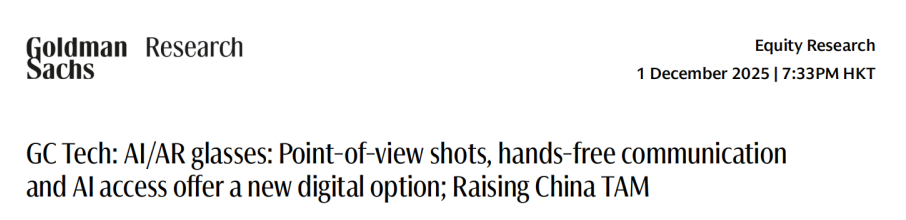
高盛上调中国AI眼镜市场预期:明后年出货量翻倍增长,5年后市场规模达30亿美元
智通财经网· 2025-12-02 13:20
Core Insights - Goldman Sachs has raised its forecast for the Chinese AI/AR glasses market, predicting a shipment growth of 87% in 2026 and 121% in 2027, with a market size expected to reach $946 million in 2026, and a compound annual growth rate of 24% from 2027 to 2030, ultimately reaching $3 billion by 2030 [1][2]. Part 1: Product Features and Core Value - The core AI functionalities of current AI/AR glasses include real-time subtitles, instant translation, visual Q&A, AR navigation, and AI smart assistants, making them suitable for daily life and seen as potential successors to smartphones [4]. - The first-person perspective experience allows glasses to display content directly in the user's line of sight and deliver sound, enhancing social sharing capabilities [4]. - The hands-free convenience integrates seamlessly into activities like walking and cycling, catering to various personal, entertainment, and office efficiency needs [4]. Part 2: Key Hardware Optimization Directions - Enhancements in perception capabilities involve increasing the number of cameras to improve motion capture and environmental detection accuracy [5]. - AI performance upgrades focus on enhancing the responsiveness and accuracy of smart assistance features [6]. - Display improvements include adopting full-color, high-resolution screens optimized for visibility in bright and dim environments [6]. - Portability enhancements aim to reduce the weight of devices (currently between 35-80 grams) to extend wear time [7]. Part 3: Cost Structure and Supply Chain - The cost structure for AI glasses includes system-on-chip (SoC) at 35%-40%, structural components at 10%-15%, sensors/memory at 5%-10%, acoustic components at 5%-10%, batteries at 3%, packaging at 2%-3%, and other costs at 0%-10% [10]. - For AR glasses, the display accounts for 30%-35%, SoC modules for 20%-25%, optical components for 15%-20%, sensors for 5%-10%, and batteries for 1%-2% [11]. - Key supply chain companies include Sunny Optical for cameras, AUO and BOE for displays, Lianyi Intelligent Manufacturing and Changying Precision for structural components, GoerTek and AAC Technologies for acoustics/batteries, and Qualcomm and Realtek for chips [12]. Part 4: Usage Scenarios and Target Users - Core usage scenarios encompass life and entertainment (first-person perspective recording, AR navigation, immersive gaming, instant messaging), and office efficiency (meeting notes, real-time translation, presentation script display, virtual workstations) [13]. - The target user group includes the 660 million myopic individuals in China (as of 2020) who have a natural habit of wearing glasses [14]. - Early adopters of new technologies, such as drones, robots, and VR devices, are also a significant target market, as Chinese consumers show a high acceptance of innovative tech products [14].