京东方

Search documents
两条8.6代OLED产线今年将量产,高端笔记本将进入OLED时代
第一财经· 2026-01-09 12:08
Core Insights - The article discusses the expansion of flexible OLED panel applications, particularly in the IT and automotive sectors, driven by the upcoming mass production of 8.6-generation OLED panel lines by major manufacturers like BOE and Samsung in 2026 [3][4]. Group 1: OLED Panel Production and Market Penetration - In 2026, BOE and Samsung are expected to start mass production of their 8.6-generation OLED panel lines in Q2, which will accelerate the adoption of flexible and hybrid OLED panels in laptops [3]. - TCL Huaxing and Visionox are projected to begin mass production of their 8.6-generation OLED panel lines in Q3 and Q4 of 2027, respectively, further enhancing OLED panel usage in laptops [3]. - By 2030, the penetration rate of OLED panels in laptops is anticipated to reach approximately 19%, with OLED screens dominating the high-end laptop market [3]. Group 2: Advantages of OLED Panels - Compared to LCD screens, laptops equipped with OLED screens will offer superior performance in terms of lightweight design, portability, and image quality [4]. - The expected shipment volume of OLED laptop screens is projected to reach 45 million units by 2030, influenced by the differing production techniques of high-generation OLED panel lines [3][4]. Group 3: Cost and Technology Developments - TCL Huaxing's 8.6-generation OLED production line utilizes printing technology, which simplifies the manufacturing process and theoretically offers cost advantages, making OLED screens more accessible for mainstream laptops [4]. - The introduction of new generation chips by Intel and AMD, utilizing 2-3 nanometer processes, will enhance computing power, transitioning laptops from the 40 TOPS to the 50 TOPS era [4]. Group 4: Market Outlook - Despite rising memory costs, the global laptop market is expected to maintain stable shipment volumes in 2026, with growth anticipated in 2027 [5].




记者手记|“物理AI”成为美消费电子展热议新词
Sou Hu Cai Jing· 2026-01-09 11:40
Core Insights - The 2026 Consumer Electronics Show (CES) in Las Vegas highlights "Physical AI" as a key trend, reflecting a shift in AI technology development and industry focus [1][5][10]. Group 1: Definition and Importance of Physical AI - "Physical AI" refers to enabling autonomous systems like cameras, robots, and self-driving cars to perceive, understand, reason, and execute complex actions in the physical world [5][10]. - Unlike previous AI discussions focused on algorithms and computing power, "Physical AI" emphasizes the integration of AI into robots, autonomous vehicles, and smart devices, allowing them to actively change their environments [5][14]. Group 2: Industry Applications and Innovations - At CES, various demonstrations showcased "Physical AI" in action, including smart robots navigating spaces, self-driving concept cars, and smart home devices executing commands accurately [5][9]. - Companies like Hisense and Xiaomi presented products such as companion robots and AI-driven cleaning devices, illustrating the practical applications of "Physical AI" in everyday life [9][10]. Group 3: Industry Perspectives and Future Directions - Industry leaders, such as Qualcomm and BOE, noted that "Physical AI" is evolving alongside "Personal AI," with applications expanding into wearables, personal devices, and public life scenarios [10][14]. - The integration of display technology and sensors is expected to enhance the capabilities of "Physical AI," leading to machines that not only perform tasks but also think and collaborate [14].

机构调研策略周报(2026.01.05-2026.01.09):机械设备、电子等行业持续获机构关注-20260109
Yuan Da Xin Xi· 2026-01-09 11:24
Investment Rating - The report does not explicitly provide an investment rating for the industry or companies discussed [28]. Core Insights - The report highlights that the mechanical equipment, electronics, and computer industries are currently receiving significant attention from institutional investors, with a notable increase in the number of institutions conducting research in these sectors [10][12]. - Key companies such as Ice Wheel Environment and Nengke Technology are leading in institutional research, showcasing their advancements in high-growth areas like data center cooling and aerospace digitalization [24][26]. Summary by Sections 1. Institutional Research on Popular Industries - During the week of January 5 to January 9, 2026, the mechanical equipment, computer, electronics, automotive, and basic chemicals sectors were the most researched by institutions, with a particular focus on the computer and automotive sectors in the past five days [10][12]. - Over the past 30 days, the same sectors maintained high interest, with mechanical equipment and electronics receiving the most attention from research institutions [12]. 2. Institutional Research on Popular Companies - In the week of January 5 to January 9, 2026, Ice Wheel Environment and BOE Technology Group were among the top companies researched, each receiving attention from more than 10 institutions [16][19]. - Over the past 30 days, Ice Wheel Environment, Kebo Technology, and Dazhu Laser were highlighted for their significant research activity, with Ice Wheel Environment receiving 13 research visits [20][21]. 3. Key Company Research Insights Ice Wheel Environment - The focus of the research on Ice Wheel Environment included advancements in data center liquid cooling, nuclear thermal management, and the commercialization of "dual carbon" technologies. The company has successfully implemented its cooling systems in major projects like the National Supercomputing Center in Guangzhou and is expanding into international markets [24][26]. - The company has also made strides in nuclear power technologies, with successful applications in several nuclear power plants and recent wins in projects related to small modular reactors [24]. Nengke Technology - Nengke Technology showcased its leadership in the aerospace sector, having served over 200 aerospace clients with total orders exceeding 1 billion yuan. The company is leveraging AI technologies in various manufacturing processes, including rocket assembly quality inspection and CAD drawing recognition [25][26]. - The company is also initiating product development in remote sensing based on new customer demands for satellite monitoring, and it has received approval for a fundraising initiative to support the development of three AI platforms [26].


两条8.6代OLED产线今年将量产,高端笔记本将进入OLED时代
Di Yi Cai Jing· 2026-01-09 10:48
Core Insights - The year 2026 is projected to be pivotal for the promotion of affordable AI PCs, driven by the increased application of OLED screens and enhanced CPU capabilities [1][2] Group 1: OLED Panel Development - Two 8.6-generation OLED panel production lines are expected to commence mass production in 2026, accelerating the penetration of flexible and hybrid OLED panels in IT and automotive display sectors [1] - BOE and Samsung's 8.6-generation OLED panels are anticipated to be used in the next generation of Apple's MacBook Pro and will supply Taiwanese IT manufacturers, respectively [1] - TCL Huaxing and Visionox are expected to start mass production of their 8.6-generation OLED panels in Q3 and Q4 of 2027, further supporting the application of OLED panels in laptops [1] Group 2: Market Projections - The penetration rate of OLED panels in laptops is projected to reach nearly 20% by 2030, with OLED screens dominating the high-end laptop market [1] - The shipment volume of OLED laptop screens is expected to reach 45 million units by 2030 [1] Group 3: Technological Advancements - The adoption of OLED screens will enhance laptops' performance in terms of portability and display quality compared to LCD screens [1] - The introduction of new generation chips by Intel and AMD, utilizing 2-3 nanometer processes, is expected to elevate laptop computing power from 40 TOPS to 50 TOPS [2] - The new CPU architectures are anticipated to penetrate mainstream laptop product lines over the next three years, enabling more diverse task processing capabilities [2] Group 4: Market Outlook - Despite rising memory costs, the global laptop market is expected to maintain stable shipment volumes in 2026, with growth anticipated in 2027 [2]
可控核聚变牛股,盘后提醒风险!主力资金出逃股曝光
Zheng Quan Shi Bao· 2026-01-09 10:19
本周主力资金净流出光模块和商业航天概念股。 今日(1月9日),A股全天震荡走强。截至收盘,上证指数涨0.92%,日K线16连阳,站上4100点关 口,最新报4120.43点。深证成指涨1.15%,创业板指涨0.77%。市场全天成交31523.68亿元,较昨日大 幅放量3260.66亿元。 | 行情 | 资金净流入 | 涨跌分布 | | --- | --- | --- | | 上证指数 | 深证成指 | 科创综指 | | 4120.43 | 14120.15 | 1803.40 | | +37.45 +0.92% +160.67 +1.15% +36.83 +2.09% | | | | 万得全A | 创业板指 | 北证50 | | 6737.75 | 3327.81 | 1524.26 | | +78.53 +1.18% +25.51 +0.77% +15.89 +1.05% | | | | 沪深300 | 中证500 | 中证A500 | | 4758.92 | 8056.69 | 5881.95 | | +21.27 +0.45% +162.14 +2.05% +51.38 +0.88% | | | | 中 ...


京东方取得阵列基板及其制备方法、显示面板专利
Sou Hu Cai Jing· 2026-01-09 09:57
Group 1 - The State Intellectual Property Office of China has granted a patent to BOE Technology Group Co., Ltd. and Chengdu BOE Display Technology Co., Ltd. for "Array Substrate and Its Preparation Method, Display Panel," with the authorization announcement number CN116794894B, applied on June 2023 [1] - BOE Technology Group Co., Ltd., established in 1993 and located in Beijing, primarily engages in the manufacturing of computers, communications, and other electronic devices, with a registered capital of 37,413.88 million RMB [1] - The company has invested in 74 enterprises, participated in 299 bidding projects, holds 775 trademark records, and possesses 5,000 patent records, along with 47 administrative licenses [1] Group 2 - Chengdu BOE Display Technology Co., Ltd., established in 2015 and located in Chengdu, focuses on software and information technology services, with a registered capital of 2,155 million RMB [1] - The company has participated in 609 bidding projects, holds 558 patent records, and possesses 841 administrative licenses [1]
光学光电子板块1月9日涨2.11%,乾照光电领涨,主力资金净流出1860.91万元
Zheng Xing Xing Ye Ri Bao· 2026-01-09 08:54
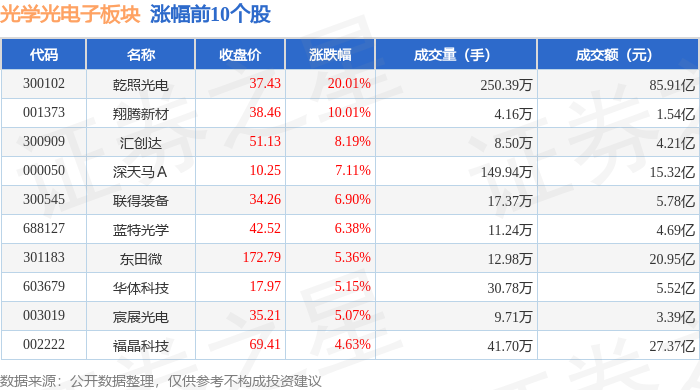
Group 1 - The optical optoelectronics sector increased by 2.11% on January 9, with Qian Zhao Optoelectronics leading the gains [1] - The Shanghai Composite Index closed at 4120.43, up 0.92%, while the Shenzhen Component Index closed at 14120.15, up 1.15% [1] - Qian Zhao Optoelectronics saw a significant rise of 20.01%, closing at 37.43, with a trading volume of 2.5039 million shares and a transaction value of 8.591 billion [1] Group 2 - The optical optoelectronics sector experienced a net outflow of 18.6091 million from institutional funds, while retail investors saw a net inflow of 48.6 million [2] - The trading data indicates that major stocks like Fuzhijing Technology and Deep Tianma A had significant net inflows from retail investors, despite overall sector outflows [3] - The stock performance varied, with some companies like Guangzhi Technology and Wenbisen experiencing declines of 5.92% and 5.81% respectively [2]


通讯丨“中国智造”在美消费电子展舞台逐浪前行
Xin Hua Wang· 2026-01-09 08:28
Core Insights - "Chinese manufacturing" is making significant strides at the CES, showcasing higher innovation density and clearer technological pathways, positioning itself at the forefront of international competition [1] Group 1: Industry Participation - Over a thousand Chinese companies participated in CES, including industry leaders like TCL, Hisense, BOE, and Lenovo, as well as numerous startups [1] - Several Chinese companies received "CES Innovation Awards," highlighting global recognition of their innovative capabilities [1] Group 2: Display Technology - Chinese companies are leading in the display technology sector, shifting focus from single product parameters to AI-supported full-scene application revolutions [2] - TCL had the largest and most diverse exhibition space, showcasing innovations in television screens, electronic writing pads, and AR glasses [2] - Hisense presented next-generation large-screen display solutions, emphasizing color space enhancement and system optimization for eye protection [2] - The Chinese display industry has evolved from a technology follower to a global leader, particularly in LCD and OLED technologies [2] Group 3: Robotics Innovation - AI and robotics were major highlights at CES, with Chinese companies dominating the humanoid robot and related sectors, demonstrating rapid iteration and scalability [3] - Various robots showcased capabilities such as emotional companionship, autonomous lawn maintenance, and advanced coffee-making, emphasizing real-world application [3] - The focus has shifted from conceptual displays to tangible intelligent products that adapt to real environments [3] Group 4: Smart Home Solutions - Smart home technology has become a key area for Chinese companies to demonstrate systemic innovation and lifestyle solutions [4] - Solutions showcased include AI and IoT applications that create intelligent systems capable of perceiving, learning, and interacting [4][5] - Products like smart air conditioners and refrigerators exhibit advanced features such as dynamic energy management and food preservation [5] Group 5: Intelligent Mobility - Intelligent mobility was a focal point, with Chinese automotive companies showcasing innovations in smart cockpits and AI integration [6] - Geely's WAM model enhances understanding of complex driving scenarios, improving overall driving experiences [6] - Chinese companies are transitioning from cost and scale advantages to focusing on user experience, system integration, and technological maturity in the smart mobility sector [6] Group 6: Global Impact - CES serves as a platform for international collaboration and industry dialogue, with China recognized as a key driver of global technological advancement [6] - Chinese consumer electronics companies are accelerating their smart upgrades, becoming pioneers in global AI development [6] - "Chinese manufacturing" continues to navigate the waves of global technological change, contributing to the formation of a new international tech landscape through innovation and application [6]


CES变成中国科技秀:机器人跳舞、熊猫获奖
3 6 Ke· 2026-01-09 08:24
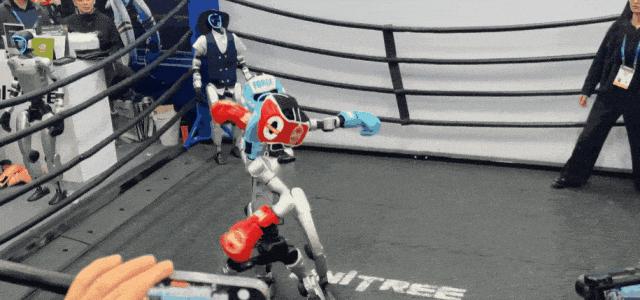
Group 1: Core Themes of CES 2026 - The main theme of CES 2026 is "human-centered" AI applications, marking a shift from traditional consumer electronics to AI-centric technological transformations [1] - Chinese companies are increasingly taking center stage at CES, with 942 exhibitors, accounting for approximately 22% of the total, maintaining their position as the second-largest exhibiting nation [1] - In specific sectors, Chinese firms dominate, with 55% of humanoid robot exhibitors and nearly 70% of AI glasses brands coming from China [1] Group 2: Robotics and AI Innovations - Chinese manufacturers are expected to continue leading in cost reduction and efficiency improvements in humanoid robots, showcasing their capabilities in unstructured environments [2] - Notable products include the Unitree H1 humanoid robot with advanced sensing capabilities and the latest generation of the "绝影" series robotic dogs, which excel in indoor navigation [4][11] - The "Care-bot" humanoid robot by Fourier demonstrates embodied intelligence in real-life interaction scenarios [7] Group 3: Consumer Electronics and Smart Devices - Over 80% of global smart glasses supply chain manufacturers are from China, with 16 Chinese companies showcasing their products at CES [15] - Innovations in smart home devices include the AI-driven "安安" companion robot designed for elderly and cognitively impaired individuals [16] - Companies like Alibaba and XREAL are launching advanced AI glasses, with features such as ultra-lightweight designs and integration with various AI services [19][20] Group 4: Automotive and AI Integration - The automotive industry is transitioning from "software-defined" to "AI-defined" vehicles, with companies like Geely and Great Wall showcasing new technologies [28] - Geely's G-ASD smart driving solution and Great Wall's focus on new energy technologies highlight the industry's shift towards AI integration [30][32] - New products like the AI-driven logistics solutions from New Stone and advanced lidar technology from Hesai demonstrate the growing importance of AI in transportation [34][35] Group 5: Home Appliances and AI - Hisense introduced new RGB-Mini LED display technology and AI-controlled smart refrigerators, showcasing the integration of AI in home appliances [41] - TCL's innovations in display technology, including the world's first printed OLED car screen, reflect advancements in consumer electronics [43][44] - Companies are increasingly focusing on AI capabilities in home security and smart home management systems [51][49] Group 6: Overall Impact of AI - CES 2026 emphasizes the profound impact of AI on the consumer electronics industry, with expectations for AI user numbers to grow significantly [59] - The event serves as a platform for global tech companies to set the foundation for future technological development and transformation [59] - The integration of AI into various sectors, including robotics, automotive, and consumer electronics, indicates a trend towards deeper AI adoption in everyday life [59]




CES 2026: 不止于卖屏 BOE(京东方)发布智能座舱
Huan Qiu Wang· 2026-01-09 05:31
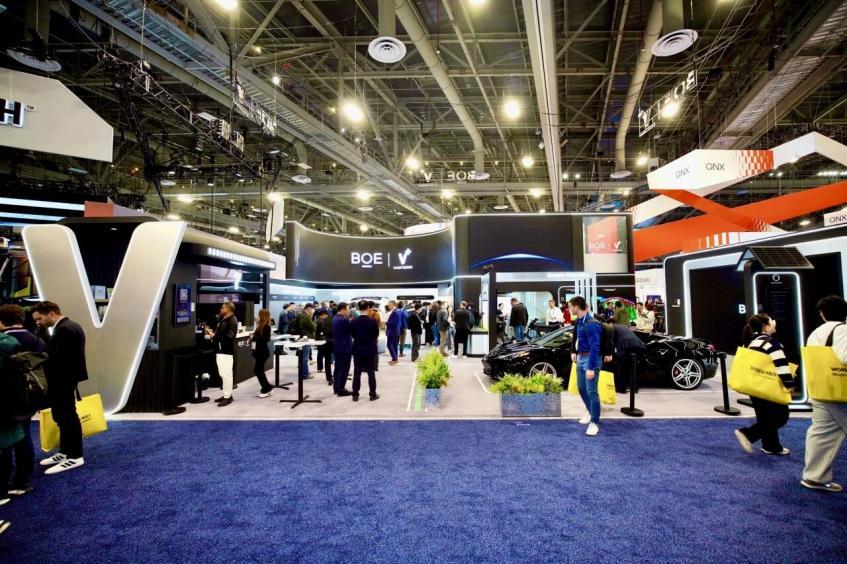
【环球网科技报道 记者 李文瑶】美西时间 2026 年 1 月 6 日,2026年国际消费类电子产品展览会(CES)开幕,全球科技巨头再 次聚首拉斯维加斯。在这场被誉为"科技界春晚"的盛会上,中国头部科技企业的展台显得更加亮眼。 其中,BOE(京东方)及其旗下业务的联合展区,以"科技+绿色"为主题,展示了从显示硬件的持续领先到智能座舱系统方案、 物联网生态的全面突破。 这是京东方连续第五年参展 CES,在看似不变的主题背后,是京东方从"全球最大显示屏供应商"向"智慧座舱综合解决方案提供 者"乃至"物联网生态构建者"的战略演进。 在接受记者采访时,BOE(京东方)集团副总裁、首席品牌官司达介绍:"过往我们更多以硬件公司形象出现,但今年近三分之 一展品是软硬融合的系统级产品。"在这背后,也是产业竞争焦点的转移——屏幕不再只是信息显示的窗口,而是集成交互、控 制、场景服务的枢纽。 展示升级:从"硬核显示"到"声色俱佳"的场景应用 今年京东方CES 展台的核心焦点,是全球首发的 "HERO 2.0 智能座舱"。HERO 计划自 2023 年 IPC 大会首次提出,其理念在于 定义智能汽车的四大场景:健康、娱乐、休闲与 ...