
吉利汽车

Search documents
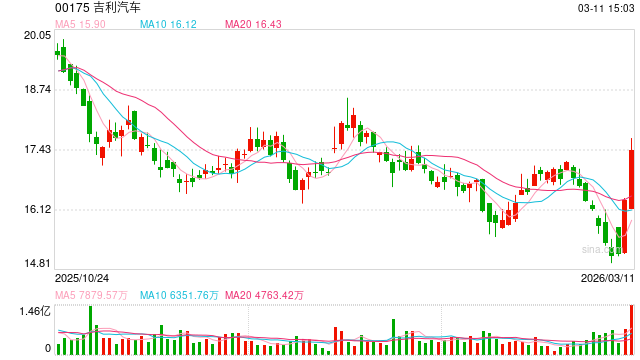
吉利汽车盘中涨超8% 创年内历史新高
Xin Lang Cai Jing· 2026-03-11 08:20
Core Viewpoint - Geely Automobile's stock price reached a year-to-date high of 17.37 HKD, with an increase of 8.09%, outperforming the Hong Kong stock market and other automotive stocks [1] Group 1: Stock Performance - As of the latest update, Geely's market capitalization exceeded 188.1 billion HKD [1] - The stock experienced an intraday increase of over 10% [1] Group 2: Upcoming Events - Geely is scheduled to hold its annual performance release meeting on March 18, where it will disclose more details about its high-end strategic layout and financial performance for the year 2025 [1] - A technology release event for the Geely 8X is set for the evening of March 16 [1]

德赛西威20260310
2026-03-11 08:11
Summary of Conference Call for Desay SV Automotive Company Overview - Desay SV Automotive focuses on intelligent cockpit and driving solutions, with significant growth in smart driving and cockpit businesses in 2025 [2][3]. Key Financial Performance - **Revenue**: Achieved approximately 32.6 billion yuan in 2025, a year-on-year increase of about 18% [3]. - **Net Profit Margin**: 7.6%, up by 0.3 percentage points from the previous year, driven by reduced impairment losses [3]. - **Gross Margin**: No growth in gross margin; however, profit margin improvement was attributed to a decrease in credit impairment losses [3][8]. Business Segmentation - **Smart Cockpit**: Contributed approximately 65% of total revenue, with domain controller products increasing from 19% to 24% of this segment [3]. - **Smart Driving**: Revenue share increased from 26% to 33%, with sensors contributing significantly to this growth [3]. New Orders and Growth Prospects - **New Orders**: Over 35 billion yuan in new orders for 2025, exceeding current revenue levels [4]. - **Future Growth**: Expected growth driven by multiple segments, including smart driving and AI technologies, with significant orders anticipated in 2026 [4][5]. International Expansion - **Overseas Orders**: Approximately several billion yuan in new overseas orders, with expectations for a doubling of production orders in 2026 [6]. - **Profitability**: Overseas products typically have gross margins 7-10 percentage points higher than domestic counterparts [6]. Product Development and Innovation - **AI Cockpit**: Transitioning to higher computing power, with expectations for AI cockpit computing power to increase from tens of TOPS to over 300 TOPS by 2026 [2][4]. - **New Products**: Introduction of AI Cube robot domain controllers and unmanned logistics vehicles, with production targets set for 2026 [2][4]. Cost and Margin Considerations - **Management Expenses**: Increased significantly in Q4 2025 due to stock incentive expenses [7]. - **Gross Margin Outlook**: Expected downward pressure on gross margin in 2026 due to rising costs of storage chips and changes in product mix [8][18]. Client Contributions and Market Dynamics - **Key Clients**: Major contributions from clients like Li Auto, Chery, and Xiaomi, with a balanced client structure where top clients each account for nearly 15% of revenue [2][3]. - **Market Trends**: Anticipated growth in traditional automotive brands deploying high-performance configurations, which will support revenue growth in 2026 [12]. Strategic Initiatives - **Hong Kong Listing**: The company has initiated the process for a Hong Kong listing to support long-term business expansion [17]. - **Supply Chain Advantages**: The company holds a strong position in the supply chain, which is expected to enhance its market share amid rising material costs [18]. Conclusion - Desay SV Automotive is positioned for robust growth in the coming years, driven by innovative product offerings, a balanced client portfolio, and strategic international expansion. The company is navigating challenges related to cost pressures while maintaining a focus on enhancing profitability and market presence.

两会精神解读:把握低空经济与Robotaxi等主题趋势性投资机会
2026-03-11 08:11
Summary of Conference Call Notes Industry and Company Involved - **Industry**: Transportation and Low-altitude Economy - **Key Companies Mentioned**: Zhongxing Haizhi, SF Holdings, Caocao Travel, Yihang, Fengfei Aviation, WoFei Aviation, and others Core Points and Arguments 1. **Government Support for Low-altitude Economy**: The government work report emphasizes the development of new productive forces, including low-altitude economy, integrated circuits, aerospace, and biomedicine as emerging pillar industries [1][2] 2. **Long-term Investment Opportunities**: Despite short-term market fluctuations due to geopolitical tensions, the transportation technology sector presents a long-term investment opportunity, with current market conditions seen as favorable for positioning [2][3] 3. **Definition of Low-altitude Economy**: The low-altitude economy refers to activities involving manned or unmanned aerial vehicles operating below 3,000 meters, which includes general aviation, drones, and electric vertical takeoff and landing (eVTOL) aircraft [3][4] 4. **Growth of General Aviation**: General aviation in China has seen rapid growth over the past decade, with flight hours projected to reach approximately 134 hours in 2024, and the number of general aviation enterprises increasing to 760 [5][6] 5. **Comparison with the U.S.**: The U.S. general aviation sector operates at a significantly higher scale, with 28.56 million flight hours in 2023, indicating substantial growth potential for China's general aviation market [5][6] 6. **Regulatory Framework**: The establishment of a regulatory framework for low-altitude operations, including the implementation of the Interim Regulations on the Management of Unmanned Aerial Vehicle Flights, marks a significant step in promoting the low-altitude economy [4][19] 7. **Drone Market Potential**: The drone market in China is projected to reach a trillion-level market size, with applications in logistics, emergency response, and social governance [8][9] 8. **Case Studies of Drone Applications**: Successful implementations of drone logistics by companies like SF Holdings demonstrate the viability of drone delivery in various scenarios, including agricultural transport and urban logistics [9][10][11] 9. **eVTOL Aircraft Development**: China is positioned to lead in the eVTOL market, with several companies making significant advancements in aircraft design and certification processes [13][15][16] 10. **Investment Opportunities in eVTOL**: The eVTOL sector is expected to see substantial growth, with various companies obtaining necessary certifications for commercial operations, indicating a shift towards market readiness [17][20] 11. **Robotaxi Development**: The emergence of Robotaxi services, particularly with advancements in autonomous driving technology, presents new investment opportunities, with companies like Caocao Travel being highlighted for their potential [21][24] 12. **Market Dynamics and Future Outlook**: The low-altitude economy and autonomous driving sectors are expected to grow significantly over the next 5-10 years, with a projected market value reaching trillions [19][20] Other Important but Possibly Overlooked Content 1. **Regional Development Focus**: The development of general aviation is particularly emphasized for less populated regions in China, where traditional transportation infrastructure may not be feasible [6][7] 2. **Technological Advancements**: Continuous improvements in drone technology and regulatory support are crucial for the successful implementation of low-altitude operations [12][18] 3. **Investment in Supporting Industries**: Companies involved in the supply chain for drones and eVTOLs, including those producing batteries and components, are also seen as valuable investment targets [20][21] 4. **Global Market Positioning**: China's ability to supply low-altitude industry needs both domestically and internationally is highlighted, especially in regions lacking robust transportation infrastructure [18][19] This summary encapsulates the key insights and discussions from the conference call, focusing on the low-altitude economy and its associated investment opportunities.
China's auto sales sink in February as phase out of subsidies for trade-ins hits demand
Yahoo Finance· 2026-03-11 08:02
Core Viewpoint - China's domestic passenger car sales have significantly declined, reflecting weakening demand as trade-in subsidies are phased out, with only 950,000 units sold in February, down from nearly 1.4 million in January, marking the fourth consecutive month of year-on-year declines [1][3] Industry Overview - Overall passenger car sales, including exports, dropped 15.4% year-on-year, despite a 58% increase in overseas shipments to 586,000, indicating challenges for Chinese carmakers in compensating for sluggish domestic sales through foreign market expansion [2] - Automakers are facing weak demand as local governments reduce trade-in subsidies aimed at promoting electric vehicle purchases, compounded by consumer hesitance due to a slowing economy and ongoing property market issues [3][4] Sales Performance - BYD reported a 41% decline in sales in February to 190,190 vehicles, while Geely Auto experienced a modest 1% increase to 206,160 vehicles [5] - Analysts predict that Chinese carmakers will continue to enhance exports to mitigate domestic sales weaknesses [5] Future Outlook - Domestic car sales in China are expected to remain weak this year due to ongoing reductions in government subsidies [4] - China's overall passenger car exports could grow approximately 20% in 2026 compared to last year, with Southeast Asia identified as a key market for expansion [6] - Chinese vehicle manufacturers are likely to adapt by cutting costs and focusing on higher-end models with larger profit margins [6]
吉利汽车盘中涨超8%,极氪8X等高端化进展引关注
Xin Lang Zheng Quan· 2026-03-11 07:03
Group 1 - Geely Automobile (0175.HK) showed strong performance on March 11, with its stock price rising significantly, outperforming the Hong Kong market and other automotive stocks, reaching a historical high of HKD 17.48, an increase of 8.77%, with a trading volume exceeding HKD 1885.41 million [2] - The capital market is highly focused on Geely's progress in high-end vehicle development, with the Zeekr 8X set to hold a technology launch event on March 16, featuring the latest G-ASD advanced driver assistance system and the world's first full-stack 900V high-voltage power system, achieving a combined range of over 1000 kilometers and supporting 6C ultra-fast charging technology [4] - A more detailed high-end strategy layout and the financial performance for 2025 will be officially disclosed at Geely's annual performance release on March 18 [4]

永安期货金融工程日报-20260311





Xin Yong An Guo Ji Zheng Quan· 2026-03-11 05:30
The provided content does not include any quantitative models or factors related to financial engineering or quantitative analysis. It primarily contains market updates, company financials, and general economic data. If you have a specific document or report containing quantitative models or factors, please provide it for analysis
吉利汽车大涨10% 近日走出反转行情 银河M7即将登场
Ge Long Hui· 2026-03-11 04:30
Core Viewpoint - Geely Automobile (0175.HK) has seen a significant stock price increase, reaching a new two-month high, driven by the announcement of its new model, the Galaxy M7, which is set to enhance its product lineup and market competitiveness [1]. Group 1: Stock Performance - On March 11, Geely's stock price surged by nearly 10%, with a current price of HKD 17.4, resulting in a total market capitalization of HKD 188 billion [1]. Group 2: Product Launch - Geely officially announced the launch of the Galaxy M7, a mid-level hybrid SUV aimed at family use, which is now arriving at 474 authorized dealerships across 266 cities in China [1]. - The Galaxy M7 will be officially unveiled on March 13 at the Jiayao Tongxing base in Quzhou, with expectations for formal sales to begin in the first half of the year [1]. Group 3: Analyst Ratings - Dongfang Securities has maintained a "Buy" rating for Geely, highlighting the Galaxy M7 as a strong competitor in the market and a key focus for Geely in 2026, especially in combination with the Starship 7 model [1].
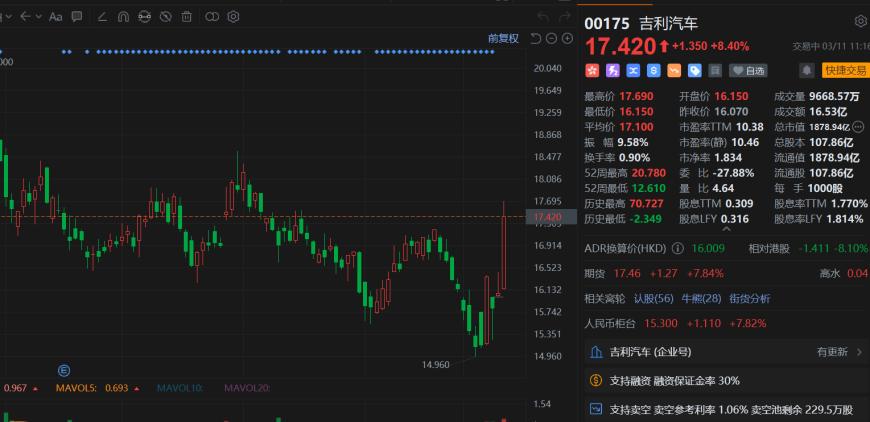
吉利汽车在香港市场午盘时股价上涨8.6%。
Xin Lang Cai Jing· 2026-03-11 04:14
Core Viewpoint - Geely Automobile's stock price increased by 8.6% in the Hong Kong market during midday trading [1] Company Summary - Geely Automobile experienced a significant rise in its stock price, indicating positive market sentiment or potential investor interest [1]
港股吉利汽车大涨10%
Jin Rong Jie· 2026-03-11 03:26
Group 1 - Geely Automobile (0175.HK) saw its stock price rise by nearly 10% during trading, marking a reversal trend over the past five days and reaching a two-month high [1] - The current stock price is reported at 17.4 HKD, with a total market capitalization of 188 billion HKD [1]
港股市场策略周报-20260311
Zhe Shang Guo Ji Jin Rong Kong Gu· 2026-03-11 03:25
Market Performance Review - The Hang Seng Index, Hang Seng Tech Index, and MSCI Hong Kong Small Cap Index experienced declines of -3.79%, -3.28%, and -3.7% respectively due to heightened risk aversion stemming from the US-Iran conflict [5][14] - Only the energy, utilities, and telecommunications sectors saw gains, with increases of 3.74%, 0.5%, and 0.08% respectively, while other sectors faced declines [5][14] - Small-cap stocks suffered the most significant losses, while large-cap and growth stocks showed relative resilience [5][14] Market Valuation Level - As of the end of the week, the 5-year PE (TTM) valuation percentile for the Hang Seng Index stood at 82.87%, indicating that the valuation level is close to one standard deviation above the 5-year average [4] Market Macro Environment - The macroeconomic environment shows that February's CPI increased significantly, while PPI continued to decline; the manufacturing PMI indicates ongoing contraction, but the service sector shows marginal recovery [42] - The government work report and the draft of the 14th Five-Year Plan have established a positive policy tone and pragmatic policy objectives [42] - The financial environment is characterized by a net outflow of 80.94 billion HKD from southbound funds, a decrease of 147.99 billion HKD compared to the previous week [42] Sector Allocation Outlook - The report favors sectors that are relatively prosperous and benefit from policy support, such as new energy, innovative pharmaceuticals, and AI technology [5] - Low-valuation state-owned enterprises that are stable in performance and stock prices are also seen as favorable due to policy benefits [5] - Hong Kong local banks, telecommunications, and utility dividend stocks are expected to benefit from the interest rate cut cycle [5]