地平线

Search documents
世界智能网联汽车大会开幕,中欧“汽车人”热议智驾规则全球协同
2 1 Shi Ji Jing Ji Bao Dao· 2025-10-16 12:54
Core Viewpoint - The global development of intelligent connected vehicles is driven by globalization and safety, with a focus on regulatory coordination and technological integration [1][2][4] Group 1: Industry Trends - Intelligent connected vehicles are transitioning from laboratory concepts to commercial applications, with significant discussions on technology evolution, regulatory alignment, and safety challenges at the World Intelligent Connected Vehicle Conference [1] - The European Union is actively working on regulatory frameworks for the automotive industry, including plans for a "European Connected and Automated Driving Alliance" by 2025 and a large-scale cross-border testing platform for autonomous vehicles [2][3] Group 2: Regulatory and Standardization Efforts - The EU's "General Artificial Intelligence Code of Conduct" will impact the development costs of L2+ autonomous driving systems, potentially increasing costs by 15%-20% due to required transparency and safety assessments [3] - Chinese companies, such as Changan Automobile, are advocating for global standardization to reduce redundant development costs and improve cross-border mobility experiences [4] Group 3: Technological Integration - The integration of AI, low-orbit satellite communication, and vehicle-road-cloud collaboration is leading to a new era of "collective intelligence" in intelligent connected vehicles [5][6] - China Mobile has established the world's largest 5G network and is accelerating the deployment of 5G+V2X technology, which supports high-precision positioning and enhances vehicle capabilities [6] Group 4: Safety and Commercialization Challenges - The industry is facing challenges in balancing safety and commercialization, with discussions highlighting the need for strong standards and safety protocols following recent autonomous driving incidents [7][8] - Industry leaders emphasize the importance of achieving a balance between innovation and safety to build consumer trust and ensure the successful adoption of intelligent connected vehicles [8]
安全是重中之重!行业大咖热议智驾未来发展趋势:不能“因噎废食”,停止智驾技术发展
Mei Ri Jing Ji Xin Wen· 2025-10-16 12:49
Core Insights - The advantages of machine driving over human driving include strict adherence to regulations, immunity to physiological and emotional factors, and the potential for data-driven evolution. However, inherent limitations exist, such as insufficient capability to handle long-tail scenarios and the risks associated with the black box effect [1] Industry Trends - The global automotive industry is undergoing a profound transformation, with China's new energy vehicle market leading the electric transformation through policy guidance and technological iteration. The commercialization of intelligent driving technology has reached a critical turning point since 2025, with increasing emphasis on safety [1] - The intelligent wave is reshaping the competitive landscape of the global automotive industry, with artificial intelligence evolving from an optional technology to a core variable affecting enterprise survival and development [1] Safety Emphasis - Safety is a consensus among industry professionals, with Momenta's CEO emphasizing that without safety, there can be no development in intelligent driving systems. Recent national efforts in establishing strong standards are expected to significantly regulate the development of the intelligent assistance market [2] - Geely's chairman highlighted that user safety must remain paramount in the development of intelligent networked technologies, which should address real user pain points rather than merely existing as concepts [2] Investment and Development - Xiaomi has committed a total investment of 5.79 billion yuan in combined auxiliary driving, with a dedicated R&D team exceeding 1,800 personnel. The focus is on reducing accidents as a primary goal of autonomous driving [3] - The industry is urged not to halt the development of intelligent driving technologies due to safety concerns. The balance between innovation and safety is crucial, as blind innovation can lead to accidents, undermining the purpose of intelligent driving [5] Collaboration and Responsibility - Industry players are encouraged to collaborate in promoting safety within the sector, with a commitment to addressing any safety issues that arise [5] - The importance of clearly defining responsibilities among various technology partners in the automotive supply chain is emphasized to ensure the safety and reliability of vehicles [4]

自动驾驶大爆发,19起融资吸金超300亿,四大赛道都很火热
3 6 Ke· 2025-10-15 00:35
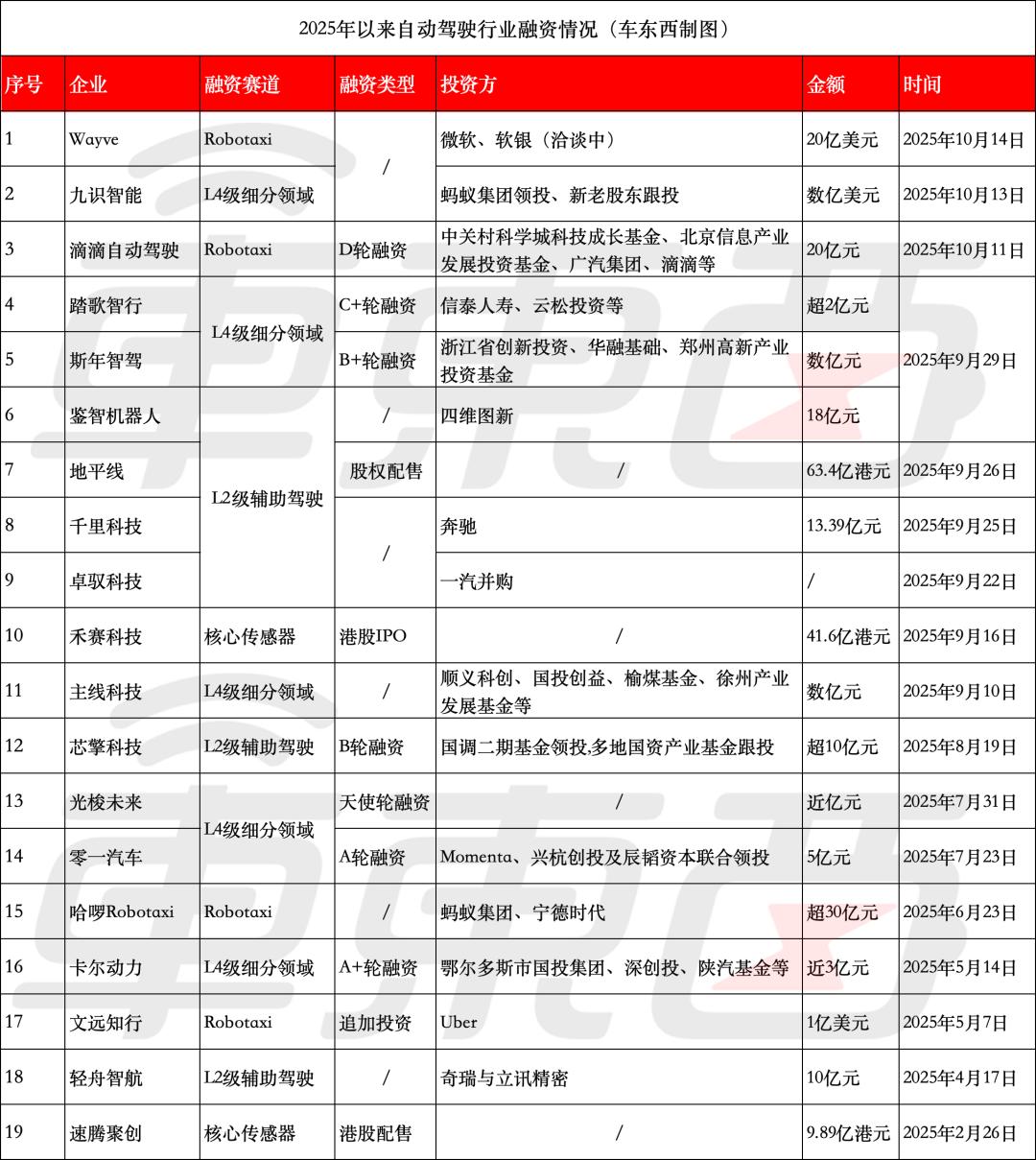
Core Insights - The autonomous driving industry is experiencing a significant surge in financing, with 11 funding events in the past month totaling over 29.2 billion yuan, bringing the total for the year to 36.7 billion yuan across 19 events [1][2][22] - This marks a stark contrast to the previous three years of capital winter, indicating a renewed confidence in the commercialization prospects of autonomous driving by 2025 [1][22] Financing Overview - The financing landscape is dominated by four main areas: L2-level assisted driving, L4-level niche applications, Robotaxi, and core sensors [3][11] - L2-level assisted driving saw six financing events this year, with notable funding including Horizon Robotics raising approximately 6.34 billion HKD (around 5.81 billion yuan) to expand overseas and support high-level assisted driving solutions [4][11] - The Robotaxi sector is particularly lucrative, with significant funding such as Didi Autonomous Driving's 2 billion yuan in Series D financing aimed at AI core algorithm development and L4 application deployment [11][16] - L4-level applications, focusing on closed or semi-closed environments, have attracted the most funding, with seven companies receiving investments, including a recent multi-million dollar round for Jiushi Intelligent [17][19] Market Dynamics - The capital market's enthusiasm for autonomous driving has markedly increased compared to the previous three years, which were characterized by a downturn in funding and operational challenges for major companies like Argo AI and Cruise [22][25] - The turning point in 2025 is attributed to a combination of technological advancements, market readiness, and supportive policies, with Tesla's launch of Robotaxi products serving as a strong market signal [25][27] - The investment focus has shifted towards companies with clear commercial applications, particularly in the Robotaxi and L4 niche sectors, reflecting a pragmatic approach to funding [27][30] Conclusion - The influx of capital is accelerating the commercialization of autonomous driving technologies, with companies that demonstrate viable applications receiving increased support [30] - The industry is poised for a transformative year in 2025, as the convergence of technology and investment is expected to turn autonomous driving from a vision into reality [30]


机器人域控制器产业趋势展望
2025-10-14 14:44
Summary of Conference Call on Robotics Domain Controller Industry Trends Industry Overview - The conference discusses the robotics domain controller industry, highlighting the transition of automotive intelligent driving domain control solutions to robotics platforms, aiming to create an efficient, safe, and open robotics controller, referred to as the "brain" platform [1][2] - Rapid advancements in artificial intelligence, particularly large language models (LLMs), are driving the growth of the robotics industry, similar to the developments seen in the autonomous driving sector a decade ago [1] Key Insights and Arguments - The acquisition of an integrated joint company by the company lays the foundation for testing and exploring new directions in robotics [1][2] - The introduction of high-performance chips like NVIDIA's Orin chip is being adopted by domestic companies such as Desay SV and Joyson Electronics, indicating strong market recognition and expectations for NVIDIA's technological solutions [1][5] - Domestic intelligent driving chip systems, including Horizon Robotics and Huawei, are reshaping the edge chip market landscape, suggesting that the robotics sector is becoming a new ecological soil for competition [1][6] - Horizon Robotics has shown promising performance in edge testing, with significant computational output efficiency, indicating substantial future potential [7] - The current market for robotics domain controllers is expected to be competitive, with multiple companies driving industry development rather than being dominated by a few players [6][10] Future Business Models and Competitive Landscape - The future business model and competitive landscape for robotics domain controllers are still uncertain, with significant differences from the automotive industry, which has a long history [4] - The rapid iteration of AI technology is expected to influence the robotics industry, but whether the controller segment will mirror the automotive sector remains to be seen [4] - Companies are encouraged to be pioneers in the industry to secure strategic advantages, as the fast pace of AI development necessitates adaptability to avoid obsolescence [4] Technological Developments - The demand for high-performance platforms is increasing due to advancements in technologies like Google DeepMind's Gemini 5.0, which showcases complex brain functions based on natural language processing [3][8] - The robotics domain controller's complexity is heightened by the lack of complete standardization, with ongoing changes in hardware and parameters [9] Domestic Chip Companies and Market Dynamics - Optimism is expressed regarding the capabilities of domestic chip companies, with Horizon Robotics expected to gain more opportunities amid U.S.-China tech competition [7] - The market is anticipated to be characterized by multi-party competition rather than a one-sided dominance [7] Collaborations and Partnerships - The company maintains close collaborations with leading humanoid robot enterprises in China, demonstrating proactive market engagement and significant progress in joint efforts [13] - The partnership with Diguang Robotics is highlighted, showcasing successful deployment of open-source models and the development of generalized kits based on Diguang chips [12] Conclusion - The robotics domain controller industry is poised for significant growth driven by technological advancements and competitive dynamics, with a focus on collaboration and innovation to navigate the evolving landscape [1][4][12]

雷军将出席2025世界智能网联汽车大会并发表演讲
Zhong Guo Jing Ji Wang· 2025-10-14 11:40
小米汽车董事长雷军也将出席10月16日下午2:00—5:30的全体会议并发表演讲,这将是小米汽车成都 交通事故后,雷军的一次公开露面,不知是否会对刚刚发生的交通事故中,车辆起火和车门无法打开做 出回应。 10月13日凌晨,一辆小米SU7在成都天府大道发生致死交通事故,救援时车门无法打开。13日下午,成 都公安微博发布警情通报,事故造成司机邓某某死亡,经检测涉嫌酒后驾驶机动车,而小米方面目前为 止未对此事件做任何公开回应。 2025世界智能网联汽车大会10月16日—10月18日在北京召开,该会议由中华人民共和国工业和信息化 部、交通运输部、北京市人民政府联合主办。大会以"汇智聚能 网联无限"为主题,将邀请多国政府部 门、国际组织、知名企业的高级别代表参会,携手推动全球汽车产业高质量发展。据悉,世界智能网联 汽车大会已连续举办六届,是全球汽车产业引领技术创新、促进国际交流、凝聚成果共识的重要平台。 大会邀请了众多重磅嘉宾出席,东风集团董事长杨青、一汽集团总经理刘亦功、中国长安汽车集团董事 长朱华荣、北汽集团董事长张建勇、广汽集团董事长冯兴亚、吉利控股集团董事长李书福、蔚来汽车创 始人李斌 、赛力斯(601127) ...
智能驾驶,造不如买?
3 6 Ke· 2025-10-14 00:15
Core Insights - The competition in the new energy vehicle market is intensifying, with smart driving transitioning from an "add-on" to a "must-have" feature, leading to a "arms race" in smart driving technology [1] - Traditional automakers are increasingly opting to acquire mature smart driving technologies rather than developing them in-house, as evidenced by recent investments from companies like FAW and Mercedes-Benz [1][2] - The market for smart driving is becoming a "game for the strong," with leading suppliers gaining significant advantages in data, computing power, and algorithm iteration [10][12] Group 1: Investment Trends - FAW has acquired a 35.8% stake in Zhuoyue Technology, becoming its largest single shareholder, while Mercedes-Benz invested 1.34 billion yuan in Qianli Technology, acquiring a 3% stake [1][2] - Traditional automakers are shifting their strategies to focus on acquiring proven smart driving technologies rather than investing in startups [1][2] - Companies like BYD and Geely are also making significant investments in smart driving firms, indicating a trend towards deeper collaboration and investment in third-party technologies [2][5] Group 2: Strategic Shifts - Many traditional automakers are consolidating their internal smart driving teams to enhance efficiency and focus on strategic partnerships with third-party suppliers [4][5] - The approach of "two-pronged betting" is becoming common, where companies maintain partnerships with third-party suppliers while also developing their own smart driving strategies [5][7] - The urgency of the market is pushing automakers to collaborate with established smart driving suppliers to mitigate risks and accelerate development [7][8] Group 3: Market Dynamics - The smart driving market is witnessing a division into three main camps: ecosystem giants like Huawei and Horizon Robotics, algorithm-focused suppliers like Momenta, and automaker-backed firms [8][9] - The competitive landscape is narrowing, with leading players like Momenta and Huawei capturing significant market shares in the navigation-assisted driving sector [9][10] - The emergence of advanced models like VLA (Vision-Language-Action) is reshaping the smart driving landscape, requiring substantial data and computing resources, thus raising the entry barriers for smaller suppliers [10][12][14] Group 4: Future Outlook - As automakers increasingly acquire smart driving capabilities, the competition will shift back to core aspects such as cost efficiency, user experience, and data iteration capabilities [21] - The collaboration between automakers and smart driving suppliers is evolving from simple partnerships to deeper, more integrated development efforts [21] - The future of smart driving will depend on how effectively companies can translate acquired technologies into tangible user benefits, emphasizing the need for both capital investment and strategic insight [21]


3亿元融资后,“追觅系”具身智能机器人创企再获2亿元融资!
Robot猎场备忘录· 2025-10-14 00:05
Core Insights - The article discusses the recent funding rounds of JoyIn, a company focused on embodied intelligent robots, highlighting its successful completion of a 200 million yuan angel round financing led by Zhongding Capital, with continued support from IDG Capital [3][4] - JoyIn has completed three rounds of angel financing in 2025, totaling approximately 500 million yuan, indicating strong investor interest in the embodied intelligence sector [4] - The company aims to accelerate the mass production of consumer-grade embodied intelligent products by investing in core components, robot body and motion control technology, and consciousness bionic model iterations [3][4] Financing and Investment - JoyIn completed a 200 million yuan angel++ round financing on September 28, 2025, led by Zhongding Capital, with IDG Capital as a continuing investor [3] - The total financing amount for JoyIn in 2025 reached approximately 500 million yuan, with previous rounds including a round led by Jinqiu Fund in May 2025 and another round in January 2025 led by IDG Capital [4] - The company has been recognized as a model for capital-backed startups in the embodied intelligence sector, achieving a post-investment valuation increase from 500 million yuan to 600 million yuan due to multiple investment offers [4] Product Development and Strategy - JoyIn, founded by former executive Guo Renjie of Chasing Technology, focuses on developing household general-purpose small embodied robots, aiming to create a new generation of mobile hardware terminals in the "robot + AI era" [4][7] - The company has developed two product platforms targeting indoor and "indoor + outdoor" family scenarios, including a 60 cm tall small embodied intelligent robot (Z-Bot) and a track-based outdoor robot (W-Bot) [7][9] - JoyIn's W-Bot has already attracted interest from various industries, including retail, education, real estate, and pets, with initial market validation achieved through a successful auction on JD.com [11] Competitive Landscape - The article notes that JoyIn is not the only company in the embodied intelligence sector; VITA Power, founded by former members of Horizon Robotics, is also gaining traction with similar product paths and commercial strategies [13][15] - VITA Power has completed three rounds of financing totaling 300 million yuan, with a focus on developing outdoor and indoor intelligent robots, indicating a competitive environment in the consumer-grade robot market [16][20] - The article highlights the trend of major automotive and tech companies entering the embodied intelligence sector, creating a crowded landscape with significant investment and innovation potential [22][23]

国产智驾芯片,靠什么卖了1000万套?
Hu Xiu· 2025-10-14 00:04
Core Insights - A domestic intelligent driving chip, the Horizon Journey series, has achieved a production and shipment milestone of over 10 million units, making Horizon the first domestic intelligent driving technology company to reach this level of shipment volume [1] Company Summary - Horizon has become the first domestic intelligent driving technology enterprise to surpass a shipment volume of 10 million units, indicating significant growth and market penetration in the intelligent driving sector [1]
地平线残差端到端是如何实现的?ResAD:残差学习让自动驾驶决策更接近人类逻辑
自动驾驶之心· 2025-10-13 23:33
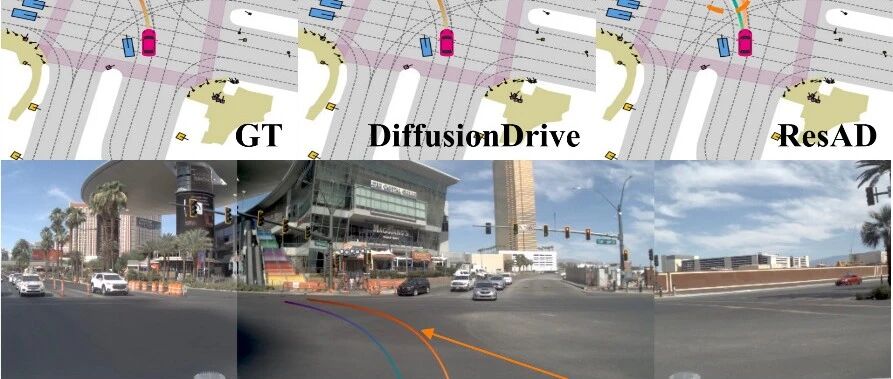
点击下方 卡片 ,关注" 自动驾驶之心 "公众号 戳我-> 领取 自动驾驶近30个 方向 学习 路线 >>自动驾驶前沿信息获取 → 自动驾驶之心知识星球 论文作者 | Zhiyu Zheng等 编辑 | 自动驾驶之心 想让车子自己开,传统方法得像搭积木:先"看"(感知),再"猜"(预测),最后"做决定"(规划)。这套流程环环相扣,一个环节出错,后面全跟着错, 既不高效,也不安全。 于是, 端到端自动驾驶 成了一条新路。它想让AI像老司机一样,直接把看到的(传感器数据)变成要走的路线(未来轨迹)。想法很美好,但现实很骨 感:现有的端到端模型,大多在死磕一个问题—— "未来的轨迹长啥样?" 为了解决这些问题,地平线、华科和武大的团队提出了 ResAD 框架。核心思想很简单: 不直接预测整条轨迹,而是先给一个"惯性参考线"——就是车子如 果不动方向盘会走的路线。然后,让模型只学习一个"调整量"(残差),即为了安全行驶,需要偏离这根参考线多少。 这样一来,学习目标就从 "轨迹是什么?" 变成了 "为什么要调整方向?" 。模型被迫去关注那些导致调整的真实原因,比如障碍物、交通规则等,而不是死 记硬背数据里的巧合。 我们 ...
2025-2031年全球手机控制智能车位锁行业市场发展深度调研及投资战略可行性预测报告
Sou Hu Cai Jing· 2025-10-13 01:52
Industry Overview - The mobile-controlled smart parking lock integrates IoT, wireless communication, and electromechanical control technologies, allowing real-time monitoring and management of parking spaces through mobile applications [3][7] - The global market for mobile-controlled smart parking locks is projected to reach $51.4 million by 2031, with a compound annual growth rate (CAGR) of 8.6% in the coming years, indicating steady market growth [3][5] Market Structure and Product Applications - The competitive landscape is fragmented, with the top five manufacturers (Parklio, Diffusion-Urbaine Ottopark, ThatsMySpot, Optima, Pilomat) holding a combined market share of 31.2%, leaving room for development among small and medium-sized enterprises [5] - Product types include mobile application-controlled locks that offer features like visitor authorization and low battery alerts, while multi-control systems can manage 4-8 parking spaces, suitable for large-scale scenarios [6] Key Growth Drivers - Urbanization and parking supply-demand imbalance are significant drivers, with global urbanization rates exceeding 55% and a parking space ratio of 1:0.8 in China, highlighting the necessity for smart parking solutions [7] - Policy support for smart city initiatives, such as China's requirement for a minimum of 70% smart device coverage in new public parking facilities, further bolsters market growth [9] - Technological advancements and cost reductions, including the introduction of specialized vehicle networking chips and lightweight deployment methods, have significantly lowered installation costs and improved operational efficiency [10] - The extension of scenarios for electric vehicles, with integrated solutions for smart locks, AI cameras, and charging management, is expected to enhance the utilization rate of charging spaces by 42% [11] Challenges Facing Market Development - Insufficient technology maturity is a challenge, with mid-range devices experiencing issues like signal delays and misjudgments, particularly in extreme weather conditions [12] - Poor system compatibility among different brands and platforms creates data silos, limiting operational efficiency and user experience [13] - High initial costs and maintenance expenses pose barriers for small to medium-sized parking facilities, while older users face challenges in adapting to mobile app operations [14] Future Development Trends - The industry is expected to evolve towards greater intelligence and integration, with advancements in AI image recognition and 5G technology enhancing operational stability [15] - The Asia-Pacific region, particularly China, is anticipated to be a primary growth driver due to high vehicle ownership and smart city initiatives, while Europe and North America will benefit from high penetration rates and acceptance [15]