
招商银行

Search documents
1月金融数据前瞻:预计新增贷款5.1-5.25万亿元,社融增速为8.3%
ZHONGTAI SECURITIES· 2026-02-07 07:25
Investment Rating - The industry investment rating is maintained at "Overweight" [2] Core Insights - The report anticipates new RMB loans in January to be between 5.1 to 5.25 trillion yuan, with a corresponding loan growth rate declining to approximately 6.3% [4][6] - The expected new social financing scale for January is projected to be between 7.41 to 7.57 trillion yuan, maintaining a stock growth rate of around 8.3% [21][25] - The report highlights a strong performance in corporate activities, with expectations for increased credit supply due to a favorable lending environment and government policies [8][28] Summary by Sections 1. RMB Loans - New RMB loans are expected to be between 5.1 to 5.25 trillion yuan, with a growth rate declining to around 6.3% [4][6] - The monthly increase is projected to vary between a decrease of 300 million to an increase of 1.2 billion yuan [8] 2. Social Financing - The anticipated new social financing scale for January is between 7.41 to 7.57 trillion yuan, with a stock growth rate around 8.3% [21][25] - The report notes that the net financing scale of local government bonds and corporate credit bonds is expected to be 1.181 trillion yuan and 490.3 billion yuan respectively [25] 3. Liquidity - M1 and M2 growth rates are expected to rise due to a low base effect, with M1 projected at 4.0% and M2 at 8.7% [26] - The report indicates that the increase in government and credit bonds' net financing will impact market liquidity [26] 4. Investment Recommendations - The report suggests a shift in bank stock investment logic from "pro-cyclical" to "weak-cyclical," emphasizing the attractiveness of high-dividend bank stocks during economic stagnation [28] - Two main investment lines are recommended: regional banks with strong certainty and large banks with high dividends [28]



年终奖到手别乱花!不同人群理财方案全解析,安全第一
Sou Hu Cai Jing· 2026-02-07 03:27
Group 1 - The core viewpoint of the article highlights the rising trend of year-end bonus investment as the 2026 Spring Festival approaches, with popular choices including large time deposits, stable funds, and gold products [1] Group 2 - The demand for investment products is driven by banks competing in the "year-end bonus investment" market, with institutions like Bank of Communications, Postal Savings Bank, and China Merchants Bank offering one-stop services for deposits, funds, and insurance [2] - Current interest rates for one-year deposits at state-owned banks have dropped to 1.75%, while large time deposit rates range from 2% to 3%, prompting investors to seek higher returns through diversified investments [3] Group 3 - Three types of investment strategies are suggested for different demographics: - Conservative strategy for low to middle-income earners includes setting aside emergency funds in money market funds and investing in government bonds for medium-term goals [4][5] - Balanced strategy for middle-class families involves allocating funds to long-term government bonds, stable financial products, and maintaining liquidity through money market funds [8] - Aggressive strategy for high-net-worth individuals focuses on low-volatility bank products or gold ETFs, along with thematic funds for potential excess returns [8][9] Group 4 - The article warns against potential risks associated with year-end bonus investments, including scams promising high returns, liquidity mismatches, and the dangers of following investment trends without proper analysis [13] - Practical advice includes managing funds through separate accounts, utilizing tax benefits from personal pension accounts, and adhering to a disciplined saving approach [14][15]

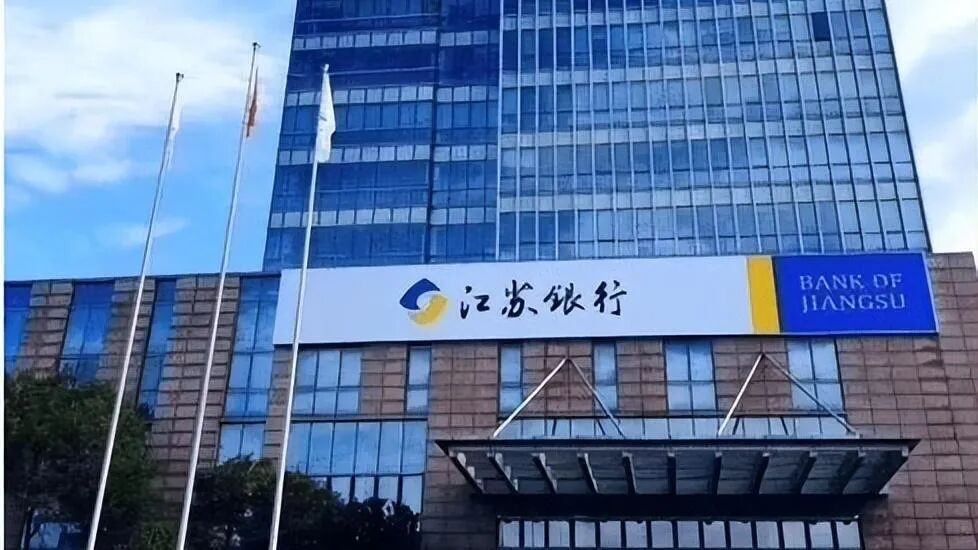
机构研究系列:03 江苏银行——从区域银行到系统重要性银行的跨越之路
Xin Lang Cai Jing· 2026-02-06 23:47
Core Viewpoint - Jiangsu Bank, as a systemically important bank in China, is undergoing significant strategic evolution to adapt to the changing banking landscape, focusing on high-quality development while maintaining its scale advantage [2][4][49]. Group 1: Background and Purpose - Jiangsu Bank is the largest legal person bank in Jiangsu Province and plays a crucial role in the development of urban commercial banks and the Chinese banking industry [2]. - The research aims to analyze Jiangsu Bank's strategic evolution since its establishment in 2007, focusing on its current strategic layout and future development direction [2]. Group 2: Strategic Evolution Process - **Foundation and Scale Breakthrough Period (2007-2015)**: Jiangsu Bank was established through the merger of ten urban commercial banks, focusing on resource integration and local market penetration, achieving total assets of over 1 trillion yuan by 2014 [3]. - **Structural Optimization and Innovation Breakthrough Period (2016-2020)**: The bank went public in 2016, shifting its focus from scale expansion to quality and efficiency, establishing a "four modernization" development vision [4][5]. - **High-Quality Development and Strategic Deepening Period (2021-Present)**: Jiangsu Bank has set five strategic goals for high-quality development, emphasizing value creation, customer service, and political integrity [6][7]. Group 3: Current Strategic Statements - **Top-Level Strategic Positioning**: Jiangsu Bank's mission is to enhance people's quality of life through innovative financial services, with a vision of becoming a leading bank characterized by intelligence, specialization, internationalization, and comprehensiveness [8]. - **Five Strategic Goals**: The bank aims to be the most valuable bank, a service leader, an intelligent innovator, an employee-satisfied bank, and a politically robust bank, with each goal supporting the others [9][10]. Group 4: Business Development Strategies - **Corporate Business**: Jiangsu Bank focuses on strengthening corporate business, particularly in manufacturing and infrastructure, achieving a corporate deposit balance of 14,197 billion yuan, a 22.20% increase year-on-year [11]. - **Retail Business**: The bank aims to expand its retail business, with retail AUM exceeding 1.59 trillion yuan, marking a historic high [12]. - **Financial Market Business**: Jiangsu Bank is enhancing its financial market capabilities, with financial investment assets reaching 18,833 billion yuan, a 23.38% increase [13]. - **Digital Financial Development**: The bank is accelerating its digital transformation, with significant advancements in AI applications and digital financial services [14]. - **Regional Layout**: Jiangsu Bank maintains a strong presence in Jiangsu and extends its services to major economic regions [15][16]. - **ESG Strategy**: The bank integrates ESG principles into its operations, actively participating in sustainable finance initiatives [17]. Group 5: Comparative Analysis - **Comparison with Similar Banks**: Jiangsu Bank's asset scale is 3.95 trillion yuan, ranking it among the top urban commercial banks, with a focus on balanced development across various financial sectors [29][30]. - **Strengths and Weaknesses**: Jiangsu Bank has notable advantages in asset quality and regional presence but faces challenges in retail business proportion and internationalization [37][41][42]. Group 6: Future Strategic Directions - **"15th Five-Year" Planning**: Jiangsu Bank is preparing for its next strategic phase, focusing on clearer positioning and practical development goals, with expected revenue growth rates of 6.9% to 7.6% from 2025 to 2027 [44][45]. - **Key Development Areas**: The bank aims to enhance its technology finance services, green finance initiatives, and wealth management capabilities, with projected growth in these areas [46].
广州白云山医药集团股份有限公司关于广州荔湾广药创业投资基金合伙企业(有限合伙)完成私募基金备案暨关联交易进展的公告
Shang Hai Zheng Quan Bao· 2026-02-06 19:24
Investment Cooperation Overview - On December 22, 2025, the company approved a proposal for its subsidiary to invest in the Guangzhou Liwan Guangyao Venture Capital Fund, establishing a partnership with several entities to create the Guangzhou Liwan Guangyao Venture Capital Fund [2] - The partnership agreement was officially signed on December 31, 2025, with the fund's establishment aimed at enhancing investment scale and efficiency [2][3] Investment Progress - The Guangzhou Liwan Fund completed its business registration and obtained a business license on January 7, 2026, with a total initial capital contribution of 120 million yuan [3] - The fund was registered with the Asset Management Association of China on February 5, 2026, and received a private investment fund registration certificate [3] Impact on the Company - This investment aligns with the strategic direction of the company's second-phase fund, facilitating risk diversification and accelerating investment pace in innovative pharmaceuticals and high-end medical devices [4] - The company aims to transition from traditional business models to technology-driven development, laying a solid foundation for high-quality growth [4] Drug Consistency Evaluation - The company's subsidiary, Guangzhou Baiyunshan Xingqun Pharmaceutical Co., Ltd., received approval for its Alfacalcidol soft capsules to pass the consistency evaluation for generic drugs [5][6] - The product is used for treating calcium metabolism disorders and has a significant market presence, with sales figures indicating a competitive position [7] Financial Investment in Drug Development - Approximately 10.36 million yuan has been invested in the research and development of the Alfacalcidol soft capsules consistency evaluation project [7]
金价可能大跌开始了,26年2月6日黄金跌价
Sou Hu Cai Jing· 2026-02-06 19:15
2026年2月6日,国内黄金价格降至1093.5元/克,国际金价跌至4884.3美元/盎司,黄金回收价格维持在1070元/克,市场整体呈现下跌趋势。周大福和六福的 黄金价格均降至1555元/克,周生生的金价也降至1558元/克,表明市场对黄金的需求减少,投资者信心不足。 一、市场价格与金饰报价 2月6日,贵金属市场呈现分化态势,上海现货黄金9999报1107元/克,沪金期货主力报1106元/克,白银现货价格为22.5元/克,铂金、钯金分别报503元/克和 392元/克。 国内品牌金饰价格维持高位稳定,六福、周大生等品牌足金报价1555元/克,周生生为1558元/克,老凤祥报1568元/克。 星光达珠宝金店的黄金饰品价格为1555.00元/克,铂金首饰价格为960.00元/克。 金兰首饰金店的黄金饰品价格为1555.00元/克,铂金首饰价格为960.00元/克。 金银街投资金条价格为1530.00元/克,工艺金条价格为1545.00元/克,千足金首饰价格为1535.00元/克。 从各地区具体成交看,如常州水贝黄金1261元/克、嘉兴周大福1555元/克等,实际购买总价因克重不同有差异。 上海黄金交易所主要合约延 ...

11家A股上市银行率先披露业绩快报,全员盈利正增长、资产规模实现突破
Sou Hu Cai Jing· 2026-02-06 16:47
Core Insights - The overall performance of A-share listed banks shows a trend of "all profitable and positive growth, with stable asset expansion," indicating a robust operational status in the banking sector [2][9] - Qingdao Bank leads with a remarkable 21.66% year-on-year growth in net profit, showcasing strong profit growth momentum among the disclosed banks [2][6] - Both CITIC Bank and Shanghai Pudong Development Bank have crossed the 10 trillion yuan asset threshold, joining the "trillion yuan club," highlighting the scale advantages and resilience of joint-stock banks [5][9] Performance Summary - As of February 5, 2026, 11 A-share listed banks have disclosed their 2025 performance reports, including four joint-stock banks, six city commercial banks, and one rural commercial bank, reflecting a balanced representation of different bank types [3][5] - Qingdao Bank reported an operating income of 14.573 billion yuan, a year-on-year increase of 7.97%, and a net profit of 5.188 billion yuan, with a growth rate of 21.66% [6][8] - Shanghai Pudong Development Bank achieved a net profit growth of 10.52%, while CITIC Bank's net profit increased by 2.98%, both benefiting from their substantial asset scales [5][6] Growth Highlights - All 11 banks reported positive year-on-year net profit growth, with four banks exceeding 10% growth: Qingdao Bank (21.66%), Qilu Bank (14.58%), Hangzhou Bank (12.05%), and Shanghai Pudong Development Bank (10.52%) [8] - Qingdao Bank's asset total surpassed 800 billion yuan, with both deposits and loans growing by over 16%, and its non-performing loan ratio improved to 0.97% [8] - Ningbo Bank also demonstrated strong performance with an operating income of 71.968 billion yuan, a year-on-year increase of 8.01%, and a net profit growth of 8.13% [8] Asset Scale Developments - CITIC Bank and Shanghai Pudong Development Bank's asset totals reached 10.081 trillion yuan and 10.132 trillion yuan respectively, marking significant milestones in their operational scale [9] - The entry of these banks into the "trillion yuan club" not only expands the membership but also underscores the pivotal role of joint-stock banks in the industry [9] - The overall performance of the 11 banks reflects a stable development trend in the banking sector, providing a solid foundation for future growth as more banks disclose their performance reports [9]



多家银行上调短信通知起点金额
Xin Lang Cai Jing· 2026-02-06 13:36
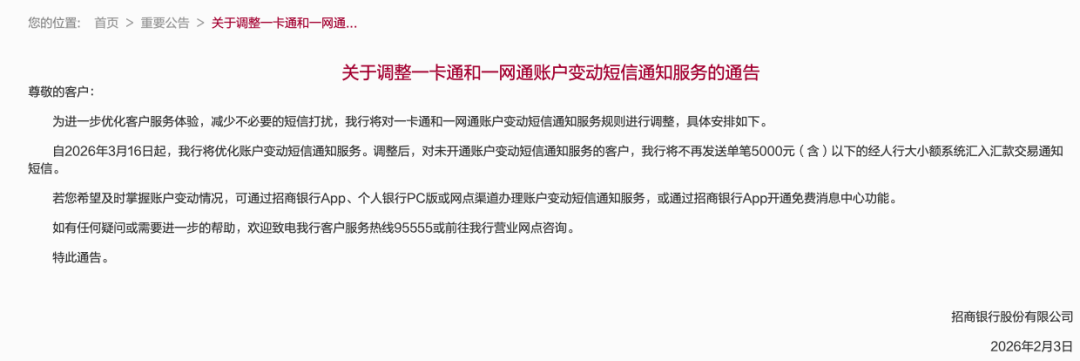
近期,多家银行进一步上调存取款等动账短信通知的起点金额。记者注意到,自去年开始,已有中国银 行、民生银行、广东华兴银行、湖北银行、甘肃银行等十家多银行相继上调了银行卡交易通知的免费短 信门槛。从金额来看,招行目前的5000元门槛为最高。若客户确有小额动账短信通知的需求,需额外缴 纳2~3元/每月的费用。小额短信通知就此步入付费时代。 ...
多家银行上调短信通知起点,最高至5000元
2 1 Shi Ji Jing Ji Bao Dao· 2026-02-06 13:00
Core Viewpoint - The banking industry is tightening cost control measures by increasing the threshold for transaction notification SMS services, with some banks raising the limit to 5000 yuan, marking the beginning of a paid SMS notification era for small transactions [1][2]. Group 1: Changes in SMS Notification Services - Multiple banks, including China Merchants Bank, have announced adjustments to their SMS notification services, with a new threshold of 5000 yuan for free notifications, which is among the highest in the industry [2][3]. - Other banks, such as Minsheng Bank and Bank of China, have also raised their SMS notification thresholds to 300 yuan and 100 yuan respectively, indicating a trend across the banking sector [3][4]. - The adjustments reflect a broader movement among banks to manage operational costs more effectively, particularly in light of the expenses associated with SMS notifications [6][13]. Group 2: Cost Savings and Digital Transition - Banks are expected to save significant costs by reducing the number of SMS notifications sent, as each message incurs a fee from telecom operators [6][9]. - The average cost for SMS services varies, with larger banks typically securing lower rates due to their scale, while smaller banks face higher costs [8][9]. - The shift towards digital notification methods, such as mobile banking apps and WeChat services, is becoming more prevalent, reducing reliance on traditional SMS notifications [12][14]. Group 3: Financial Implications - The banking sector's net interest margin remains stable at 1.42%, with expectations of continued optimization in asset-liability structures and a gradual decline in interest margins [14][15]. - The cost structure for SMS notifications suggests that charging customers around 3 yuan per month can cover operational costs, especially if the average customer receives fewer than 100 notifications monthly [11][10].



多家银行上调短信通知起点,最高至5000元
21世纪经济报道· 2026-02-06 12:58
Core Viewpoint - The banking industry is tightening cost control by increasing the threshold for transaction SMS notifications, with some banks raising it to 5000 yuan, marking the beginning of a paid SMS notification era [1][3]. Group 1: Changes in SMS Notification Policies - Several banks have raised the threshold for free SMS notifications, with China Merchants Bank setting the highest threshold at 5000 yuan for single transactions [3][4]. - Other banks, including Minsheng Bank and Bank of China, have also adjusted their SMS notification thresholds to 300 yuan and 100 yuan respectively [4]. - The trend of increasing the threshold for free SMS notifications has been observed since the second half of last year, with over ten banks making similar adjustments [3][4]. Group 2: Cost Savings from SMS Notifications - Banks incur costs for each SMS sent, and the adjustments in notification policies are aimed at reducing these expenses [8]. - Estimates suggest that a bank with 1 million personal customers could save approximately 300 million yuan monthly if they stop sending free SMS notifications for small transactions [9]. - The procurement prices for SMS services vary, with larger banks generally securing lower rates than smaller banks due to their scale advantages [8]. Group 3: Shift to Digital Notification Channels - Banks are increasingly shifting towards digital notification methods, such as mobile banking apps and WeChat service accounts, which are more cost-effective than SMS [11]. - For example, Bank of China encourages customers to use its mobile banking app for free transaction notifications instead of relying on SMS [11]. - The overall trend indicates a decline in the necessity of SMS notifications as banks enhance their digital service offerings [11].

策略跟踪报告:机构配置侧重成长与周期板块
Wanlian Securities· 2026-02-06 12:52
Group 1 - The overall market fund value increased to 36.63 trillion yuan by December 31, 2025, with bond funds accounting for 30.31% of the total, marking a 0.31 percentage point increase from the end of Q3 2025 [5][9] - The performance of public funds varied, with bond funds showing a positive return of 0.5%, while QDII funds experienced a significant decline of -2.98% [20][23] - By the end of 2025, stock and mixed funds accounted for 24.84% of total fund value, with stock investment ratios remaining high, as 33.76% of funds had over 90% in stock investments [41][42] Group 2 - The top 20 heavy stocks were primarily in the electronics, non-bank financial, and power equipment sectors, with Ningde Times, Zhongji Xuchuang, and Xinyi Sheng being the top three by market value [28][29] - The performance of heavy stocks was mixed, with Zhongji Xuchuang leading with a 46.31% increase, while Ningde Times saw a decline of -7.32% [30][32] - The distribution of heavy stocks showed that electronics remained the largest sector, accounting for 8.21% of the total stock investment value [33] Group 3 - The top 20 stocks with increased holdings were concentrated in electronics, non-bank financial, and power equipment sectors, with Zhongji Xuchuang and China Ping An seeing significant increases in their market value [34][37] - The top gainers among the increased holdings included China Satellite with a remarkable 170.90% increase, followed by Maiwei Shares at 104.67% [38][39] - The communication sector had the highest increase in fund allocations, with a 1.74% increase in Q4 2025 [40] Group 4 - The report suggests focusing on technology innovation sectors that are expected to see improvements in industry conditions and performance, particularly in non-bank financial sectors with strong leading brokers [41][42]