
银华基金

Search documents
资本热话 | 踏空科技后,这些知名基金经理反思出什么布局计划?
Sou Hu Cai Jing· 2025-11-05 08:31
Core Insights - The article discusses the candid reflections of fund managers in their quarterly reports, highlighting their struggles and strategies in the current market environment, particularly in the technology sector [2][3][4]. Group 1: Market Performance and Fund Manager Reflections - The A-share market has seen a significant "profit-making effect," with 53 funds reporting over 100% net value growth year-to-date, many of which are heavily invested in technology [3]. - Fund managers are openly addressing their performance issues, with some admitting to "missing out" on the tech rally and using their reports to reflect on their trading strategies and market conditions [3][4]. - The concept of a "slow bull" market is introduced, where a few tech leaders drive the market while other stocks lag behind, prompting fund managers to reassess their strategies [3]. Group 2: Investment Strategies and Challenges - Fund managers like Jiao Wei from Yinhua Fund acknowledge the need for a thorough evaluation of their trading strategies during volatile times, emphasizing the importance of long-term effectiveness [3][4]. - The article highlights the challenges faced by fund managers due to large fund sizes, which limit their ability to make quick trades and adapt to market trends [9]. - Managers are encouraged to maintain a rational investment approach, focusing on simple business models and avoiding the pitfalls of market euphoria [11]. Group 3: Future Market Outlook - As the fourth quarter approaches, fund managers are not only reflecting on past performance but also providing forecasts for future market trends and investment strategies [11]. - Concerns are raised about the potential for bubbles in the technology sector, particularly in AI and robotics, with calls for a more cautious and rational approach to investing [12]. - The importance of "anti-involution" policies is emphasized, suggesting that a shift from price competition to value competition is necessary for sustainable growth in the technology sector [13].


跑柜台的年轻人:LOF折价套利的江湖往事
集思录· 2025-11-04 20:04
Core Insights - The article discusses the early days of LOF funds in China, highlighting the arbitrage opportunities that existed due to the mispricing between market prices and net asset values [1][2] - It reflects on the transition from a manual, hands-on approach to arbitrage to a more automated and sophisticated trading environment, marking the end of an era for simple arbitrage strategies [2] Group 1: Arbitrage Opportunities - In the early 2000s, LOF funds often traded at a discount to their net asset values, creating opportunities for risk-free arbitrage [1] - Investors could buy LOF funds at a lower market price and redeem them at a higher net asset value, locking in profits [1][2] - The article describes a young investor who capitalized on these opportunities, earning significant profits by frequently redeeming funds at the brokerage [1] Group 2: Evolution of the Market - As the market matured, the pricing discrepancies in LOF funds diminished, and brokerages began offering in-house redemption options, reducing the need for manual arbitrage [2] - The influx of arbitrageurs and improved information flow contributed to the decline of the arbitrage opportunities that once existed [2] - The narrative emphasizes the shift from a "golden age" of arbitrage to a more structured and automated trading environment, where strategies have evolved significantly [2]

踏空科技后,这些知名基金经理反思出什么布局计划?
Di Yi Cai Jing· 2025-11-04 12:37
Group 1 - The article highlights the introspective reflections of fund managers in their quarterly reports, showcasing a blend of professional analysis, humor, and future predictions in response to market pressures [1][2][5] - Fund managers are candidly addressing their performance amidst a booming technology sector, with some acknowledging their strategies have not kept pace with market trends, leading to a sense of "missing out" [2][3][4] - The performance of funds has varied significantly, with 53 funds reporting over 100% net value growth year-to-date, particularly those heavily invested in technology [1] Group 2 - Fund managers like Jiao Wei from Yinhua Fund emphasize the importance of evaluating the long-term effectiveness of trading strategies during market fluctuations, suggesting that historical lessons are crucial for future success [2][7] - The article notes that some fund managers, despite underperforming, express a positive outlook on the overall market, indicating a willingness to learn from peers who have benefited from technology investments [3][5] - Concerns are raised about the extreme focus on technology stocks, with warnings of potential bubbles and the need for rational participation in the market [8][9] Group 3 - The article discusses the challenges faced by fund managers in maintaining a balance between risk management and seizing opportunities in a rapidly changing market environment [6][9] - There is a consensus among fund managers that the current market dynamics require a shift from short-term trading to a more sustainable long-term investment approach, emphasizing the importance of fundamental analysis [6][7] - The concept of "anti-involution" is highlighted as essential for the long-term growth of technology stocks, suggesting that a focus on value rather than price competition is necessary for sustainable development [9][10]
光迅科技股价连续4天下跌累计跌幅9.67%,银华基金旗下1只基金持6.13万股,浮亏损失39.92万元
Xin Lang Cai Jing· 2025-11-04 07:23
Core Points - The stock price of Guangxun Technology has declined by 2% as of November 4, reaching 60.79 CNY per share, with a trading volume of 1.229 billion CNY and a turnover rate of 2.57%. The total market capitalization is 49.049 billion CNY. The stock has experienced a continuous decline for four days, with a cumulative drop of 9.67% during this period [1] - Guangxun Technology, established on January 22, 2001, and listed on August 21, 2009, specializes in the research, production, sales, and technical services of optoelectronic devices and subsystems. The revenue composition is as follows: data and access 70.86%, transmission 28.94%, and others 0.20% [1] Fund Holdings - According to data from the top ten holdings of funds, one fund under Yinhua Fund has a significant position in Guangxun Technology. The "Technology Leading" fund (562380) reduced its holdings by 77,400 shares in the third quarter, now holding 61,300 shares, which accounts for 3.86% of the fund's net value, ranking as the ninth largest holding. The estimated floating loss today is approximately 76,000 CNY, with a total floating loss of 399,200 CNY during the four-day decline [2] - The "Technology Leading" fund was established on June 26, 2023, with a current scale of 106 million CNY. Year-to-date returns are 18.66%, ranking 3024 out of 4216 in its category; the one-year return is 20.19%, ranking 2648 out of 3896; and since inception, the return is 5.9% [2] - The fund manager of "Technology Leading" is Wang Shuai, who has a cumulative tenure of 6 years and 132 days. The total asset scale under management is 28.944 billion CNY, with the best fund return during his tenure being 76.27% and the worst being -31.79% [2]

云铝股份股价跌5.02%,银华基金旗下1只基金重仓,持有82.65万股浮亏损失100.83万元
Xin Lang Cai Jing· 2025-11-04 06:57
Core Viewpoint - Yun Aluminum Co., Ltd. experienced a 5.02% decline in stock price, closing at 23.07 CNY per share, with a total market capitalization of 800.06 billion CNY [1] Company Overview - Yun Aluminum Co., Ltd. was established on March 20, 1998, and listed on April 8, 1998. The company is located in Chenggong District, Kunming City, Yunnan Province [1] - The main business activities include bauxite mining, alumina production, aluminum smelting, aluminum processing, and production of carbon products for aluminum [1] - The revenue composition is as follows: electrolytic aluminum 58.12%, aluminum processing products 40.67%, and others 1.21% [1] Fund Holdings - Silver Hua Fund has a significant holding in Yun Aluminum Co., Ltd. through its fund, Silver Hua Shanghai-Shenzhen Stock Connect Selected Mixed A (008116), which increased its holdings by 267,000 shares in the third quarter, totaling 826,500 shares, representing 6.11% of the fund's net value [2] - The fund has incurred an estimated floating loss of approximately 1.0083 million CNY as of the report date [2] Fund Performance - The fund was established on May 14, 2020, with a current scale of 164 million CNY. Year-to-date returns are 48.84%, ranking 1128 out of 8150 in its category; the one-year return is 37.05%, ranking 2090 out of 8043; and since inception, the return is 55.33% [2]

加仓!继续加仓
Zhong Guo Ji Jin Bao· 2025-11-04 06:20
Group 1 - On November 3, the stock ETF market saw a net inflow of approximately 5.974 billion yuan, with significant contributions from industry-themed ETFs, particularly the brokerage sector, which attracted over 3.6 billion yuan in a single day [2][5] - The total scale of all stock ETFs in the market reached 4.64 trillion yuan as of November 3, with the Korean semiconductor ETF leading the market with a 4.62% increase [3][4] - The brokerage sector, referred to as the "bull market flag bearer," experienced a notable inflow of 1.767 billion yuan in ETF funds on the same day, with specific ETFs from Guotai Fund and Huabao Fund seeing substantial inflows [5][6] Group 2 - The industry-themed ETFs and Hong Kong market ETFs were the top gainers in terms of net inflow, with 3.675 billion yuan and 3.54 billion yuan respectively [5] - Several industry-themed ETFs, including those focused on banking, liquor, and chemicals, also saw significant inflows, with the banking ETF alone attracting 678 million yuan [5][6] - Despite the overall positive trend in industry-themed ETFs, broad-based ETFs experienced significant outflows, particularly the Shanghai Stock Exchange 50 ETF, which saw a net outflow of 1.195 billion yuan [7][8]
加仓!继续加仓
中国基金报· 2025-11-04 06:13
Core Viewpoint - On November 3, the A-share market experienced a "V" shaped reversal, with stock ETFs seeing a net inflow of approximately 5.974 billion yuan, indicating a strong interest in sector-specific ETFs, particularly in the brokerage sector, while broad-based ETFs faced significant outflows [2][3]. Summary by Categories ETF Market Overview - As of November 3, the total scale of 1,240 stock ETFs in the market reached 4.64 trillion yuan [4]. - The stock ETF market saw a net inflow of 5.974 billion yuan on November 3, with sector-specific ETFs attracting significant capital [5]. Sector-Specific ETF Performance - The brokerage sector, referred to as the "bull market flag bearer," attracted substantial inflows, with a total of 1.767 billion yuan flowing into securities company ETFs on that day [6]. - Notable inflows included 1.098 billion yuan into the Guotai Fund's securities ETF and 0.382 billion yuan into the Huabao Fund's brokerage ETF [6]. - The innovative drug ETFs also saw significant inflows, with the Hong Kong Stock Connect innovative drug ETF from Huatai Fund attracting 0.944 billion yuan [6]. Top Performing ETFs - The top-performing ETFs on November 3 included the China-Korea Semiconductor ETF, which rose by 4.62%, and several others in the photovoltaic and biotechnology sectors, all gaining over 4% [4]. - The leading inflows were recorded in the following ETFs: - Securities ETF: 1.098 billion yuan - Hong Kong Stock Connect innovative drug ETF: 0.944 billion yuan - A500 ETF: 0.914 billion yuan [7]. Broad-Based ETF Performance - Broad-based ETFs experienced significant outflows, with the Shanghai Stock Exchange 50 ETF leading the losses at 1.195 billion yuan [10]. - Other ETFs with notable outflows included the CSI 300 ETF and the CSI 500 ETF, with outflows of 0.656 billion yuan and 0.523 billion yuan, respectively [12]. Recent Trends - Despite the outflows on November 3, the CSI 300 index ETF has seen a total inflow exceeding 7.5 billion yuan over the past five days, indicating a potential recovery trend [13].

11月首周新基发行回暖 环比增近3成
Xin Hua Cai Jing· 2025-11-04 05:58
Core Insights - The public fund issuance showed signs of recovery in the first week of November, with a total of 35 public products launched, marking a 29.63% increase from the previous week [1][2] - The average subscription days for the new funds decreased to 19 days, indicating enhanced market activity [1] Fund Issuance Overview - A total of 35 new public funds were issued, with equity funds (including stock and mixed funds) being the primary contributors, accounting for over 70% of the total issuance [2][3] - The breakdown of fund types shows that stock funds comprised 16 of the new issues, representing 45.71% of the total, with passive index funds leading at 13 issues (37.14%) [3][4] Fund Type Distribution - The issuance of mixed funds reached 10, making up 28.57% of the total, with the core being the equity-mixed funds [3] - Bond funds maintained a stable issuance with 4 mixed bond funds, accounting for 11.43% of the total [4] - FOF products also performed well, with 5 new issues, matching the highest weekly issuance for the year [4] Institutional Participation - The 35 new funds were launched by 25 different public fund institutions, with 18 institutions issuing one fund each and 7 institutions issuing two or more [4] - E Fund led the issuance with 4 new funds, primarily in passive index stock funds, followed by Huatai-PineBridge with 3 new funds [4]
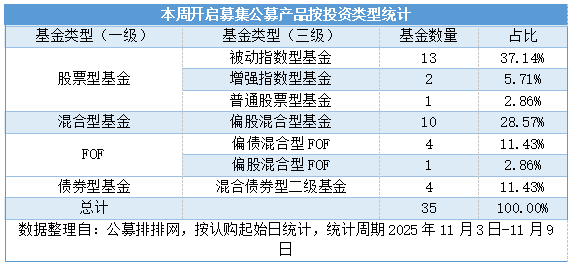
博瑞医药股价跌5%,银华基金旗下1只基金位居十大流通股东,持有291.09万股浮亏损失847.07万元
Xin Lang Cai Jing· 2025-11-04 05:47
Group 1 - The core point of the news is that 博瑞医药 (Borui Pharmaceutical) experienced a 5% drop in stock price, currently trading at 55.25 yuan per share, with a total market capitalization of 23.376 billion yuan [1] - The company, established on October 26, 2001, specializes in the research and production of high-end generic drugs and original new drugs, with product sales accounting for 89.90% of its revenue [1] - The company is located in Suzhou Industrial Park, Jiangsu Province, and was listed on November 8, 2019 [1] Group 2 - Among the top shareholders of 博瑞医药, a fund under 银华基金 (Yinhua Fund) has increased its holdings by 98,300 shares in the third quarter, now holding 2.9109 million shares, representing 0.69% of the circulating shares [2] - The fund, named 创新药 (Innovation Drug), has a total scale of 12.005 billion yuan and has reported a year-to-date return of 31.41% [2] - The fund manager 马君 (Ma Jun) has a tenure of 13 years and has achieved a best fund return of 144.61% during his management period [3]

基金回报榜:68只基金昨日回报超3%
Zheng Quan Shi Bao Wang· 2025-11-04 01:46
Core Insights - The stock and mixed funds achieved a positive return of 65.19% on November 3, with 68 funds returning over 3% and 541 funds experiencing a net value drawdown exceeding 1% [1][2] - The Shanghai Composite Index rose by 0.55% to close at 3976.52 points, while the Shenzhen Component Index and the ChiNext Index increased by 0.19% and 0.29%, respectively. The Sci-Tech Innovation 50 Index fell by 1.04% [1] - The top-performing sectors included media, coal, and oil & petrochemicals, with increases of 3.12%, 2.52%, and 2.28%, respectively. Conversely, sectors such as non-ferrous metals, home appliances, and comprehensive sectors saw declines of 1.21%, 0.66%, and 0.39% [1] Fund Performance Summary - On November 3, the average net value growth rate for stock and mixed funds was 0.18%, with 65.19% of funds showing positive growth. The top fund, Tongtai Huili Mixed A, had a net value growth rate of 4.25% [1][2] - Among the funds with a net value growth rate exceeding 3%, 60 were index stock funds, and 8 were equity funds. The fund with the largest drawdown was AVIC New Start Flexible Allocation Mixed A, with a decline of 3.02% [2][4] - The top funds by net value growth rate included: - Tongtai Huili Mixed A: 4.25% - Tongtai Huili Mixed C: 4.24% - GF CSI Photovoltaic Leading 30 ETF: 3.83% - Guotai CSI Film and Television Theme ETF: 3.79% [2][3] Drawdown Analysis - A total of 541 funds experienced a drawdown exceeding 1%, with the largest drawdown recorded by AVIC New Start Flexible Allocation Mixed A at 3.02% [2][4] - Other funds with significant drawdowns included: - AVIC New Start Flexible Allocation Mixed C: -3.01% - Qianhai Kaiyuan Hong Kong and Shanghai Core Resource Mixed A: -2.69% - Qianhai Kaiyuan Hong Kong and Shanghai Core Resource Mixed C: -2.67% [4][5]