
三花智控

Search documents
马斯克科技生态链系列之国内深度绑定解码
Xin Lang Cai Jing· 2026-01-13 11:54
Core Insights - Elon Musk's technological ecosystem is rapidly evolving, integrating six key industries: commercial space (SpaceX), brain-machine interfaces (Neuralink), humanoid robots (Optimus), autonomous driving (FSD), artificial intelligence (X AI), and hyperloop (The Boring Company) [1][19] - The technological advancements and mass production efforts are reshaping the global tech industry landscape and presenting certain investment opportunities for domestic companies in related sectors [1][19] Group 1: Deep Binding from Components to System Integration - The production of Tesla's Optimus robot is set to begin, with a target of 100,000 units by 2026, but the localization rate of core components is still below 30%, leaving significant market penetration opportunities for domestic high-barrier companies [21] - Top Group is a core supplier for Tesla's vehicle chassis and has entered the testing phase for Optimus's rotating joints, showcasing strong system integration capabilities [21] - Greentech Harmonic is a leading global harmonic reducer supplier, with its Y series products passing Tesla's extreme conditions test and set to deliver 10,000 units by 2025 [21] - Sanhua Intelligent Control is leveraging its experience in automotive thermal management to quickly enter the robot electromechanical actuator and thermal management systems market [21] - Mingzhi Electric is one of the few companies capable of mass-producing hollow cup motors, which are critical for achieving human-like dexterity in robotic hands [21] Group 2: L5 Autonomous Driving - Hardware and Software Integration - Tesla's Full Self-Driving (FSD) is accelerating its rollout, with deep participation from the Chinese supply chain in hardware iteration and software adaptation [22] - Desay SV is supplying the autonomous driving domain controller to Tesla's North American supply chain, with FSD-related orders expected to reach 1.2 billion yuan by 2025 [22] - Lianchuang Electronics is the main supplier of vehicle-mounted lenses for Tesla's HW4.0, holding approximately 60% market share [22] - Zhongke Chuangda, as a leading vehicle operating system provider, is continuously optimizing AI model efficiency on Tesla's platform to support smooth FSD software deployment [22] Group 3: Technical Collaboration - Patent Sharing and Capability Building - Some companies, while not supplying on a large scale, are building long-term barriers through technical cooperation [23] - Changying Precision has reached a cross-licensing agreement with Tesla regarding flexible sensors, enhancing its technological moat in robot perception [23] - Sanhua Intelligent Control is jointly developing actuator efficiency optimization solutions to enhance Optimus's operational endurance [24] - Yanshan Technology's pure vision autonomous driving solution aligns closely with FSD technology, currently supporting Tesla indirectly through international Tier 1 suppliers [24] Group 4: Potential Tracks - From Benchmarking to Entry - In commercial space, Chinese companies are gaining certification in key areas as SpaceX's Starlink accelerates deployment [25] - Tongyu Communication has developed a microwifi antenna module that has passed SpaceX interface certification, expected to supply 60% of Starlink's dedicated modules starting Q3 2025 [25] - Xinyi Communication's subsidiary is the exclusive supplier of high-frequency connectors for Starlink ground terminals, with annual revenue projected to exceed 1.5 billion yuan [25] - Blue Arrow Aerospace is the only domestic company mastering reusable liquid oxygen-methane rocket technology, establishing a significant barrier in low-cost, high-frequency launches [25] Group 5: Brain-Machine Interfaces - Complementary Paths for Cooperation - Neuralink focuses on invasive methods, while Chinese companies are exploring non-invasive and clinical translation paths [30] - Yanshan Technology's non-invasive BCI technology complements Neuralink's approach, indicating clear cooperation potential if Neuralink expands into consumer products [30] - Hanwei Technology's subsidiary has developed ultra-flexible sensors that are cost-competitive and have entered the international supply chain [30] - Sanbo Brain Science is the only private hospital in China with clinical implantation qualifications for brain-machine interfaces, performing over 30,000 surgeries annually [30] Group 6: Indirect Competition and Strategic Value - Some companies, while not directly collaborating with Musk's ecosystem, play a crucial role in national projects, fulfilling "domestic substitution" responsibilities [31] - China Satellite and China Satcom are leading the "Star Network Project," competing with Starlink in satellite manufacturing and operations [31] - Cambrian is developing AI chips that meet xAI's computational needs, presenting potential entry points if Tesla or xAI expands their supply chains [32] - Four-dimensional Map has over 60% market share in high-precision mapping, providing core positioning services for Tesla in China [33] Group 7: Selection Logic for "Invisible Champions" - Companies that meet the criteria of "technological leadership, low public recognition, high industry relevance, and sustained innovation barriers" have emerged as key players [34] - Mingzhi Electric is a global leader in hollow cup motors, essential for dexterous robotic hands [34] - Sanhua Intelligent Control is a dual leader in thermal management and actuators, validated by Tesla [34] - Top Group excels in system integration from chassis to joint assembly, showcasing deep binding [34] - Industrial Fulian is the largest server manufacturer globally, benefiting directly from xAI's computational expansion [34] - Blue Arrow Aerospace is the only player in liquid oxygen-methane reusable rockets, shaping the future of China's commercial space industry [34]

57家上市公司预亏,疫苗龙头首亏超百亿,有公司净利大增14倍
2 1 Shi Ji Jing Ji Bao Dao· 2026-01-13 10:59
Core Viewpoint - The A-share annual report performance forecast season is unfolding with a notable difference from previous years, as companies with poor performance are disclosing their losses earlier than usual, alongside profit warnings from companies with better performance [1]. Group 1: Performance Forecast Trends - As of January 13, 2026, 105 listed companies have released their performance forecasts for 2025, accounting for 70.9% of recent disclosures, with 57 companies (54.29%) predicting losses [1]. - Traditionally, companies with good performance tend to report positive forecasts early, while those with poor performance delay their disclosures. However, this trend has been disrupted in January 2026, with loss announcements appearing simultaneously with profit increases [1][3]. Group 2: Industry Impact and Loss Distribution - The current wave of loss announcements is characterized by "uneven scale and industry concentration," with traditional cyclical industries being the hardest hit. The real estate sector has shown particularly poor performance, with all six companies that disclosed forecasts reporting losses [3]. - Among the 57 companies predicting losses, two are expected to lose over 10 billion, while others fall into various loss brackets, with the real estate giant Greenland Holdings projected to lose between 16 billion to 19 billion yuan, marking its third consecutive year of losses [3][4]. Group 3: Specific Company Forecasts - Yonghui Supermarket is expected to report a negative net profit for the fifth consecutive year, while the vaccine leader Zhifei Biological Products anticipates a loss of 10.698 billion to 13.726 billion yuan, representing a year-on-year decline of 630% to 780%, marking its first annual loss in 25 years [4]. - Other companies, such as Sanan Optoelectronics and Zhuosheng Micro, are also forecasting significant losses, with declines in their respective sectors [5]. Group 4: Profit Growth in Certain Sectors - In contrast to the loss announcements, companies in the resource and technology sectors are experiencing significant profit growth, driven by rising commodity prices and technological innovations. For instance, Zijin Mining expects a net profit of 51 to 52 billion yuan, a year-on-year increase of 59% to 62% [8]. - The technology sector is also seeing growth, with companies like Sanhua Intelligent Control projecting a profit increase of 25% to 50% due to advancements in their automotive parts business [8][9]. Group 5: Market Reactions and Future Outlook - Analysts suggest that the early disclosure of losses is a strategy to manage investor expectations and prevent market volatility during the concentrated reporting period. This reflects a regulatory focus on transparency and investor protection [14]. - Looking ahead to 2026, there is a positive sentiment among institutions regarding market recovery, with expectations of improved corporate earnings driven by macroeconomic recovery and increased investor confidence [15].



搭上特斯拉,人形机器人供应商冲刺A股IPO
2 1 Shi Ji Jing Ji Bao Dao· 2026-01-13 08:32
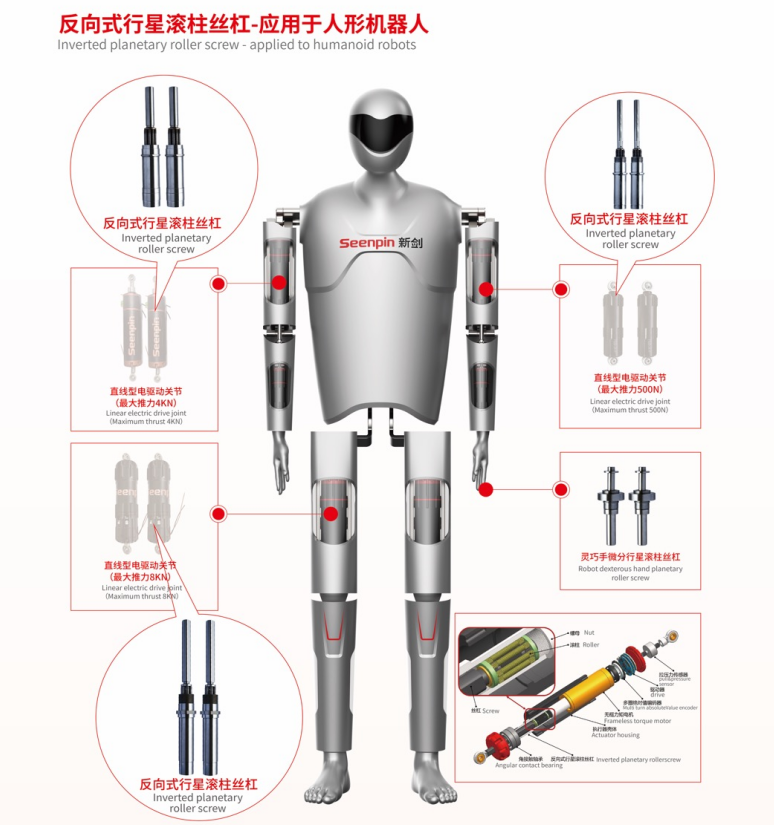
Core Viewpoint - The article highlights the IPO preparation of Xinjian Transmission, a key supplier for Tesla's humanoid robot "Optimus," signaling strong industrialization prospects for humanoid robots and the potential for mass production by 2026 [3][11]. Company Overview - Xinjian Transmission, established in 1999 in Hangzhou, specializes in precision machinery and is classified under "C34 General Equipment Manufacturing" [5]. - The largest shareholder is Shanghai Xinjian Asset Management Co., holding 29.40% of the shares, while the actual controllers hold 35.27% [5][6]. Industry Context - The humanoid robot industry has gained traction, with Xinjian Transmission emerging as a core supplier for Tesla's Optimus robot, which has expanded the market potential for planetary roller screws [7][8]. - The company transitioned from traditional precision manufacturing for luxury watch brands to focus on planetary roller screws, a critical component for robots, seizing the opportunity as the humanoid robot market began to flourish [6][7]. Market Dynamics - Xinjian Transmission's IPO is expected to attract attention to the entire supply chain of humanoid robots, particularly benefiting other suppliers like Sanhua, Top Group, and Wuzhou Xinchun [3][10]. - The company has initiated a project to produce 1 million planetary roller screws annually, capitalizing on the demand from Tesla and the broader market [8][11]. Financial Implications - The anticipated IPO of Xinjian Transmission is seen as a landmark event for the humanoid robot industry, potentially leading to a revaluation of assets within the supply chain [11][12]. - Collaborations with other companies, such as Wuzhou Xinchun, are expected to enhance Xinjian's revenue streams and market presence, further solidifying its role in the Tesla supply chain [10][11].

搭上特斯拉,人形机器人供应商冲刺A股IPO
21世纪经济报道· 2026-01-13 08:20
Core Viewpoint - The article highlights the upcoming IPO of Xinjian Transmission, a key supplier for Tesla's humanoid robot "Optimus," signaling strong industrialization prospects for the humanoid robot sector and the potential for mass production by 2026 [6]. Group 1: Company Overview - Xinjian Transmission, established in 1999, specializes in precision machinery processing and is classified under "C34 General Equipment Manufacturing" [8]. - The largest shareholder, Shanghai Xinjian Asset Management Co., holds 29.40% of the shares, while the actual controllers hold 35.27% [8]. - Initially focused on producing watch screws and precision gears, Xinjian has transitioned into the planetary roller screw industry, which is crucial for robotics [8][9]. Group 2: Market Position and Opportunities - Xinjian Transmission began domestic production of planetary roller screws in 2022, coinciding with Tesla's release of the Optimus Gen1 robot, expanding the market potential significantly [9]. - The company has secured a project to produce 1 million planetary roller screws annually, capitalizing on the growing demand in the humanoid robot market [9]. - Xinjian's geographical advantage and early entry into the screw market have positioned it as a core supplier for Tesla's humanoid robots, despite not being a key supplier for Tesla's vehicles [9]. Group 3: Industry Impact and Collaborations - The IPO of Xinjian Transmission is seen as a landmark event for the humanoid robot industry, potentially leading to a revaluation of core component assets within the sector [13]. - Collaborations with suppliers like Wuzhou Xinchun, which will provide various critical components, indicate a strengthening of Xinjian's supply chain and market presence [12]. - The anticipated IPO and subsequent production capacity expansion are expected to benefit related equipment manufacturers and enhance the clarity of supply chain shares [13][15].

百惠金控:人工智能概念股活跃 政策与资本双动力带动行业升温
Jiang Nan Shi Bao· 2026-01-13 07:28
Group 1 - The recent performance of artificial intelligence and humanoid robot concept stocks in the Hong Kong market has been notably active, indicating a significant increase in market sentiment driven by industry development dividends [1] - Companies listed in Hong Kong related to humanoid robots and intelligent manufacturing, such as MINIMAX-WP (0100.HK), UBTECH (9880.HK), and Kingsoft Cloud (3809.HK), have seen their stock prices rise, reflecting a reassessment of the growth potential and commercial value of the AI and robotics sectors [1] - Nobikang AI Technology (Chengdu) Co., Ltd., which was listed on December 23, 2025, experienced a remarkable debut with its stock price opening at HKD 319.8 and increasing by over 300%, showcasing strong market interest in quality AI stocks [1] Group 2 - The Chinese government has emphasized accelerating the commercialization of high-end manufacturing, artificial intelligence, and intelligent robotics, incorporating the robotics industry into key development directions and implementing supportive measures such as industrial funds and tax incentives [3] - The Hong Kong government is committed to establishing itself as an international innovation and technology center, supported by initiatives like the HKD 3 billion "Frontier Technology Research Support Program" and the AI Supercomputing Center's upgrade to 3000 PFLOPS, creating a comprehensive support system from research to industrialization [3] Group 3 - Baohui Capital has played a crucial role in promoting industry development, successfully assisting UBTECH (9880.HK) in its listing on the Hong Kong Stock Exchange, which has become a focal point in the global capital market [5] - Following its listing, UBTECH has further raised funds through placement to invest in core R&D and capacity expansion, solidifying its leading position in China's humanoid robot industry, with production capacity increasing to 300 units per month and expected annual deliveries surpassing 500 units in 2025 [5] - The outlook for the Hong Kong market is positive, with expectations that it will serve as a core platform for corporate financing and become a regional hub for global capital, technology, and enterprises due to its status as an international financial center and a well-developed innovation ecosystem [5]
碳酸锂期货暴涨9%,一度涨12%涨停!电池50ETF(159796)窄幅震荡,电池出口退税调整,有何影响?全产业链解析!
Sou Hu Cai Jing· 2026-01-13 06:46
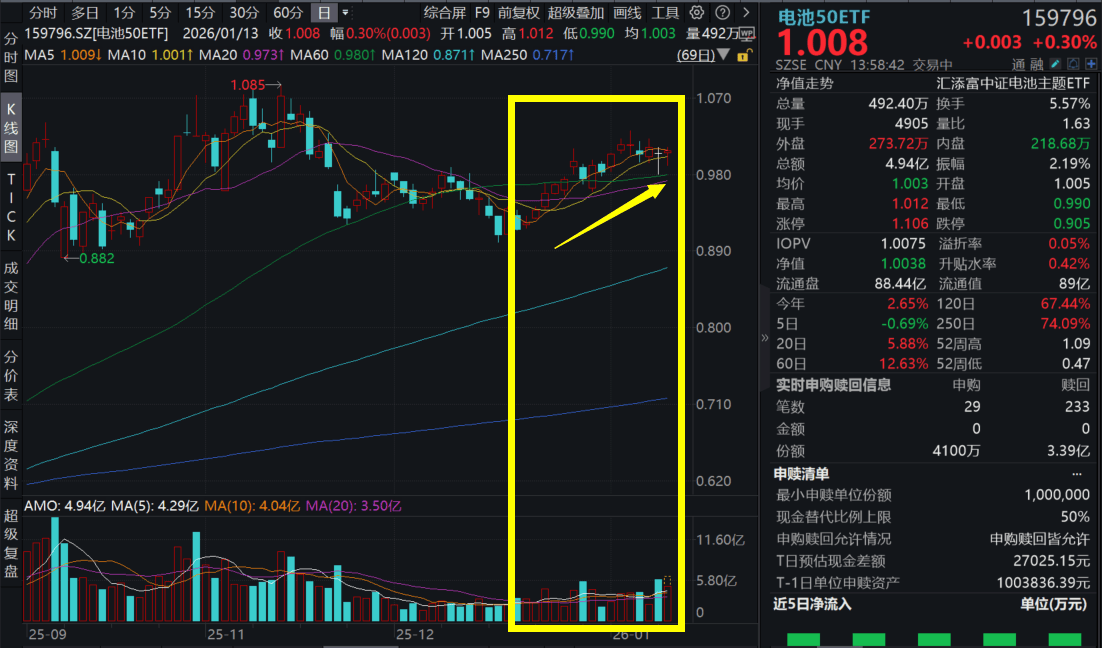
Core Viewpoint - The A-share market showed mixed performance on January 13, with the Battery 50 ETF (159796) experiencing a slight increase of 0.3% amid fluctuations in trading [1] Group 1: Market Performance - The Battery 50 ETF (159796) recorded a trading volume of 4.94 billion CNY, with a price range between 0.990 and 1.012 CNY [1] - The ETF's net asset value was reported at 1.0038 CNY, with a premium rate of 0.42% [1] - The ETF's five-day net inflow was noted at 2.65% [1] Group 2: Component Stocks - Major component stocks of the Battery 50 ETF included Sanhua Intelligent Controls, which rose by 1.05%, and multiple fluorine, which increased by 1.26% [2] - Notable declines were observed in XINWANDA, which fell by 2.40%, and other key players like Yangguang Electric and Ningde Times also experienced slight declines [2] Group 3: Policy Impact - The recent adjustment in export tax rebates for battery products is expected to lead to a surge in exports in 2026, tightening supply and demand in the lithium battery industry [4] - The tax rebate for battery products will decrease from 9% to 6% starting April 1, 2026, and will be eliminated entirely by January 1, 2027 [5] Group 4: Industry Outlook - The battery sector is anticipated to benefit from increased demand driven by both domestic and international markets, with projections indicating a significant rise in global demand for power batteries from 1,253.4 GWh in 2025 to 1,834.2 GWh by 2027 [5] - The storage demand is also expected to grow substantially, with domestic installations projected to reach 265 GWh in 2026, reflecting a 60% increase [5] Group 5: Investment Strategy - The Battery 50 ETF (159796) is highlighted as a leading option for investors due to its significant exposure to the storage sector, which accounts for 18.7% of its index, and a high proportion of solid-state battery technology at 45% [6][8] - The ETF's management fee is noted to be the lowest in its category at 0.15% per year, making it an attractive investment vehicle for capturing opportunities in the battery sector [11]






人形机器人:参与者布局梳理-Humanoid Robotics Who plays where
2026-01-13 02:11
Summary of Humanoid Robotics Industry Analysis Industry Overview - The analysis covers the humanoid robotics sector, focusing on approximately 150 global players, including OEMs and parts suppliers [1][2][3]. Key Characteristics of the Humanoid Robotics Ecosystem 1. **Supply Chain Structure** - Humanoid robotics companies are categorized into OEMs and parts suppliers, with a supply chain structure similar to the automotive industry, featuring multiple actuator suppliers [1]. 2. **Key Know-Hows** - Hardware expertise centers on robotic design, while software involves distinct layers: "robotic models" (brain and locomotion algorithms) and "world models" (simulation environments) [1]. 3. **Vertical Integration** - Most OEMs design critical components in-house, with varying degrees of outsourcing for production. Unitree is noted for its unique approach, focusing on hardware with integrated locomotion algorithms [1]. 4. **Competition and Differentiation** - The industry has a high number of participants, indicating low entry barriers. However, differentiation is possible through quality, agility, and cost, particularly in robotic models and actuators [1]. 5. **China vs. the West** - China is emerging as a significant player in humanoid robotics, with more participants than the rest of the world combined. China leads in most areas of the value chain, except for AI chips and simulation environments [1]. Competitive Landscape - **Non-Chinese Humanoid Robot OEMs** - Key players include Tesla, Boston Dynamics, and Agility Robotics, with varying capabilities in hardware and software [2]. - **Non-Chinese Humanoid Parts Suppliers** - Major suppliers include NVIDIA, Google, and Intel, providing essential components like AI chips and actuators [3]. - **Chinese Humanoid Robot OEMs** - Notable companies include Unitree Robotics, UBTech, and XPeng, with a focus on various hardware and software capabilities [4]. - **Chinese Humanoid Parts Suppliers** - Key suppliers include Hesai and RoboSense, contributing to the hardware and software needs of the industry [6][9]. Investment Implications - Recommendations include: - **Outperform**: Shuanghuan, Hesai, Tuopu, Inovance, Harmonic Drive - **Market-Perform**: Sanhua - **Underperform**: Leader Drive [10]. Financial Metrics - Specific financial metrics and projections for key companies are provided, including EPS and P/E ratios for 2024-2026 [11]. Conclusion - The humanoid robotics industry is characterized by rapid growth, significant competition, and a clear divide between Chinese and Western players. Investment opportunities exist, particularly in companies that demonstrate strong differentiation and technological capabilities.




双融日报:鑫融讯-20260113
Huaxin Securities· 2026-01-13 01:47
- The report introduces the "Huaxin Market Sentiment Temperature Indicator," which is constructed based on six dimensions: index fluctuation, trading volume, number of rising and falling stocks, KDJ indicator, northbound capital, and margin trading data. This indicator is classified as an oscillation indicator, similar to the RSI indicator, and is more suitable for range-bound markets rather than trend prediction. It may experience lagging effects during trending markets, indicating the emergence of trends. When the indicator remains near 80 or above or 20 or below for an extended period, its applicability should be reassessed [19] - The sentiment indicator provides a comprehensive score ranging from "overcool" (0-19), "cool" (20-39), "neutral" (40-59), "warm" (60-79), to "overheat" (80-100). The current sentiment score is 95, indicating an "overheat" market condition. Historical data suggests that when the sentiment score is below or near 60, the market tends to find support, while scores above 90 may lead to resistance [8][19] - The sentiment indicator is evaluated as a useful tool for high-frequency trading strategies in oscillating markets, offering guidance for high-selling and low-buying opportunities. However, it lacks predictive power for trends and may require adjustments during prolonged extreme sentiment levels [19] - Backtesting results show that the sentiment indicator effectively identifies market conditions, with scores below 60 correlating with market support and scores above 90 correlating with resistance. The current score of 95 aligns with the "overheat" classification [8][19]
从CES看人形机器人叙事变化
2026-01-13 01:10
Summary of Key Points from Conference Call Records Industry Overview - The humanoid robot market is dominated by Chinese companies, with the top six companies expected to account for 87% of global shipments by 2025, indicating a significant lead in the market [1][2]. Core Insights and Arguments - The investment logic in humanoid robots is shifting from simple hardware production to a focus on AGI-related brain technologies and software applications, as hardware mass production becomes less meaningful due to the dominance of Chinese firms [1][3]. - There is a valuation inversion in the humanoid robot sector, exemplified by Figure AI, which holds a mere 1% market share but has a market capitalization of $39 billion, surpassing the combined market value of leading Chinese companies [1][4]. - Rising market risk appetite, influenced by geopolitical changes and ongoing government support for AI, is beneficial for the AI application sector, with humanoid robots being a key area of interest [1][5]. Notable Companies and Developments - Tesla is highlighted as a significant player, potentially integrating its Full Self-Driving (FSD) capabilities into humanoid robots, leveraging its extensive real-world data and algorithmic architecture [1][6][7]. - Hengli Hydraulic is expanding its operations in Mexico to meet the overseas production demands of clients like Tesla, with a notable increase in excavator exports expected [1][8]. - Starship Transmission is preparing for an IPO and plans to establish a production capacity of 1 million humanoid robot components annually, which could enhance its market position [1][9][10]. Market Segmentation and Key Players - The humanoid robot market is concentrated in vertical applications such as sewing, packaging, logistics, and automotive production, with companies like Jack Sewing, Yongchun Intelligent, Anhui Heli, Hangcha Group, and UBTECH being noteworthy [1][12]. - Future vertical models in humanoid robotics may emerge in agriculture, mining, and road transport, particularly from leading companies capable of accumulating data collaboratively [1][13]. Additional Important Insights - The integration of Tesla's FSD technology is expected to play a crucial role in the development of humanoid robots, with supply chain companies needing strong cost control and resilience to enhance their competitive edge [1][11].

三花智控遭施罗德投资减持302.2万股 每股作价38.067港元
Xin Lang Cai Jing· 2026-01-13 00:43
Core Viewpoint - Schroders Investment has reduced its stake in Sanhua Intelligent Control (02050) by selling 3.022 million shares at a price of HKD 38.067 per share, totaling approximately HKD 115 million, resulting in a new holding of about 71.4712 million shares, representing 14.99% of the company [1] Group 1 - Schroders Investment sold 3.022 million shares of Sanhua Intelligent Control on January 8 [1] - The sale price was HKD 38.067 per share, leading to a total transaction value of approximately HKD 115 million [1] - After the reduction, Schroders' remaining shares amount to approximately 71.4712 million, equating to a 14.99% ownership stake in the company [1]