上海家化

Search documents
可选消费W35周度趋势解析:全球奢侈品板块触底反弹,A/H业绩落地主导各子行业表现-20250901
Haitong Securities International· 2025-09-01 14:31
研究报告 Research Report 可选消费 W35 周度趋势解析:全球奢侈品板块触底反弹,A/H 业绩落地主导各子行业表现 Week 35 Discretionary Trends: Global Luxury Sector Bottoms Out and Rebounds, A/H Results Drive Sub-sector Performance [Table_yemei1] 观点聚焦 Investment Focus | 股票名称 | 评级 | 股票名称 | 评级 | | --- | --- | --- | --- | | 耐克 | Outperform 石头科技 | | Outperform | | 美的集团 | Outperform 科沃斯 | | Outperform | | 京东集团 | Outperform 永辉超市 | | Outperform | | 海尔智家 | Outperform 波司登 | | Outperform | | 安踏体育 | Outperform 李宁 | | Outperform | | 格力电器 | Outperform 苏泊尔 | | Outperf ...
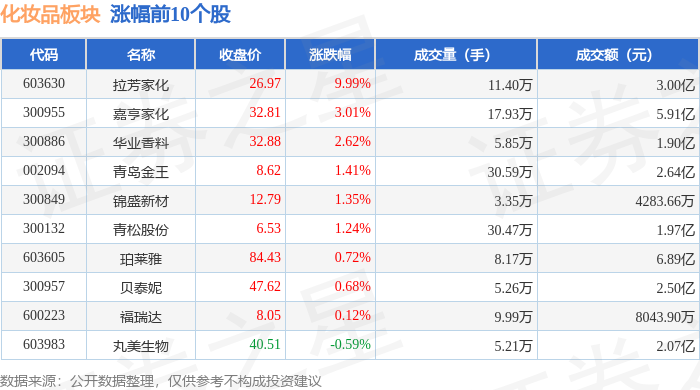
化妆品板块9月1日涨0.56%,拉芳家化领涨,主力资金净流入1555.8万元
Zheng Xing Xing Ye Ri Bao· 2025-09-01 08:53
Group 1 - The cosmetics sector increased by 0.56% on September 1, with Lafang Jiahua leading the gains [1] - The Shanghai Composite Index closed at 3875.53, up 0.46%, while the Shenzhen Component Index closed at 12828.95, up 1.05% [1] - Lafang Jiahua's stock price rose by 9.99% to 26.97, with a trading volume of 114,000 shares and a transaction value of 300 million yuan [1] Group 2 - The cosmetics sector saw a net inflow of 15.558 million yuan from institutional investors, while retail investors contributed a net inflow of 45.296 million yuan [2] - Major stocks in the sector experienced varied capital flows, with Lafang Jiahua having a net inflow of 75.247 million yuan from institutional investors [3] - Other companies like Jiahen Jiahua and Huaye Fragrance also saw significant net inflows, while stocks like Marubi Biological and Shanghai Jahwa experienced net outflows from institutional and retail investors [3]







大消费行业周报(8月第5周):在线旅游行业龙头中报业绩稳健增长-20250901
Century Securities· 2025-09-01 00:39
Investment Rating - The report suggests a positive outlook for the online travel industry, particularly for leading companies like Ctrip and Tongcheng, which have shown steady growth in their mid-year reports [1][2]. Core Insights - The online travel industry is experiencing a robust recovery, with Tongcheng's revenue growing by 10% year-on-year in Q2 2025 and Ctrip's revenue increasing by 16.2% in the same period. Both companies maintained stable growth rates compared to Q1 2025, with notable performance in international business [1][2]. - Domestic tourism is on the rise, with the Ministry of Culture and Tourism reporting 5.62 billion domestic trips in 2024, a 14.8% increase year-on-year, and total spending of 5.8 trillion yuan, up 17.1% [1][2]. - The Guangdong provincial government plans to launch a "Golden Autumn Cultural Tourism Consumption Season" on September 12, 2025, with a budget of 20 million yuan for issuing tourism consumption vouchers, which is expected to stimulate local tourism and related industries [1][2]. Summary by Sections Market Weekly Review - The consumer sector saw mixed performance, with retail, food and beverage, and social services showing positive growth, while beauty care, home appliances, and textile and apparel sectors experienced declines [1][2]. - Notable stock performances included Wanchen Group (+41.10%) and Jiaheng Home Care (+55.37%), while West China Animal Husbandry (-5.88%) and Gree (-8.30%) faced declines [1][2]. Industry News and Key Company Announcements - The report highlights significant announcements from various companies, including Taiping Bird's revenue decline of 7.86% and Shanghai Jahwa's revenue growth of 4.75% in the first half of 2025 [1][2]. - Noteworthy is the performance of companies like Nongfu Spring, which reported a 15.6% increase in revenue, and Youyou Food, which saw a 45.59% rise in revenue [1][2].

中金:走进非洲“热土”消费市场,赴约勇敢者游戏
中金点睛· 2025-08-31 23:39
Core Insights - The article emphasizes the growth potential of the African consumer market, particularly in essential goods, driven by a young population and increasing penetration rates in essential categories [3][18]. Group 1: Overall Economic and Demographic Insights - Africa's GDP is projected to reach $3 trillion in 2024, accounting for 3.10% of the global economy, with a population of approximately 1.515 billion, representing 18.56% of the global population [3][33]. - The region has a youthful demographic, with a median age of around 21 years and 38% of the population aged 0-14, which supports the growth of essential consumer goods [3][36]. - East and West Africa show significant growth potential due to better business environments and relatively stable exchange rates compared to other regions [3][27]. Group 2: Consumer Market Characteristics - The African consumer market is characterized as an early seller's market, with essential goods penetration and per capita consumption steadily increasing [4][5]. - Essential categories, such as packaged water and beverages, are expected to grow at a compound annual growth rate (CAGR) of 13.9% and 15.7% respectively from 2021 to 2024, while optional categories lag behind with growth rates below 6% [4][5]. - Traditional offline channels dominate the retail landscape, with e-commerce projected to account for only 2% of total retail sales by 2024 [4][5]. Group 3: Regional Insights from Field Research - The field research covered major cities in Ghana, Kenya, and Tanzania, which together account for approximately 10% of Africa's total population and 8.2% of its GDP [8]. - The average annual spending per capita in these countries ranges from $1,000 to $2,000, with over 35% of expenditures allocated to essential goods [8][11]. - Consumer behavior is heavily influenced by traditional marketing channels, with limited penetration of modern retail formats [9][11]. Group 4: Investment Opportunities and Challenges - The African market presents opportunities for investment in essential goods due to the expanding population and increasing demand for these products [18][21]. - However, challenges include weak supply chain infrastructure, complex trade policies, and significant currency fluctuations, particularly in countries like Ghana where the currency has depreciated by 154% since 2022 [21][22]. - The operational complexity across different countries necessitates a high level of management capability and adaptability from companies looking to enter the market [23][24]. Group 5: Competitive Landscape - International brands like Unilever and Nestlé have established a presence in Africa, while local brands often compete on price [4][20]. - Chinese companies are leveraging their supply chain and organizational management strengths to penetrate the market, focusing on localized innovation and cost-effective manufacturing [24][25].

魔镜洞察:2025年,美妆人必须关注三大趋势
FBeauty未来迹· 2025-08-31 11:14
Core Viewpoint - The beauty and skincare industry experienced a subtle performance in the first half of 2025, with sales increasing by 10.1% year-on-year, indicating a shift in market dynamics towards lower-priced skincare and a rapid rise of mid-tier brands, while high-end brands maintained steady growth [3][5]. Group 1: Market Performance - The beauty and skincare market achieved a sales figure of 235.23 billion yuan in the first half of 2025, with a year-on-year increase of 10.1%, and a volume of 2.564 billion units sold, up by 5.5% [5]. - The low-price segment of the beauty market saw a market share increase of 0.5%, while the skincare market's segment of products priced at 100 yuan and below grew by 3.9% [7]. - The top 10 brands' sales increased by 3.3%, but their market share decreased by 1.0%, while mid-tier brands expanded their market share by 2.1% and saw a sales increase of 7.5% [7]. Group 2: Trends in Anti-Aging Products - The total sales of anti-aging products reached 65.49 billion yuan, reflecting a year-on-year increase of 30.3%, with significant attention on these products across social media platforms [12]. - The demand for anti-aging products has transcended age barriers, with younger consumers (25+) increasingly aware of anti-aging needs, and male consumers showing an 83.7% year-on-year increase in interest [15]. - The anti-aging market is expanding into new consumer demographics, including lower-tier cities, indicating a broadening appeal [15]. Group 3: Shifts in Makeup Trends - The concept of "naked makeup" has evolved into "authentic aesthetics," shifting consumer logic from concealing flaws to expressing individuality [4][27]. - The sales of products that combine makeup and skincare saw a year-on-year growth of 94.3%, indicating a rising consumer demand for products that serve dual purposes [37]. - The beauty market is characterized by a strong consumer preference for natural looks and personalized expressions, with keywords like "high-end" and "natural" dominating discussions [25]. Group 4: Brand Performance - L'Oréal remains the market leader with a sales figure of 5.34 billion yuan, showing a slight increase of 0.3%, while the brand La Mer experienced the highest growth among the top 10, achieving a 27.3% year-on-year increase [8]. - The brand Kiehl's saw a remarkable growth of 204.5% in the first half of 2025, driven by innovative marketing strategies and product offerings [10]. - Lancôme and La Mer maintained steady growth, while Helena Rubinstein's flagship products saw a decline in sales by 17.2% [21].
上海家化改革成效显现 线上渠道依然面临挑战
Zhong Guo Jing Ying Bao· 2025-08-31 11:12
Core Insights - The new chairman Lin Xiaohai's reforms have started to show results, with Shanghai Jahwa reporting a net profit of 270 million yuan in the first half of 2025, a year-on-year increase of 11.7% [1][2] - The company experienced significant fluctuations in performance prior to these reforms, including its first loss since listing in 2024 [1][2] Financial Performance - In the first half of 2025, Shanghai Jahwa achieved an operating income of 3.48 billion yuan, representing a year-on-year growth of 4.8% [2] - The improvement in operational quality is evident, with accounts receivable and inventory both decreasing year-on-year, and operating cash income increasing [2] Brand Strategy - Lin Xiaohai categorized Shanghai Jahwa's brands into three tiers, with Yuze and Liushen in the first tier, Baicaojie and Meijiajing in the second tier, and others in the third tier [2] - Baicaojie brand saw over 50% growth year-on-year, with the Dabaimei product becoming the first item to exceed 100 million yuan in online sales [3] Pricing and Market Positioning - Adjustments were made to Baicaojie's pricing strategy, lowering the price of the Taiji series to below 300 yuan to enhance competitiveness, which resulted in improved conversion rates [3] - Future product lines for Baicaojie will see prices return to above 300 yuan to maintain brand image [3] Online Channel Development - The company has focused on online channel development, achieving a 34.64% year-on-year increase in domestic online sales in Q2 [4] - Challenges in online transformation include product category suitability for online sales and high operational costs associated with online channels [5] Future Directions - The company aims to enhance channel efficiency by focusing on core products and aiming for top rankings in niche markets [5] - Future growth opportunities include online channels, instant retail, and international expansion, leveraging the global recognition of Chinese brands [5]

【最全】2025年中国功能性护肤品行业上市公司全方位对比(附业务布局、业绩对比、业务规划等)
Qian Zhan Wang· 2025-08-31 02:10
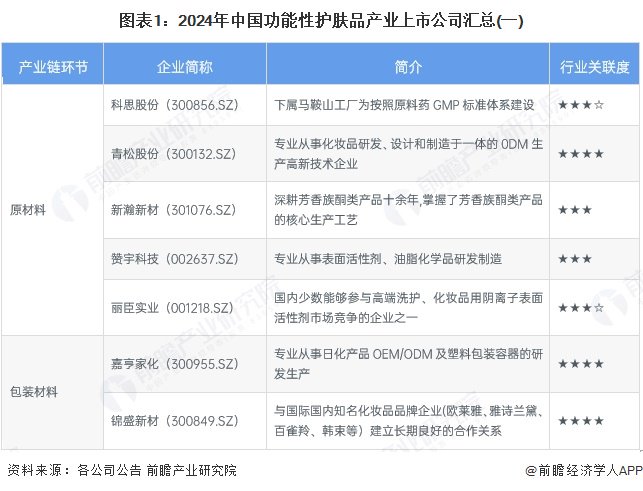
Core Viewpoint - The functional skincare industry in China is experiencing a rise of domestic brands, with various listed companies involved across the supply chain, including raw materials, packaging, and sales channels [1][2]. Group 1: Industry Overview - Functional skincare products are designed to address specific skin issues and possess certain pharmacological effects, indicating a growing market for targeted skincare solutions [1]. - The industry is characterized by a diverse range of companies, from raw material suppliers to online and offline sales channels [2]. Group 2: Company Distribution - Key companies in the raw materials segment include Kesheng Co., Qingsong Co., and Xinhang New Materials, while packaging material companies include Jiaheng Household and Jinsong New Materials [2][3]. - Major players in the functional skincare segment include Betaini, Huaxi Biological, Shanghai Jahwa, and Chuang'er Biological, with significant online sales channels represented by Alibaba, JD.com, and Pinduoduo [2][4]. Group 3: Financial Performance - Betaini leads the industry with a revenue of 57.36 billion yuan in 2024, followed by Huaxi Biological with 53.71 billion yuan and Shanghai Jahwa with 56.79 billion yuan [6][18]. - The gross profit margins for most companies in the functional skincare sector range from 70% to 85%, with Juzhi Biological achieving the highest margin at 82.09% [17][18]. Group 4: Business Strategies - Companies are focusing on R&D innovation, brand enhancement, and channel optimization to capture more market share and adapt to competitive pressures [19]. - Betaini plans to enhance its product offerings in the baby skincare segment and expand its online and offline presence, while Huaxi Biological is shifting towards anti-aging strategies and enhancing its technological capabilities [20][19]. Group 5: Market Positioning - Betaini has a dominant market position with 99.49% of its business in functional skincare, primarily targeting the Chinese market [16]. - Huaxi Biological and Shanghai Jahwa have also established strong brand identities with competitive product lines, while Chuang'er Biological focuses on collagen products [14][16].

邀请函|“新消费时代”国泰海通证券2025消费品年会
国泰海通证券研究· 2025-08-30 13:42
Core Viewpoint - The article discusses the upcoming 2025 Consumer Goods Annual Conference organized by Guotai Junan Securities, highlighting key trends and opportunities in the consumer goods sector, particularly in the context of new consumption patterns and technological advancements [3][6]. Group 1: Conference Agenda - The conference will feature a series of presentations and discussions on various topics, including consumer trends in the longevity era, the resurgence of domestic beauty brands, and the rise of functional health products [6][7]. - Notable speakers include experts from Fudan University, health product companies, and retail specialists, indicating a diverse range of insights into the consumer goods market [6][8]. Group 2: Industry Trends - The article emphasizes the high growth potential in the new consumption era, driven by strong policy support and evolving consumer preferences [6][7]. - Specific focus areas include the development of smart home appliances, the impact of AI on consumer behavior, and the growth of the pet industry, which is expected to undergo significant changes by 2025 [7][10]. Group 3: Participating Companies - A variety of companies from different sectors will participate in the conference, including food and beverage brands, cosmetics firms, and retail businesses, showcasing the breadth of the consumer goods industry [10][12]. - Notable participants include well-known brands such as Huayi Beer, Shanghai Jahwa, and various pet product companies, indicating a comprehensive representation of the market [10][12].

美妆赛道上半年成绩单出炉,谁掉队、谁赶超?
Zhong Guo Ji Jin Bao· 2025-08-30 11:55
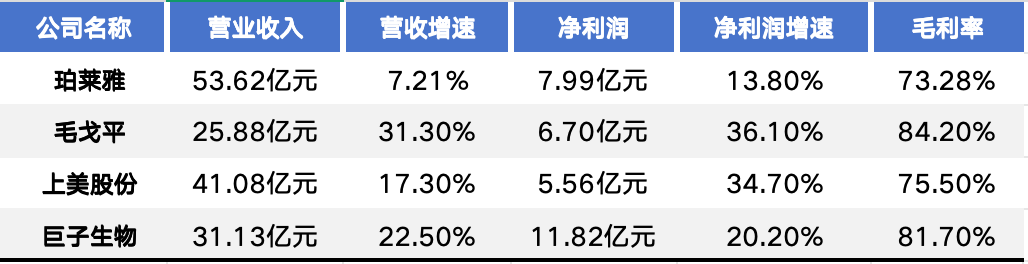
Core Insights - The beauty industry in China is experiencing a significant performance divergence among leading companies, with a notable emphasis on quality improvement amidst a deep industry adjustment [1][2]. Group 1: Industry Performance - In the first half of 2025, retail sales of cosmetics in China increased by 2.9% year-on-year, with domestic brands capturing over 55% market share [2]. - Exports of cosmetics surged by 12% to 25.8 billion yuan, indicating strong overseas growth potential [2]. Group 2: Leading Companies - Leading companies like Proya, Mao Geping, and Shangmei continue to excel, while others like Huaxi Biological and Fulejia are lagging behind [2]. - Proya reported revenue of 5.362 billion yuan, a 7.21% increase, and a net profit of 799 million yuan, up 13.8% [4]. - Mao Geping achieved a revenue of 2.588 billion yuan, with a remarkable growth rate of 31.3%, and a net profit of 670 million yuan, reflecting a 36.1% increase [5]. - Shangmei's revenue reached 4.108 billion yuan, growing by 17.3%, with a net profit of 556 million yuan, up 34.7% [5]. - Juzhi Biological reported revenue of 3.113 billion yuan, a 22.5% increase, and a net profit of 1.182 billion yuan, up 20.2% [5]. Group 3: Underperforming Companies - Huaxi Biological reported a significant decline, with revenue dropping nearly 19.57% to 2.261 billion yuan and net profit falling 35.38% to 221 million yuan [6]. - Fulejia's revenue decreased by 8.15% to 863 million yuan, with a net profit decline of 32.54% to 230 million yuan, largely due to increased marketing expenses [9][11]. Group 4: Second-Tier Companies - Second-tier companies like Shanghai Jahwa, Marubi, and Shuiyang are showing improved performance [13]. - Shanghai Jahwa's revenue was 3.478 billion yuan, up 4.8%, with a net profit of 270 million yuan, increasing by 11.7% [14]. - Marubi achieved revenue of 1.769 billion yuan, a 30.83% increase, but net profit growth was only 5.21% [14]. - Shuiyang reported revenue of 2.5 billion yuan, a 9.02% increase, and a net profit of 123 million yuan, up 16.54% [14].
美妆赛道上半年成绩单出炉,谁掉队、谁赶超?
中国基金报· 2025-08-30 11:52
Core Viewpoint - The beauty industry in China is experiencing a significant performance divergence among leading companies, with a notable increase in quality, as evidenced by the half-year reports of domestic beauty brands [2]. Group 1: Leading Companies Performance - Leading beauty companies such as Proya, Mao Geping, and Shangmei continue to outperform, while Huaxi Biological and Fulejia are lagging behind [2][4]. - Proya reported a revenue of 5.362 billion yuan, a year-on-year increase of 7.21%, and a net profit of 799 million yuan, up 13.8%. However, its main brand experienced a slight revenue decline of 0.08% [5][6]. - Mao Geping, known as the "first stock of high-end domestic beauty," achieved a revenue of 2.588 billion yuan, with a net profit of 670 million yuan, both showing over 30% growth. The gross margin reached 84.2% [6]. - Shangmei's revenue was 4.108 billion yuan, growing 17.3%, with a net profit of 556 million yuan, up 34.7%. The "newpage" brand saw a revenue increase of 146.5% [6][7]. - Juzhi Biological reported a revenue of 3.113 billion yuan, a 22.5% increase, and a net profit of 1.182 billion yuan, up 20.2%, although growth rates have slowed compared to the previous year [7]. Group 2: Underperforming Companies - Huaxi Biological, referred to as the "first stock of hyaluronic acid," reported a revenue decline of 19.57% to 2.261 billion yuan and a net profit drop of 35.38% to 221 million yuan, marking its worst interim report since listing [9]. - The decline in Huaxi's revenue is attributed to a significant drop in its functional skincare business, which saw a 31.62% year-on-year decrease in 2024 [9]. - Fulejia's revenue was 863 million yuan, down 8.15%, with a net profit of 230 million yuan, a decrease of 32.54%. The company faced a substantial increase in sales expenses, which rose by 39.56% [11][12]. Group 3: Second-Tier Companies - Second-tier beauty companies such as Shanghai Jahwa, Marubi, and Shuiyang are showing improved performance [13][14]. - Shanghai Jahwa achieved a revenue of 3.478 billion yuan, a 4.75% increase, and a net profit of 266 million yuan, up 11.66%, attributed to online channel growth [15]. - Marubi reported a revenue of 1.769 billion yuan, a 30.83% increase, but its net profit only grew by 5.21%, indicating a potential profitability challenge [15][16]. - Shuiyang's revenue reached 2.5 billion yuan, a 9.02% increase, with a net profit of 123 million yuan, up 16.54%. The company is transitioning to a global high-end beauty brand management model [16].