
金风科技

Search documents
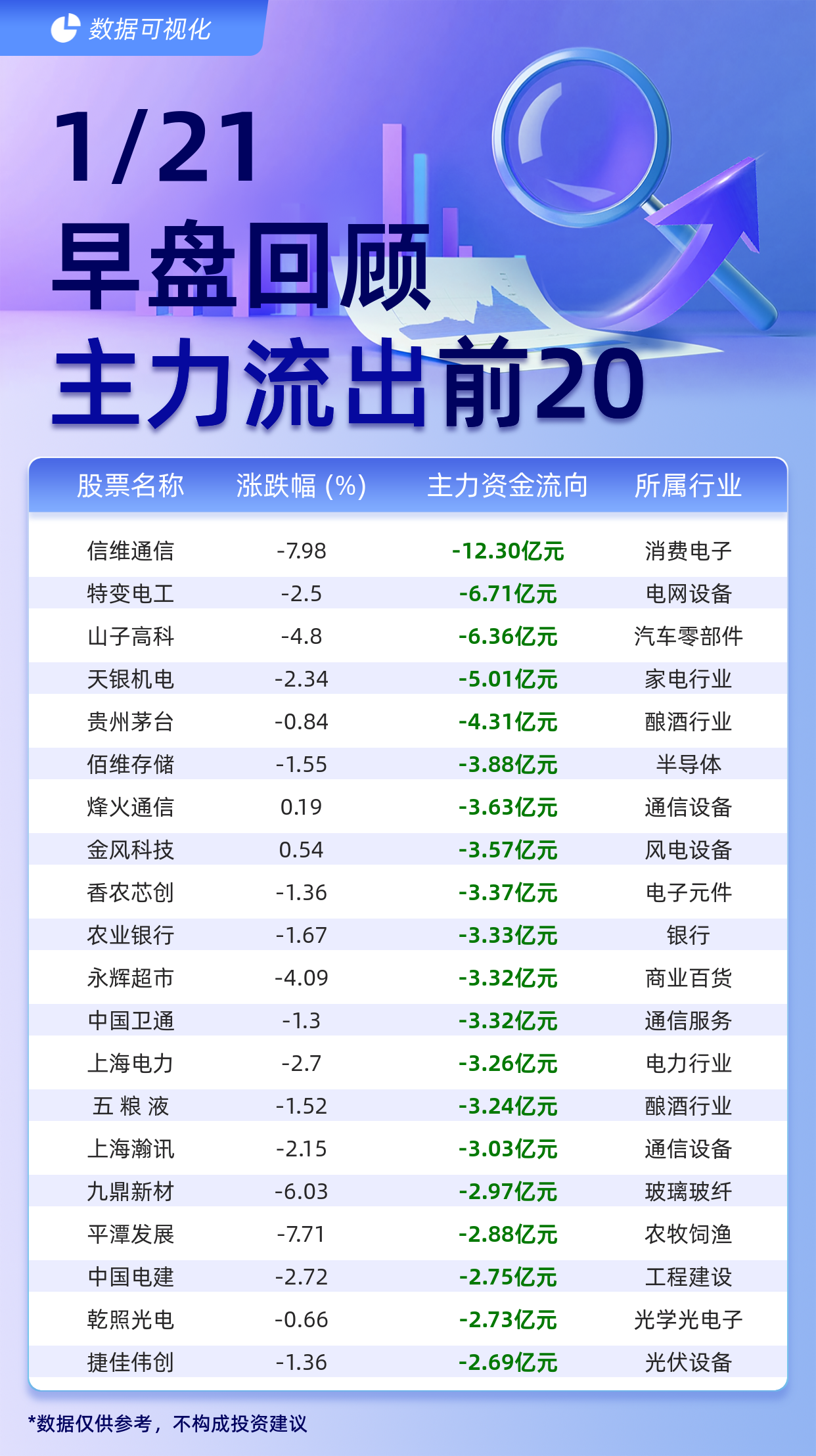
主力个股资金流出前20:信维通信流出12.30亿元、特变电工流出6.71亿元
Jin Rong Jie· 2026-01-21 04:04
Core Viewpoint - The data indicates significant outflows of capital from various stocks, with notable declines in share prices across multiple sectors, suggesting a bearish sentiment in the market. Group 1: Major Stocks with Capital Outflows - Xinyi Communication experienced a capital outflow of 1.23 billion, with a price drop of 7.98% [1][2] - Tebian Electric witnessed a capital outflow of 671 million, with a price decline of 2.5% [1][2] - Shanzi Gaoke had a capital outflow of 636 million, with a decrease of 4.8% [1][2] - Tianyin Electromechanical saw an outflow of 501 million, with a drop of 2.34% [1][2] - Kweichow Moutai experienced a capital outflow of 431 million, with a decline of 0.84% [1][2] Group 2: Additional Stocks with Notable Outflows - Baiwei Storage had a capital outflow of 388 million, with a price drop of 1.55% [1][2] - Fenghuo Communication saw an outflow of 363 million, with a slight increase of 0.19% [1][2] - Goldwind Technology experienced a capital outflow of 357 million, with a price increase of 0.54% [1][2] - Shannon Chip Creation had an outflow of 337 million, with a decline of 1.36% [1][2] - Agricultural Bank saw a capital outflow of 333 million, with a drop of 1.67% [1][2] Group 3: Further Stocks with Capital Outflows - China Satellite Communications experienced a capital outflow of 332 million, with a decline of 1.3% [3] - Shanghai Electric saw an outflow of 326 million, with a price drop of 2.7% [3] - Wuliangye experienced a capital outflow of 324 million, with a decline of 1.52% [3] - Shanghai Hanxun had an outflow of 303 million, with a drop of 2.15% [3] - Jiuding New Materials saw a capital outflow of 297 million, with a significant decline of 6.03% [3]




稀土精矿价格六连涨,稀土ETF嘉实(516150)一键布局稀土产业链机遇
Xin Lang Cai Jing· 2026-01-21 03:16
Group 1 - The core viewpoint of the news highlights a significant increase in the rare earth permanent magnet sector, with the China Rare Earth Industry Index rising by 1.46% as of January 21, 2026, driven by price adjustments in rare earth concentrate [1] - Major rare earth companies, Northern Rare Earth and Baotou Steel, announced a price increase for rare earth concentrate to 26,834 yuan per ton (dry weight, REO=50%) for Q1 2026, marking the sixth consecutive price hike since Q3 2024 [1] - The Ministry of Industry and Information Technology and CITIC Securities predict that China's rare earth mining volume will reach 255,000 tons and the smelting and separation output will be 244,000 tons in 2023, with projections of 521,000 tons and 519,000 tons respectively by 2030 [1] Group 2 - Jianghai Securities emphasizes that despite current market focus on aluminum, tungsten, and tin, the core applications of rare earths in electric vehicles, wind power, and energy-efficient motors support long-term demand growth [2] - The penetration rate of high-performance neodymium-iron-boron materials in electric vehicle drive motors is increasing, with per vehicle usage significantly higher than traditional models, further enhancing the demand resilience for rare earth permanent magnet materials [2] - The top ten weighted stocks in the China Rare Earth Industry Index, including Northern Rare Earth and Xiamen Tungsten, account for 60.4% of the index as of December 31, 2025 [2]
生物油专家交流
2026-01-21 02:57
Summary of Key Points from the Conference Call Industry Overview - The conference call discusses the **Sustainable Aviation Alternative Fuels (SAAS)** and **biodiesel** industry, highlighting the potential for biodiesel (including first-generation and HVO) to become more popular than SAAS by 2026 due to economic conditions in Europe [2][3]. Core Insights and Arguments - **SAAS Demand and Economic Impact**: The overall volume of SAAS in 2026 may not meet expectations, with a 6% blending target achievable depending on the European economic situation [2][3]. - **Airline Industry Challenges**: Airlines face significant challenges due to high asset costs and poor profitability, with rising jet fuel prices potentially impacting internal competition [2][5]. - **Domestic Supply Issues**: There is insufficient supply of UCO (Used Cooking Oil) to meet SAAS demand, leading to a contraction in device authorizations by technology suppliers [2][6]. - **New Capacity Projections**: Domestic new capacity is expected to exceed 4 million tons in 2026, primarily concentrated in the southwestern region of China, but raw material supply remains a bottleneck [2][6]. - **Raw Material Quality**: Waste cooking oil is the primary raw material for SAAS, with kitchen waste oil being the highest quality. A shortage of waste oil could lead to price increases that affect the entire supply chain [2][7]. - **Price Stability**: The cancellation of large wave calculations may cause short-term price fluctuations in the UCO market, but overall prices should remain stable or slightly decrease in the long term due to strong demand and resource scarcity [2][8][10]. Additional Important Insights - **Production Costs**: The total processing cost for producing SAP (Synthetic Aviation Fuel) from UCO is approximately 11,000 RMB per ton, with raw material costs being a significant factor [4][12]. - **Market Dynamics**: The demand for UCO in the overseas market is significant, with high-quality UCO primarily being exported, which could impact domestic SAAS production if not retained [19]. - **Investment Trends**: There is a trend of overseas companies investing in biodiesel and astaxanthin products, driven by the oil content in waste oils and geopolitical risk considerations [20]. - **Biomass Char for Green Methanol**: The development of biomass char for green methanol production is facing challenges in China, with a need to shift towards pre-treatment methods to improve process efficiency [21]. Future Price Trends - **Market Price Fluctuations**: The UCO market is expected to follow a trend of stability in the first half of the year, with potential price increases in the second half due to stockpiling demands [23].
未知机构:①近1个月来化工行业迎来一场全球性涨价潮巴斯夫陶氏亨斯迈等-20260121
未知机构· 2026-01-21 02:00
Summary of Key Points from Conference Call Records Industry Overview - The chemical industry has experienced a "global price surge" in the past month, with major companies like BASF, Dow, and Huntsman implementing price increases across Europe, Asia, and the Middle East [1][1][1] - Significant price increases have been noted for certain chemical products, with propylene oxide prices rising by 7.9% week-over-week [2][2][2] Companies Mentioned - Companies involved in the chemical sector include: - Xinxiang Chemical Fiber - Cangzhou Dahua - Weiyuan Co. - Shandong Heda - Hongbaoli - Hongbai New Materials - Red Wall Co. - Zhongyida - Zanyu Technology - China National Chemical - Jiangtian Chemical - Meibang Technology [2][2][2] Core Insights and Arguments - The recent price increases in the chemical market are attributed to a combination of supply chain pressures and increased demand for chemical products globally [1][1][1] - The government has introduced new policies to support urban renewal and stimulate the economy, which may further impact the demand for chemical products [2][2][2] Additional Important Information - The National Energy Administration reported that national electricity load has reached a historical winter high, exceeding 1.4 billion kilowatts for the first time, indicating strong energy demand [2][2][2] - The investment in new power systems is expected to grow significantly, with a projected 40% increase in investment during the 14th Five-Year Plan period [2][2][2] - The chemical industry is likely to benefit from these macroeconomic trends, as increased urban development and energy demands will drive further consumption of chemical products [1][1][1]



A股尾盘强势拉升,释放什么信号?
Guo Ji Jin Rong Bao· 2026-01-20 15:16
Core Viewpoint - The A-share market is experiencing a structural adjustment, with a shift in investment focus from speculative themes to a combination of policy and performance-driven strategies. Short-term fluctuations are expected as the market digests excess supply, suggesting a cautious approach to high-concept stocks and a preference for high-quality investments [1][5][7]. Market Performance - The Shanghai Composite Index closed down 0.01% at 4113.65 points, while the ChiNext Index fell 1.79% to 3277.98 points. The Shenzhen Component Index dropped nearly 1%, and the Northbound 50 Index decreased by 2% [2]. - Trading volume across the Shanghai, Shenzhen, and Beijing markets reached 2.8 trillion yuan, an increase of 72 billion yuan from the previous trading day. The margin balance in the Shanghai and Shenzhen markets slightly decreased to 2.72 trillion yuan as of January 19 [2][5]. Sector Performance - High-performing sectors such as real estate, oil, and chemicals provided support during the market's downturn, while technology sectors, particularly communications and aerospace, saw significant declines [2][4]. - Notable individual stock movements included China Western Power and TBEA rising against the trend, while companies like Cambricon Technologies and Gree Electric Appliances faced substantial losses [2][3]. Investment Strategy - Analysts recommend a cautious approach, advising investors to reduce holdings in purely speculative stocks and to consider reallocating to high-quality stocks. The focus should be on sectors with solid fundamentals, such as new production capabilities and undervalued cyclical stocks [5][7]. - The market is expected to remain in a "slow bull" phase, with ongoing adjustments needed to digest previous gains. Investors are encouraged to adopt a strategy of gradual positioning and to avoid chasing high-risk stocks [7][8]. Future Outlook - The upcoming two weeks will see a surge in annual report forecasts, which may increase the importance of fundamental factors in stock pricing. Analysts suggest focusing on growth sectors like AI and semiconductors, as well as industries benefiting from policy support [8]. - Despite recent volatility, the overall market trend remains upward, supported by favorable macroeconomic policies and potential positive developments from upcoming political meetings [8].
两只公募REITs终止发行,新规后首现“清退”效应
第一财经· 2026-01-20 14:32
Core Viewpoint - The public REITs market in China has witnessed its first case of a failed issuance during the exchange review stage, highlighting the impact of new regulatory guidelines introduced at the end of 2025 [3][4]. Group 1: Case Studies of Failed Issuance - Jin Feng Technology announced the termination of its public REITs application on January 19, 2026, due to long-standing failure to respond to exchange feedback, aligning with new regulatory requirements [4]. - Similarly, Electronic City also withdrew its public REITs project application on the same day, indicating a trend of stalled projects under the new guidelines [5]. Group 2: Regulatory Changes and Market Impact - The new guidelines issued by the Shanghai and Shenzhen Stock Exchanges on December 31, 2025, aim to enhance transparency and efficiency in the review process for public REITs, defining specific circumstances under which applications can be terminated [5]. - The guidelines list seven conditions for termination, including failure to respond to feedback within the stipulated time and the expiration of financial data and asset evaluation reports [5]. - As of the end of 2025, there are several projects in the review stage that have not progressed, raising concerns about their compliance and operational status [5]. Group 3: Future Market Trends - A head of REITs business at a leading fund company noted that the new regulations necessitate enhanced due diligence before application submissions, shifting the focus from issuance to compliance and operational management [6]. - The public REITs market is transitioning towards favoring projects with stable cash flows and sound operational management, as indicated by the Jin Feng Technology case [6]. - According to Wind statistics, by the end of 2025, there were 79 public REITs listed with a total issuance scale exceeding 210 billion yuan, reflecting a growing market [6]. - A report from China International Capital Corporation suggests that the public REITs market is entering a new phase of normalized issuance, with expectations for continued growth in scale, asset diversity, and improved investor structure in 2026 [6].



上证早知道|卫星互联网,加速组网!易点天下,停牌核查完成!华菱线缆,终止收购商业航天资产!
Shang Hai Zheng Quan Bao· 2026-01-20 13:43
Group 1 - The National Bureau of Statistics reported that in December 2025, the sales prices of commercial residential properties in 70 large and medium-sized cities decreased month-on-month, with an expanded year-on-year decline. The GDP for the entire year of 2025 was 14,018.79 billion yuan, reflecting a growth of 5.0% at constant prices [6] - The International Monetary Fund updated its World Economic Outlook report, raising the economic growth forecast for China in 2026 [7] - Micron Technology indicated that the shortage of memory chips has worsened over the past quarter, reiterating that supply tightness will persist into the following year due to surging demand for high-end semiconductors driven by AI infrastructure development [7] Group 2 - Jianghua Microelectronics announced that its stock will resume trading on January 20, 2026, with a change in its actual controller to the Shanghai State-owned Assets Supervision and Administration Commission [5] - Hunan YN announced an expected net profit for 2025 of 1.15 billion to 1.4 billion yuan, representing a year-on-year growth of 93.75% to 135.87% due to the rapid development of the new energy vehicle and energy storage markets [10] - Jiangxi Copper signed a cooperation framework agreement with a military supply company to supply various metal products, which will enhance its market competitiveness and brand influence [10] Group 3 - The satellite internet industry is entering a rapid development phase, with the successful launch of 19 low-orbit satellites by China's Long March 12 rocket, indicating accelerated networking and industrialization of satellite internet [8] - The demand for AI is driving up the prices of copper-clad laminates (CCL) due to tight supply of raw materials, with price increases of over 30% announced by Resonac and 10% by Kintor Group [9] - The company Ding Tong Technology expects a net profit of 242 million yuan for 2025, marking a year-on-year increase of 119.59% [10]
两只公募REITs终止发行,新规后首现“清退”效应
Di Yi Cai Jing· 2026-01-20 12:00
Core Viewpoint - The recent regulatory changes have led to the first case of a public REIT failing to issue after entering the exchange review stage, highlighting the impact of new guidelines aimed at preventing projects from remaining unresolved for extended periods [1][2]. Group 1: Regulatory Changes - The new guidelines from the Shanghai and Shenzhen Stock Exchanges, effective by the end of 2025, explicitly define circumstances under which public REIT applications can be terminated, aiming to enhance transparency and efficiency in the review process [2][3]. - The guidelines list seven specific scenarios for application termination, including failure to respond to exchange feedback within the stipulated timeframe [2]. Group 2: Company-Specific Cases - Jin Feng Technology announced the termination of its public REIT application, which began in September 2021 and had not progressed due to a lack of response to feedback from the exchange [1]. - Similarly, Electronic City plans to withdraw its infrastructure public REIT project application, which was submitted in May 2025, due to a lack of progress following initial feedback [2]. Group 3: Market Implications - The implementation of the new regulations is expected to shift the focus of public REITs from merely issuing to emphasizing operational compliance and management capabilities, favoring projects with stable cash flows [3]. - As of the end of 2025, there are 79 public REITs listed in the market, with a total issuance scale exceeding 210 billion yuan, indicating a growing market despite recent challenges [3].
首例终止 金风科技撤回公募REITs申报
Xin Lang Cai Jing· 2026-01-20 10:20
Core Viewpoint - The company, Goldwind Technology, has announced the termination of its public REITs application process, which was initiated in 2021 for three wind power projects, later adjusted to focus on one project [1] Group 1: Company Actions - The board of directors of Goldwind Technology has approved the decision to halt the public REITs application for infrastructure [1] - The initial plan included three wind power projects: Quan Nan Tian Pai Shan, Chong Yi Long Gui, and Chong Yi Tian Xing, but was later revised to focus solely on the Quan Nan Tian Pai Shan project [1] - The application materials were submitted to the China Securities Regulatory Commission and the Shenzhen Stock Exchange in September 2023 and were accepted [1] Group 2: Reasons for Termination - The termination of the REITs application is attributed to the need for resource integration and optimization of operational management [1] - The company has stated that this decision will not impact its operational and financial performance [1]
雪球封禁多个违规账号,发言不当或涉嫌“抢帽子交易”
Feng Huang Wang· 2026-01-20 08:21
Core Viewpoint - The article discusses the crackdown on market manipulation by influential figures in the stock trading community, particularly focusing on the case of Jin Yongrong, who was penalized for manipulating stock prices through misleading recommendations and subsequent sell-offs [1][2]. Group 1: Regulatory Actions - The Zhejiang Securities Regulatory Bureau imposed a penalty of 83.25 million yuan on Jin Yongrong for manipulating the stock market, which includes the confiscation of illegal gains of 41.62 million yuan and an equal fine [1][2]. - Jin Yongrong's account on the Snowball platform had over 107,000 followers, and his posts averaged 1.3 million views each from September 2024 to April 2025 [1][2]. Group 2: Market Impact - During the period from September 2, 2024, to April 16, 2025, Jin Yongrong recommended 32 stocks, including Qidi Environment and Luvi Optoelectronics, and executed significant sell-offs shortly after his recommendations, totaling approximately 631 million yuan in trading volume [2]. - The stocks recommended by influential figures often exhibited extreme volatility, leading to substantial losses for late investors who failed to cut their losses in time [3]. Group 3: Community Reactions - Investors expressed frustration over the recommendations from influential figures, with some reporting significant losses, such as a 40% drop in the stock price of Luyan Pharmaceutical after a peak [3]. - Legal experts highlighted that the actions of these influential figures could violate securities laws, emphasizing the need for caution in their public statements and trading activities [3].