韩束

Search documents
知行数据观察:化妆水/爽肤水品类
知行战略咨询· 2026-01-14 14:24
Investment Rating - The report does not explicitly state an investment rating for the industry Core Insights - The facial skincare market is expanding, with e-commerce sales projected to grow by 19.4% year-on-year in 2024, while Tmall's market share is expected to decline to 30.5% [9][11] - Douyin has emerged as the leading platform for sales, surpassing 1340.39 billion in sales by 2024, marking a significant increase of 53.6% [9][10] - The market is entering a phase of stock competition, focusing on differentiation rather than scale expansion, as total sales growth is projected to be only 2.8% from 2023 to 2025 [19] Summary by Sections Market Overview - The facial skincare category is a core segment of the beauty industry, with a focus on hydrating and soothing products [8] - The market is characterized by a stable demand for basic hydration, while anti-aging and soothing effects are emerging as key growth trends [12][14] Sales Performance - E-commerce sales for facial skincare products reached 98.1 billion in 2023, with a projected increase to 121.8 billion by 2025, reflecting a modest growth rate [20] - Douyin's sales in the facial skincare category reached 54.27 billion in 2023, showing a year-on-year growth of 16%, while Tmall's sales declined by 11% [21][30] Consumer Trends - Anti-aging and hydration are identified as essential selling points, with a high willingness to pay among consumers [14] - The report highlights a significant opportunity in the sensitive skin and repair segments, which currently have a supply-demand gap [14][15] Brand Analysis - The top brands on Tmall are dominated by international high-end brands, while Douyin features a higher proportion of domestic brands with rapid growth [26][30] - The report notes that brands like La Mer and Lancôme dominate the high-price segment on Tmall, while domestic brands like Rellet and Dr. Wu are gaining traction on Douyin [27][33] Channel Dynamics - Douyin is becoming the primary growth channel, with a sales share increasing from 46% to 55% by 2025, while Tmall's share is declining [17][19] - The report indicates that live streaming is a key driver of sales on Douyin, accounting for 72% of sales in the facial skincare category [23]

央视曝光韩束涉嫌违法添加,上美股份创始人吕义雄的百亿目标遇阻
Xi Niu Cai Jing· 2026-01-13 05:41
Group 1 - The core issue revolves around the controversy regarding Han Shu's face masks containing the banned ingredient Epidermal Growth Factor (EGF), leading to a significant trust crisis for the brand and its parent company, Up Beauty Co. [2][3] - Han Shu's response included presenting testing reports claiming no EGF was added, but discrepancies in test results from different third-party organizations raise questions about the legitimacy of the findings [4][9] - The investigation highlighted that the cosmetic industry may have "AB formula" practices, where different formulations are used for testing and actual production, contributing to the confusion [4][10] Group 2 - The pricing strategy of Han Shu has come under scrutiny, with reports indicating that a product priced at 399 yuan may only cost around 26 yuan to produce, raising concerns about inflated pricing and marketing over substance [10][12] - Han Shu's heavy reliance on marketing, with significant sales expenses amounting to 23.37 billion yuan in the first half of 2025, contrasts sharply with its low research and development expenditure of only 1.03 billion yuan [11][12] - Up Beauty Co. is heavily dependent on Han Shu, which accounted for 81.4% of the company's total revenue in the first half of 2025, indicating a lack of diversification in its brand portfolio [12][13] Group 3 - The company has attempted to revitalize its other brands, such as One Leaf, but faces challenges due to market saturation and lack of unique competitive advantages [13][14] - The ongoing controversy and reliance on a single brand may hinder Up Beauty Co.'s long-term stability and growth, especially in a highly competitive beauty market [14]

新消费观察|250亿元新蓝海!男士护肤赛道崛起
新华网财经· 2026-01-08 11:39
Core Insights - The demand for men's skincare products is rapidly increasing, with significant sales growth observed during the holiday season, particularly for gift sets [1][3] - Men's skincare has transitioned from a niche market to a mainstream necessity driven by changing social norms and increased health awareness [1][3] Group 1: Market Trends - In the last 30 days, several men's skincare gift sets sold over 750,000, with the top two exceeding 1 million in sales [1] - By December 2025, the number of men's skincare products, brands, and stores is expected to grow by 54.2%, 28.5%, and 37.0% respectively [1] - A survey indicates that 44% of consumers believe that managing one's appearance is necessary for men, with nearly 40% stating it enhances personal image and confidence [5] Group 2: Consumer Behavior - Men's skincare is increasingly viewed as a part of daily routines, with products like cleansers and moisturizers becoming essential [5][11] - Social media discussions around men's skincare have surged, with topics related to men's skincare reaching over 120 million views on Weibo [5] - The shift in perception from "should men use skincare?" to "how to use skincare effectively?" reflects a growing acceptance of men's grooming [6] Group 3: Product Development - The market is moving towards more refined, scientific, and personalized skincare solutions for men, addressing specific skin issues such as oiliness and acne [8][10] - During the 2025 Double Eleven shopping festival, men's beauty products saw a staggering increase in sales, with facial essence sales up 7064% year-on-year [8] - Brands are developing products tailored to different age groups, focusing on efficacy and simplicity, such as multi-functional creams that combine several skincare steps [11][12] Group 4: Market Potential - The men's skincare market is projected to reach approximately 25 billion by 2025, with a compound annual growth rate of 18% [17] - The market is evolving from a "blue ocean" to a "deep blue ocean," indicating untapped potential and opportunities for brand value establishment [17] - Major brands, both international and domestic, are increasingly entering the men's skincare space, creating a competitive and diverse market landscape [16][17]
“十全大补”面膜神话落幕:又一外资护肤品撤离中国
Guan Cha Zhe Wang· 2026-01-08 04:45
Core Insights - Filorga, a well-known French skincare brand, announced its withdrawal from the Chinese market, closing its Tmall flagship store on January 31, 2026, along with its 3.03 million followers and popular products like the "Ten Full Nourishing Mask" [1] - The exit of Filorga is part of a broader trend, with over 60 foreign beauty brands leaving the Chinese market between 2024 and 2025, indicating a significant retreat of foreign skincare brands [1] - Domestic beauty brands have gained market share, surpassing foreign brands for the first time in 2023, with Proya becoming the first domestic brand to exceed 10 billion yuan in revenue [1] Group 1: Filorga's Market Performance - Filorga entered the Chinese market in 2015 and quickly gained popularity, achieving a sales record of over 1 billion yuan during the 2018 Double Eleven shopping festival, with a year-on-year growth of 148% [2] - However, growth slowed significantly after 2020, attributed to ineffective pricing strategies and a lack of competitive advantage against domestic brands [2][3] - The brand's high-priced star product, the mask priced at 599 yuan, failed to maintain its premium image due to frequent discounts, while domestic competitors offered more affordable alternatives [2] Group 2: Challenges in Channel Operations - Filorga's online sales performance was poor, with only 2.5 million to 5 million yuan in sales on Douyin in 2025, indicating a lack of effective online marketing strategies [3] - The closure of physical stores resulted in a loss of high-end brand image and direct consumer engagement opportunities [3] - In contrast, other brands under the L'Oréal group, such as La Roche-Posay and Kiehl's, maintained strong market positions through effective product offerings and operational strategies [3] Group 3: Broader Industry Trends - The withdrawal of Filorga aligns with Colgate's global strategy to streamline operations, as the company's personal care segment saw a 2.05% decline in net sales in the first half of 2025 [4] - Similar strategic adjustments are occurring across the foreign beauty sector, with brands like Shiseido and LVMH also closing stores or withdrawing from the market due to declining performance [5] - Domestic brands like Proya and Winona have shown significant growth, with Proya achieving over 10.778 billion yuan in revenue in 2024, marking a year-on-year increase of over 20% [5] Group 4: Future Outlook - Analysts suggest that the challenges faced by foreign brands are not solely due to their foreign status but rather their inability to adapt to the Chinese market and consumer preferences [6] - L'Oréal's success is attributed to its localized operations, contrasting with Filorga's failure to establish a coherent market strategy in China [6] - The Chinese high-end beauty market is expected to continue facing challenges, but opportunities remain for brands that can effectively engage with local consumers [6]
2025美妆行业转型:胜者愈胜,弱者重组
3 6 Ke· 2026-01-04 03:22
Core Insights - The global beauty industry is entering a transformation phase, with average growth slowing from 7% (2022-2024) to 5% (2025-2030), indicating a shift towards a more complex and segmented market focused on high-end and fragrance products [1][3][25]. Group 1: Major Corporate Movements - L'Oréal's acquisition of Kering's high-end beauty business for €4 billion is a significant event, expanding L'Oréal's presence in the luxury beauty and fragrance market while allowing Kering to focus on its core fashion business [1][5][11]. - L'Oréal has been active in the beauty capital market with six major global transactions this year, including acquisitions and minority investments, enhancing its portfolio in high-end and trendy markets [5][6][7][11]. - Estée Lauder is undergoing a restructuring plan to focus on high-end fragrances, with a new innovation center in Paris aimed at improving efficiency and product development [12][14]. Group 2: Market Trends and Dynamics - The beauty industry is witnessing a shift from product competition to capital and licensing restructuring, with leading groups focusing on mergers and acquisitions to strengthen their positions in luxury fragrances and high-end segments [3][4][25]. - The rise of domestic brands in China, such as Perfect Diary and Huaxizi, is attributed to the growing interest from Gen Z consumers and effective online marketing strategies, leading to a 10.1% year-on-year growth in the beauty market [18][19][25]. - The trend towards high-end and fragrance products is becoming a growth highlight, with luxury fragrances showing nearly 10% business growth, indicating consumers' willingness to pay for premium beauty experiences [26][29]. Group 3: Strategic Adjustments by Companies - Shiseido is implementing a two-year action plan to rebuild profits through cost-cutting and operational efficiency, successfully turning a previous loss into a profit in its latest financial report [14][15]. - Coty faces significant risks due to the impending expiration of its Gucci licensing agreement in 2028, prompting a strategic review and a focus on fragrance business growth [15][25]. - Consumer goods giants like Unilever and Procter & Gamble are steadily expanding their beauty and personal care segments, with Unilever acquiring several natural and functional brands to enhance its portfolio [17][25]. Group 4: Future Industry Trends - The beauty industry is expected to see continued acceleration in mergers and asset restructuring, with both global giants and local brands adapting to market fluctuations [25][26]. - Digitalization and technological advancements are becoming key competitive factors, with brands leveraging AI and online channels to enhance customer engagement and product offerings [27][29]. - The overall transformation in the beauty industry is characterized by a focus on high-end products, technological innovation, and global expansion, with domestic brands poised to lead in the international market [25][29].


短剧造富折叠:顶流年入千万,群演时薪不到9元
凤凰网财经· 2026-01-01 12:37
Core Insights - The short drama industry has seen a significant transformation in its ability to create stars, with over 130 short dramas on the Hongguo platform achieving over 1 billion views this year, and several hitting over 20 billion views, indicating a booming market for short dramas and their actors [3][4] - The financial dynamics of the industry have shifted, with top short drama actors earning substantial incomes, with some potentially reaching annual earnings of 10 million yuan, reflecting a new wealth distribution within the entertainment sector [10][11] Group 1: Industry Dynamics - The short drama sector has established a new ecosystem distinct from traditional long dramas, creating opportunities for actors to rise from background roles to leading positions [5][6] - The pay structure for actors varies significantly, with background actors earning around 80-100 yuan per day, while leading roles can command daily rates of 3,000 to 5,000 yuan, showcasing a steep income gradient within the industry [9][10] - The competition for roles is intense, particularly for female actors, with a reported ratio of 400 female to 1 male actor in certain markets, leading to downward pressure on wages [15][16] Group 2: Actor Earnings and Market Trends - Top-tier actors in the short drama industry can earn between 3,000 to 5,000 yuan per day, with some achieving annual incomes exceeding 10 million yuan through a combination of acting fees and brand endorsements [10][11] - The cost of producing short dramas is rising, with actor salaries now accounting for approximately 45% of total production costs, and in some cases, exceeding 50% [12] - The market for short dramas is becoming increasingly saturated, with many aspiring actors facing challenges in securing roles and often having to pay for training or entry fees to production companies [16]

抖音美妆或突破2300亿!
Xin Lang Cai Jing· 2025-12-31 05:19
Core Insights - The Douyin beauty sector showed strong performance in 2025, with GMV exceeding 210 billion yuan from January to November, representing a year-on-year growth of over 22% [2][29] - The total GMV for Douyin beauty is expected to surpass 230 billion yuan for the entire year, solidifying its position as a significant player in the e-commerce landscape [2][29] Category & Product - Color cosmetics led the growth, with GMV for color cosmetics, perfumes, and beauty tools reaching approximately 58 billion yuan, a year-on-year increase of 24.8% [30][31] - Five Douyin brands entered the top 10 in color cosmetics, with TILOWE winning the annual top spot, surpassing established brands like YSL and Mao Ge Ping [31] - New entrants like "Hua Jian Song" disrupted the powder market, ending the dominance of Fang Li, with expectations to reach 1 billion yuan in GMV [33] - Multiple subcategories saw new brands claiming top positions, including skincare and men's grooming, with brands like Xiu Ke Fu and Su Shuo Mei Li achieving rapid growth [33][36] Brand & Marketing - The rise of "white label" brands, leveraging founder IP for sales, has become a notable trend, with brands like Mei Shi achieving over 1.5 billion yuan in GMV [39][41] - The pharmaceutical company Sanjing Pharmaceutical experienced explosive growth, achieving over 500 million yuan in GMV through strategic partnerships and effective supply chain management [43] - Influencer marketing remains crucial for both new and established brands, with notable cases of influencers driving significant sales for brands like VEIRFOO and Bai Que Ling [44][46] - Domestic brands like Lin Qing Xuan and Yi Xian E-commerce have successfully transitioned to high-end markets, with Lin Qing Xuan's revenue growing by 98.3% year-on-year [47] Trends & Future Outlook - The competitive landscape in Douyin beauty is evolving, with a shift from merely gaining traffic to demonstrating comprehensive brand capabilities [50][51] - Future competition will focus on overall performance rather than singular successes, requiring brands to excel in product development, supply chain stability, and customer retention [52] - Brands must either establish themselves as experts in specific niches or build emotional connections with consumers to succeed in the changing market dynamics [54][55] - The Douyin beauty sector is entering a new phase of competition, emphasizing the importance of sustained brand strength and consumer trust [56]
美团的\"碰一碰\"来了
Xin Lang Cai Jing· 2025-12-29 13:45
Group 1 - Retail media networks (RMN) are projected to grow at an annual rate of 25% over the next five years, expected to account for two-thirds of global retail advertising spending by 2025 [1][18] - The "Tap and Go" feature from Alipay and Focus Media exemplifies the efficiency of retail advertising, reducing the steps from payment to completion from 4-5 to just 2, with significant engagement metrics [1][19] - Meituan's smart charging screens are designed to influence consumer purchasing decisions at critical moments in real shopping scenarios, showcasing promotions and new products effectively [3][22] Group 2 - Brands are increasingly recognizing the need for marketing solutions in real shopping environments, as traditional online advertising becomes fragmented and costly [5][24] - The shift towards offline advertising is accompanied by challenges in measuring effectiveness and leveraging data for personalized experiences [6][25] - Retail advertising based on advertising platforms offers a new opportunity for brands to utilize data analytics for tailored advertising content, enhancing exposure and conversion rates [8][26] Group 3 - Meituan has strategically positioned itself in the "retail + technology" space, with over 5 million offline touchpoints through its charging stations, facilitating a blend of retail, technology, and media [9][28] - The charging stations serve as a new media touchpoint, allowing brands to create a digital consumption experience that enhances the commercial value of offline scenarios [12][31] - The smart charging screens are considered "the most technological outdoor advertising," addressing traditional outdoor advertising's shortcomings in precision and efficiency [14][33] Group 4 - The smart charging screens can significantly improve the conversion rates of offline advertising and provide measurable results for advertising agencies, while also increasing foot traffic and order rates for stores [18][37] - Brands must adapt their content marketing strategies to create more engaging and differentiated narratives that resonate with consumers in specific contexts [36] - The ability to connect with consumers at the point of decision-making is crucial for brands to capitalize on retail advertising opportunities in the evolving market landscape [37]

8点1氪丨爱奇艺回应充25年会员退费难;B站2025年度弹幕为“致敬”;官方明确明年继续“国补”
3 6 Ke· 2025-12-29 00:02
Group 1 - The movie "Zootopia 2" has become the first imported film in Chinese history to surpass 100 million viewers [5] - Bilibili announced that the annual bullet screen for 2025 is "Tribute," with over 22.82 million mentions and 4.59 million users participating [2] - The Chinese government plans to relax household registration restrictions outside of a few mega cities to promote urban integration [2] Group 2 - Xiaomi's co-founder Lin Bin plans to sell up to $2 billion worth of B-class ordinary shares starting December 2026, with proceeds aimed at establishing an investment fund [4] - The new national standard for electric vehicle energy consumption, considered the strictest globally, will be implemented starting January 1, 2026, limiting energy consumption for 2-ton vehicles to no more than 15.1 kWh per 100 km [6] - Guizhou Moutai aims to prevent price speculation and ensure reasonable pricing to stabilize market expectations [6] Group 3 - The precious metals market has seen significant price increases, with platinum futures surpassing $2,400 per ounce, marking a weekly increase of over 22% [5] - A lawsuit involving a subsidiary of XWANDA is seeking over 2.314 billion yuan due to alleged quality issues with delivered battery cells [6] - NASA's new director has stated that the U.S. will return to the moon during Trump's second term, emphasizing the importance of lunar exploration for economic and national security [8]




被曝光添加违法成分!韩束紧急回应!
Xin Lang Cai Jing· 2025-12-28 03:55
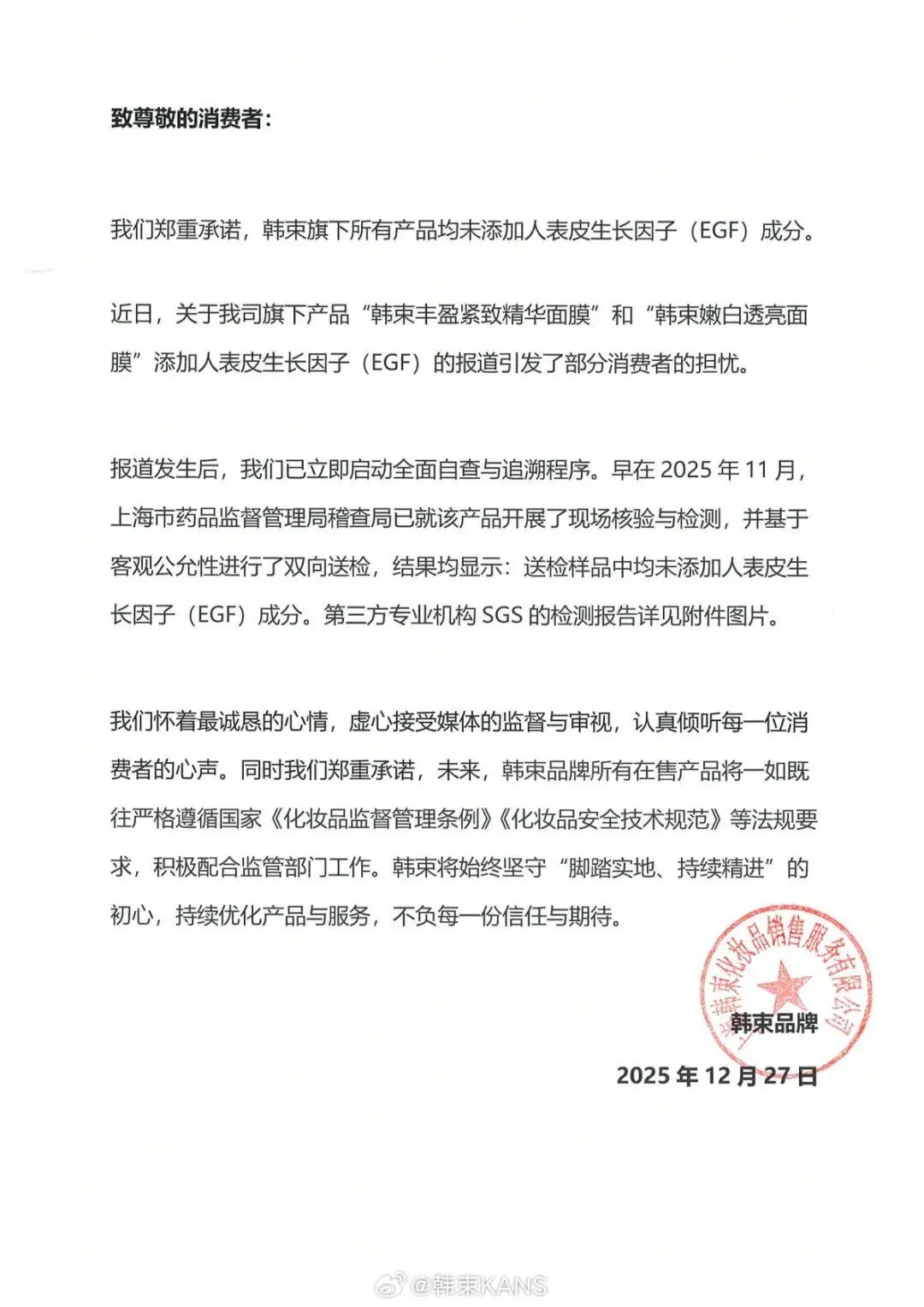
Core Viewpoint - The company, Han Shu, has publicly committed that all its products do not contain human epidermal growth factor (EGF) following consumer concerns raised by recent reports about specific products [2][3]. Group 1: Company Response - Han Shu initiated a comprehensive self-inspection and traceability process after reports suggested that its products, specifically "Han Shu Firming Essence Mask" and "Han Shu Brightening Mask," contained EGF [2][3]. - The Shanghai Municipal Drug Administration conducted on-site verification and testing in November 2025, confirming that the samples tested did not contain EGF [2][3]. - Han Shu expressed its commitment to adhere strictly to national regulations regarding cosmetics and to cooperate with regulatory authorities in the future [2][4]. Group 2: Regulatory Context - EGF is a polypeptide composed of 53 amino acids that promotes cell proliferation and growth, but it is prohibited in cosmetics due to safety concerns [3][4]. - The National Medical Products Administration clarified in 2019 that EGF cannot be used as a cosmetic ingredient due to its large molecular weight and potential safety issues [3][4]. - There is currently no unified detection standard for EGF in the cosmetics industry, and existing testing methods may yield false positives, necessitating comprehensive testing approaches [4].