顺丰

Search documents
一季度包裹量同比增长超19%,行业亏损件量占比扩大 中通快递能否挺过白热化竞争?
Mei Ri Jing Ji Xin Wen· 2025-05-21 13:18
Core Insights - ZTO Express reported a total package volume of 8.54 billion pieces in Q1 2025, representing a year-on-year growth of 19.1% [1] - The company's revenue reached 10.89 billion yuan, up 9.4% year-on-year, while net profit surged by 40.9% to 2.04 billion yuan [1] - The competitive landscape in China's express delivery industry has intensified, with a notable increase in low-value or loss-making packages [1] Financial Performance - Adjusted net profit increased by 1.6% to 2.26 billion yuan, with operating cash flow at 2.36 billion yuan [1] - The average revenue per package decreased by 0.11 yuan due to competitive pricing and changes in package weight [4][5] - Capital expenditure for the quarter was 2 billion yuan, with management expenses accounting for 4.7% of revenue [4] Market Position and Strategy - ZTO Express aims to maintain its leading position in the market while focusing on service quality and volume [10] - The company has set a package volume guidance of 40.8 billion to 42.2 billion pieces for 2025, reflecting a year-on-year growth of 20% to 24% [9] - The company is increasing its focus on parcel business, which saw a 46% year-on-year growth in Q1 2025 [2][11] Competitive Landscape - Competitors like YTO Express and SF Express are also experiencing growth, with YTO achieving a revenue of 17.06 billion yuan and a package volume of 6.779 billion pieces in Q1 2025 [5][6] - The price competition remains fierce, with significant declines in average revenue per package across the industry [6][7] - The industry is shifting towards high-quality development, with ZTO Express planning to enhance service capabilities and optimize costs through technology [11]

降价已无法抢到业务量,通达兔快递出清提速?
3 6 Ke· 2025-05-20 11:28
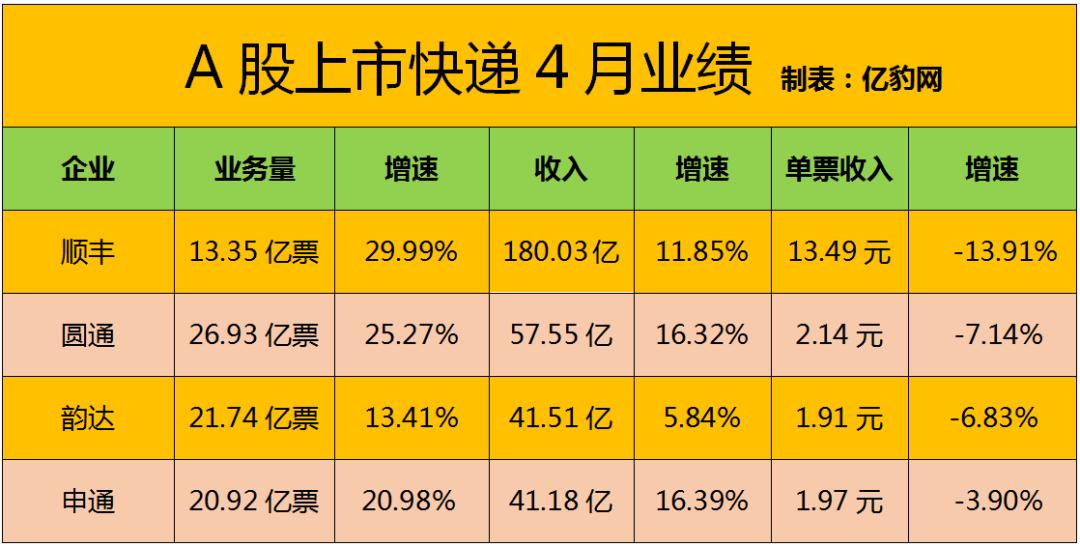
Core Insights - The express delivery industry in A-shares shows that SF Express has led in business volume growth for three out of four months this year, indicating strong growth momentum [1][2] - YTO Express is gradually widening the gap with its competitors, while the average revenue per package for the four major express companies continues to decline [1][5] Group 1: Company Performance - SF Express reported a business volume of 1.335 billion packages in April, with a growth rate of 29.99%, and revenue of 18.003 billion yuan, reflecting an 11.85% increase. However, its average revenue per package fell by 13.91% to 13.49 yuan [2] - YTO Express handled 2.693 billion packages with a growth rate of 25.27%, generating revenue of 5.755 billion yuan, a 16.32% increase, but its average revenue per package decreased by 7.14% to 2.14 yuan [2] - Yunda Express and Shentong Express reported business volumes of 2.174 billion and 2.092 billion packages respectively, with growth rates of 13.41% and 20.98%. Their revenues were 4.151 billion and 4.118 billion yuan, with average revenues per package dropping below 2 yuan [2][5] Group 2: Market Trends - The demand for same-city delivery services has surged, with SF Express reporting a 102% year-on-year increase in same-city delivery orders during the May Day holiday, driven by the rapid adoption of new consumption models [3][5] - The express delivery sector is facing intense price competition, leading to a decline in average revenue per package across the board, which may affect the stability of delivery networks [5] - The market capitalization of express companies remains low, with SF Express valued at 220 billion yuan, indicating a need for industry consolidation and potential recovery in stock prices following the inclusion of ZTO Express in the Hang Seng Index [7]
机器人行业点评:物流+机器人应用空间广阔,降本提效为核心驱动力
Shenwan Hongyuan Securities· 2025-05-19 04:57
Investment Rating - The report gives an "Overweight" rating for the logistics automation and robotics industry, indicating that it is expected to outperform the overall market [3][10]. Core Insights - The logistics automation application space is extensive, covering various sectors such as factory logistics, commercial distribution, and consumer logistics. It can be categorized by application scenarios, functions, and industry chain segments [4]. - The core driving force behind the adoption of robotics and unmanned vehicles in logistics is to enhance operational efficiency and reduce labor costs. For instance, leading express delivery companies like SF Express have deployed numerous robots in their operations, indicating significant future potential [4]. - The report highlights that there is still a vast space for logistics automation and robotics, as many manual processes remain in logistics scenarios. Technological advancements in AI, sensors, and control systems are enabling the deployment of humanoid and wheeled robots, as well as drones [4]. Summary by Relevant Sections Application Areas - Logistics automation encompasses factory logistics, commercial distribution, and consumer logistics, with functionalities including automated warehousing, transportation, sorting, and control [4]. Market Dynamics - The logistics sector is experiencing a structural change with an increasing share of automated equipment, particularly robots and unmanned vehicles, despite the overall capital expenditure peak having passed [4]. Key Companies and Their Focus - Key companies in the logistics automation sector include: 1. Dematic Technology: Focuses on logistics automation components and systems solutions [4]. 2. Lanjian Intelligent: Concentrates on industrial robotics and warehouse automation [4]. 3. Zhongyou Technology: Develops intelligent sorting systems and relies on postal group resources for unmanned delivery [4]. 4. Jintian International: Provides comprehensive solutions for smart logistics and manufacturing systems [4]. 5. Zhongke Weizhi: Engages in intelligent logistics sorting systems with clients like Zhongtong and SF Express [4]. 6. Yinfeng Storage: Develops intelligent logistics robots and high-precision shelving equipment [4]. 7. Kunshan Intelligent: Covers intelligent logistics systems and equipment in the tobacco industry [4]. 8. Anhui Heli: A leading forklift company also venturing into logistics robotics [4]. 9. Hangcha Group: Offers a range of products including forklifts and automated guided vehicles [4]. Financial Metrics - The report includes a valuation table for key companies, showing metrics such as EPS and PE ratios for the years 2024 to 2027, indicating growth expectations for several companies in the sector [5].


人形机器人企业爆单!宇树机器人最新发声,机器人ETF基金(159213)再度飙涨超2%,全球资管巨头唱多人形机器人!
Xin Lang Cai Jing· 2025-05-12 03:17
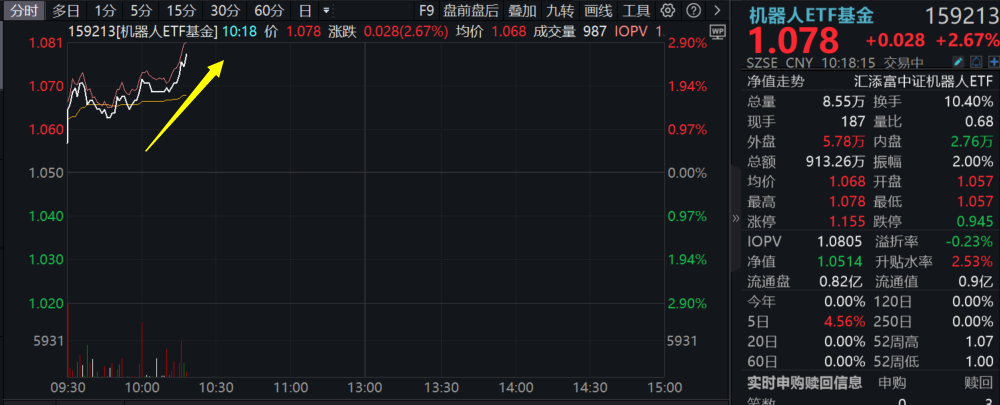
Core Viewpoint - The humanoid robot market is experiencing significant growth, driven by favorable government policies and increasing demand across various sectors, with projections indicating a potential market size of over 15 trillion yuan by 2025 [4][9]. Group 1: Market Performance - The A-share market showed an upward trend on May 12, with the robot sector rebounding, particularly the Robot ETF fund (159213), which opened high and rose by 2.67% [1]. - Major components of the Robot ETF fund saw substantial gains, with companies like Tuosida reaching a 20% limit up, and others like Koli'er and Xinjie Electric also experiencing significant increases [3]. Group 2: Industry Advantages - The humanoid robot industry in China benefits from strong policy support, with various national and local initiatives aimed at fostering development, including the inclusion of robots in key work reports and the establishment of industry funds [5][6]. - China's competitive edge in the humanoid robot market is highlighted by its leading position in patent applications, with 5,925 patents filed from 2020 to 2024, significantly outpacing other countries [4][5]. Group 3: Production and Supply Chain - The domestic robot industry is witnessing a rise in localization, with the domestic production rate of key components increasing from 17.5% in 2015 to 35.7% in 2022, indicating a trend towards cost reduction and efficiency [7]. - Major companies are preparing for mass production of humanoid robots, with 2025 expected to be a pivotal year for the industry, as several manufacturers are on the brink of entering small-scale production [7][8]. Group 4: Application Scenarios - The demand for robots is driven by manufacturing upgrades and demographic changes, with the global aging population creating a pressing need for robotic solutions to address labor shortages [9]. - The potential market for humanoid robots is projected to exceed 1 billion units, corresponding to a market space of over 15 trillion yuan, as the industry prepares for widespread adoption across industrial, commercial, and domestic applications [9].

晶科科技电站产品化路径独树一帜 2025年一季度营收同比增长43%
Zheng Quan Ri Bao Wang· 2025-04-30 02:14
Core Viewpoint - Jinko Power Technology Co., Ltd. (晶科科技) continues to demonstrate robust growth, with significant improvements in revenue and net profit in Q1 2025, reflecting strong operational efficiency and cash flow generation [1][2]. Group 1: Financial Performance - In Q1 2025, the company achieved operating revenue of 1.112 billion yuan, a year-on-year increase of 43% [1]. - The net profit showed a substantial reduction in losses, indicating a significant improvement in performance [1]. - The net cash flow from operating activities reached 1.199 billion yuan, marking a strong recovery [1]. - As of the end of Q1, the company's cash and cash equivalents amounted to 6.515 billion yuan, an increase of nearly 1.5 billion yuan from the end of the previous year [1]. Group 2: Business Strategy and Operations - The company has established a unique productization path for its power stations, emphasizing a light asset operation strategy that promotes healthy asset turnover from development to sale [1]. - Jinko Power has diversified its business layout, enhancing its ability to withstand risks and adapt to industry cycles [1]. - A significant transaction was made with CITIC Financial Leasing Co., Ltd. for a 320MW household photovoltaic asset package, improving asset turnover efficiency [1]. Group 3: Project Development and Partnerships - The company launched a demonstration project in the integrated microgrid field in Q1, optimizing resources across power generation, grid, and load sides [2]. - Jinko Power has successfully operated multiple microgrid and large-scale integrated projects, with a distributed photovoltaic installed capacity of nearly 1.4GW [2]. - The company has established long-term partnerships with major industry players such as Alibaba Cloud, Tencent Cloud, JD.com, and SF Express [2]. Group 4: Future Outlook - The year 2024 is critical for achieving the goals set in the 14th Five-Year Plan, with a record increase in new energy installed capacity and accelerated power market reforms [2]. - The company is focused on deepening regional market development while controlling the pace of self-invested power stations, targeting economically strong areas with high consumption and electricity prices [3]. - Jinko Power aims to enhance its business model through a combination of light and heavy asset strategies, ensuring steady growth in core operational metrics [3].

市场竞争激烈单票收入承压,快递公司继续降本增效
Di Yi Cai Jing· 2025-04-29 09:24
Core Insights - The core viewpoint of the articles highlights that the "Rural Express" initiative and e-commerce business have become significant drivers for the growth of express delivery companies in 2024 [2][4]. Financial Performance - YTO Express reported a revenue of 69.033 billion yuan in 2024, a year-on-year increase of 19.67%, with a net profit of 4.012 billion yuan, up 7.78% [3]. - Yunda Express achieved a revenue of 48.543 billion yuan, a 7.92% increase, and a net profit of 1.914 billion yuan, up 17.77% [3]. - Shentong Express reported a revenue of 47.169 billion yuan, a 15.26% increase, and a net profit of 1.04 billion yuan, a significant rise of 205.24% [3]. - The overall express delivery business volume in China reached 1.758 billion pieces, a year-on-year growth of 21.5% [3]. Market Trends - The "Rural Express" initiative has led to the establishment of 346,000 village-level logistics service stations across the country in 2024 [4]. - The live e-commerce sector contributed significantly to the express delivery industry, with retail sales reaching 4.3 trillion yuan from January to November 2024, accounting for 80% of the e-commerce sector's growth [4]. Operational Efficiency - Companies are focusing on cost reduction and efficiency improvements, with Yunda reporting a 21.91% decrease in core operating costs per ticket in 2024 [8]. - YTO Express has implemented demand-based delivery and improved delivery performance, resulting in a nearly 28% reduction in false signing rates [5]. Pricing Pressure - YTO Express experienced a decline in revenue per ticket to 2.3 yuan, a decrease of 4.86%, while the cost per ticket fell to 2.09 yuan, down 4.04% [7]. - The average price for express delivery in the industry was reported at 8.02 yuan per ticket, indicating a continuous downward trend [7]. Technological Advancements - Companies are increasingly adopting unmanned delivery technologies, with Shentong testing smart-assisted driving vehicles on express routes [9]. - YTO Express is exploring the application of autonomous driving technology to enhance transportation efficiency and reduce costs [8].



优必选与东风柳汽签订人形机器人采购合同,已收到预付款
Nan Fang Du Shi Bao· 2025-04-27 11:53
Core Viewpoint - The company, UBTECH Robotics, has secured its first procurement contract for humanoid robots in industrial manufacturing, marking a significant step in the commercialization of humanoid robots in automotive factories [1][3]. Group 1: Procurement Contract Details - UBTECH announced on April 27 that it signed a procurement contract for humanoid robots, specifically the Walker S1 and Walker C models, with a known automotive manufacturer, Dongfeng Liuzhou Motor [1][3]. - The contract involves a "small batch" of humanoid robots, with a total of 20 units to be deployed by Dongfeng Liuzhou Motor by mid-2025, representing the first mass entry of humanoid robots into automotive factories globally [3]. Group 2: Business Strategy and Goals - The procurement contract signifies a solid step towards the commercial application of humanoid robots in industrial settings, with the company planning to continue its focus on research and commercialization of humanoid robots [3]. - The CEO of UBTECH stated that the company aims to produce approximately 1,000 humanoid robots this year to gather more data in real customer environments [3]. Group 3: Financial Performance - In its annual report, UBTECH reported a total revenue of 1.305 billion yuan for 2024, reflecting a year-on-year increase of 23.7%, while the loss narrowed to 1.16 billion yuan from 1.265 billion yuan in 2023, a reduction of 8.3% [4][5]. - The gross profit increased from 3.328 billion yuan in 2023 to 3.74 billion yuan in 2024, representing a year-on-year growth of 12.4%, although the gross margin decreased from 31.5% to 28.7% [5].

低空经济行业专题系列二:eVTOL动力系统的市场空间、技术趋势和产业链机遇【国信汽车】
车中旭霞· 2025-04-17 02:33
Industry Overview - The low-altitude economy supply chain in China has formed a comprehensive development pattern characterized by "upstream independent breakthroughs, midstream collaborative tackling, and downstream standard leadership" with eVTOL and drone manufacturing at its core [2][19] - The domestic market for eVTOL is projected to have a potential demand of 24000 units for tourism and 85000 units for commuting, leading to a total market size exceeding 250 billion [2][45][46] - The eVTOL power system is a critical component of the low-altitude economy, accounting for approximately 40% of the total cost structure of eVTOLs [2][48] Technological Trends - eVTOL technology is diversifying with three main configurations: multirotor, compound wing, and tilt-rotor, each offering unique advantages for different applications [34][35] - The shift towards electric propulsion systems is evident, with a focus on high energy density and low emissions, making them the preferred choice for future urban air mobility [54][55] Market Dynamics - The global low-altitude economy market is expected to grow from approximately 2.08 trillion yuan in 2023 to 2.32 trillion yuan in 2024, indicating significant growth potential [23] - In China, the low-altitude economy market is projected to reach 859.2 billion yuan by 2025, with a compound annual growth rate of 33.8% [23][27] Company Insights - EHang Intelligent (EH.O) has become the first company in China to obtain all four necessary certifications for eVTOL, indicating a significant step towards commercialization [6][51] - Companies like EHang and others are actively collaborating with electric motor manufacturers to enhance their eVTOL offerings, with substantial orders already in place [52] Policy Support - The development of the low-altitude economy has been elevated to a national strategy, with various government departments providing comprehensive support through policies aimed at infrastructure, regulations, and industry standards [14][17] - By 2025, over 30 provinces and cities in China are expected to include low-altitude economy initiatives in their government work reports, promoting infrastructure development and industry standards [14][18]

顺丰净利润首次超百亿元;lululemon受到美国高通胀冲击;金价续刷新高丨百亿美元公司动向
晚点LatePost· 2025-03-29 11:41
顺丰 2024 年归母净利润超百亿元。 2024 年,顺丰营收同比上升 10% 至 2844 亿元,归母净利润上升 24% 至 102 亿元,归母净利率同 比提高 0.4 个百分点。 占总营收 43% 的主要业务 "时效快递" 已经稳定,增长有限,仅录得 6% 的同比增长率,占营收 10% 的 "经济快递" 又面对通达系的激烈竞争,国际化成为顺丰寄予希望的新增长点。 顺丰于 2010 年开始做跨境业务,于 2021 年以 176 亿港币的价格,收购东南亚物流企业嘉里物流 51.5% 的股权。去年 11 月,已在深圳交易所上市的顺丰在香港联交所再次上市,募资 53 亿元,称 要依托港股,更好地发展国际业务、优化国际品牌形象。 公司在年报中公布了这笔资金的用途:45% 用来加强国际及跨境物流能力;35% 用来提升在中国 的物流网络及服务;10% 用来研发先进技术及数字化解决方案,升级供应链、实施 ESG;10% 作 为营运资金。 2024 年,顺丰的 "供应链及国际业务" 营收同比增长 18% 至 705 亿元,占总营收的比重同比提高 1.6 个百分点。但这笔钱里包含一部分面向国内客户提供的供应链解决方案收入。顺 ...
周末利好!新能源,突传四大重磅!低空经济、机器人......
券商中国· 2025-03-29 10:15
Group 1: Electric Vehicle Industry Insights - The State-owned Assets Supervision and Administration Commission (SASAC) is pushing for strategic restructuring of central enterprises in the automotive sector to enhance competitiveness and promote the development of smart connected electric vehicles [4][5] - The Ministry of Commerce plans to increase policy support for the new energy vehicle (NEV) sector, including a doubling of special national bond support funds to 300 billion yuan, and maintaining a subsidy of 20,000 yuan for scrapping old vehicles [6][7] - The Ministry of Industry and Information Technology (MIIT) aims to accelerate the industrialization of autonomous driving and has indicated conditional approval for the production of L3 autonomous vehicles [8][9] Group 2: Future Market Projections - The electric vehicle market is projected to see significant growth, with total annual sales expected to approach 30 million units by 2035, and ownership potentially reaching 200-300 million vehicles [11] - The flying car market is anticipated to grow substantially, with sales volume potentially reaching 3%-5% of the current automotive market size, and revenue could account for 20% of the automotive market [12] Group 3: Low-altitude Economy and Robotics - The low-altitude economy is gaining momentum, with initiatives in Hong Kong and Sichuan aiming to cultivate leading enterprises and establish a complete ecosystem by 2026, targeting an industry scale exceeding 50 billion yuan [14] - The 2025 Zhongguancun Forum is showcasing various robots capable of performing tasks such as vegetable picking and emergency rescue, highlighting advancements in robotics technology [2][15]